


Quality and expertise
TREATMENT OF NATURAL GEMSTONES
Many natural gemstones on the market have undergone one or more treatments. This does not mean they are fake or synthetic. A treated stone remains a natural stone, as long as its structure and natural origin have not been artificially altered.
Treatments have been used for centuries in gemology. Their goal is generally to improve the stone’s appearance: enhance its color, improve its transparency, reduce the visibility of certain cracks, or lessen the impact of natural inclusions.
Treatment itself is not an issue when it is disclosed transparently. What truly becomes a problem is deliberately hiding a significant treatment—especially when it involves fracture filling, stabilized stones, or modifications that directly affect the gemstone’s durability and value.
Heat-treated stones
Heat treatment is the most common treatment in the world of precious and semi-precious stones. It involves exposing the stone to higher or lower temperatures to alter or enhance its natural color. This process can also reduce certain visible inclusions and improve transparency.
Heat treatment has been used since Antiquity. Evidence of this process has been found more than 1,000 years ago in Sri Lanka and India, notably on rubies and sapphires. Even today, this treatment is widely accepted by the trade because it does not involve adding chemicals to the stone. It acts only on elements already naturally present in the gemstone.
In most cases, heat treatment does not negatively affect the stone’s commercial value—especially for gemstones where heating is traditionally part of market practice, such as sapphires, rubies, tanzanites, and aquamarines.
Tanzanite
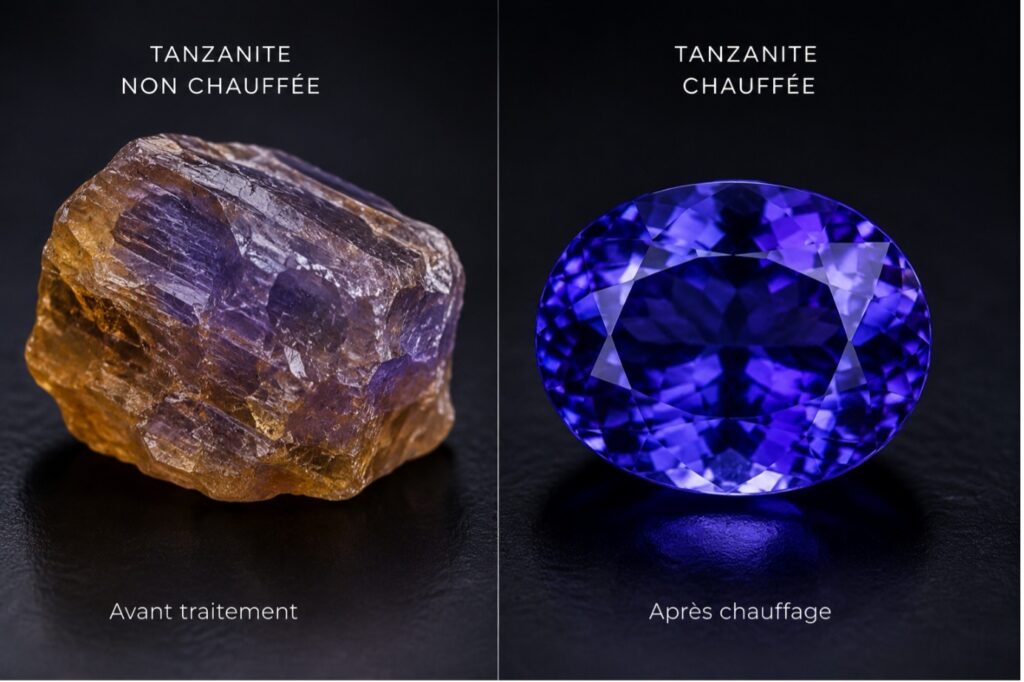
Almost all tanzanites sold are heat-treated. In its rough state, the stone often shows brownish or yellowish tones that are not very sought after. Heating reveals the famous blue-violet color that made this gemstone renowned.
Without this treatment, tanzanite would probably never have enjoyed such success in the jewelry market.
Sapphires and rubies
The vast majority of sapphires and rubies are heat-treated. Heating improves color intensity and can also reduce certain inclusions. Vivid red rubies and deep blue sapphires have very often undergone this process.
Unheated stones do exist, but they are much rarer and generally more expensive.
Citrines
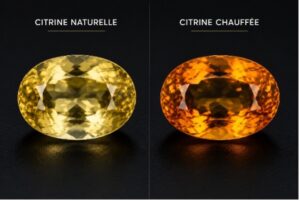
A large portion of the citrines on the market are produced by heating amethysts or smoky quartz. This practice is extremely common in the trade.
The issue is not the treatment itself, but the lack of information given to the buyer. Some unscrupulous sellers present these stones as natural citrines without specifying that they are heated amethysts.
However, this can often be identified fairly easily, even by a beginner. Natural citrines generally have a relatively soft pale yellow to golden color. When a stone shows a very bright yellow, orange, amber, or intense brownish-orange color, it is very often a heated amethyst.
True natural citrines of fine quality are rarer and often significantly more expensive. Discover our selection of natural citrine points.
Aquamarines
Most aquamarines are also heat-treated. This treatment is generally mild and mainly aims to reduce greenish tones in order to obtain a purer blue.
Heating aquamarines is virtually impossible to detect with the naked eye. Even for a gemologist, only an in-depth laboratory examination can sometimes determine whether the stone has been heated.
Irradiated stones
The term “irradiation” can be worrying, but it is a common process that is strictly regulated in the gem industry.
Irradiation involves exposing certain stones to controlled radiation in order to alter or intensify their color. After treatment, the stones are kept for several weeks—or even several months depending on local regulations—to eliminate any residual radioactivity before they are sold.
Irradiated stones therefore pose no health risk when they are placed on the market by professionals who comply with current standards.
In some cases, the color obtained solely by irradiation can change over time or under strong exposure to heat or light. This is why some stones are then heated to stabilize their color over the long term.
Irradiation can sometimes be difficult to detect, even in a laboratory, depending on the type of stone and the process used.
Blue topaz
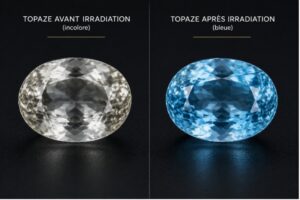
Natural blue topaz is extremely rare. Almost all blue topaz available in the trade has been treated by irradiation, often followed by heating.
These are nonetheless genuine natural topazes whose color alone has been modified. This practice is fully accepted in the trade.
Kunzite
Kunzite is also frequently irradiated to intensify its pink or purplish tones.
Aquamarines
Some aquamarines may be irradiated to obtain a deeper blue reminiscent of the very rare “Santa Maria” aquamarines, which are particularly sought after.
True Santa Maria aquamarines take their name from a former Brazilian mine known for naturally producing stones with a deep, bright blue. Today, the term “Santa Maria” is also used to refer to aquamarines showing this characteristic color, even when they come from other deposits.
Discover our selection of aquamarine jewelry.
Other stones may occasionally be irradiated, such as certain tourmalines, morganites, or colored diamonds.
Oiling
Oiling is a very common treatment, mainly used on emeralds.
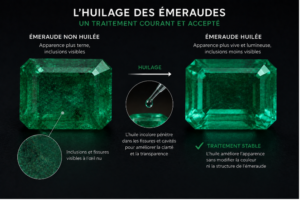
Emeralds naturally contain many internal fissures called “gardens”. These fissures can reduce the stone’s transparency. Oiling involves filling these microfissures with a colorless oil to make them less visible and improve the gemstone’s overall appearance.
It is estimated that around 90% of emeralds sold are oiled.
The oil traditionally used is cedar oil, because its refractive index is close to that of emerald. Other oils or transparent substances can also be used.
Oiling is considered a normal treatment and is widely accepted in the emerald trade, provided it is done moderately and with colorless products.
However, this treatment is not permanent. Over time, the oil can dry out or partially disappear, making it seem as though the stone has lost some of its brilliance. In most cases, professional cleaning followed by re-oiling restores the emerald’s appearance.
Why resins are an issue
Some stones are filled with synthetic resins rather than oil. This process is much more controversial.
Unlike oil, resin alters the stone’s visual structure more and can mask major cracks. Some resins also age poorly: they can yellow, crack, or deteriorate over time.
An emerald heavily resin-filled can therefore have a significantly lower value than a stone that is simply oiled.
Stabilized stones
Some porous or fragile stones are stabilized using resins or polymers to strengthen them.
This treatment is common for turquoise, opal, malachite, and some chrysocollas. Stabilization helps the stone better withstand impacts and changes in humidity.
Unlike simple oiling, resins penetrate deeper into the stone and alter its appearance and structure more. Some resins can also age poorly, yellow, or deteriorate over time.
In some cases, stabilization can be visible to the naked eye, especially when the stone looks too plastic-like, has an unusual shine, or a very uniform color. However, some treatments are difficult to detect without gemological equipment.
A stabilized stone remains natural, but its value is generally lower than that of a good-quality untreated stone.
Diffusion treatments
Diffusion involves introducing certain chemical elements into the surface of the stone at very high temperature in order to change its color.
This treatment is best known for sapphires. It can produce very intense colors, notably blues, yellows, or oranges.
Unlike classic heat treatment, diffusion artificially changes the color by adding external elements. This treatment must therefore be declared.
Glass filling
Glass filling is mainly found in certain low-quality rubies.
Major fractures are filled with lead glass to improve the stone’s appearance and transparency.
Although these rubies are natural to begin with, this treatment is considered heavy because it significantly alters the stone. Their value is therefore much lower than that of simply heat-treated rubies.
These stones also require more precautions because they are more fragile when exposed to heat, impacts, and chemicals.
In some cases, glass filling can be suspected with the naked eye. Unusual colored reflections, bubbles, cracks with a glassy look, or overly transparent areas can be clues.
However, reliable identification often requires a gemological examination with a loupe or microscope.
Dyed stones
Some stones can be dyed to enhance or change their color.
This treatment is common for agate, chalcedony, jade, and some turquoises.
Dyeing can be stable or, on the contrary, lose intensity over time or under the effect of light.
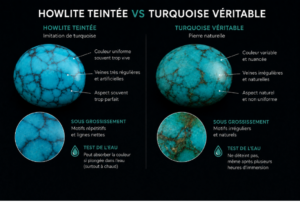
Dyed howlite is very commonly used to imitate turquoise. Thanks to its natural veining, this white stone can, once dyed blue, visually resemble turquoise to an untrained eye. This imitation is common in costume jewelry or low-priced jewelry.
Some dyed stones can be recognized with the naked eye when the color concentrates in cracks, pores, or certain specific areas of the stone. A color that is too bright, artificial, or uneven can also be a clue.
Dyeing is generally accepted in the trade when it is clearly declared. However, hiding this treatment in order to pass off a common stone as a rarer or more precious gemstone is a deceptive practice.
The treatments presented in this article are among the most common, but there are many other processes used in gemology.
Key takeaways
Treatments are an integral part of the world of natural gemstones and have existed for centuries. Some are considered completely normal and widely accepted, such as heating sapphires or oiling emeralds.
What matters is not necessarily whether a stone is treated, but rather knowing the exact nature of the treatment applied, its impact on the stone’s durability, and its potential influence on its value.
Transparency and information remain essential so that everyone can buy a stone with confidence.