

Minerals
IS BUMBLEBEE JASPER A TRUE JASPER?
Did you know? Bumblebee Jasper is not a true jasper!
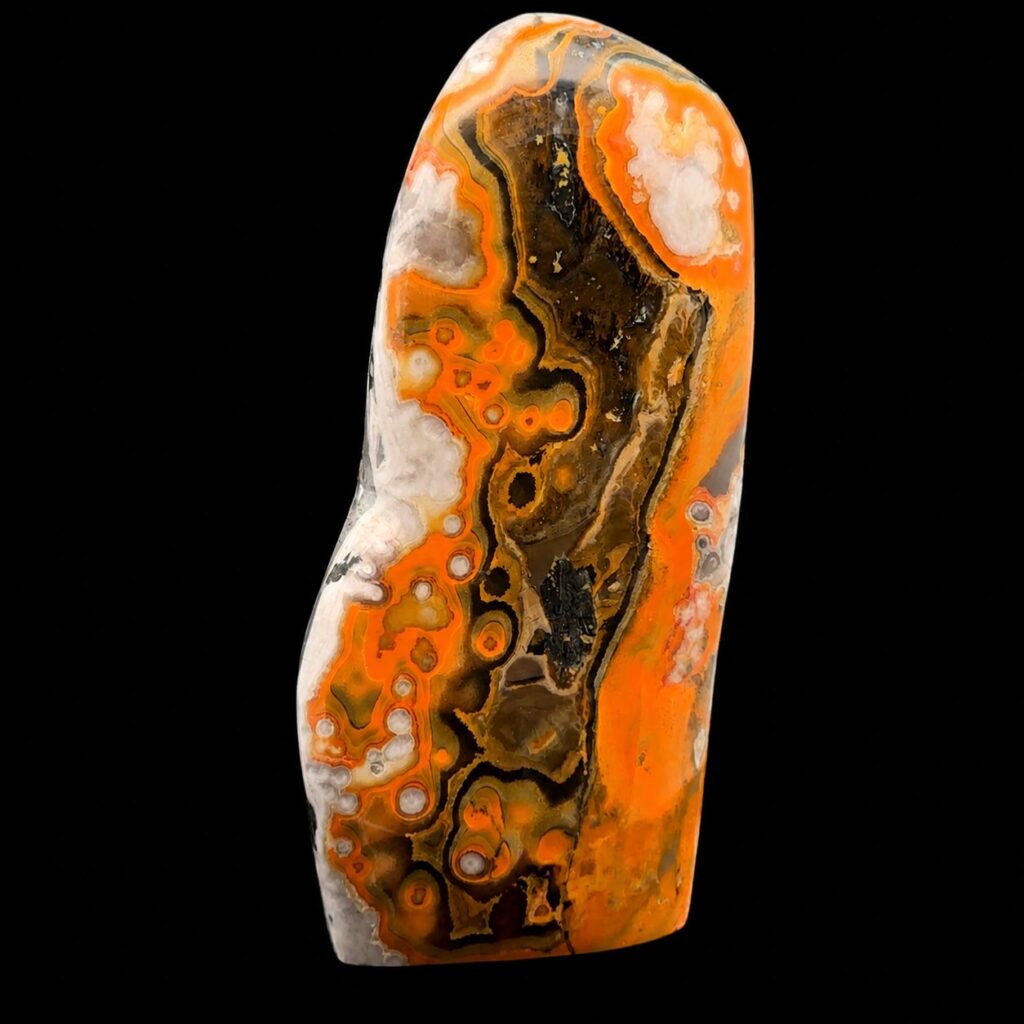
With its flamboyant colors reminiscent of a bumblebee, Bumblebee Jasper is one of the most fascinating stones in the mineral world. However, contrary to what its name suggests, it is not a true jasper but a rock of volcanic origin with unique characteristics.
Bumblebee Jasper, a rock linked to volcanic activity
Despite its widespread commercial name, Bumblebee Jasper is not part of the classic jasper family, which are normally varieties of microcrystalline quartz rich in silica.
Bumblebee is a complex rock formed in a volcanic hydrothermal environment, primarily composed of sulfur, calcite, orpiment, realgar, and other minerals associated with volcanic activity.
Contrary to what one might imagine, this stone does not form directly in classic volcanic lava. Bumblebee results rather from a hydrothermal alteration phenomenon: hot fluids rich in minerals circulate through limestone rocks located near volcanic zones, gradually causing the formation of this rock with spectacular colors.
The bright yellow comes primarily from sulfur, while the orange hues are linked to the presence of arsenic minerals such as realgar and orpiment. The darker zones are associated with manganese oxides or certain iron sulfides depending on the specimens studied.
With a hardness of about 5 on the Mohs scale, Bumblebee also remains softer than most true quartz-rich jaspers. It can therefore scratch more easily and requires some precautions, particularly in jewelry or when storing with harder minerals.
Between commercial designation and geological reality
The use of the term “jasper” to designate this stone is more a commercial designation than a strict geological classification.
This phenomenon is relatively common in the world of minerals and jewelry, where certain stones retain popular names for historical, aesthetic, or marketing reasons.
Bumblebee is not an isolated case:
- “Marine Sediment Jasper” is generally a reconstituted or dyed stone;
- “Picasso Jasper” actually corresponds to a metamorphic rock;
- certain brecciated jaspers marketed do not always correspond to true jaspers in the mineralogical sense of the term.
A rare and unique deposit in Indonesia
To date, the only known deposits of Bumblebee are located in Indonesia, in active volcanic zones of western Java.
Its bright yellow, orange, and black colors recall those of a bumblebee, hence its name “Bumblebee.” In Indonesia, it is sometimes known as Batu Badar Belerang, which could be translated as “sulfur stone.”
The known deposit remains relatively limited and extraction takes place in a particularly challenging volcanic environment, near zones rich in sulfur gases and geothermal activity.
Workable blocks of fine quality remain rare and the deposit tends to gradually diminish. This rarity, combined with extraction conditions and high demand, explains the sometimes high prices of Bumblebee on the mineral and jewelry market.
The famous “eye” patterns of Bumblebee Jasper
Certain specimens present particularly spectacular concentric structures called “eyes” by collectors.
These natural patterns, formed during the hydrothermal phenomena that created the rock, are particularly sought after by lapidaries and rare mineral enthusiasts.
The more numerous, contrasting, and well-defined the “eyes” are, the higher the specimen’s value can be. Pieces featuring large yellow and orange areas dotted with perfectly visible eyes are among the most sought-after on the market. Also discover our selection of natural Bumblebee Jasper available on Odin Minéraux.
A mineral that deserves some precautions
Beyond its spectacular appearance and particularly appreciated energetic properties, Bumblebee also deserves some precautions for use.
Naturally containing arsenic compounds, it is preferable to avoid any inhalation of dust during polishing or working with the raw stone.
Furthermore, enthusiasts of energetic practices must be particularly vigilant: this mineral should never be used for preparing elixirs or be placed in prolonged contact with water intended for consumption.
In its polished form, Bumblebee can be handled normally, but it is recommended to wash your hands after working with the stone or handling raw specimens.
Care and preservation
With its relatively modest hardness, Bumblebee Jasper deserves some preservation precautions.
It is recommended to:
- avoid impacts;
- store it separately from harder minerals;
- avoid aggressive chemicals;
- avoid prolonged immersion in water;
- clean it simply with a soft cloth.
These few steps will help preserve its colors and natural luster over time.
How to recognize genuine Bumblebee?
Authentic Bumblebee generally presents irregular yellow, orange, black, and sometimes grayish bands, with very marked contrasts.
Unlike certain true silica-rich jaspers, its texture may appear slightly softer or more chalky depending on the zones of the mineral.
The value of Bumblebee varies greatly depending on the visual quality of the patterns and the intensity of the colors. Specimens presenting particularly vivid yellows, marked contrasts between the different color bands, or circular patterns called “eyes” are generally the most sought after by collectors and lapidaries. The most aesthetic pieces can thus reach significantly higher prices on the market.
As with many popular stones, there are imitations, dyed stones, or reconstituted materials sold under the Bumblebee designation on the market.
A few signs should draw attention:
- excessively uniform colors;
- absence of natural contrasts;
- repetitive patterns;
- abnormally low prices for large pieces;
- absence of clearly indicated origin.
Particular vigilance is therefore recommended when purchasing, especially when faced with artificially homogeneous colors or prices that are too attractive for large, high-quality pieces.