

Minerals
SWEDISH BLUE: THE BLUE STONE BORN FROM SWEDISH MEDIEVAL FOUNDRIES

A stone born of fire and time
The “Swedish Blue“, also known as “Swedish Slag blue” or “Bergslagen”, is one of a kind. It comes from the remains of medieval foundries located in the Bergslagen region of Sweden. It is the result of centuries of interaction between metallic minerals, extreme heat, and the passage of time. The bluish color variations of the stone are determined by the residual minerals present in the original rocks. The name Swedish Blue refers to the stone’s characteristic blue hue, symbolizing its Swedish heritage.
Origin and formation of the stone
The Swedish Blue is actually a byproduct of iron ore smelting in the ancient blast furnaces of the Bergslagen region, the historical heart of Swedish iron production from the Middle Ages until the 18th century. During smelting, slag – a vitreous material resulting from the removal of impurities from the ore – was discharged and left in piles around the foundries.
This slag, as it solidified, sometimes took on an almost crystalline appearance. The Swedish Blue stands out from other metallurgical residues due to its characteristic color and smooth texture, similar to volcanic glass or obsidian.
Its composition is predominantly siliceous, enriched with elements such as copper, iron, and sometimes manganese, which directly influence its hue. Over the centuries, the foundries were abandoned, and the stone became rare, making it a precious material for crafting jewelry and decorative objects.
A rediscovery in the heart of the Swedish forests
In the early 1960s, a Swedish goldsmith rediscovered this blue stone in the heart of the Swedish forests, in a region where mines had previously existed. All early traces of mining had been erased, and the slag heaps had been covered by vegetation after being left untouched for hundreds of years. He named the stone “Bergslaggsten“, in homage to the region of its discovery. He began to make jewelry with this stone, which quickly became very popular locally in Sweden. Only a fraction of the slag fragments are of sufficient quality to be used in jewelry, which has limited its production.
“Bergslaggsten” is a difficult word to pronounce for non-Swedish speakers. This led to the stone being called “Swedishblue” due to its blue colors. It can be said that the gemstone is named “Swedishblue” and “Bergslaggsten” is the name of the raw stone.
A hand-crafted stone, reflecting artisanal expertise.
To create jewelry, each stone is hand-cut. Its vitreous structure requires great precision in shaping: artisans must manually reveal the internal patterns and unique reflections of each fragment, making every piece of jewelry absolutely unique.
Despite its beauty, Swedish Blue is not officially recognized as a distinct mineral species in standard mineralogical classifications. It does not correspond to a uniform chemical composition.
Due to its composite nature, the physical properties of Swedish Blue can vary. However, in general, it exhibits moderate hardness and variable density, reflecting its heterogeneous mineral composition.

A rare material, reflecting a living heritage
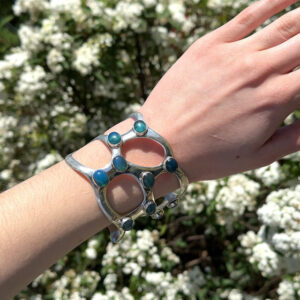
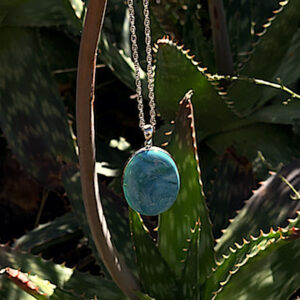
Today, Swedish Blue is used for both refined jewelry and decorative objects. It embodies both the memory of a bygone industrial era and the renewal of an artisanal art rooted in respect for the past. As a heritage stone, it attracts history enthusiasts as much as lovers of atypical stones.
Its use remains limited due to the rarity of exploitable deposits, and each creation made with this stone is perceived as a piece of history transformed into a work of art.