

Minerals
SEPTARIA, AN ENIGMATIC STONE

Septaria, nicknamed the “dragon stone,” is worthy of any cabinet of curiosities. The Odin Minéraux team particularly appreciates Septaria when it is fractured, revealing its crystallizations.
The name septaria comes from the radial fissures that form internal partitions within the stone, giving it a unique and intriguing structure. This term actually refers to a complex mixture of rocks, minerals, and sometimes even organic matter. Despite its geological interest, septaria is not classified as an official mineral species by the International Mineralogical Association (IMA), which reflects its unique character and the difficulty of defining it strictly.
Septarias begin as siliceous nodules featuring a network of fractures often filled with calcite, but sometimes also other minerals such as aragonite, chalcedony, celestine, baryte, or even pyrite. This particular geological phenomenon often results from processes such as desiccation—a kind of slow, natural dehydration—which gives these stones their fascinating appearance. Depending on the mineral composition of the fissures, septarias can display a wide range of colors. Brown varieties mainly contain chalcedony, while yellow and orange septarias house calcite.
Septaria generally forms in marine or semi-marine environments, where specific sedimentation conditions favor the appearance of these concretions. It results from a complex geological process that takes millions of years. For example, in France, these nodules formed in Jurassic and Cretaceous marls about 170 to 120 million years ago. These stones therefore carry a true geological memory, tracing ancient eras when the earth was very different from the one we know today.
The most famous septaria deposits are found in Madagascar, the United States, Morocco, England, and France. One of the most impressive septaria formations is the Moeraki Boulders in New Zealand.
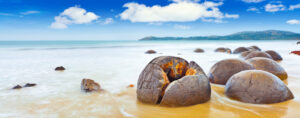
These gigantic spherical concretions, which can reach nearly three meters in diameter and weigh several tons, are a breathtaking geological curiosity. According to a Maori legend, these boulders are the petrified remains of a canoe and its occupants, shipwrecked during a terrible storm. They were said to have turned to stone, symbolizing the unpredictability and power of nature.
The Moeraki Boulders formed from marine sediments that accumulated around a core of fossilized mud about 60 million years ago. Waves and erosion gradually polished these rocks, creating perfectly round spheres decorated with calcite-filled fractures.
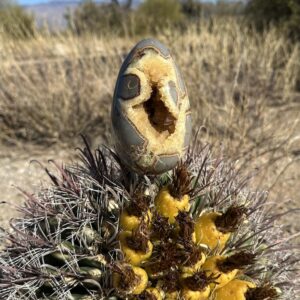
Septarias particularly fascinate collectors when they are cut and polished into the shape of an egg. Their oval shape evokes mystical and mysterious symbols, like the dragon eggs of ancient legends. They are often considered lucky or magical stones, believed to protect those who own them. Through their structure and geological history, they have spanned ages and civilizations, carrying within them the mysteries of an ancient and often mystical world.
Septaria is much more than a simple mineral: it is a testament to our planet’s history, a stone that seems to have captured the magic of the earth and time. It remains a fascinating link between ancient myths and geological reality, an object of endless contemplation and curiosity.
Caring for septaria is relatively simple, but a few precautions should be taken to preserve its beauty and unique structure. Due to its varied composition, which includes softer minerals like chalcedony and calcite, septaria can be sensitive to scratches and heavy impacts. It is therefore recommended to handle it with care and avoid contact with abrasive surfaces.