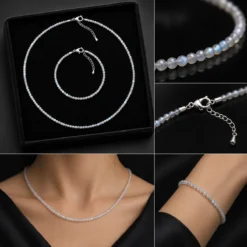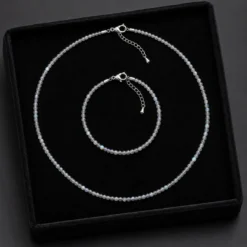



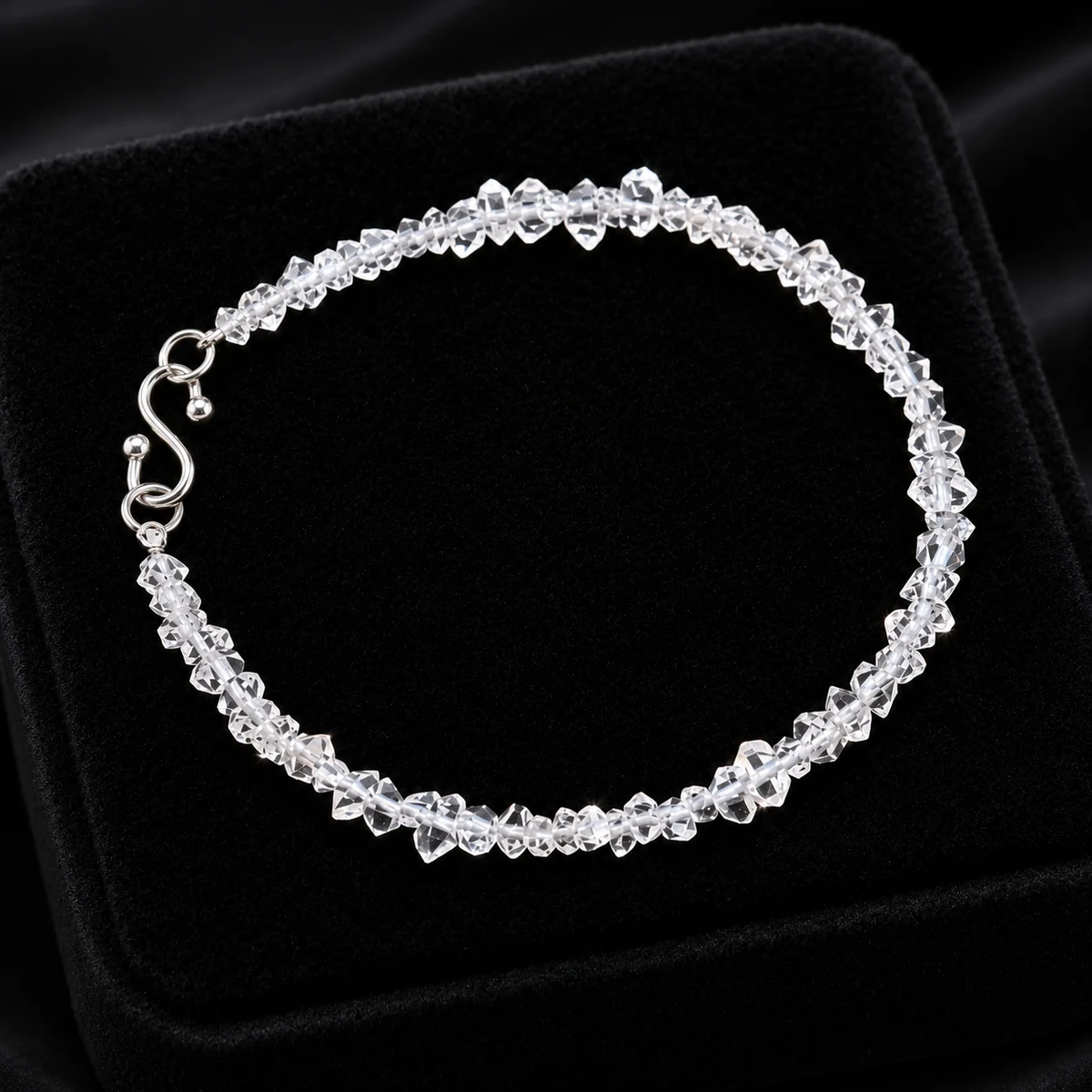
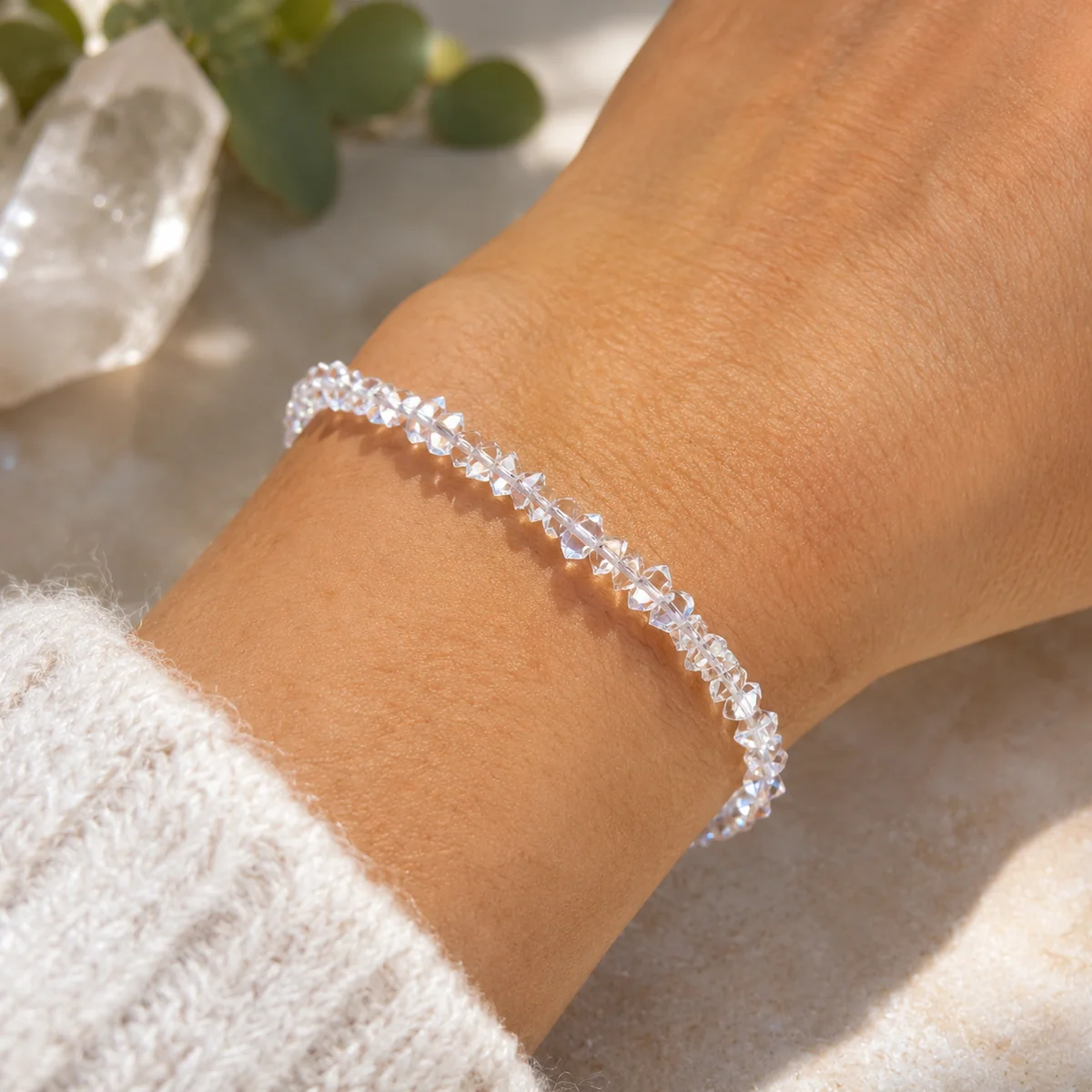
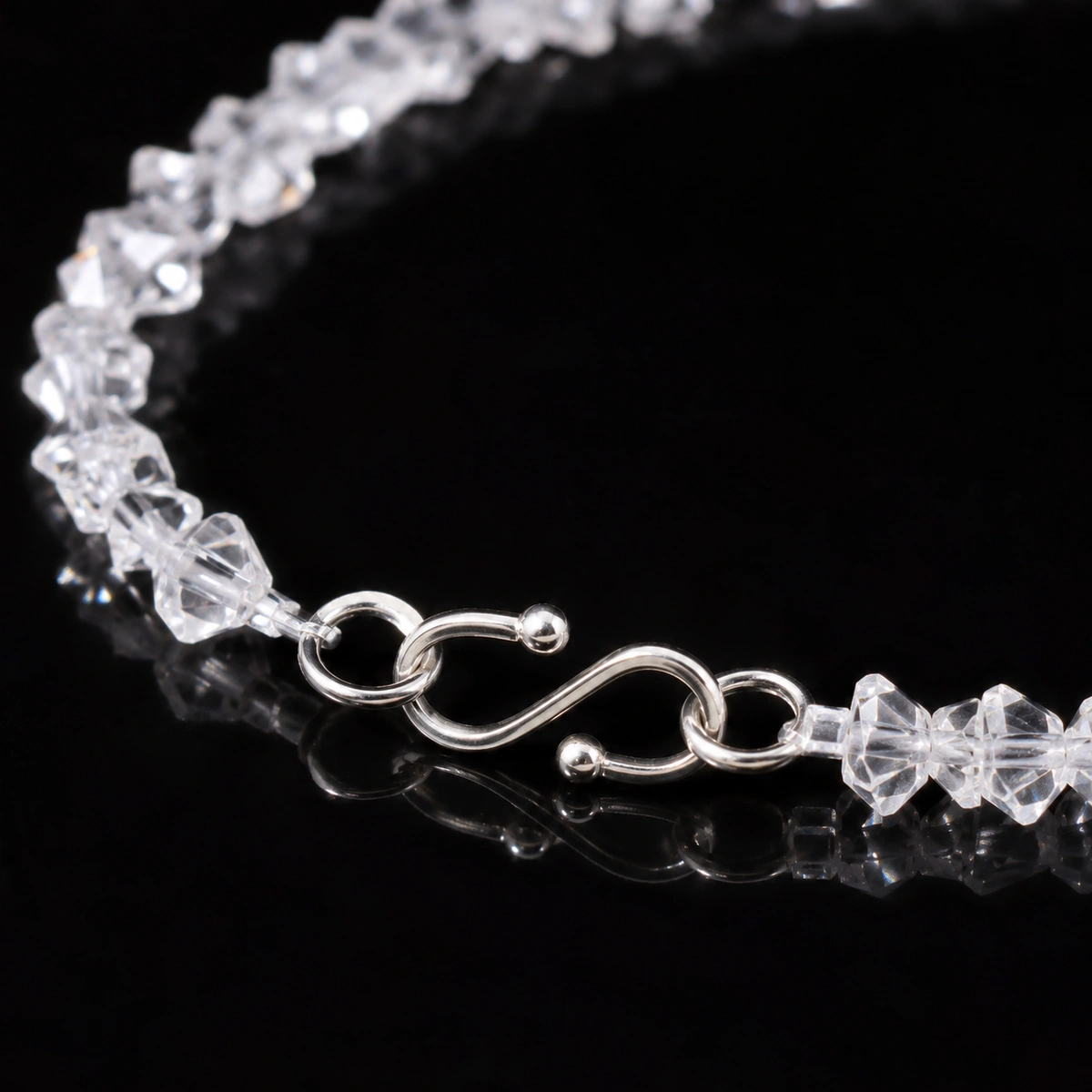
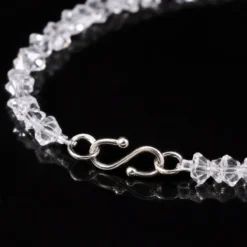
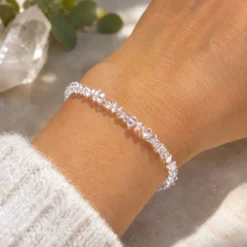
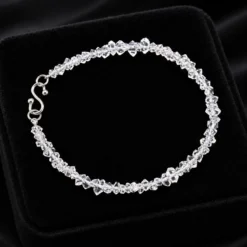
AA quality herkimer-type diamond bracelet
48,00 € incl. VAT
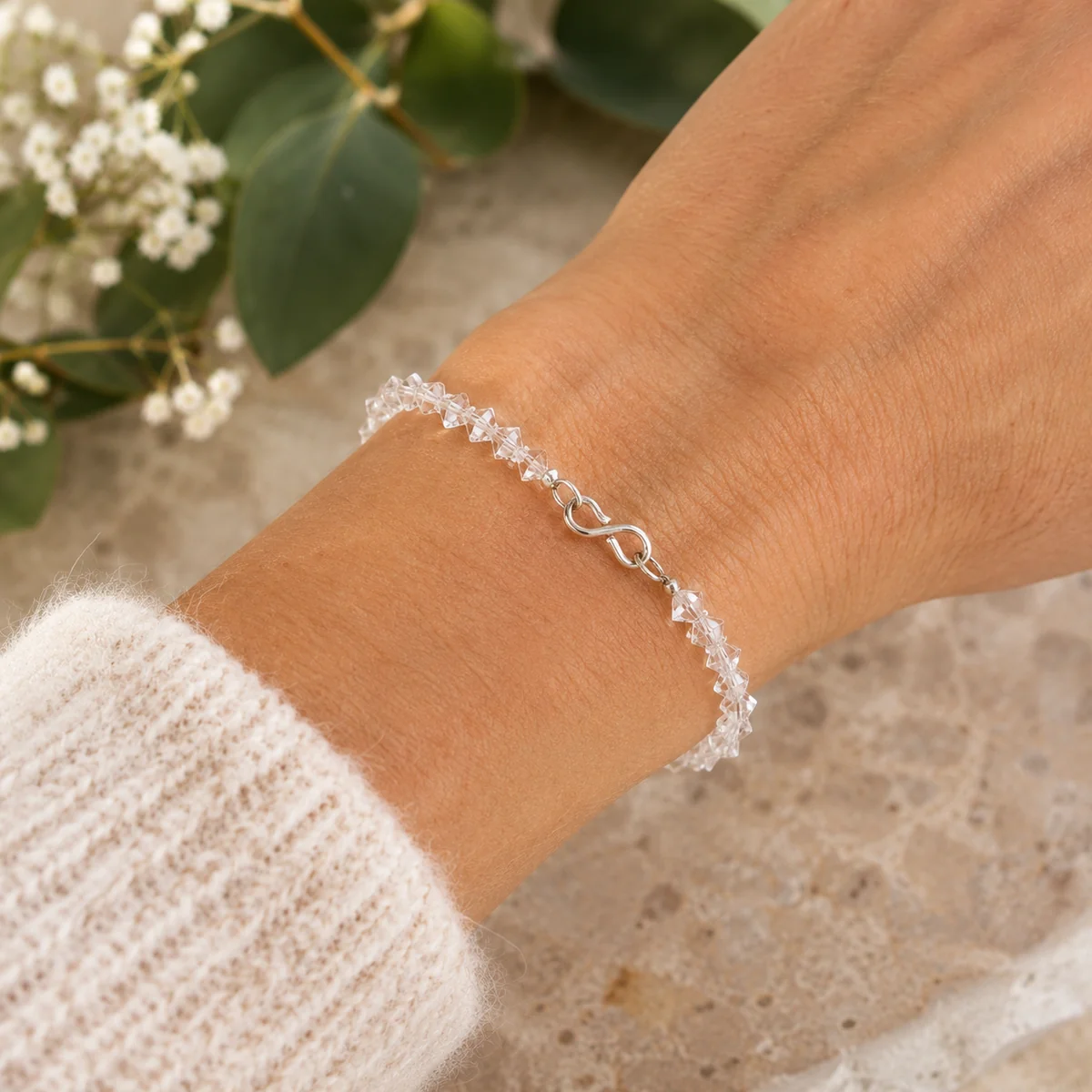
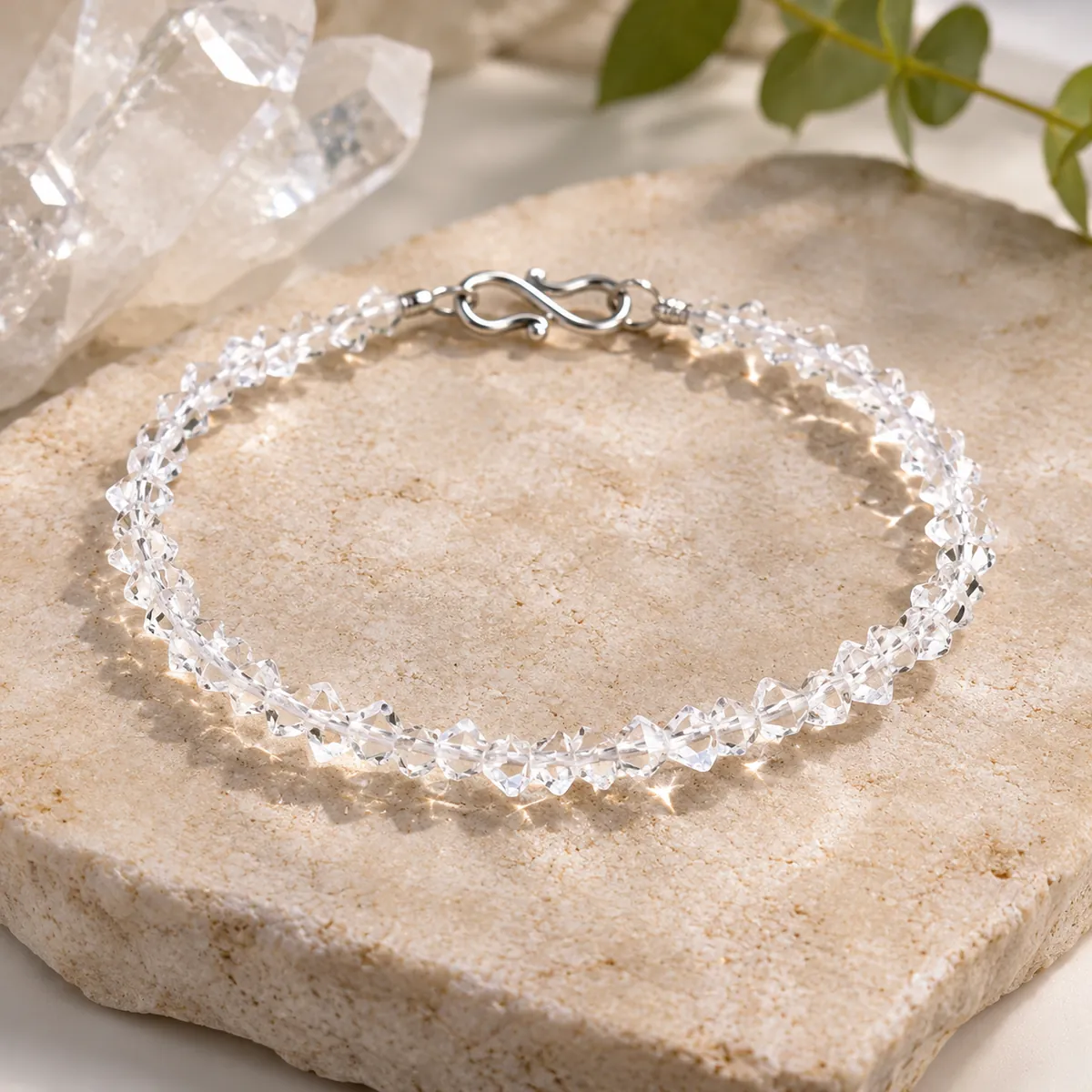
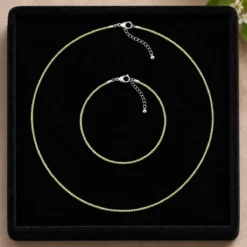
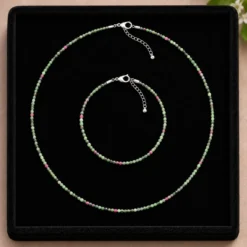
Faceted Herkimer-type crystal bracelet, also known as Herkimer diamond. 16 cm long and AA quality, it stands out for the transparency and beautiful sparkle of its crystals.
A simple and refined piece of jewelry, highly elegant, which easily matches all your outfits. It can be paired with the necklace from the same range.
In stock
Stone(s): Herkimer-type crystal, known as “Herkimer Diamond”
Color: translucent
Dimensions: 16 cm long
Diameter: 3 to 4mm
Necklace weight: approx. 3.5 g
Precious metal: none
Stone cut: faceted
Setting: none
Shape: freeform
Photos are non-contractual.
Classification: quartz group
Mohs hardness: 7
Density: 2.65
Origin: Pakistan, United States
Care Instructions: No specific maintenance required.
About this listing: faceted herkimer-type diamond bracelet
Rock crystal is the colorless and transparent variety of quartz, a silicon dioxide (SiO2) with a trigonal crystal system. Its hardness is 7 on the Mohs scale. Its density is approximately 2.65.
Quick specs: 45 cm; weight 9 g; freeform.
To expand the selection, the Faceted Bracelets category includes similar items.
Origins and minéralogy
Herkimer diamond: origin, formation, and mineralogical properties
Origin and formation
The Herkimer diamond is a variety of hyaline quartz (SiO₂), highly prized for its clarity, brilliance, and natural double-terminated crystallization. Despite its name, it is not a genuine diamond, but a quartz crystal whose appearance often resembles that of a cut gem.
Its name comes from Herkimer County in New York State, USA, where these crystals were first discovered and studied.
The geological history of the Herkimer diamond dates back to the Cambrian period, approximately 500 million years ago. At that time, the region was covered by a shallow sea where carbonate sediments accumulated. Over time, these deposits solidified to form dolomitic rocks, notably those of the Little Falls formation.
Throughout their geological evolution, these rocks developed internal cavities. Silica-rich fluids circulated through them, gradually allowing the quartz to crystallize.
Unlike crystals that grow directly on a rock wall, some Herkimer diamonds were able to develop almost freely within these cavities. This unique trait accounts for their double-terminated morphology, featuring crystal points at both ends.
Crystallization occurred under relatively moderate temperature conditions. Certain studies based on fluid inclusions suggest formation temperatures close to 50°C.
However, a distinction should be made between the age of the host rocks and that of the crystals themselves, whose exact period of formation remains debated.
Composition and mineralogical properties
The Herkimer diamond belongs to the quartz group within the silicate class and tectosilicate subclass.
Its chemical composition is silicon dioxide (SiO₂), identical to that of rock crystal, amethyst, or citrine.
Its main mineralogical characteristics include:
- Classification: quartz group, tectosilicates
- Chemical composition: silicon dioxide (SiO₂)
- Crystal system: trigonal
- Mohs hardness: 7
- Density: approx. 2.65
- Refractive index: 1.544 to 1.553
- Luster: vitreous, often very bright
- Clarity: transparent to translucent
- Color: generally colorless, occasionally slightly smoky
- Cleavage: none or very indistinct
- Fracture: conchoidal
- Morphology: short prismatic crystals, frequently double-terminated
Natural double-terminated crystallization
Double termination is one of the most distinctive features of the Herkimer diamond.
While many quartz crystals develop with one end attached to host rock, Herkimer crystals can form two opposing pyramidal terminations.
The most characteristic crystals exhibit up to 18 primary natural faces: six prism faces and six faces on each of the two terminations.
Their often short, stubby shape combined with well-defined crystal faces can give them the appearance of small faceted gems.
This geometry is generally natural: the facets form during crystal growth rather than through human cutting.
However, some crystals are recut or polished for jewelry applications.
Clarity, luster, and inclusions
The Herkimer diamond is distinguished by the quality of its vitreous luster. The most transparent crystals feature particularly sharp faces capable of intense light reflection.
This natural brilliance explains its “diamond” moniker, even though its physical and optical properties differ from real diamond.
Notably, diamond has a hardness of 10 on the Mohs scale compared to 7 for quartz.
Herkimer crystals can also contain various natural inclusions:
- Carbonaceous inclusions: notably anthraxolite, a carbon-rich material forming black spots or specks.
- Fluid inclusions: tiny cavities containing liquids, sometimes accompanied by gas bubbles.
- Mineral inclusions: including calcite, dolomite, pyrite, or small quartz crystals.
- Veils and internal fractures: structures that can produce iridescent rainbow flashes as light passes through.
These inclusions provide valuable evidence of the conditions under which the quartz formed. Their presence does not necessarily signify a flaw: some specimens with inclusions are particularly prized by collectors.
Deposits
Authentic Herkimer diamonds originate from New York State, USA, primarily from the Mohawk Valley and around Herkimer County.
Well-known localities include:
- Middleville
- Little Falls
- Herkimer
- Newport
- St. Johnsville, in neighboring Montgomery County
Crystals are mainly extracted from pockets in ancient dolomitic rocks, specifically the Little Falls formation.
Mining often requires breaking through very hard dolomite boulders to access crystal pockets. Some cavities hold individual crystals, while others contain quartz clusters associated with carbonaceous deposits.
Double-terminated quartz with similar characteristics is also found elsewhere in the world, including Afghanistan, Pakistan, China, and Europe.
However, in the strict geographic sense, the designation “Herkimer diamond” is reserved for crystals from the Herkimer region in New York State. For crystals from other origins, the term “Herkimer-type quartz” is more accurate.
History and use
Double-terminated quartz crystals from the Herkimer region have been known for centuries.
Historical accounts report their use by Indigenous peoples of the Mohawk Valley, notably as ornamental objects and trade items.
The first scientific studies on these crystals date back to the early 19th century. They later earned a strong reputation among American mineralogists and collectors thanks to their shape and clarity.
Their resemblance to small cut gems earned them names such as “Herkimer Diamonds”, “Little Falls Diamonds”, and “Middleville Diamonds”.
Today, they are sought after both as mineral specimens and for jewelry making.
Their compact size, clarity, and crystal facets make them ideal for creating necklaces, bracelets, earrings, and pendants.
Crystals can be kept in their natural shape or shaped and polished depending on the jewelry design.
Care instructions
With a hardness of 7 on the Mohs scale, Herkimer diamond offers good scratch resistance. It remains vulnerable to impacts, however, especially at the crystal points and along any internal fractures.
To preserve its brilliance, wiping it with a soft, slightly damp cloth is usually sufficient.
For jewelry, it is best to avoid harsh chemicals, impacts, and abrupt temperature swings. Ultrasonic cleaners should be avoided when crystals contain fluid inclusions or internal fractures.
It is also advisable to store Herkimer diamond jewelry separately from other pieces to prevent scratches.
Well-being and energies
Properties traditionally attributed to Herkimer diamond
In crystal healing, Herkimer diamond is linked with mental clarity, intuition, and energy amplification.
It is traditionally used to support:
- Mental clarity: associated with focus and lucidity.
- Intuition: considered an aid for reflection and introspection.
- Meditation: traditionally used to encourage grounding and self-awareness.
- Energy amplification: believed in energetic practices to symbolically enhance the properties of other minerals.
- Inner balance: associated with harmony and serenity.
Associated chakras
- Third Eye Chakra – AJNA
- Crown Chakra – SAHASRARA
Associated zodiac signs
- Aries
- Sagittarius
- Gemini
These associations may vary across different crystal healing traditions.
Purification and recharging
Purification
In crystal healing, Herkimer diamond can be purified by smudging with white sage or Palo Santo. Simply pass the crystals gently through the smoke for a few moments, ensuring the room is well-ventilated.
The quartz can also be rinsed with plain water. For jewelry, however, prefer a soft, slightly damp cloth to protect the cord and metal components.
Recharging
Herkimer diamond can be symbolically recharged under moonlight by leaving it overnight on a suitable surface.
It can also be placed on an amethyst cluster or a selenite plate, following contemporary energetic practices.
Gentle exposure to daylight is also possible, keeping it away from strong heat and sudden temperature changes.
The energetic properties mentioned stem from contemporary crystal healing traditions and are not scientifically proven. They do not substitute for medical treatment.
Expédition : 48 à 72 heures, hors week-ends et jours fériés, après confirmation du paiement.
Livraison offerte dès 60 € en France métropolitaine.
Droit de rétractation : 14 jours pour nous signaler votre décision.
You may also like…


Drop and Teardrop Pendants


Natural Stone Jewelry
Faceted round rock crystal and rhodium-plated silver pendant


Drop and Teardrop Pendants


Bracelets
Related products


Drop and Teardrop Pendants
Bracelets