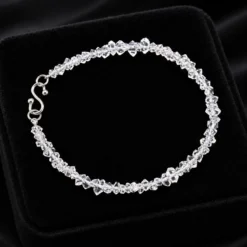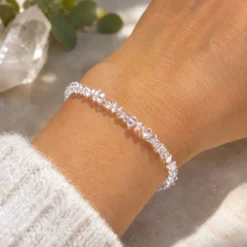



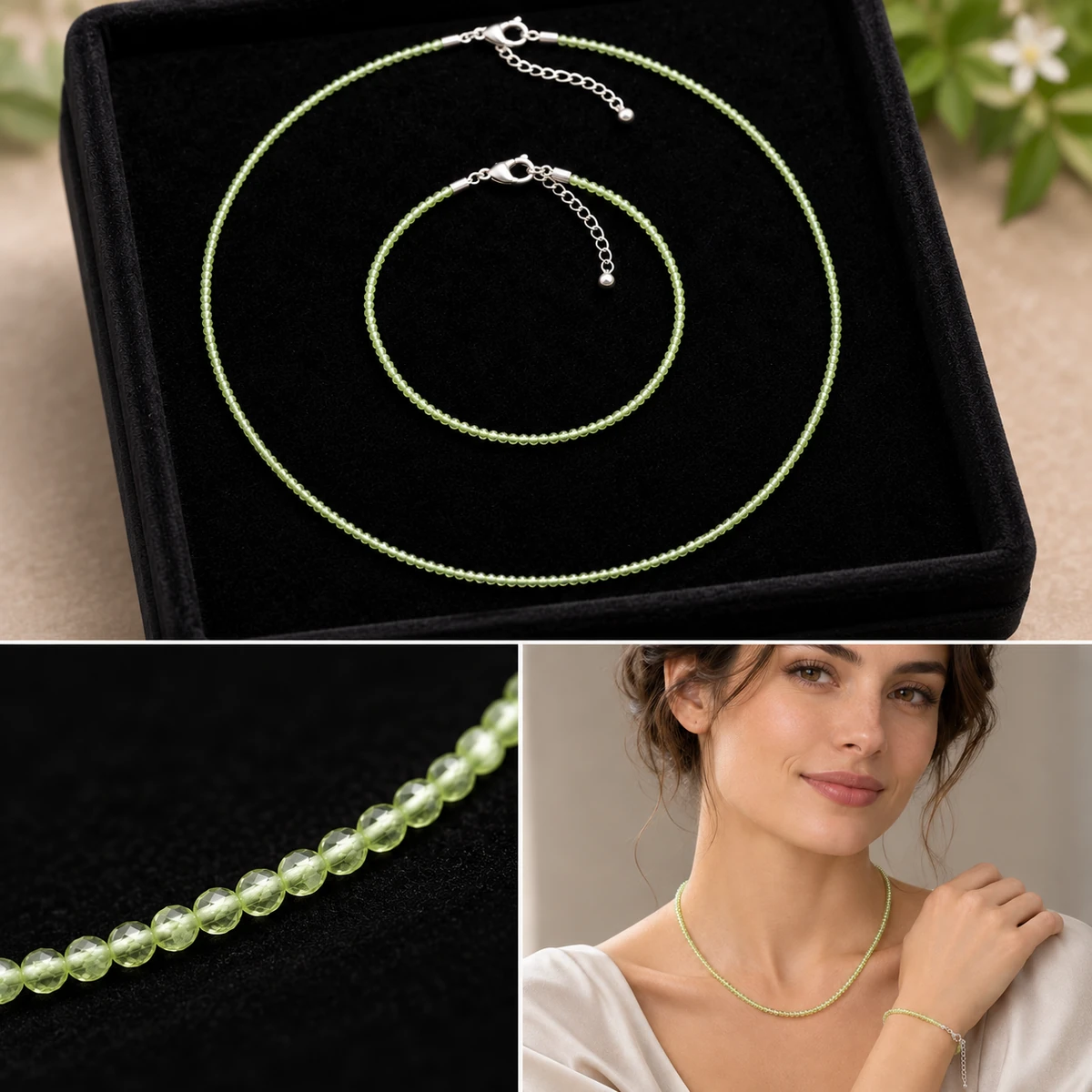
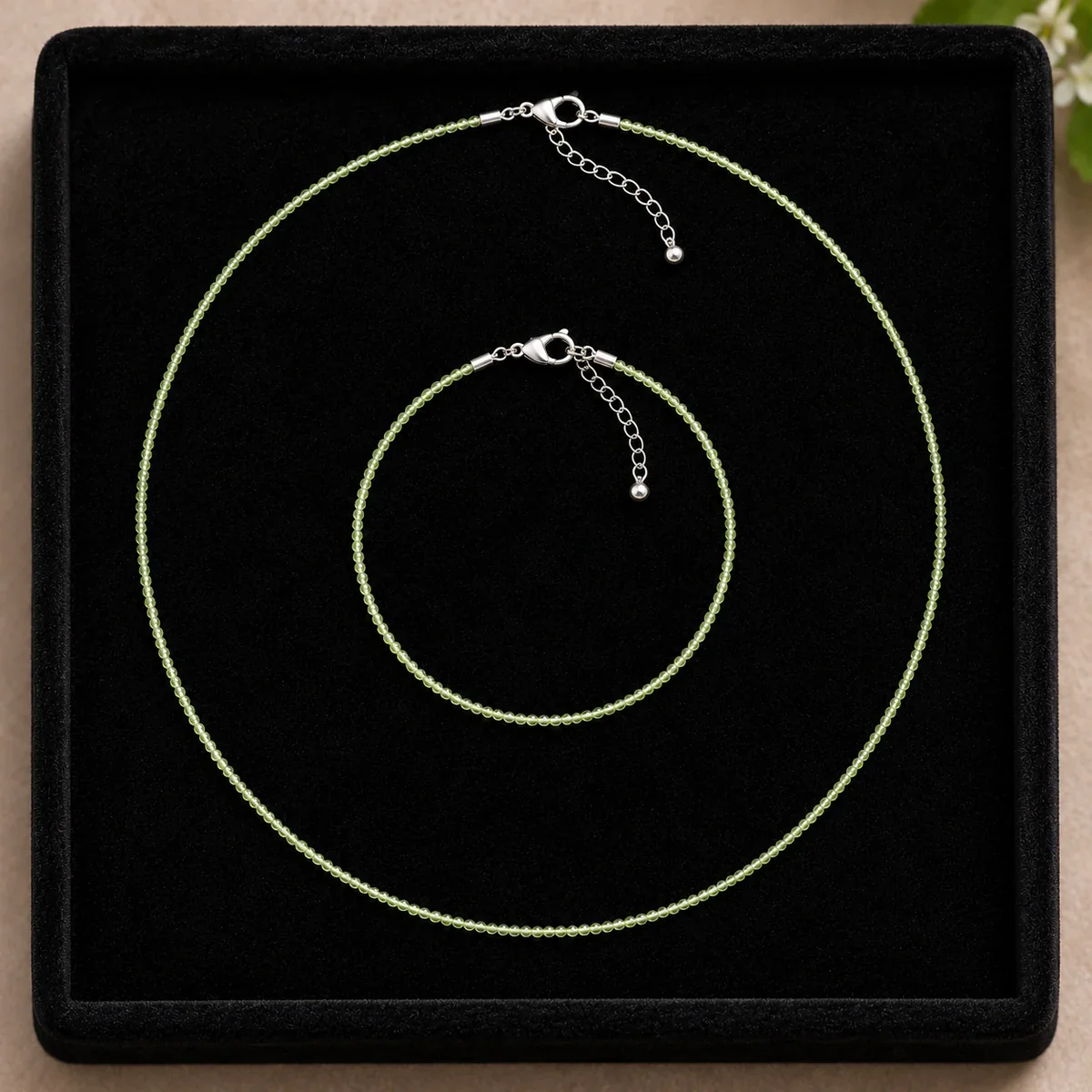
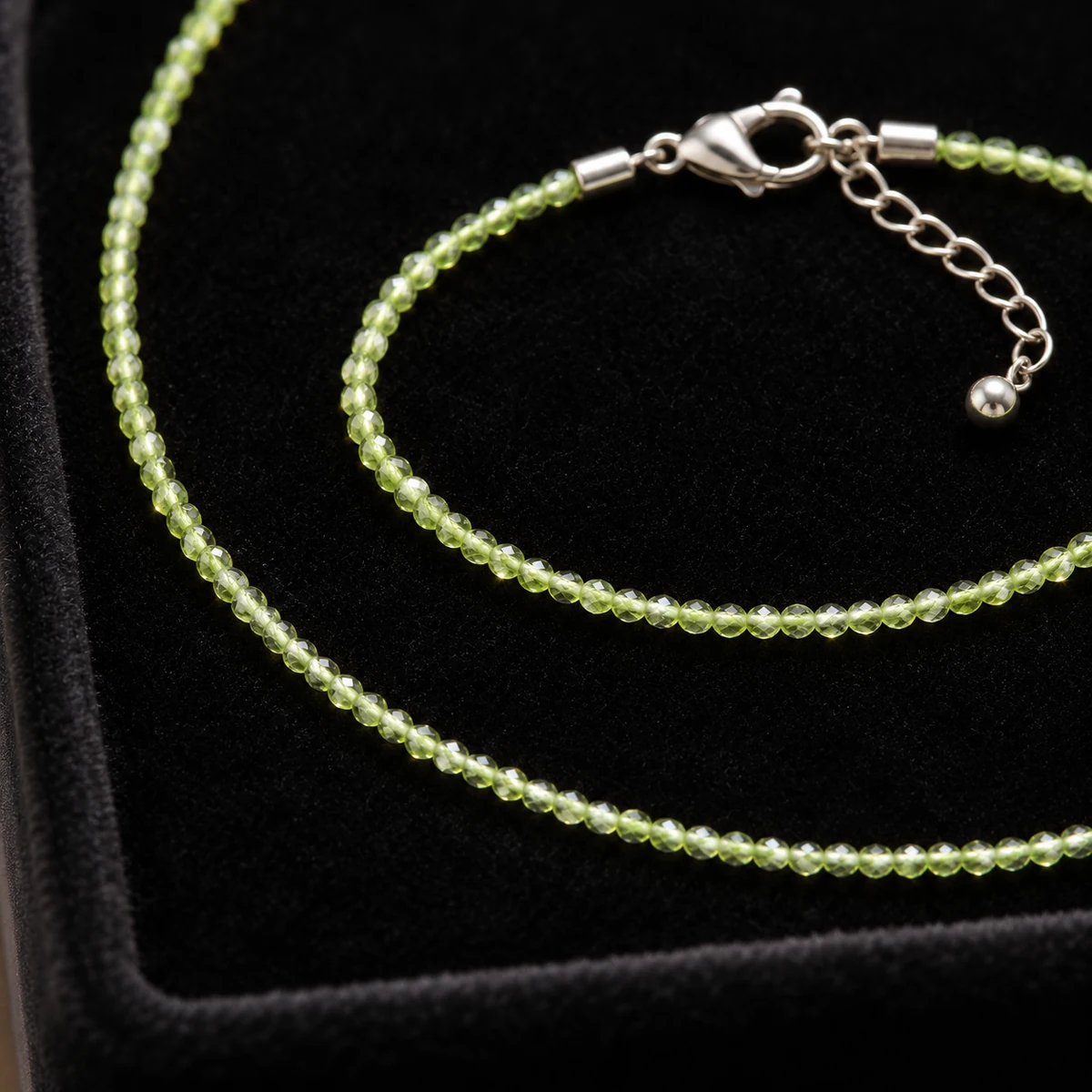
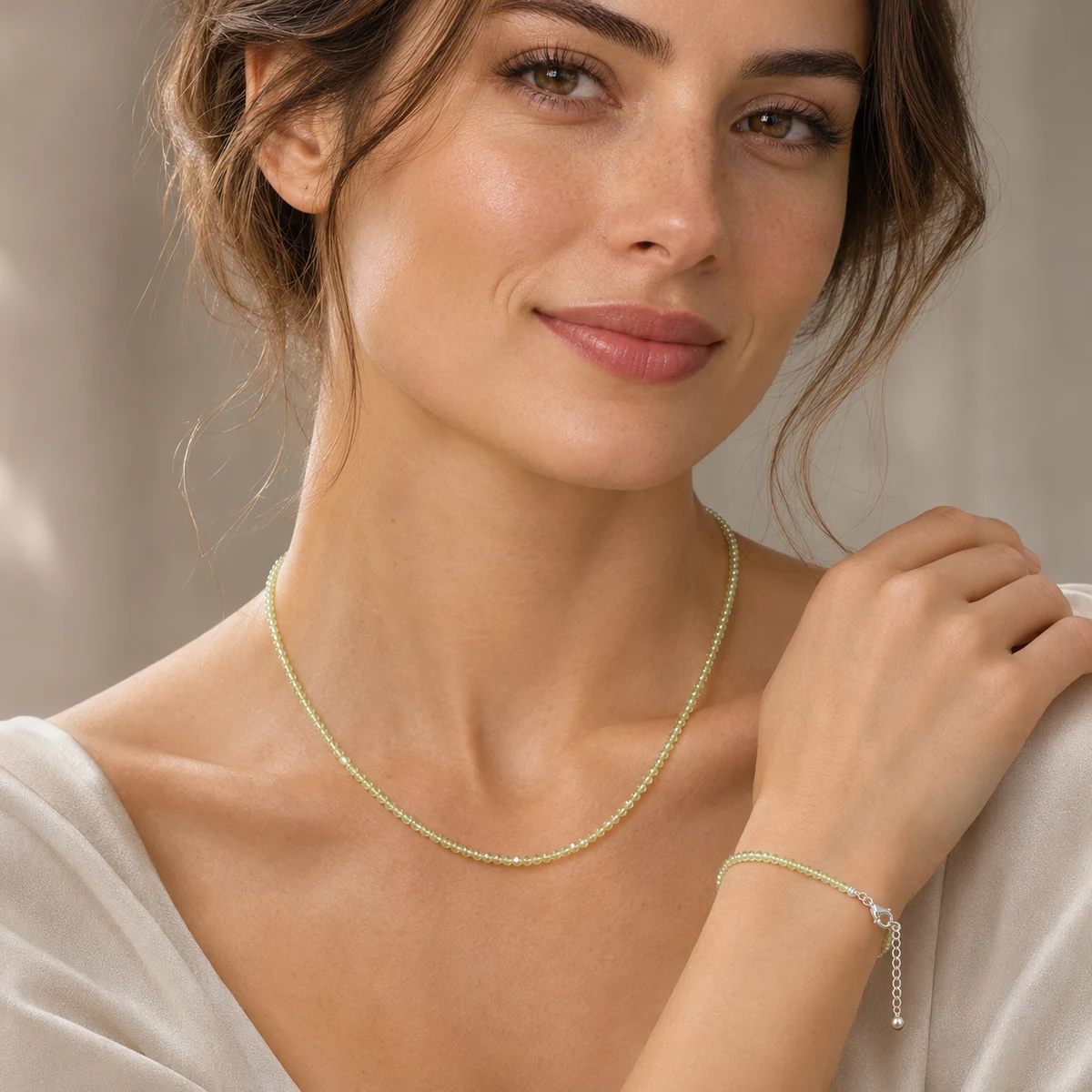



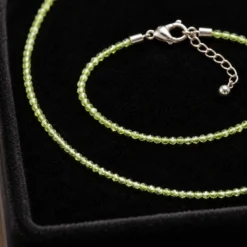
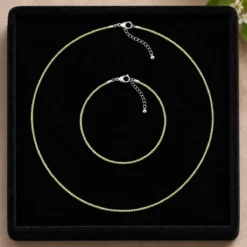
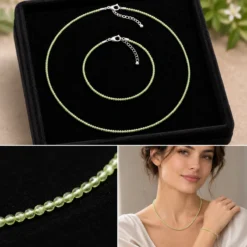
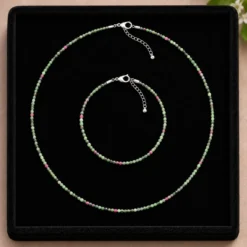
Peridot faceted necklace and bracelet set
49,00 € incl. VAT
Faceted peridot necklace and bracelet set, 2mm beads. With an extension chain, the necklace and bracelet can be adjusted to suit your preference. Pair with other faceted necklaces or a silver chain.
In stock
Stone(s): peridot or olivine
Color: translucent green
Necklace length: 38 cm, with 4.5cm extension chain
Bracelet length: 16cm, with 5cm extension chain
Stone diameter: 2mm
Precious metal: none – steel clasp
Necklace weight: 3.3 g
Bracelet weight: 2.2 g
Stone cut: faceted
Shape: round beads
Classification: silicate group
Mohs hardness: 6.5–7
Density: 3.32–3.37
Origin: United States, Brazil, Australia, Burma, South Africa
Care instructions: It’s recommended to clean peridot with a soft, slightly damp cloth. Do not expose peridot to extreme heat. Also avoid exposure to soap/shower gel, cosmetics (perfume, etc.) or household products, which will damage the stone.
When you’re not wearing your peridot jewelry, it’s recommended to store it in an individual pouch to protect it from scratches.
Non-contractual photos.
Faceted peridot necklace and bracelet: mineralogical facts
Peridot is the gem variety of olivine, a magnesium and iron silicate ((Mg,Fe)2SiO4), always green in color. Its hardness ranges from 6.5 to 7 on the Mohs scale.
Round beads: 3mm diameter, silver weight 8.1g.
This product sheet belongs to the Faceted Stone Necklaces and faceted bracelets categories, where similar pieces can be found.
ORIGINS AND MINERALOGY
Peridot: origin, formation and mineralogical properties
Origin and formation
Peridot is the gem variety of olivine, a mineral belonging to the silicate group. Recognizable by its shades ranging from yellow-green to olive green, it stands out for its vitreous luster and natural color, directly linked to its chemical composition.
Unlike many precious stones that form in the Earth’s crust, peridot mainly comes from the Earth’s upper mantle, several dozen kilometers deep.
It crystallizes in magnesium- and iron-rich rocks, particularly peridotites, under high temperature and pressure conditions. During certain volcanic eruptions, fragments of these deep rocks can be carried to the surface by rising magma.
These fragments, called xenoliths, sometimes contain olivine crystals transparent and well-formed enough to be used in jewelry.
Other deposits result from geological transformations of rocks originating from the Earth’s mantle, particularly due to fluid circulation and tectonic movements.
A sometimes extraterrestrial origin
Peridot has a remarkable feature: olivine can also be found in certain meteorites.
Pallasites, a rare category of meteorites, consist of an iron-nickel metallic matrix containing olivine crystals.
Some of these crystals have sufficient transparency and color to be used as gems.
These extraterrestrial peridots bear witness to mineral formation processes dating back to the early days of the solar system, around 4.5 billion years ago.
However, they remain very rare and represent only a tiny fraction of the peridots used in jewelry.
Composition and mineralogical properties
Peridot belongs to the olivine group, a family of magnesium and iron silicates.
Its general chemical composition is (Mg,Fe)₂SiO₄. It belongs to a mineralogical series between two end members:
- Forsterite (Mg₂SiO₄), magnesium-rich.
- Fayalite (Fe₂SiO₄), iron-rich.
Gem-quality peridots generally have a composition close to that of forsterite.
The iron present in their crystal structure is responsible for their characteristic color. Depending on its proportion, shades vary from light, slightly yellowish green to deeper olive green.
This coloring is called idiochromatic, as it comes from an essential element of the mineral’s composition rather than simply from impurities.
Main mineralogical properties
- Classification: silicates, olivine group, nesosilicates
- Chemical composition: (Mg,Fe)₂SiO₄
- Crystal system: orthorhombic
- Mohs hardness: 6.5 to 7
- Density: generally 3.27 to 3.48
- Refractive index: about 1.65 to 1.69
- Birefringence: about 0.035 to 0.038
- Luster: vitreous, sometimes slightly greasy
- Transparency: transparent to translucent
- Colors: yellow-green, olive green, light to deep green
- Cleavage: imperfect
- Fracture: conchoidal to irregular
Transparency, faceting and optical features
Peridot is prized in jewelry for its transparency and luminous shades.
Fine-quality crystals can be cut into various shapes: ovals, rounds, cushions, pears or faceted beads.
Faceting multiplies the light-reflecting surfaces and highlights the gem’s natural brilliance.
Peridot also has relatively high birefringence. This optical property can produce an apparent doubling of certain internal edges when a faceted stone is viewed through its facets.
Some crystals show characteristic inclusions, notably small discoid fractures, sometimes called lily pad inclusions (lily pad inclusions).
These structures can appear as small rings or discs around a mineral inclusion.
They can serve as a possible identifying feature of natural peridot, even though not all crystals display them.
Deposits
Peridot is found in various regions around the world, mainly in volcanic environments or geological formations associated with mantle rocks.
Egypt – Zabargad Island
Located in the Red Sea, Zabargad Island, also known as St. John’s Island, is one of the most famous historical deposits.
Mined since antiquity, it has yielded remarkable peridot crystals, some of which are now kept in major museums.
Pakistan
The mountainous regions of Kohistan, particularly around Sapat, produce peridots renowned for their transparency and deep green colors.
Some crystals reach significant sizes, allowing gems of several dozen carats to be cut.
Myanmar
The Mogok region is known for its intensely green peridots, sometimes exceptionally transparent.
These crystals are sought after in jewelry for their color and gemological quality.
United States
Arizona, particularly the San Carlos region, is a major source of peridot.
The crystals are mainly associated with basaltic volcanic rocks that carried mantle material to the surface.
Other deposits
Peridot is also mined in China, Vietnam, Tanzania and Ethiopia.
Occurrences are known in Norway, Australia and several other volcanic regions around the world.
Each deposit has geological particularities that can influence the size, color and transparency of the crystals.
History and use
Peridot has been used in jewelry since antiquity.
The Egyptians mined the deposits of Zabargad Island in the Red Sea for their bright green crystals. This gem was particularly associated with the sun and light.
In ancient texts, the term topazion referred to a stone extracted from this region, generally identified today as peridot. This name did not correspond to topaz as defined by modern mineralogy.
Over the centuries, peridot has sometimes been confused with other green gems, notably emerald, due to certain color similarities.
It also appears in European jewelry, particularly in antique religious jewelry and ornaments.
Its use developed alongside improvements in cutting techniques, which further highlighted its transparency and brilliance.
Today, peridot is used to make rings, pendants, earrings, necklaces and bracelets.
It is also recognized as one of the birthstones for August.
Care
With a hardness between 6.5 and 7 on the Mohs scale, peridot offers satisfactory resistance for jewelry use. However, it remains sensitive to impacts and scratches caused by harder materials.
To preserve its shine, it’s recommended to clean peridot jewelry with a soft, slightly damp cloth if needed.
Occasional cleaning with warm soapy water is also possible, followed by careful drying.
Harsh chemicals, particularly acids, as well as steam or ultrasonic cleaning, should be avoided.
Sudden temperature changes can also weaken the crystals.
For jewelry made with small faceted beads, it’s best to limit repeated rubbing and store them separately from other jewelry.
Well-being and energies
Properties traditionally attributed to peridot
In lithotherapy, peridot is associated with renewal, emotional balance and self-confidence.
Its green color symbolically connects it to harmony, growth and openness to others.
In contemporary energy practices, it is notably associated with:
- Emotional balance: traditionally used to support the search for serenity and calm.
- Self-confidence: associated with personal assertiveness and a positive attitude.
- Energy and vitality: considered a stone that symbolically promotes dynamism and renewal.
- Harmony: associated with opening the heart and improving relationships.
- Stress management: used in relaxation and grounding practices.
- Energetic protection: traditionally associated with warding off negative influences.
Associated chakras
- Heart chakra – ANAHATA
- Solar plexus chakra – MANIPURA
Associated zodiac signs
- Leo
- Virgo
- Libra
- Sagittarius
These correspondences vary according to lithotherapy traditions.
Purification and recharging
Cleansing
In lithotherapy, peridot can be symbolically purified through smudging with white sage or Palo Santo.
Simply pass the stone or jewelry gently through the smoke for a few moments, making sure to ventilate the room well.
This method helps avoid prolonged soaking, especially for jewelry assembled on thread and featuring metal elements.
Recharging
In contemporary energy practices, peridot is traditionally recharged under moonlight.
It can also be placed on an amethyst geode or near a cluster of clear quartz.
Gentle exposure to natural light is also possible, avoiding intense heat and sudden temperature changes.
The energetic properties mentioned stem from lithotherapy traditions and contemporary practices. They do not correspond to scientifically proven effects and do not replace any medical treatment.
Expédition : 48 à 72 heures, hors week-ends et jours fériés, après confirmation du paiement.
Livraison offerte dès 60 € en France métropolitaine.
Droit de rétractation : 14 jours pour nous signaler votre décision.
You may also like…
Bracelets


Bracelets


Faceted Stone Necklaces
Related products


Faceted Stone Necklaces