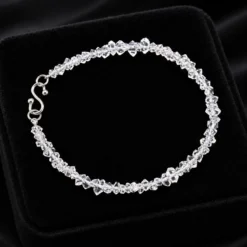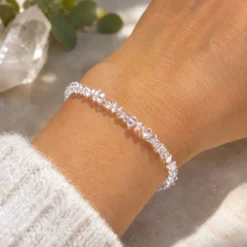



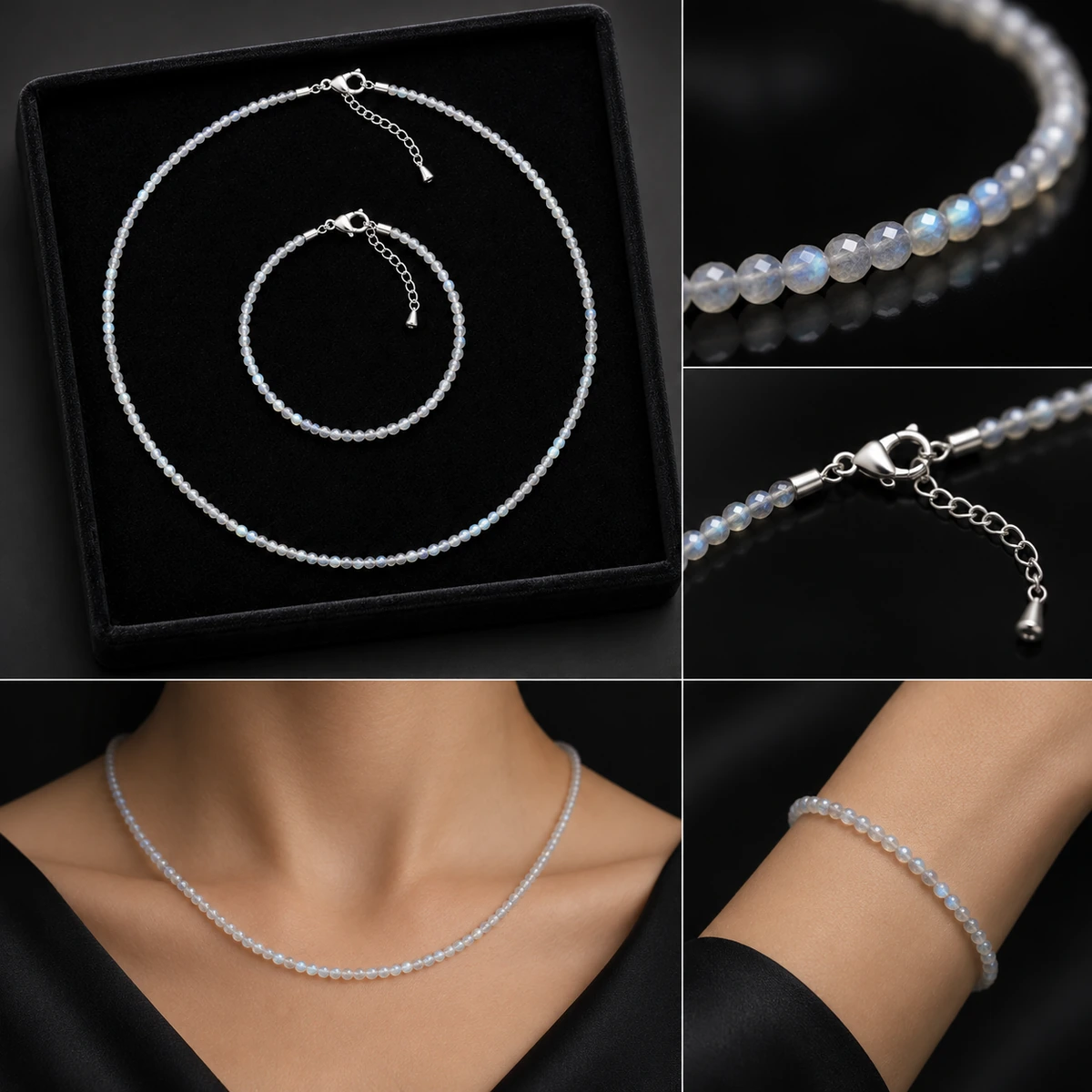
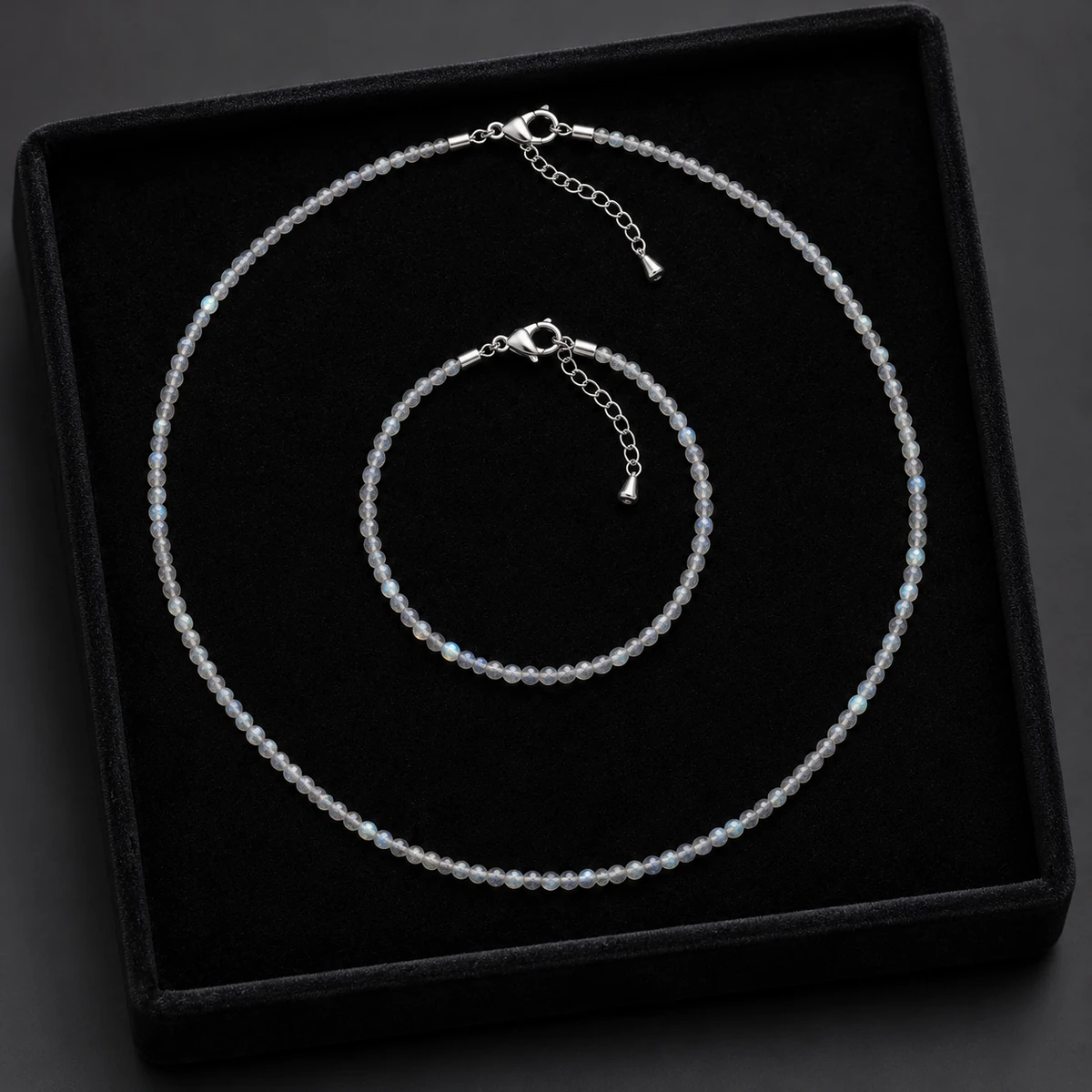




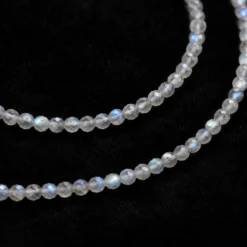
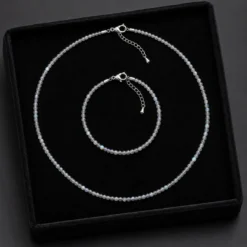
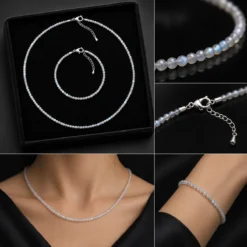
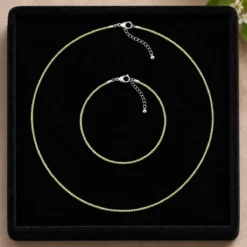
Faceted 2mm labradorite necklace and bracelet set
49,00 € incl. VAT
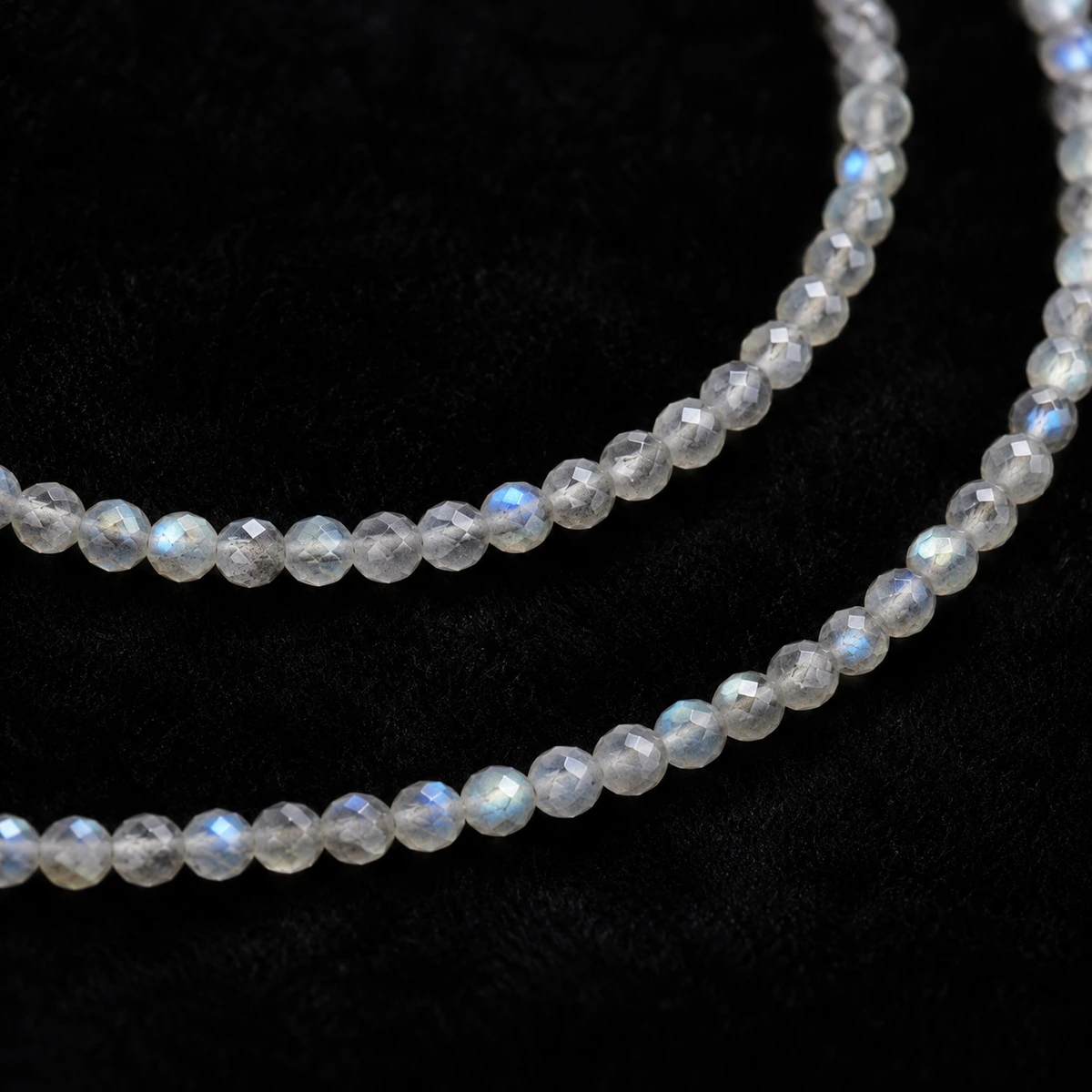
Faceted labradorite necklace and bracelet set with 2mm round beads. A discreet set with a subtle and modern design. You can also layer several faceted stone necklaces or pair it with a silver chain.
In stock
Color: grey with blue glints
Bead type: faceted rounds
Bead diameter: 2mm
Precious metal: none – steel bail
Necklace length: 38 cm – extension chain: 4.5cm
Bracelet length: 16cm – extension chain: 5cm
Weight: necklace: 3.8g – Bracelet: 2.1g
Non-contractual photos
Classification: Feldspar group
Mohs hardness: 6-6.5
Density: 2.70
Origin: Madagascar
Care advice: No specific care required.
About this sheet: 2mm labradorite necklace and bracelet set
Labradorite is a feldspar from the plagioclase family, composed mainly of aluminum, calcium, and sodium silicates. Its hardness is between 6 and 6.5 on the Mohs scale.
It is distinguished by its labradorescence, an optical phenomenon that creates iridescent blue, green, or gold glints depending on the viewing angle. This play of light results from light interference within fine lamellar structures present in the crystal.
Faceted beads. 2mm diameter. Approximate weight: 3.8g; 2.1g.
To see more, the Faceted Stone Necklaces and Faceted Bracelets categories include similar items.
ORIGINS AND MINERALOGY
Labradorite: Origin, Formation, and Mineralogical Properties
Origin and formation
Labradorite is a feldspar belonging to the plagioclase family, a group of silicates particularly widespread in the Earth’s crust. It is recognizable by its iridescent glints, mainly blue, green, and gold, which can also show shades of violet, pink, or orange.
Its name comes from the Labrador region in Canada, where it was identified in the 18th century.
Labradorite forms mainly during the cooling and crystallization of magmas rich in calcium and sodium. It is present in various igneous rocks, notably gabbros, basalts, and anorthosites.
During crystallization, chemical elements gradually organize into a crystalline structure composed of aluminum, calcium, and sodium silicates.
When the cooling of the rock is particularly slow, very fine internal structures can develop within the crystals. These structures are the source of labradorite’s characteristic optical phenomenon: labradorescence.
Labradorite can also be present in certain metamorphic rocks that have undergone significant transformations under the effect of temperature and pressure.
Labradorescence: the origin of its iridescent glints
Labradorescence is the most remarkable characteristic of this variety of feldspar.
It is an optical phenomenon of light interference produced by the internal structure of the crystal.
During the cooling of the rock, microscopic lamellae of slightly different compositions can form in the labradorite. These structures are extremely fine, with dimensions on the order of a few tens to a few hundred nanometers.
When light enters the stone, it interacts with these different layers. Certain light wavelengths are reinforced, while others are attenuated, causing colored glints to appear.
Depending on the thickness of the lamellae, their orientation, and the viewing angle, the colors can vary considerably:
- Blue: from light blue to intense electric blue.
- Green: emerald, turquoise, or golden green shades.
- Yellow and gold: bright glints with warm tones.
- Violet and pink: shades sometimes visible on certain multicolored pieces.
- Orange and copper: rarer glints, particularly sought after for their intensity.
These colors do not necessarily correspond to the actual color of the mineral. A dark grey labradorite can thus reveal remarkable blue glints when oriented toward the light.
Labradorescence depends on the internal crystalline structure and does not come from a surface treatment.
However, not all labradorites exhibit this phenomenon with the same intensity. Some pieces have very discreet glints, while others reveal large iridescent areas covering almost their entire surface.
Composition and mineralogical properties
Labradorite belongs to the plagioclase series, located between two mineralogical poles:
- Albite: NaAlSi₃O₈, rich in sodium.
- Anorthite: CaAl₂Si₂O₈, rich in calcium.
Labradorite generally corresponds to an intermediate composition containing about 50 to 70% of the anorthite component.
Its chemical composition can be represented by the general formula (Ca,Na)(Al,Si)₄O₈, with the proportions of calcium, sodium, aluminum, and silicon varying by crystal.
Main mineralogical properties
- Classification: silicates, tectosilicates subclass
- Family: feldspars, plagioclase group
- Chemical composition: (Ca,Na)(Al,Si)₄O₈
- Crystal system: triclinic
- Mohs hardness: 6 to 6.5
- Density: approximately 2.68 to 2.72
- Refractive index: approximately 1.559 to 1.568
- Luster: vitreous, sometimes pearly
- Transparency: transparent to opaque depending on the variety
- Base color: grey, dark grey, blackish, white, brown, or greenish
- Glints: blue, green, gold, violet, pink, and orange
- Cleavage: perfect in two crystallographic directions
- Fracture: irregular
Crystalline structure and particularities
Labradorite crystals frequently exhibit twins, which are associations of several crystalline parts oriented according to precise geometric relationships.
These structures are common in plagioclase feldspars and can appear as fine parallel striations on certain surfaces.
Labradorite also has two well-defined cleavage directions, close to a right angle.
This property explains why it can fracture along certain planes despite its relatively high hardness.
In jewelry and lapidary work, the orientation of the polishing is particularly important. The surface must be worked to highlight the crystalline planes responsible for labradorescence.
A piece polished in an unfavorable orientation may show much less visible glints than another from the same block.
Deposits
Labradorite is found in various regions of the world, mainly within igneous formations rich in feldspars.
Canada – Labrador
Labrador, in northeastern Canada, is the historical region where this variety of feldspar was discovered.
The first specimens studied came notably from Paul Island, near Nain.
The region contains significant anorthosite formations, igneous rocks composed mainly of plagioclase feldspars.
Some Canadian labradorites are renowned for their particularly intense blue and green glints.
Madagascar
Madagascar is among the main commercial sources of labradorite for decoration and jewelry.
Malagasy deposits provide blocks that can reach significant sizes, allowing for the manufacture of pebbles, spheres, polished slabs, sculptures, and decorative pieces.
Labradorite from Madagascar is particularly appreciated for the diversity of its glints: electric blue, green, golden yellow, orange, and sometimes violet.
Some multicolored pieces reveal several shades on the same surface, with significant variations depending on the light orientation.
Finland – Spectrolite
Finland is famous for a commercial variety of labradorite called spectrolite, mainly associated with the Ylämaa region in the southeast of the country.
Spectrolite is generally distinguished by particularly intense labradorescence and a wide diversity of colors.
A single piece can show blue, green, gold, orange, and violet glints, contrasting strongly with a dark matrix.
The term spectrolite is historically associated with Finnish labradorite. Its commercial use should therefore not be generalized to all multicolored labradorites.
Other deposits
Labradorite is also present in Norway, Russia, Ukraine, the United States, and various regions with geological formations suitable for its crystallization.
The color and intensity of the glints vary according to the chemical composition, internal structure, and formation conditions of the crystals.
History and use
The discovery of labradorite
Labradorite was known to the indigenous populations of Labrador long before its identification in European mineralogical publications.
The first specimens to attract the attention of European naturalists were collected on the Labrador coast during the 18th century, notably around 1770.
The stone owes its name to this Canadian region, where its blue and green glints were noticed.
Its identification and description in mineralogical literature then helped make it known in Europe.
Labradorite gradually acquired an important place among ornamental stones due to its particularly spectacular optical phenomenon.
A stone sought after for its glints
From the 19th century, labradorite was notably used in decorative objects, architectural elements, and the cutting of ornamental stones.
Varieties showing strong labradorescence particularly caught the attention of lapidaries.
Polishing reveals the iridescent zones and creates surfaces with changing colors.
Today, labradorite is used for making jewelry, but also spheres, pebbles, slabs, sculptures, and decorative objects.
Large polished pieces are appreciated for their natural patterns and for the color changes produced by light.
Different commercial names
Several names are used to designate certain presentations of labradorite.
Spectrolite traditionally refers to Finnish labradorite with particularly intense multicolored labradorescence.
Sunset Labradorite is a commercial name used to highlight pieces with warm glints, notably pink, violet, copper, or orange. It does not correspond to an officially distinct mineralogical variety.
Rainbow Moonstone is a commercial name often applied to certain light-colored feldspars with blue or multicolored glints. Despite its name, many specimens marketed under this name belong to the plagioclase series, sometimes within the composition range of labradorite.
These different names describe specific visual aspects but do not all constitute distinct mineralogical classifications.
Care instructions
With a hardness of 6 to 6.5 on the Mohs scale, labradorite has suitable resistance for decorative or jewelry use.
However, it has marked cleavage planes that make it sensitive to shocks.
To preserve its polish and glints, it is recommended to use a soft cloth, slightly damp if necessary.
Occasional cleaning with lukewarm soapy water is possible for suitable pieces, followed by careful drying.
It is best to avoid harsh chemicals, abrasives, ultrasonic or steam cleaning, and sudden temperature variations.
For jewelry made of small faceted beads, it is advisable to limit repeated friction and store them separately from harder jewelry.
Well-being and energies
Properties traditionally attributed to labradorite
In lithotherapy, labradorite is mainly associated with energetic protection, intuition, and emotional balance.
Its changing glints are also symbolically associated with transformation and renewal.
In contemporary energy practices, it is notably used to support:
- Energetic protection: traditionally associated with preserving one’s personal balance against external influences.
- Emotional balance: associated with stability and serenity.
- Intuition: considered a symbolic support for introspection and inner perception.
- Self-confidence: associated with self-assertion and gaining perspective.
- Concentration: traditionally used to accompany periods of reflection.
- Renewal: associated with changes and new stages of life.
Associated Chakras
- Third Eye Chakra – AJNA
- Crown Chakra – SAHASRARA
- Throat Chakra – VISHUDDHA (secondary association)
Associated Astrological Signs
- Cancer
- Scorpio
- Sagittarius
- Pisces
These correspondences vary according to lithotherapy traditions.
Purification and recharging
Cleansing
In lithotherapy, labradorite can be symbolically purified by smudging with palo santo or white sage.
Simply pass the stone or jewelry gently through the smoke for a few moments, making sure to ventilate the room well.
This method avoids prolonged immersion, particularly for jewelry with stringing wire or metal elements.
Recharging
In contemporary energy practices, labradorite can be symbolically recharged in moonlight.
It can also be placed on an amethyst druse or near a quartz geode.
Gentle exposure to natural light is also possible, avoiding high heat and sudden temperature variations.
The energetic properties mentioned stem from lithotherapy traditions and contemporary practices. They do not correspond to scientifically proven effects and do not replace any medical treatment.
Expédition : 48 à 72 heures, hors week-ends et jours fériés, après confirmation du paiement.
Livraison offerte dès 60 € en France métropolitaine.
Droit de rétractation : 14 jours pour nous signaler votre décision.
You may also like…
Bracelets


Bracelets


Faceted Stone Necklaces
Related products


Faceted Stone Necklaces