

Minerals
LAPIS LAZULI OR SODALITE: THE BEST TIPS TO TELL THEM APART
Why these two stones are often confused
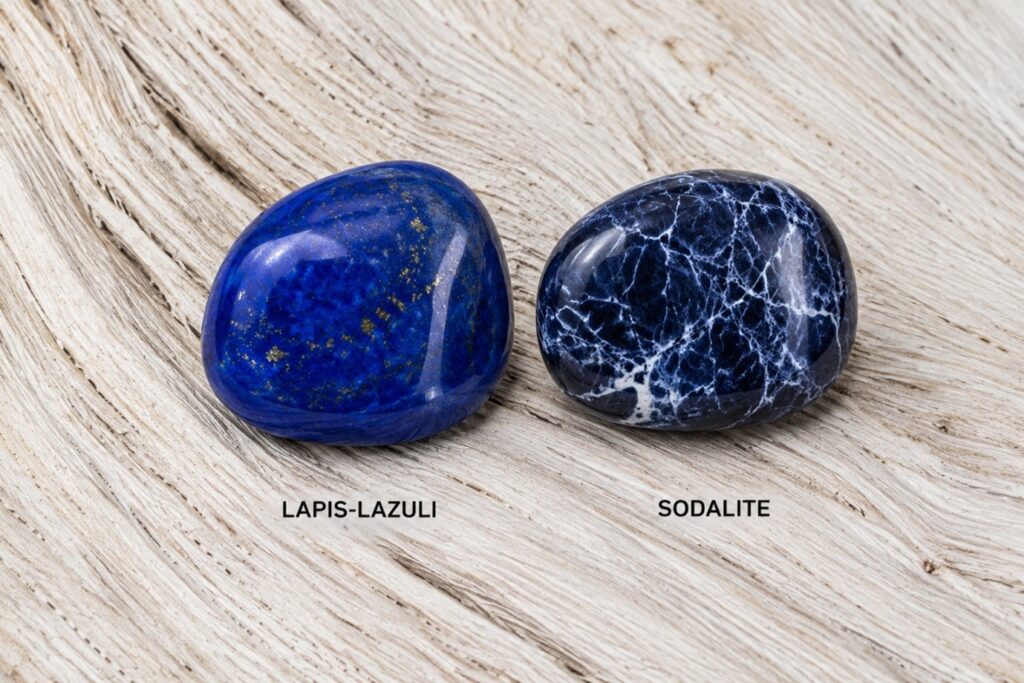
Lapis lazuli and sodalite are two blue stones that look remarkably similar at first glance. Yet they are two very different minerals.
The confusion mainly stems from their color: both display shades of deep blue that can sometimes appear very similar to the untrained eye.
However, lapis lazuli is not a single mineral but a rock composed of several minerals, whereas sodalite is a mineral in its own right.
Some very dark sodalites can easily be mistaken for lapis lazuli.
Fortunately, there are several simple tips to distinguish them.
What the eye can spot immediately
The first detail to look for is the presence of pyrite.
Lapis lazuli often contains small golden flecks of pyrite, sometimes called “fool’s gold.” These shimmering inclusions resemble a starry sky and are one of the most characteristic signs of lapis.
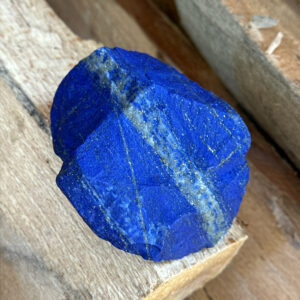

Images: Raw and polished Lapis Lazuli
Sodalite, on the other hand, almost never contains pyrite.
Another important difference: white veins.
Sodalite very often displays marbling or white calcite veins that run through the stone quite visibly. These patterns can form fine lines or broad light areas, making each stone unique.
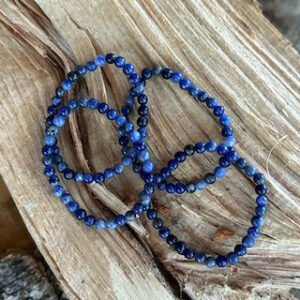

Images: Sodalite in various forms: jewelry and raw stone with different shades
Lapis lazuli can also contain white calcite, but generally more discreetly when the stone is of good quality.
Color also provides valuable clues:
- lapis lazuli typically has an intense, deep, and uniform royal blue;
- sodalite often displays a slightly duller blue, more gray or cloudy.
Finally, the luster of the two stones differs slightly.
Once polished, sodalite often has a more glassy appearance, whereas lapis lazuli generally appears brighter and more lustrous.
Be careful, however: some lower-quality lapis lazuli contains many white veins. In this case, confusion with sodalite becomes easier. You’ll then need to carefully look for the presence of pyrite.

Hardness and composition
Lapis lazuli is not a single mineral but a rock, meaning an assemblage of several minerals. It is primarily composed of lazurite, but also calcite, pyrite, and sometimes sodalite.
Sodalite, on the contrary, is a mineral in its own right belonging to the feldspathoid family.
Both stones have relatively similar hardness on the Mohs scale:
- sodalite: between 5.5 and 6;
- lapis lazuli: between 5 and 6.
This means they remain fairly fragile and sensitive to scratches or harsh chemicals.
The UV test: a complementary clue
Some sodalites may display orange to red-orange fluorescence under ultraviolet light, whereas lapis lazuli generally shows little or no visible reaction.
This difference is related to the minerals present in each stone.
However, not all sodalites necessarily react under UV light. This test therefore does not constitute absolute proof, but rather an additional clue that can help with identification.
A small pocket UV lamp makes it easy to observe this type of reaction on certain stones.
Price and value
The difference between sodalite and lapis lazuli becomes particularly important when discussing value.
Sodalite remains a relatively affordable stone.
Lapis lazuli, on the other hand, can reach very high prices depending on its quality. The finest gem-quality specimens can easily exceed 1,000 euros per kilo. The main lapis lazuli deposits are located notably in Afghanistan, a region historically renowned for producing the most sought-after stones for thousands of years.
“Lapis lazuli” sold at an abnormally low price should raise suspicion. It may sometimes be sodalite incorrectly sold as lapis, dyed stone, reconstituted material containing resin, or composite materials imitating the appearance of natural lapis lazuli.
Of course, a low price does not automatically mean it’s an imitation, but it remains an element to take into consideration.
Quick comparison table
| Criteria | Lapis Lazuli | Sodalite |
| Nature | Rock composed of several minerals | Single mineral |
| Color | Intense royal blue | Softer or cloudy blue |
| Golden pyrite | Very common | Absent |
| White veins | Sometimes present | Very common |
| Luster | Brighter and more lustrous | More glassy |
| UV fluorescence (complementary clue) | Little or not visible | Orange to red-orange for some sodalites |
| Price | High | More affordable |