


History & Culture
WHERE DO BIRTHSTONES COME FROM? HISTORY AND ORIGIN OF A LITTLE-KNOWN TRADITION
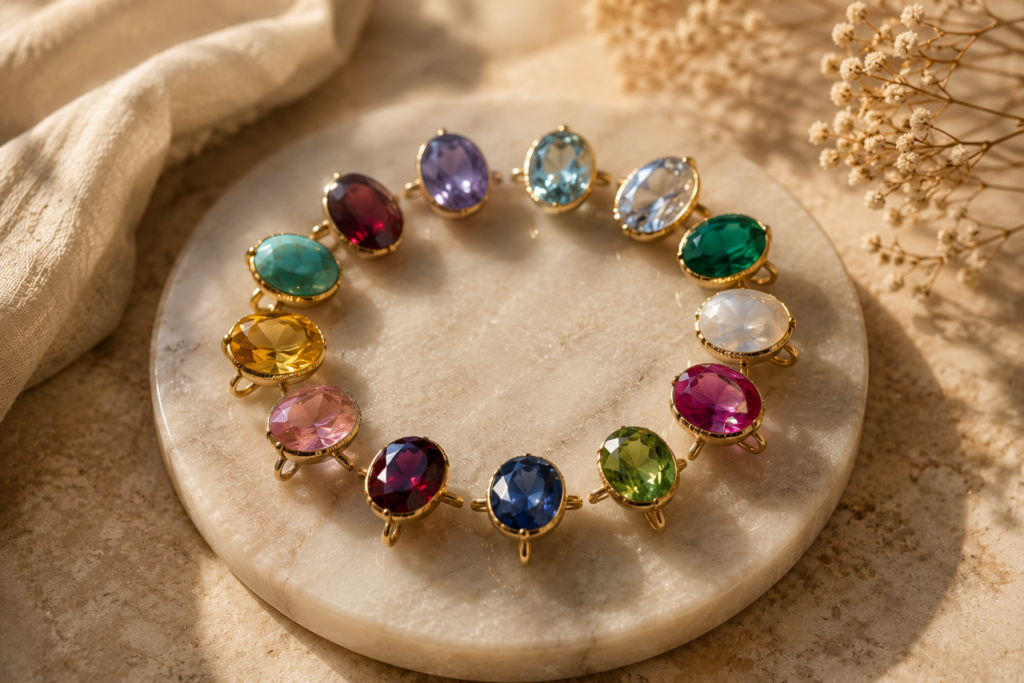
Garnet for January, amethyst for February, diamond for April… Today, the birthstone tradition associates one or more gems with each month of the year.
But where does this association come from? Who decided that amethyst would be the February stone or that ruby would represent July?
The history of birthstones is more complex than it seems. It blends ancient texts, symbolism, evolving traditions and, much more recently, a desire to bring some order to the many lists that were circulating.
A story that begins with twelve stones
One of the oldest references generally associated with the history of birthstones is found in the Book of Exodus.
The text describes the breastplate worn by the high priest Aaron. It was adorned with twelve stones arranged in four rows of three, each bearing the name of one of the twelve tribes of Israel.
At that time, no association with the months of the year had yet been established.
We must also be careful when trying to give a modern name to each of these stones today. Translations vary considerably from one text to another: mineralogical knowledge and the names used in Antiquity were not the ones we use today. A stone described as “sapphire” in some ancient texts, for example, did not necessarily correspond to the blue corundum we call sapphire today.
Over time, gemological knowledge has also made it possible to better identify stones, their characteristics, and any treatments of natural gemstones.
When the twelve stones meet the twelve months
Several centuries later, in the 1st century AD, the historian Flavius Josephus revisited this same breastplate in his Antiquities of the Jews. He then proposed a new symbolic reading of the twelve stones, which he linked to the twelve months of the year and the twelve signs of the zodiac.
This interpretation constitutes an important step in the history of birthstones: the twelve stones, initially associated with the twelve tribes of Israel, thus began to be linked to the calendar and the zodiac.
But this is still not exactly our modern concept of a “birthstone.” Josephus does not say that a person born in January must wear a specific stone. Rather, he proposes a symbolic interpretation of the twelve stones as a whole. It was therefore gradually, over the following centuries, that these different traditions would come together.
So, when did people start wearing the stone corresponding to their birth month?
For a long time, different European cultures established their own correspondences between stones, months, and astrological signs. The lists were not necessarily identical and could evolve according to the era and region.
In the early 20th century, the American mineralogist and gemologist George Frederick Kunz attributed the development of the custom of wearing the stone corresponding to one’s own birth month to 18th-century Poland. He also put forward a more anecdotal hypothesis: this Polish tradition might have gained popularity in Europe through Marie Leszczyńska, a Polish princess who became Queen of France after her marriage to Louis XV in 1725.
However, this origin remains difficult to establish with certainty. Historical sources mainly show a gradual evolution of the practice, rather than a single event that allows us to say precisely when birthstones appeared. This is probably what makes their history so interesting: they were not “invented” all at once, but were built up over time from older traditions.
1912: birth of the modern list
The real turning point finally occurred in the world of jewelry.
At the beginning of the 20th century, different birthstone lists were still circulating. Depending on the traditions or sources consulted, the same month could be associated with different gems.
In 1912, the American National Retail Jewelers Association, an organization that later became Jewelers of America, adopted a list intended to harmonize the correspondences between months and stones. This list forms the basis of the modern system widely used today.
It has not remained completely fixed, either. New stones have been added over time. Tanzanite was notably added to December in 2002, and spinel to August in 2016. This explains why some months have several birthstones today.
What are the birthstones today?
Here is the modern list commonly used today. Depending on the country, traditions, or professional organizations, some variations may exist.
Why have some stones changed?
Because birthstones have always been influenced by their era.
Mineralogical knowledge has become more precise, new gems have been discovered or marketed, some have become more accessible, and jewelry habits have evolved.
Tanzanite is a good example: this gem was only discovered in the 20th century. It obviously could not appear in a medieval list of birthstones. Yet, it is now part of the stones associated with the month of December in the modern American list.
Spinel is another interesting example: it only officially joined the August list in 2016. A tradition can therefore have ancient roots while continuing to evolve.
From ancient symbolism to personal jewelry
Today, birthstones have largely left the realm of ancient symbolic correspondences to enter that of personal jewelry. They allow a date, a memory, or a family bond to be associated with a stone: a garnet for a January birth, an emerald for the month of May, or even several gems brought together on the same piece of jewelry to represent family members.
What makes this tradition interesting is precisely that it does not rely on an immutable list passed down from Antiquity. It was built in stages, through religious interpretations, European customs, jewelry practices and, more recently, commercial standardization.
Birthstones are therefore less the intact vestige of a thousand-year-old custom than the result of a long cultural evolution. The associations we know today still bear the trace of this history, while continuing to evolve with their time.
Behind a simple “month = one stone” lies a much richer journey: that of twelve biblical stones that have become, over the centuries, personal symbols often worn today for their beauty, their history, or the emotional value attributed to them.
Main Sources
- Book of Exodus, chapter 28 (description of Aaron’s breastplate).
- Flavius Josephus, Antiquities of the Jews, Book III.
- George Frederick Kunz, The Curious Lore of Precious Stones (1913).
- Jewelers of America, birthstone guide.
- National Jeweler, history of the evolution of the birthstone list.