

Minerals
STAUROLITE: HOW DO ITS REMARKABLE NATURAL CROSSES FORM?

Staurolite can form brown crystals that intersect at nearly right angles, as if they had been assembled or carved by hand. Some staurolites display such a regular shape that it seems scarcely natural. Yet the cross is indeed produced during the mineral’s growth. It results from a precise crystallographic phenomenon called twinning.
Not all staurolites form a cross, and not all crosses have the same angle. The most characteristic are associations of two crystals oriented according to very precise rules, forming either a cross close to 90°, or an oblique cross around 60°. This phenomenon explains the very name of the mineral and the many stories associated with it over the centuries.
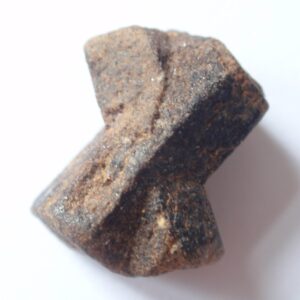
Staurolite twin cross. Photo: Helgi; cropping: User-duck. Wikimedia Commons, CC BY-SA 3.0.
What is staurolite?
Staurolite, sometimes called staurotide in French, is a silicate rich in aluminum and iron, among other elements. It is generally reddish brown to very dark brown and has a high hardness, around 7 to 7.5 on the Mohs scale.
It is mainly found in certain metamorphic rocks, particularly micaschists and some gneisses derived from materials initially rich in clays and aluminum. It can form relatively large crystals within finer minerals: geologists then refer to them as porphyroblasts.
The presence of staurolite is also useful to geologists, as this mineral appears under a particular range of metamorphic conditions. It is one of the so-called “index” minerals, used to reconstruct the pressure and temperature conditions experienced by a rock during its history.
Discover our selection of staurolites.
How does staurolite form?
Staurolite does not form in a cavity like some quartz crystals can. It generally appears within an already existing rock when it is transformed by metamorphism.
Imagine ancient sediments rich in clays. Gradually buried during tectonic movements, they undergo an increase in pressure and temperature. The rock does not melt: its minerals become unstable, react with each other, and recrystallize. New mineral assemblages can then appear, for example, micas, garnet, kyanite, and, when the rock’s composition and conditions are suitable, staurolite.
It is during this recrystallization that staurolite crystals grow. Pressure and temperature therefore make their formation possible, but they do not directly “draw” the cross. To understand this geometry, one must look at the organization of crystals on another scale: that of their crystal lattice.
Why do some staurolites form a cross?
The cross is the result of crystal twinning. A twin is an ordered association of two or more crystals of the same mineral. The crystals do not meet randomly like two objects colliding during their growth: their crystal lattices exhibit a determined geometric orientation between them, called a twinning law.
In the case of staurolite, the two crystals can interpenetrate. Visually, each seems to pass through the other, but the whole developed according to a common crystallographic relationship. This is called an interpenetration twin.
| To remember: the staurolite cross is not a crack, a dark inclusion, or a sculpted shape. It corresponds to several staurolite crystals linked by a precise twinning relationship. |
Two main cross forms
Staurolite mainly exhibits two well-known cruciform twins:
- the twin known as the “Saint Andrew’s cross,” around 60°, which is the most frequent;
- the twin known as the “Greek cross,” close to 90°, whose silhouette more closely resembles the “+” sign.
These angles are not chosen randomly. They correspond to two particular orientations allowed by the crystal structure of staurolite. A crystallographic study published in 2014 showed that at the atomic level, a large part of the lattice organization — notably the substructure formed by oxygen atoms — is almost superimposed from one crystal to another in these twins. This compatibility helps to understand why staurolite twins so readily according to these geometries.
The study also explains why the St. Andrew’s cross is more frequent: in this orientation, a larger proportion of the positions occupied by cations are almost aligned between the two crystal individuals. In other words, the structure “agrees” better in this configuration than in the 90° twin.
This does not mean that every staurolite crystal will form a cross. Many remain simple, while others are twinned more or less distinctly. Beautiful cruciform specimens are simply the most immediately recognizable forms. You can find in our shop a selection of twinned cross crystals displaying this characteristic shape.
Staurolite and chiastolite: two crosses, two different phenomena
Staurolite is often compared to chiastolite, and the comparison is logical: both can show a very visible natural cross. However, mineralogically, these crosses do not have the same origin.
| Staurolite: the cross is formed by two twinned crystals. | Chiastolite: the cross is an internal pattern within the crystal. |
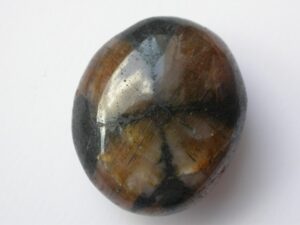
Left: staurolite — photo Helgi, cropped by User-duck, CC BY-SA 3.0. Right: chiastolite — photo Ra’ike, CC BY-SA 3.0. Images via Wikimedia Commons.
Chiastolite is a variety of andalusite. When certain crystals are cut perpendicular to their length, a dark cross appears inside. This pattern is linked to inclusions, notably graphite and quartz, incorporated and organized during the crystal’s growth.
A 2010 study on chiastolite shows that the arms of the cross contain quartz and graphite inclusions and that they develop in relation to the growth of andalusite. It is therefore not a cruciform twin comparable to that of staurolite.
| Staurolite | Chiastolite | |
| Origin of the cross | Twinning of two crystals | Organized inclusions within a crystal |
| Appearance | Cruciform external shape | Internal pattern visible in section |
A “cross-stone” known before modern mineralogy
The cruciform shape of certain crystals attracted attention long before their structure could be explained. Ancient names like “cross stone” or lapis crucifer attest to this immediate identification with a cross.
The scientific name staurolite was attributed in 1792 to the French naturalist and mineralogist Jean-Claude Delamétherie. It is formed from the Greek stauros, “cross,” and lithos, “stone”: literally, the “cross-stone.” René Just Haüy later used the name “staurotide,” a term still found in French today.
It is therefore preferable to speak of a scientific description and naming in 1792 rather than a “discovery” at that date: cruciform crystals were known and collected before then.
From Brittany to the “Fairy Stones” of the Appalachians
The cross shape naturally favored symbolic uses. In Brittany, where staurolite is present in several areas, cruciform crystals have been preserved and worn as amulets. The Pitt Rivers Museum in Oxford, for example, holds staurolites from Auray and documents their historical association with protective objects and “cross stones.”
Across the Atlantic, the cruciform staurolites of the Blue Ridge Mountains, particularly in Virginia, have been given the names “Fairy Stones” or “Fairy Crosses.” A local legend tells that fairies wept upon learning of Christ’s crucifixion, and their tears turned into small stone crosses.
Fairy Stone State Park in Virginia owes its name to the staurolite crystals found in the region. The stone has thus become both a geological and cultural element of the local landscape.
Further south, in Georgia, staurolite is particularly present in the northern part of the state, notably around Blue Ridge and Mineral Bluff, in Fannin County, as well as in Cherokee County. Cross-twinned crystals are also found there. This presence is emblematic enough that staurolite was designated the official state mineral in 1976.
Why is this stone so intriguing?
Staurolite brings together two things that are often wrongly opposed: spectacular geometry and a very precise natural phenomenon. The cross is not a geological whim or a simple growth coincidence. It reveals how two crystal lattices can organize themselves in relation to each other according to rules of symmetry and atomic compatibility.
This is also what distinguishes it from chiastolite. Two minerals can produce an almost identical image — a cross — through entirely different mechanisms: the ordered interpenetration of several crystals for staurolite, the organization of inclusions during growth for chiastolite.
This dual reading, scientific and historical, undoubtedly explains the lasting fascination with “cross-stones.” Where traditions saw amulets, religious signs, or fairy tears, crystallography now reveals a particularly remarkable natural architecture.
Sources and main references
- Marzouki, M. A. et al. (2014), “The staurolite enigma solved”, Acta Crystallographica A.
- Mason, R. (2010), “Chiastolite”, Gondwana Research / Oxford Research Archive.
- Handbook of Mineralogy – Staurolite.
- Pitt Rivers Museum, Oxford – Staurolite crystals from Auray, Brittany, France.
- Virginia Department of Conservation and Recreation – Legend of the Fairy Stone.
- Official Code of Georgia, § 50-3-59 – staurolite is designated the official state mineral of Georgia.
- Georgia Mineral Society – State Mineral: Staurolite