


History & Culture
STONES AND ASTROLOGICAL SIGNS: WHERE DO THESE ASSOCIATIONS COME FROM?
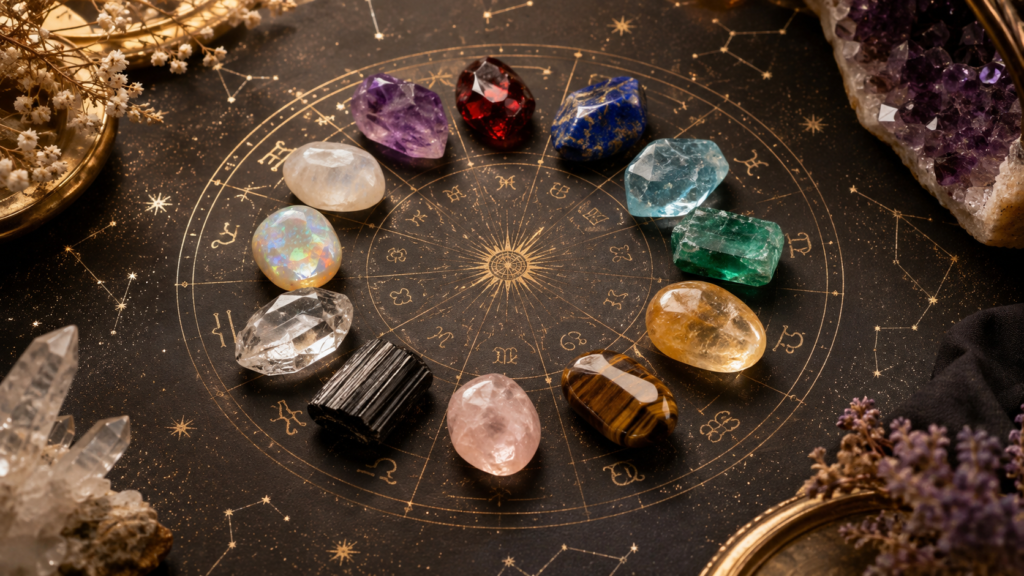
Amethyst for Pisces, emerald for Taurus, garnet for Aquarius… Links between stones and astrological signs are now very common. Yet they vary depending on the source: the same stone can be attributed to several signs, while the same sign can be associated with several gems.
This diversity doesn’t come only from recent variations. It reflects a much older history, in which stones were linked to planets, stars, and the zodiac according to systems that changed from one era to another. To understand today’s stone–astrological sign associations, we therefore need to go back to the links that ancient and medieval societies established between the sky and the mineral world.
Before the signs: the role of the seven traditional celestial bodies
In the astrology of Classical Antiquity, the sky was organized around seven moving celestial bodies visible to the naked eye: the Sun and the Moon, called the two luminaries, as well as Mercury, Venus, Mars, Jupiter, and Saturn. Uranus, Neptune, and Pluto would enter astrological systems much later, after their discovery by modern astronomy.
In the 2nd century CE, Claudius Ptolemy describes in the Tetrabiblos a system of planetary domiciles that links the twelve signs to the seven traditional celestial bodies. Leo is associated with the Sun, Cancer with the Moon, Gemini and Virgo with Mercury, Taurus and Libra with Venus, Aries and Scorpio with Mars, Sagittarius and Pisces with Jupiter, Capricorn and Aquarius with Saturn. This astrological framework would become one of the routes through which certain stones would later be linked to the signs.
The sky engraved in stone
Archaeological collections show that, in the Greco-Roman world, small engraved gems could bring together on a single object deities, celestial bodies, and zodiac signs. They were used in particular as ornaments, seals, or amulets; some are now classified by researchers among “magical gems” because of their iconography or inscriptions.
A particularly telling example is a small Roman amethyst, dated from the 1st to the 3rd century and found in Egypt, now kept at the British Museum. At the center appears Serapis (or Sarapis), a Greco-Egyptian deity developed under the Ptolemies and depicted in a Hellenistic form. Around him are engraved the personifications of the seven days of the week—Sun, Moon, Mars, Mercury, Jupiter, Venus, and Saturn—then, on the outer ring, the twelve signs of the zodiac.
Another gem from the British Museum, carved in bloodstone and dated to the 1st–2nd century, also links the zodiac to a solar figure. It shows Helios, the Greek god of the Sun, in the middle of a chariot team of horses, while twelve compartments bear the zodiac signs.
These objects show that stones, celestial bodies, and the zodiac could already be brought together in Antiquity. However, they do not allow us to conclude that an amethyst was then “the stone of Pisces,” or that a specific gem was assigned to each of the twelve signs as in contemporary charts.
The stone could also become a personal support for signs and images. Intaglios were set into rings or worn as amulets, sometimes with religious, astral, or ritual iconography. A 2nd-century Roman ring from Egypt, in gold and red jasper, kept at the Metropolitan Museum of Art, concretely illustrates this place of the engraved gem in everyday life, even if its motif is not zodiacal.
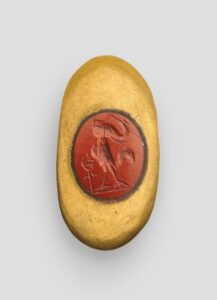
Roman gold ring set with an engraved jasper, Egypt, 2nd century. The Metropolitan Museum of Art, 10.130.1425. Image: public domain (Open Access).
In the Middle Ages: stones classified according to the sky
In the Middle Ages, the relationship between stones and celestial bodies becomes more explicit in certain lapidaries—that is, treatises devoted to stones, their characteristics, and the properties attributed to them. These works do not correspond to modern gemology: they can combine material observations, medicine, natural philosophy, religious traditions, and astrology.
The Lapidario of Alfonso X of Castile, compiled in the 13th century, offers a remarkable example. Its first book organizes stones according to the degrees of the zodiac signs: the principle is far more detailed than a simple correspondence between twelve signs and twelve gems. Other parts of the text also classify stones according to the zodiacal “faces” or planetary conjunctions.
In the same intellectual environment, the Picatrix—the Latin name of a vast Arabic treatise known as Ghāyat al-Hakīm—describes practices of astral magic and the making of talismans, taking into account celestial configurations, images, and materials. Here again, the logic rests on a network of relationships between earthly materials, planets, stars, and moments in the sky, far more than on the modern formula “one sign = one stone.”
The zodiac in objects from the medieval Islamic world
Between the late 12th and the 14th century, the zodiac and planetary personifications frequently appear on objects produced notably in Iran, Syria, or Egypt. Astronomy and astrology were distinct fields but historically close; celestial motifs could thus become part of the decoration of prestige objects or items for personal use.
An Iranian bowl from the late 12th or early 13th century, now kept at the Metropolitan Museum of Art, offers a spectacular illustration. The Sun occupies the center of the composition, surrounded by personifications of Mars, Mercury, Venus, the Moon, Saturn, and Jupiter. The museum indicates that the circles placed around these figures may refer to the outer sphere of constellations and zodiac signs.
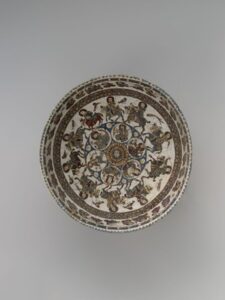
Bowl with astrological motifs and courtly scenes, Iran, late 12th–early 13th century. The Metropolitan Museum of Art, 57.36.4. Image: public domain (Open Access).
The planets could be recognized by visual attributes borrowed from astrological texts: Mercury sometimes appears as a scribe, Venus as a musician, Mars as a warrior, Jupiter as a sage or a judge. The image thus made visible correspondences that, in texts, linked celestial bodies to colors, activities, days, or materials.
Another 13th-century Iranian bowl, produced in Kashan, bears the twelve zodiac signs in its outer decorative band. On some objects in this tradition, the “planetary lord” of a sign is even depicted directly with it: Saturn can, for example, appear with Capricorn. The notion of planetary rulership then becomes almost literal in the image.
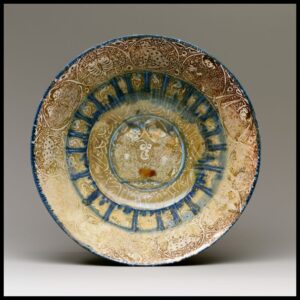
Kashan bowl, Iran, 13th century, with the twelve zodiac signs in the outer band. The Metropolitan Museum of Art, 27.13.9. Image: public domain (Open Access).
In the Renaissance: Agrippa’s correspondences
In the 16th century, Heinrich Cornelius Agrippa gathers and systematizes much of this thinking about correspondences in his De occulta philosophia. He does not create the modern system of “stones by sign”: in his work, a stone can receive the influence of several planets and fixed stars at once.
In the chapter devoted to signs and fixed stars, Agrippa places the emerald, for example, under the influence of Jupiter, Venus, and Mercury, as well as the star Spica. Amethyst is linked to Mars, Jupiter, and the “heart of Scorpio”; chrysolite to the Sun, Venus, and Mercury; diamond to Mars and the head of Algol. His system therefore looks more like a map of overlapping influences than a chart with twelve boxes.
The appearance of materials can also play into this logic. Agrippa links certain things to the Sun through their brilliance or color, while red, fiery tones can evoke Mars. These visual analogies add to traditions inherited from ancient texts: color, symbol, planet, star, and stone can thus overlap.
From planet to sign: how the link was simplified
The simplest bridge comes from planetary rulerships. If Mars traditionally rules Aries and Scorpio, a stone considered “Martian” can be linked to those two signs. In the same way, a stone associated with Venus can be linked to Taurus and Libra, and a stone attributed to Jupiter to Sagittarius and Pisces.
But this mechanism is only one possible route. The Lapidario links stones directly to degrees of the zodiac; Agrippa combines planets and fixed stars; other traditions use colors, constellations, or talismans. As these systems are taken up and popularized, their complex networks tend to be reduced to correspondences that are easier to remember.
When did the “one sign = one stone” model appear?
It is difficult to attribute this simplification to a single date or author. However, in the early 20th century, the familiar model is clearly attested in works devoted to gems, talismans, and folk traditions.
In 1913, American gemologist George Frederick Kunz publishes in The Curious Lore of Precious Stones a section titled “Zodiacal Gems.” He directly presents one gem for each of the twelve signs: garnet for Aquarius, amethyst for Pisces, heliotrope (bloodstone) for Aries, sapphire for Taurus, agate for Gemini, emerald for Cancer, and so on. Kunz does not claim to have created these correspondences; he compiles earlier traditions and sources.
A book by William Thomas and Kate Pavitt, The Book of Talismans, Amulets and Zodiacal Gems, first published in 1914, also adopts a presentation very close to what we see today: each sign is accompanied by a gem and a metal. Some associations match Kunz’s, others do not.
Two early 20th-century lists, for historical reference:
The table is revealing: eight associations are identical in both books, while four differ. The “one sign = one stone” format is therefore already well established, but it is not standardized. Kunz also reproduces, just after his own list, an old Spanish list that he cautiously links to an Arabic tradition and that gives yet other correspondences.
Why do modern lists still contradict each other?
Because no zodiacal list has benefited from standardization comparable to that of birthstones in jewelry. Some charts reuse early 20th-century correspondences; others prioritize the ruling planet, the sign’s color, birthstones, or much more recent attributions.
The integration of Uranus, Neptune, and Pluto into certain schools of modern astrology has added an extra layer, especially for Aquarius, Pisces, and Scorpio. Depending on the tradition used, the same sign can therefore be assigned different stones, without it being possible to designate one as historically “official.”
Astrological stones should therefore not be confused with birthstones. The two traditions sometimes overlap in contemporary lists, but their history is different: birthstones have gradually been the subject of standardized lists in the jewelry world, while zodiac correspondences have remained multiple.
Correspondences shaped over the centuries
The association of stones with astrological signs is part of a long history of correspondences between the sky, natural materials, and human life.
The planetary rulerships of Antiquity, the engraved gems of the Roman world, the lapidaries and astral magic of the Middle Ages, the correspondence systems of the Renaissance, and then the simplified lists of the early 20th century gradually provided the elements from which the associations we know today were built.
It is precisely this layered history that explains why a stone can be linked to several signs—and why the same sign can, depending on the sources, have several stones.
Sources and main references
- Claudius Ptolemy, Tetrabiblos, Book I – planetary domiciles
- British Museum, amethyst 1907,0717.1 – Serapis, seven celestial bodies and zodiac
- British Museum, gem EA56391 / 1872,0604.1408 – Helios and zodiac
- Alfonso X of Castile, Lapidario – Biblioteca Virtual Miguel de Cervantes
- Picatrix: Latin edition by David Pingree – Warburg Institute
- Heinrich Cornelius Agrippa, Three Books of Occult Philosophy, Book I, ch. 32
- The Metropolitan Museum of Art, Astronomy and Astrology in the Medieval Islamic World
- The Metropolitan Museum of Art, Bowl with Courtly and Astrological Motifs, 57.36.4
- The Metropolitan Museum of Art, Bowl, Kashan, 27.13.9
- The Metropolitan Museum of Art, Roman ring with engraved jasper, 10.130.1425
- George Frederick Kunz, The Curious Lore of Precious Stones, 1913 – Project Gutenberg
- William Thomas & Kate Pavitt, The Book of Talismans, Amulets and Zodiacal Gems, first edition 1914 – Internet Archive
Editorial note on the images: the three Metropolitan Museum images included in this document are indicated by the museum as being in the public domain and available in Open Access for commercial or non-commercial use.