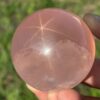


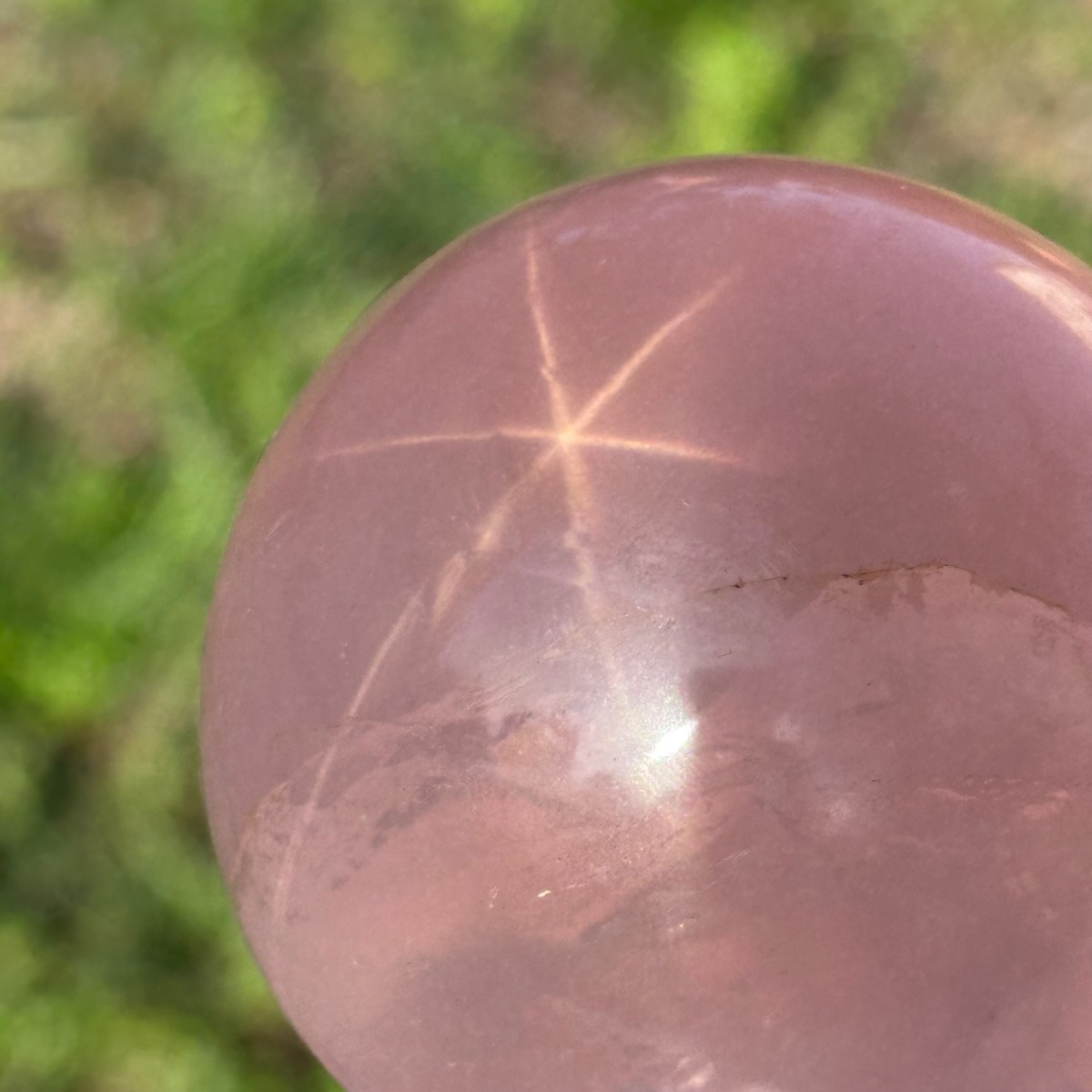
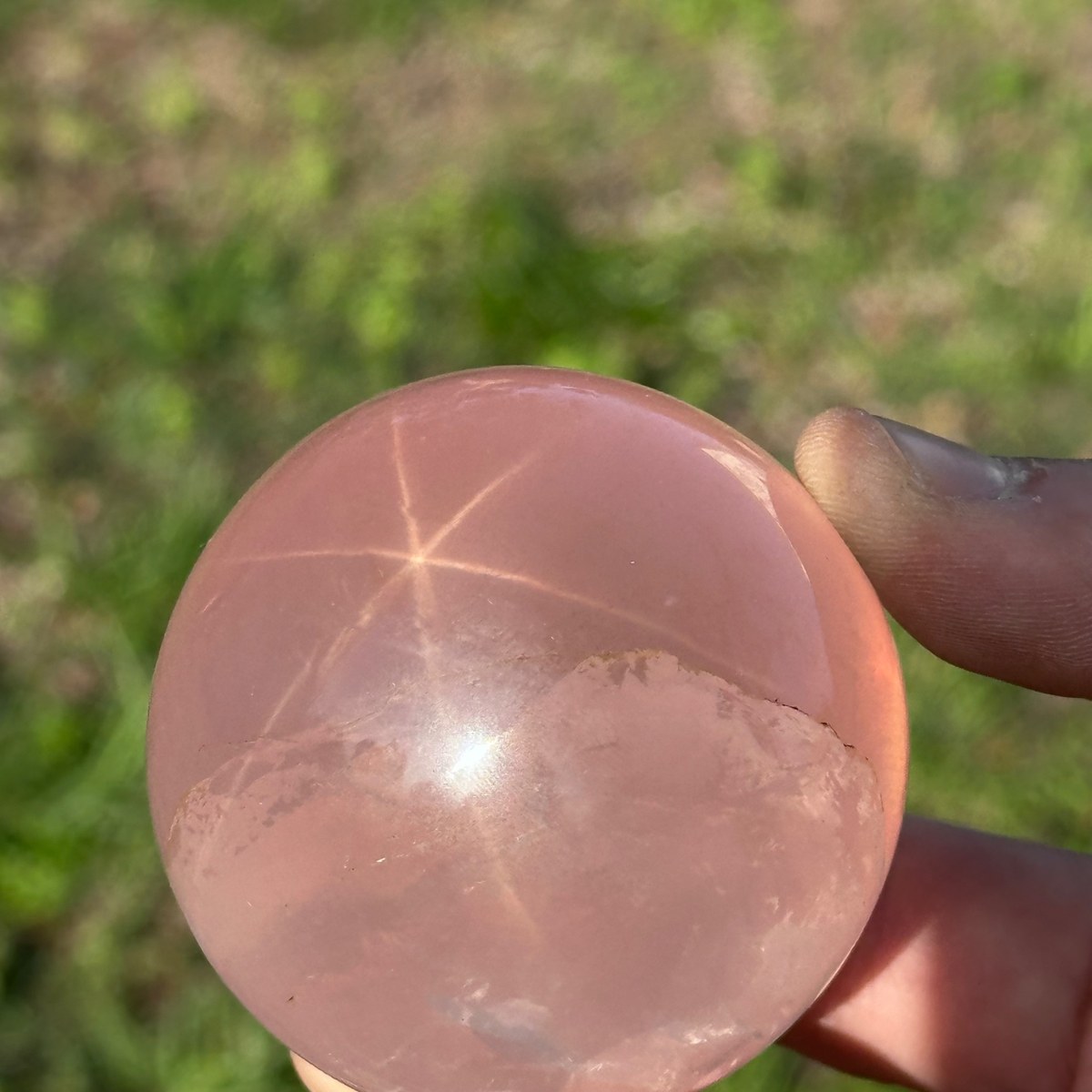
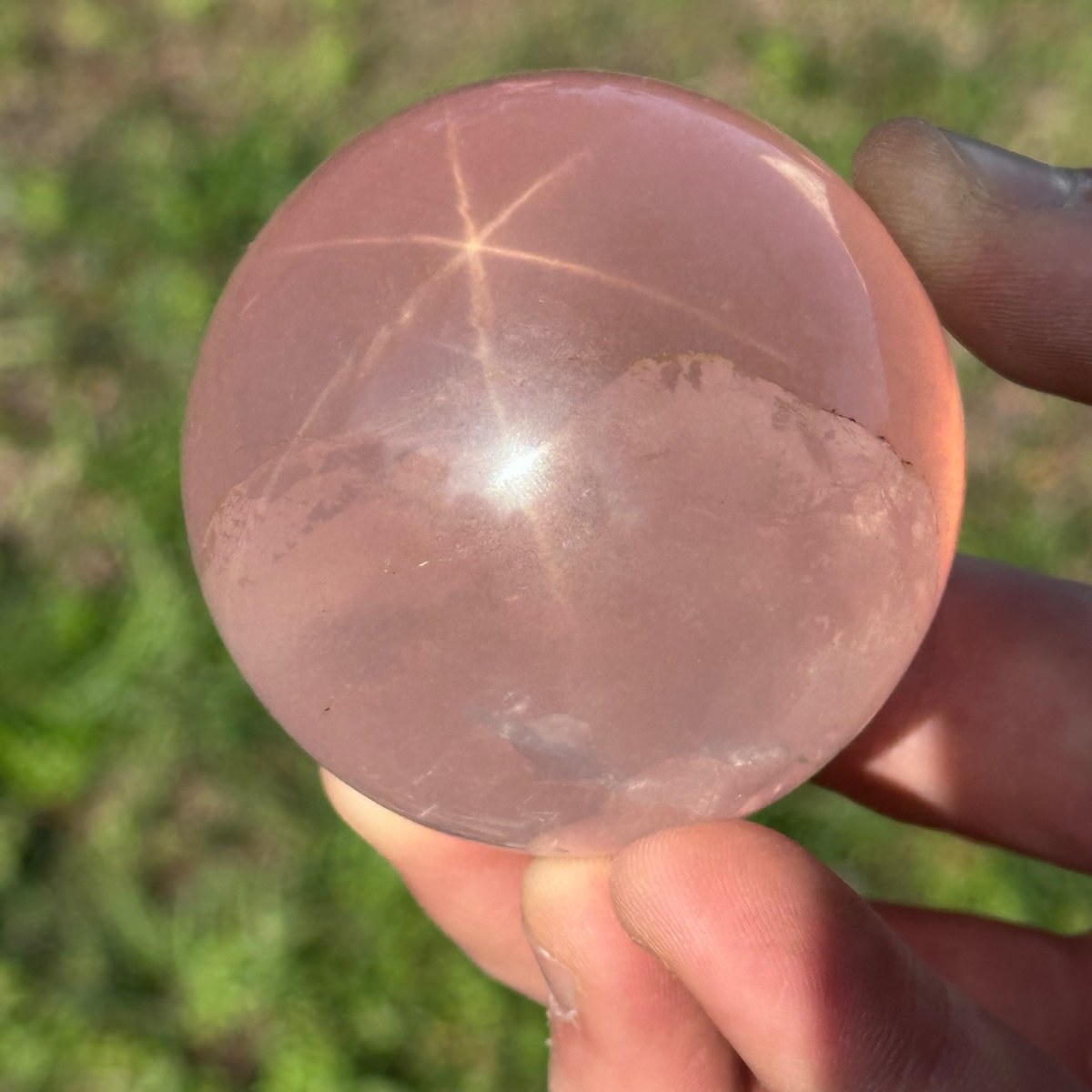
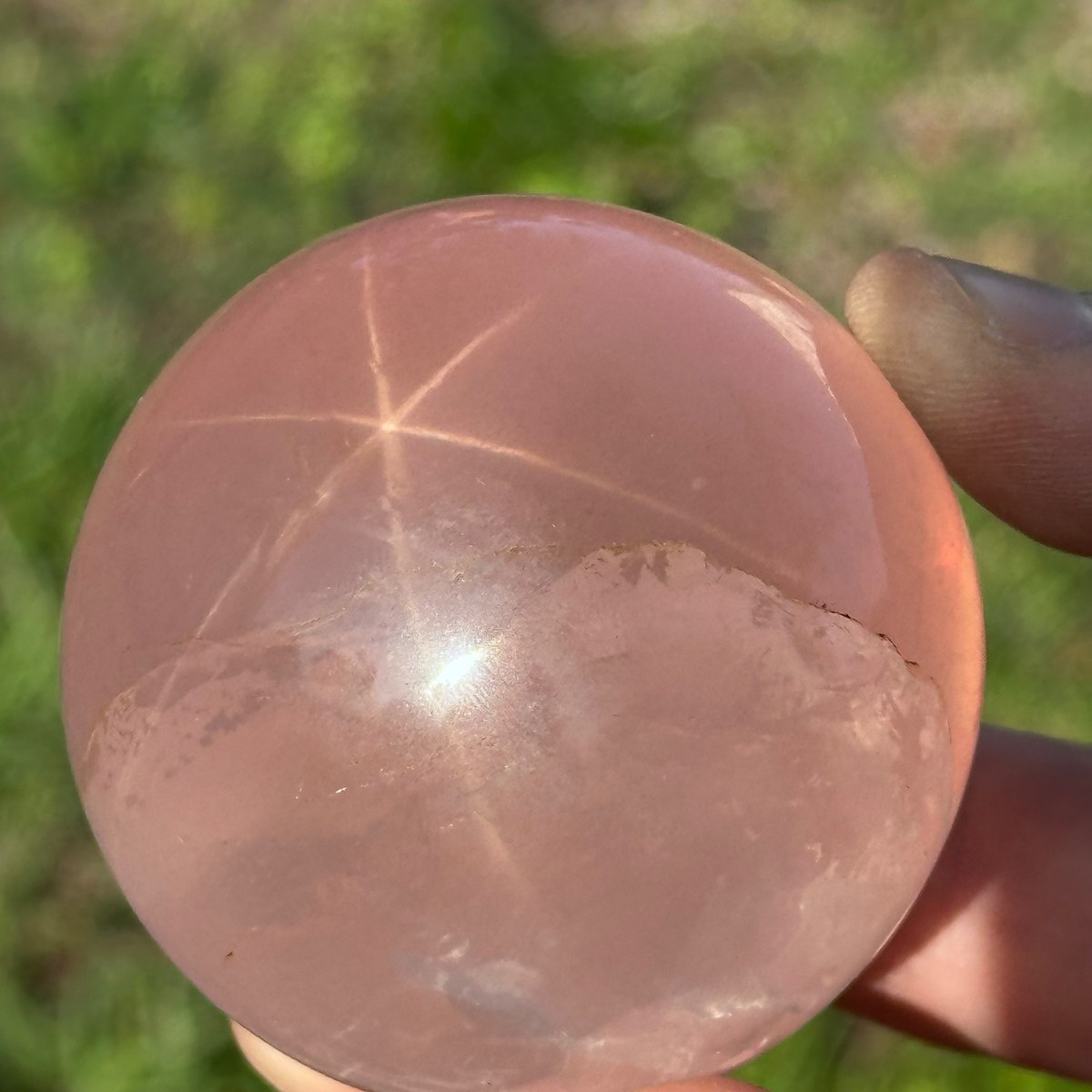
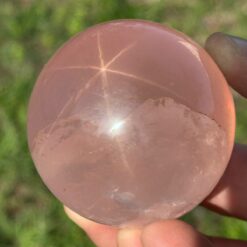
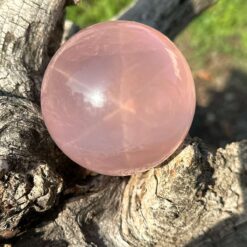
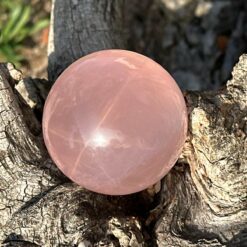
Star Rose Quartz Sphere 10cm
204,00 € incl. VAT
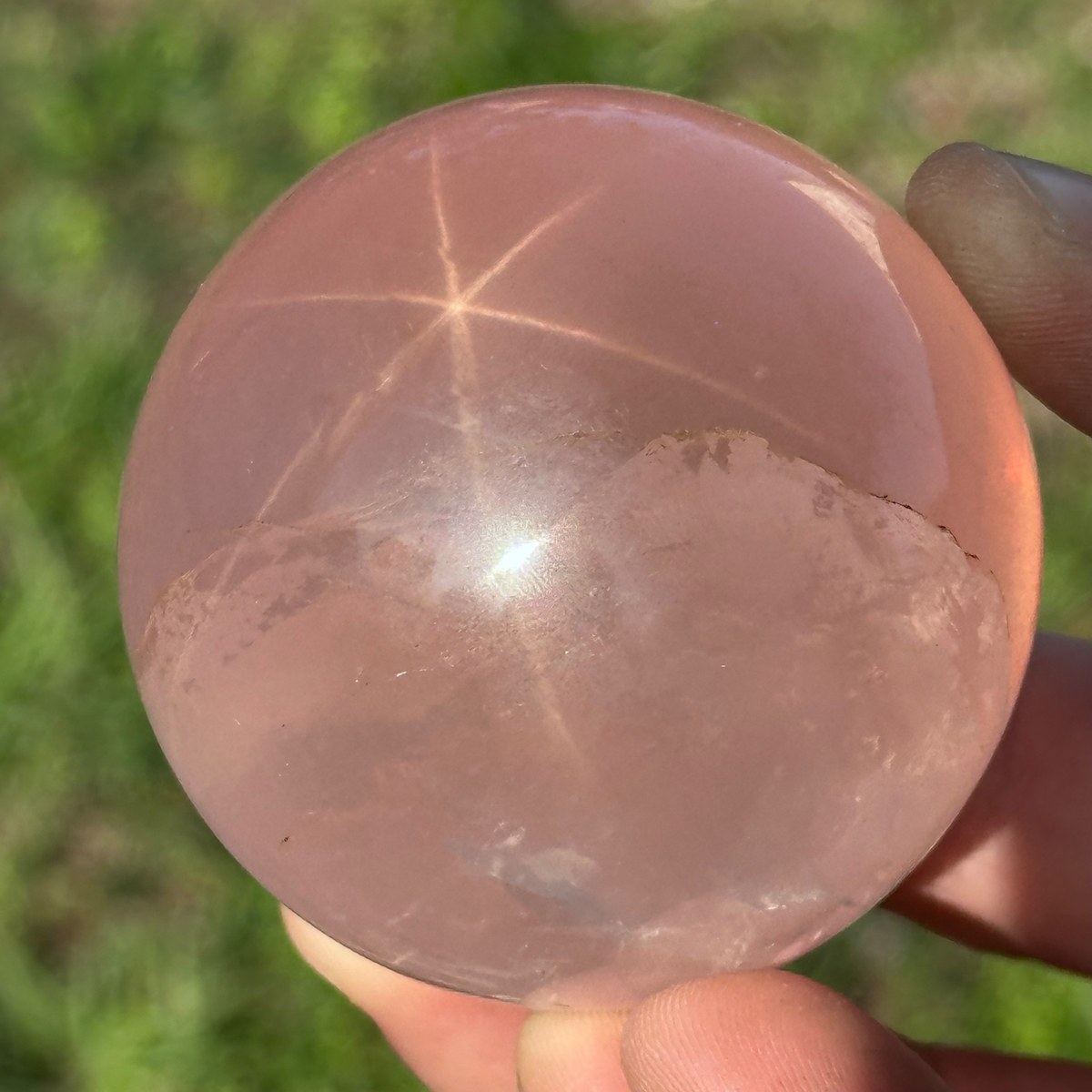
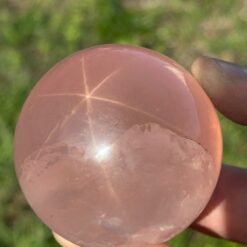
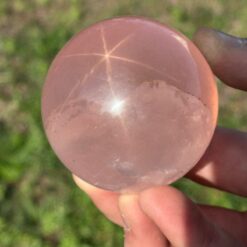
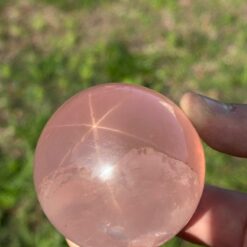
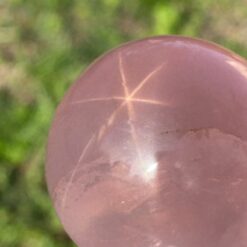
This 10 cm diameter Madagascar rose quartz sphere exhibits a natural asterism phenomenon. This optical peculiarity manifests as a luminous star-shaped figure, produced by fine, oriented mineral inclusions within the quartz. The asterism is particularly visible in direct sunlight; gently rotate the sphere to observe the appearance and movement of the luminous branches.
In stock
Stone(s): Rose Quartz with Asterism (Star)
Color: Pink
Dimensions: 10cm diameter
Approximate weight: 950g to 1kg
Number of stones: sold individually
Shape: Sphere
Non-contractual photos.
Classification: quartz group
Mohs hardness: 7
Density: 2.65
Origin: Madagascar
Care instructions: Avoid exposing rose quartz to high temperatures or prolonged direct sunlight, as the stone may discolor. Avoid repeated exposure to soap/shower gel, cosmetic products (perfume, etc.) or household products.
10 cm asteriated rose quartz sphere, close-up
Rose quartz is a pink variety of quartz, a silicon dioxide (SiO2). Its pale, often milky color is attributed to traces of chemical elements or fine inclusions. Its hardness is 7 on the Mohs scale.
Sphere: 10cm diameter, weight 950g to 1kg.
To compare with other models, check the Spheres category.
ORIGINS AND MINERALOGY
Rose quartz: origin, formation, and mineralogical properties
➤ Origin & formation of rose quartz
Rose quartz is a variety of quartz belonging to the silicate family. It is distinguished by its pale pink to deep pink color, sometimes slightly purplish, as well as its generally translucent appearance.
This natural stone is mainly composed of silicon dioxide (SiO₂), like rock crystal, amethyst, citrine, or smoky quartz.
Rose quartz usually occurs in massive form, without crystals with well-developed geometric faces. Its color, transparency, and the possible presence of inclusions depend on the geological conditions in which it formed.
Certain varieties also exhibit a particular optical phenomenon called asterism, which is particularly sought after in spheres and polished stones.
How is rose quartz formed?
Rose quartz forms mainly in granitic pegmatites, igneous rocks characterized by the presence of sometimes very large crystals.
Pegmatites generally result from the final stages of crystallization of a granitic magma. Residual liquids, rich in silica, water, and various chemical elements, allow for the development of many minerals.
Under these conditions, quartz can crystallize in large masses, sometimes associated with feldspars, micas, tourmalines, or beryls.
Rose quartz is notably found in certain internal zones of these pegmatitic formations.
It can also appear in hydrothermal veins, when hot fluids rich in silica circulate through rock fractures and gradually deposit minerals there.
Its formation therefore depends on several factors:
- The availability of silica.
- The chemical composition of the crystallization environment.
- Temperature and pressure conditions.
- The presence of chemical elements and mineral inclusions.
- The evolution and cooling of the material after its formation.
These different parameters contribute to the variations in color, transparency, and texture observed in natural rose quartz.
Why is rose quartz pink?
The color of rose quartz has long been the subject of various mineralogical interpretations.
It has notably been attributed to the presence of certain chemical elements, such as titanium, iron, or manganese.
Scientific research dedicated to massive rose quartz has shown, however, that its coloration comes mainly from tiny fibrous inclusions consisting of a silicate close to dumortierite.
These fibers, ranging from microscopic to nanometric in size, are distributed inside the quartz.
Analyses have highlighted a charge transfer mechanism involving iron and titanium within these inclusions, which is the source of their coloration.
Their distribution and concentration contribute to the diversity of shades observed.
Rose quartz can thus present:
- A very pale pink, almost white.
- A soft, relatively uniform pink.
- A deeper pink.
- Slightly purplish shades.
- A milky or cloudy appearance.
- More transparent zones alternating with cloudier parts.
The presence of these inclusions also explains why many rose quartzes exhibit a milky translucency, rather than perfectly clear transparency.
Rose quartz asterism: a natural optical phenomenon
Asterism is an optical phenomenon that causes a star-shaped light figure to appear on the surface or within the apparent interior of certain polished stones.
In rose quartz, it is linked to the presence of very fine mineral inclusions oriented along specific crystallographic directions.
When light hits these inclusions, their organization can produce a star figure, generally composed of six light rays.
Some stones show more complex figures, which can have twelve rays.
Asterism does not appear in all rose quartz. It requires a specific arrangement of inclusions and a suitable orientation of the polished surface.
Under what conditions is asterism visible?
The phenomenon is particularly visible under a direct and sufficiently point-like light source, notably in direct sunlight.
It can also be observed with a concentrated artificial light source.
Conversely, under diffuse light or an overcast sky, the star figure can become much less perceptible, or even visually disappear.
The position of the stone, that of the observer, and the angle of incidence of the light influence the appearance of the star.
In some spheres, light partially passing through the stone can also help make the light figure visible. This phenomenon is called diasterism, as opposed to asterism observed mainly in reflected light.
Why are spheres particularly suited for observing asterism?
Spherical polishing allows the material to be observed from different angles by rotating the stone in front of the light.
When the inclusions have a favorable orientation, the star figure can appear and visually move across the surface of the sphere.
The quality of the asterism depends notably on:
- The orientation of the mineral inclusions.
- Their concentration and regularity.
- The transparency of the quartz.
- The orientation of the cut.
- The quality of the polishing.
- The lighting conditions.
Star rose quartzes from Madagascar are particularly appreciated for this optical phenomenon, which constitutes a mineralogical and gemological characteristic of the material.
Mineralogical characteristics of rose quartz
- Nature: natural mineral, variety of quartz.
- Mineralogical family: silicates.
- Sub-group: tectosilicates.
- Chemical composition: silicon dioxide.
- Chemical formula: SiO₂.
- Crystal system: trigonal.
- Structure: generally massive, consisting of interlocking quartz crystals.
- Hardness: 7 on the Mohs scale.
- Density: approximately 2.65 to 2.66 g/cm³.
- Refractive index: approximately 1.544 to 1.553.
- Luster: vitreous, sometimes slightly greasy in appearance.
- Transparency: mainly translucent, sometimes almost opaque or exceptionally transparent.
- Colors: pale pink, deep pink, whitish pink, and sometimes purplish pink.
- Streak: white.
- Cleavage: no distinct cleavage.
- Fracture: conchoidal to irregular.
- Characteristic inclusions: fine mineral fibers, notably related to dumortierite.
- Possible optical phenomenon: asterism, generally with six rays.
- Deposits: mainly associated with granitic pegmatites and, more rarely, with certain hydrothermal veins.
These characteristics correspond to the general properties of rose quartz. Variations in color, transparency, and inclusions depend on each deposit and each sample.
Main deposits of rose quartz
Rose quartz is present in many regions of the world, mainly in geological formations rich in silica.
Certain countries hold an important place in its production and in the trade of ornamental stones.
Madagascar
Madagascar is one of the best-known sources for rose quartz, especially for materials intended for cutting spheres, pebbles, and decorative objects.
Several occurrences are documented in the island’s pegmatitic formations, notably:
- In the Antsirabe and Betafo region, within the Vakinankaratra region.
- In the pegmatitic formations of the Ihosy sector, in southern Madagascar.
- In the Vorondolo pegmatitic field, where specimens of star rose quartz are documented.
Malagasy rose quartzes can present variable shades, ranging from very pale pink to deeper hues.
Some materials are distinguished by their translucency and by the presence of inclusions responsible for asterism.
Brazil
Brazil is a major source of rose quartz, particularly in the state of Minas Gerais, known for its many quartz deposits and pegmatitic formations.
Brazilian materials are used in jewelry as well as for sculpture and decorative objects.
Some deposits provide rose quartzes with a relatively homogeneous color and good transparency.
Namibia
Namibia has several occurrences of rose quartz associated with pegmatitic contexts.
The stones can present more or less pronounced pink shades and massive or translucent aspects.
South Africa
South Africa is also among the producing countries of rose quartz for the ornamental stone market.
India and Sri Lanka
These two countries are recognized sources of rose quartz.
Sri Lanka is notably known for certain quartzes presenting optical phenomena, including asterism.
Mozambique
Mozambique also has occurrences of rose quartz, notably in pegmatitic formations.
United States
In the United States, historical deposits are known in the Black Hills, South Dakota, particularly in the Custer sector.
These pegmatitic formations have provided rose quartz used as an ornamental stone.
The diversity of these sources explains the many shades and textures encountered in the trade.
However, identifying a country of origin alone does not determine the precise deposit of a stone. A local source must be supported by traceability information.
Rose quartz, star rose quartz, and crystallized rose quartz: what are the differences?
These names refer to materials that are chemically similar but present different characteristics.
Massive rose quartz
This is the most common variety in the trade.
The material generally presents a massive structure, a pink color linked to fine inclusions, and variable transparency.
It is particularly used for making pebbles, spheres, jewelry, and sculpted objects.
Star rose quartz
Star rose quartz is a rose quartz containing oriented inclusions capable of producing an asterism phenomenon.
This peculiarity becomes visible when the stone is properly polished and observed under appropriate lighting.
Asterism is a natural optical phenomenon and corresponds neither to fluorescence nor to a color change of the quartz.
Crystallized rose quartz or pink quartz
In rare occurrences, pink-colored quartz appears in the form of crystals with well-developed faces.
This material is sometimes referred to by the English name pink quartz to distinguish it from massive rose quartz.
Its coloration may be linked to color centers associated with elements present in the crystal structure and natural irradiation phenomena.
This mechanism differs from that observed in massive rose quartz.
The color of some crystallized rose quartzes can also be more sensitive to light and heat.
This distinction explains why not all varieties of quartz with a pink hue possess exactly the same optical and physical characteristics.
➤ Discovery & history through the ages
🌍 Prehistory and early civilizations: the first uses of rose quartz
The use of rose quartz dates back several millennia.
According to historical information presented by the Gemological Institute of America (GIA), rose quartz beads dated to around 7000 BCE were found in the region of ancient Mesopotamia, corresponding mainly to present-day Iraq.
Natural stones were already used to make finery, ornaments, and various decorative elements.
Rose quartz owed its interest notably to its color and its ability to be worked and polished.
These early uses testify to the antiquity of cutting and shaping practices for siliceous materials.
🏺 Antiquity: rose quartz in ancient civilizations
In Antiquity, quartz and its various varieties held an important place in the manufacture of jewelry, amulets, and engraved objects.
In Mesopotamia, the working of hard stones developed with the production of beads and seals intended for the identification of people and goods.
The GIA notably mentions the creation of rose quartz jewelry by the Assyrians between approximately 800 and 600 BCE.
In ancient Egypt, different varieties of quartz were used to create ornaments and symbolic objects.
Ancient beliefs attributed protective qualities or properties related to youth and vitality to certain stones.
In the Greco-Roman world, engraved stones and gems also played a role in finery and in the creation of seals.
Rose quartz was notably associated with decorative and symbolic uses.
These ancient traditions must, however, be distinguished from the interpretations proposed by contemporary lithotherapy.
📜 Middle Ages: natural stones and symbolic traditions
In the Middle Ages, minerals continued to be used in jewelry, religious objects, and symbolic practices.
Certain traditions attributed particular influences on the body or mind to stones.
Quartz was among the materials mentioned in various ancient practices, notably medicinal ones.
These uses belong to the history of beliefs and practices of the time. They do not constitute a scientific demonstration of therapeutic properties.
The precise identification of quartz varieties in ancient sources sometimes remains difficult, as modern mineralogical classifications were not yet established.
🔬 18th and 19th centuries: the development of modern mineralogy
With the development of crystallography and mineralogy, the different varieties of quartz were gradually described according to their physical, chemical, and crystallographic properties.
The study of crystal systems, hardness, density, and optical properties allowed for a better understanding of the differences between materials.
In the 19th century, the development of the Friedrich Mohs hardness scale, published in 1812, notably contributed to the practical classification of minerals.
Quartz became one of the reference minerals on this scale, with a hardness of 7.
Progress in geology simultaneously allowed for a better understanding of the formation of granitic pegmatites, the main geological environments for rose quartz.
💎 20th century: development of mining and lapidary techniques
During the 20th century, the exploitation of many rose quartz deposits accompanied the development of the international trade in ornamental stones.
Brazil and Madagascar held an important place in the supply of materials intended for cutting.
The refinement of sawing, polishing, and shaping techniques allowed for the creation of a great diversity of objects:
- Polished spheres and pebbles.
- Cabochons.
- Beads and jewelry.
- Sculptures.
- Decorative objects.
Star rose quartz also attracted the attention of gemologists due to its particular optical properties.
Improvements in microscopic observation methods gradually contributed to a better understanding of the inclusions present in the material.
🔬 Late 20th and early 21st centuries: identification of the origin of the pink color
The scientific understanding of rose quartz coloration underwent a major evolution thanks to progress in analytical techniques.
Research conducted notably from the 1980s, then deepened in the early 2000s, allowed for the identification of extremely fine mineral fibers present in massive rose quartz.
The work of researchers, including Goreva and her collaborators, contributed to showing that these inclusions related to dumortierite play a decisive role in its coloration.
These studies also allowed for a better explanation of the relationships between:
- The internal structure of the quartz.
- The nature of the inclusions.
- The pink coloration.
- The translucency of the material.
- The possible appearance of asterism.
They led to a clearer distinction between massive rose quartz and the rare rose quartzes presenting well-formed crystals.
🔬 21st century: new knowledge on asterism
Contemporary gemological research continues to deepen the understanding of optical phenomena observed in minerals.
In 2025, a scientific synthesis published in the GIA journal Gems & Gemology notably reviews the microscopic and nanometric structures responsible for optical phenomena in different stones.
Star rose quartzes are studied there in relation to their mineral inclusions and the mechanisms of light scattering and reflection.
This work also highlights the diversity of figures observed, notably six- or twelve-rayed stars and certain more complex phenomena visible in spheres.
Today, rose quartz is appreciated as much for its mineralogical characteristics as for its uses in jewelry, decoration, and natural stone collections.
➤ Rose quartz care: natural stones and jewelry
With a hardness of 7 on the Mohs scale, rose quartz has a relatively high resistance to scratches.
It remains, however, sensitive to major impacts, fractures, and sudden temperature changes.
Proper care allows it to maintain its polish, transparency, and surface appearance.
Care for tumbled stones, spheres, and polished minerals
To clean a tumbled stone or a rose quartz sphere, preferably use a soft, slightly damp cloth.
In case of dirt, a quick cleaning with lukewarm water and a small amount of mild soap can be performed.
Rinse thoroughly, then dry with a clean, non-abrasive cloth.
It is recommended to avoid:
- Harsh chemicals.
- Ultrasonic cleaning.
- Steam cleaning.
- Impacts against hard surfaces.
- Strong temperature variations.
Massive rose quartz is generally stable in light, but it is best to avoid prolonged exposure to excessive heat.
For spheres, use a stable stand suitable for their diameter to limit the risk of falling.
Rose quartz jewelry care
For bracelets, pendants, necklaces, and other jewelry, opt for a delicate cleaning using a soft cloth.
Occasional cleaning with lukewarm soapy water is generally possible for the rose quartz itself, but other components of the jewelry must also be taken into account.
Notably avoid prolonged immersion when jewelry includes:
- Elastic threads.
- Metal parts sensitive to moisture.
- Glued elements.
- Fragile assemblies.
Also limit contact with perfumes, cosmetics, and household products.
When you are not wearing your jewelry, store it in a soft pouch or an individual case to limit friction with other materials.
These precautions help to durably preserve the polish and appearance of the rose quartz.
➤ Well-being & energies: the symbolism of rose quartz
In contemporary traditions of lithotherapy, rose quartz is mainly associated with love, softness, tenderness, and emotional harmony.
Its pink color gives it a symbolism particularly linked to feelings, affective relationships, and the search for serenity.
According to lithotherapy beliefs and practices, rose quartz is notably appreciated for:
- Love and tenderness: it symbolizes affection, benevolence, and openness to feelings.
- Emotional balance: it is associated with the search for calm, soothing, and inner harmony.
- Self-confidence: it represents self-acceptance, self-gentleness, and self-esteem.
- Affective relationships: it symbolizes understanding, friendship, and the strengthening of romantic bonds.
- Serenity: it is traditionally associated with the reduction of emotional tension and recentering.
- Sleep: it is often used symbolically in relaxation rituals and preparation for rest.
- Harmony: it represents the balance between emotions and relationships with others.
In some practices, a tumbled stone, a sphere, or a raw block of rose quartz is placed in a bedroom or near the bed to symbolically accompany a calm and restful atmosphere.
These associations stem from lithotherapy beliefs and do not constitute scientifically established physiological effects.
Rose quartz and the heart chakra
In contemporary energy traditions, rose quartz is mainly associated with the heart chakra, also called Anahata.
This symbolic center is traditionally linked to love, compassion, affective balance, and human relationships.
Rose quartz is thus considered a stone representing:
- Openness to feelings.
- Softness and benevolence.
- Self-acceptance.
- Relational harmony.
- Emotional balance.
This association belongs to spiritual traditions and contemporary interpretations of lithotherapy. It does not correspond to a measurable physical property of the mineral.
Warning: the energetic properties mentioned are based on lithotherapy beliefs. They are not scientifically proven. Using minerals for well-being is not a medical treatment and cannot replace medical advice or follow-up.
Purification and recharging of rose quartz in lithotherapy
In lithotherapy traditions, purification and recharging correspond to symbolic rituals, distinct from physical maintenance and stone cleaning.
Purification:
Rose quartz can be symbolically purified by smudging with white sage or palo santo.
Burn a stick of sage or palo santo, then gently pass the stone near the smoke, without exposing it directly to the flame.
It is recommended to perform this operation in a well-ventilated room.
Some practices also use a quick pass through demineralized water, followed by careful drying. For jewelry and stones with fragile elements, it is preferable to choose a method without immersion.
Recharging:
In contemporary lithotherapy practices, rose quartz is generally associated with soft sunlight or moonlight.
It is common to place it in a bright spot, favoring moderate exposure and avoiding high heat.
Other symbolic practices involve placing the stone:
- In a quartz geode.
- On a quartz cluster.
- On an amethyst druse.
- On a selenite plate, with care not to scratch the latter.
These practices belong to lithotherapy traditions. They do not modify the physical, chemical, or crystallographic properties of rose quartz.
Expédition : 48 à 72 heures, hors week-ends et jours fériés, après confirmation du paiement.
Livraison offerte dès 60 € en France métropolitaine.
Droit de rétractation : 14 jours pour nous signaler votre décision.
You may also like…
Minerals


Minerals


Purification and recharging


Related products


Decor

Minerals