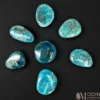


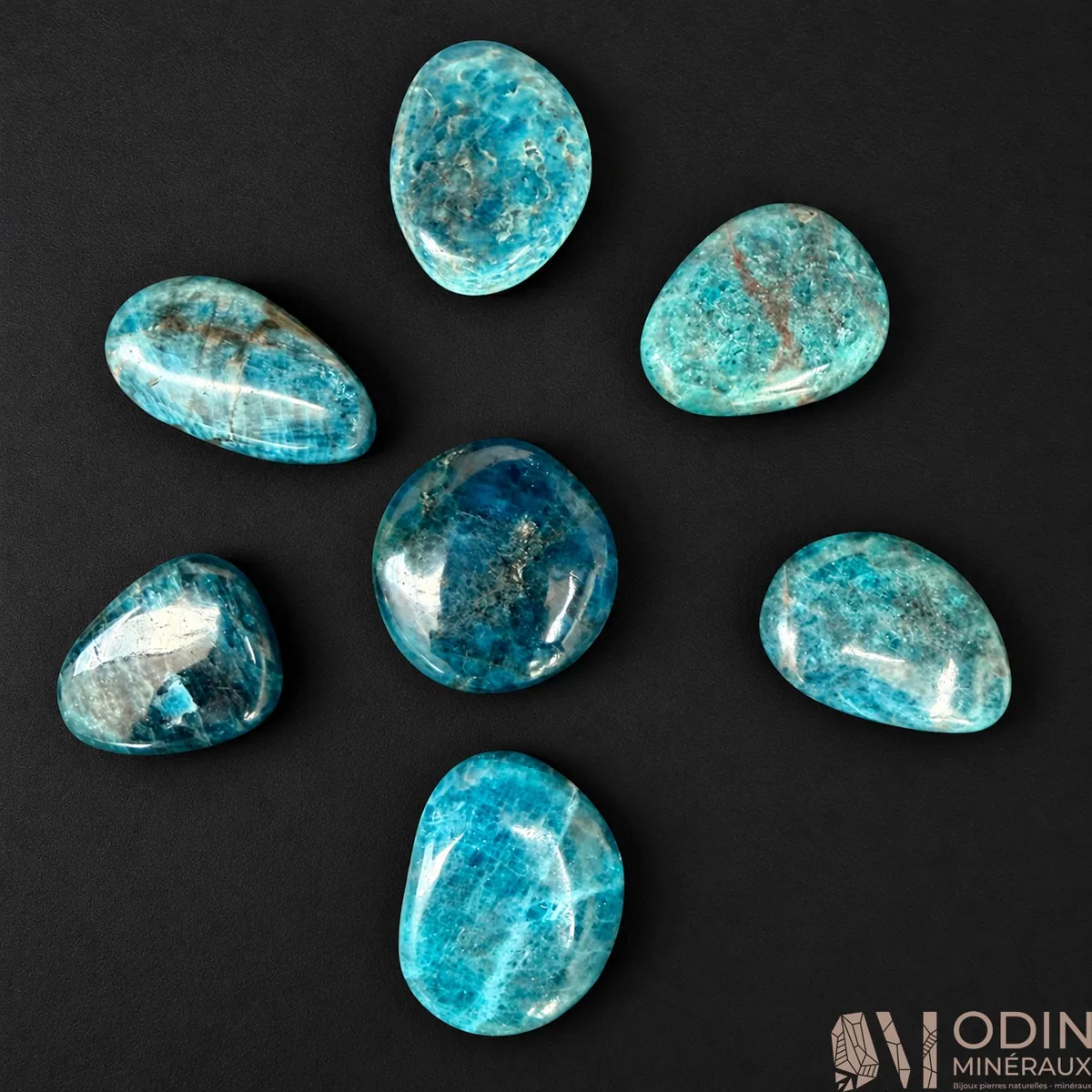
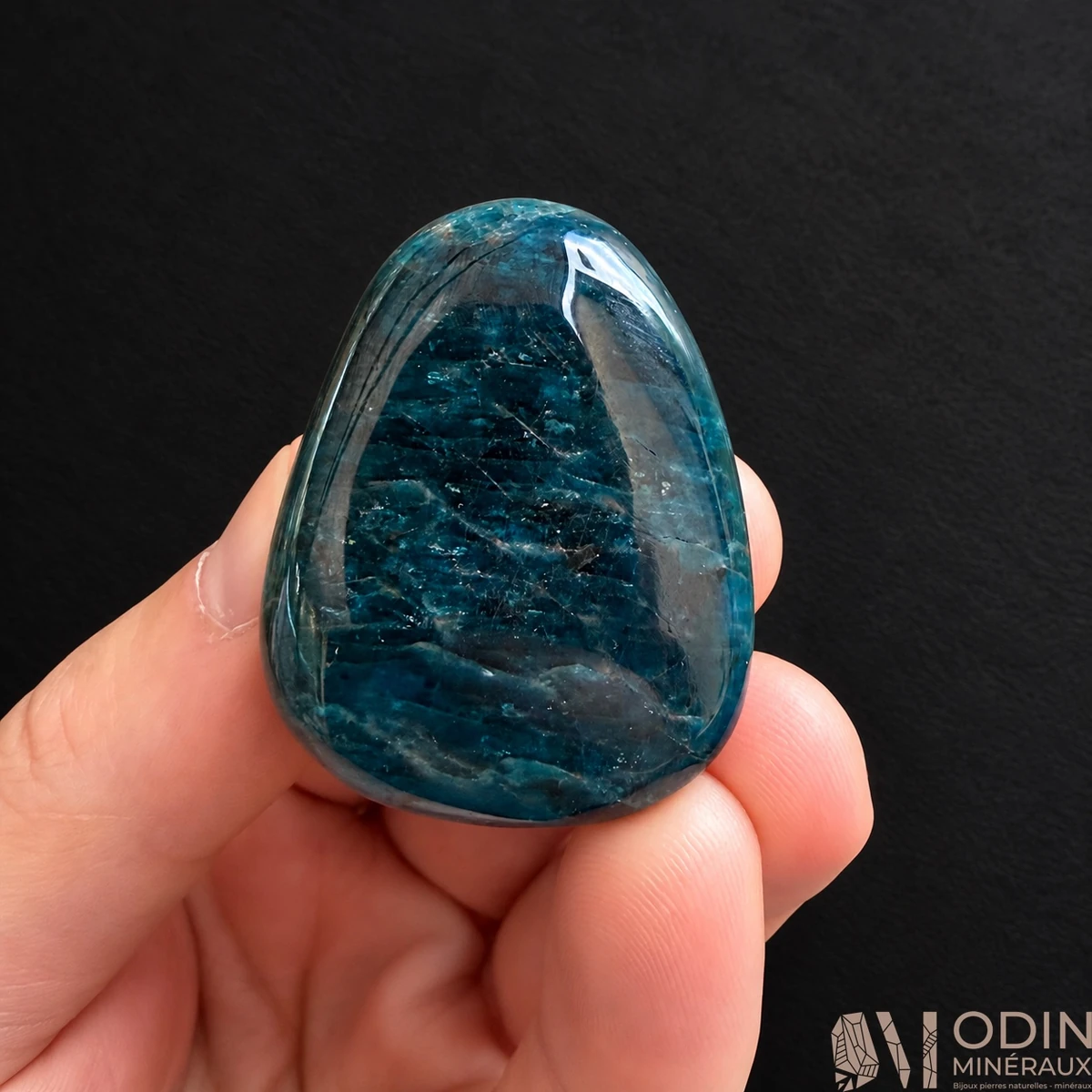
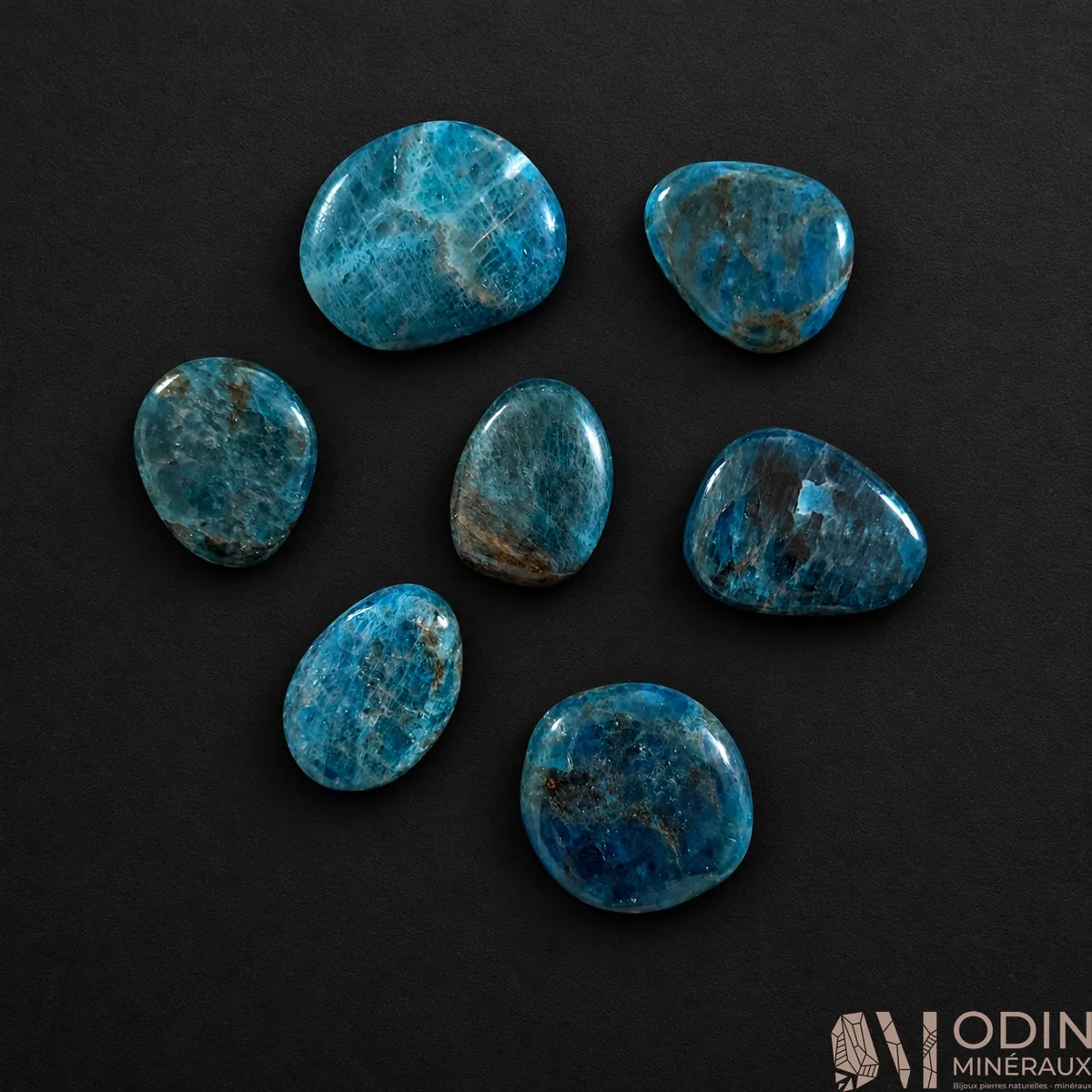
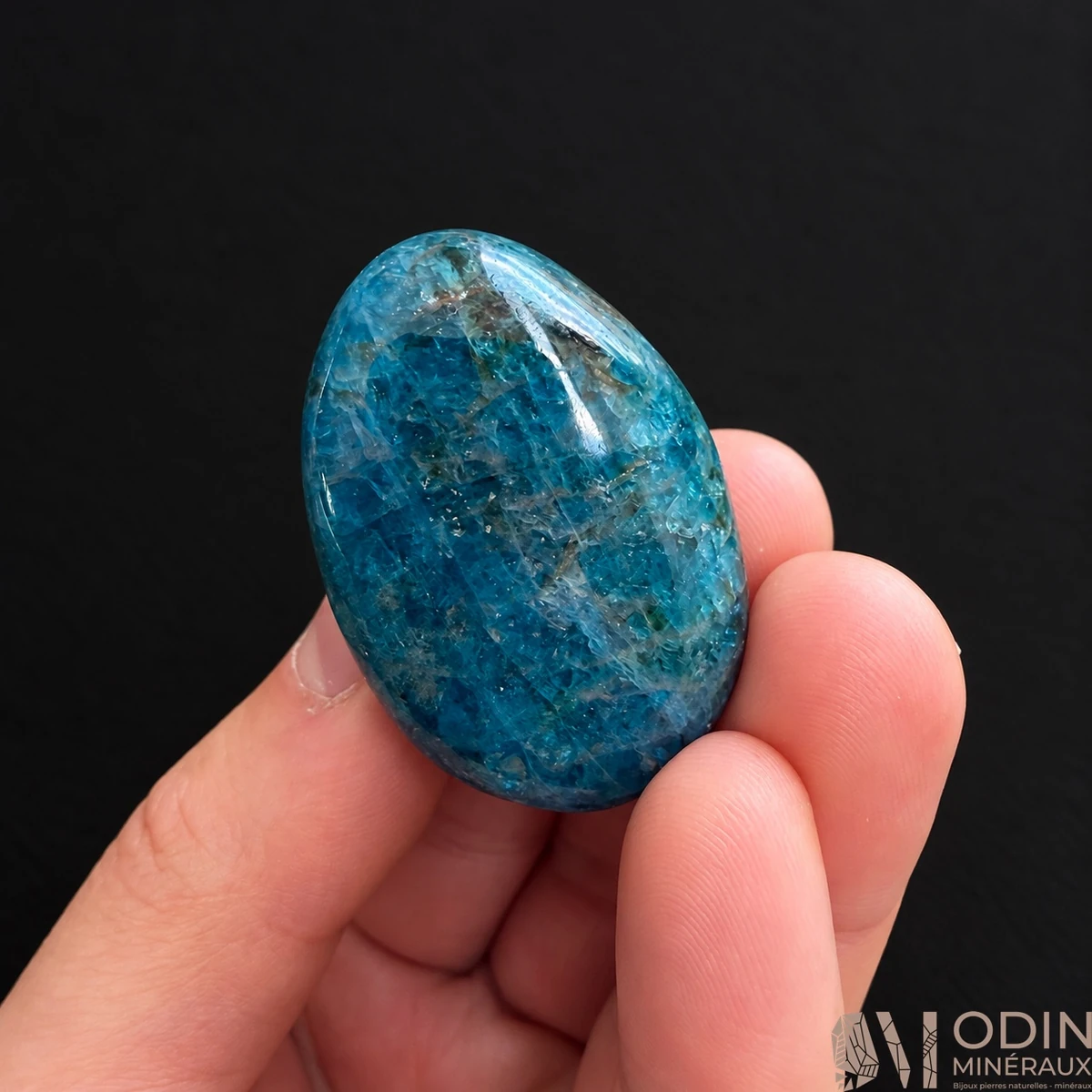
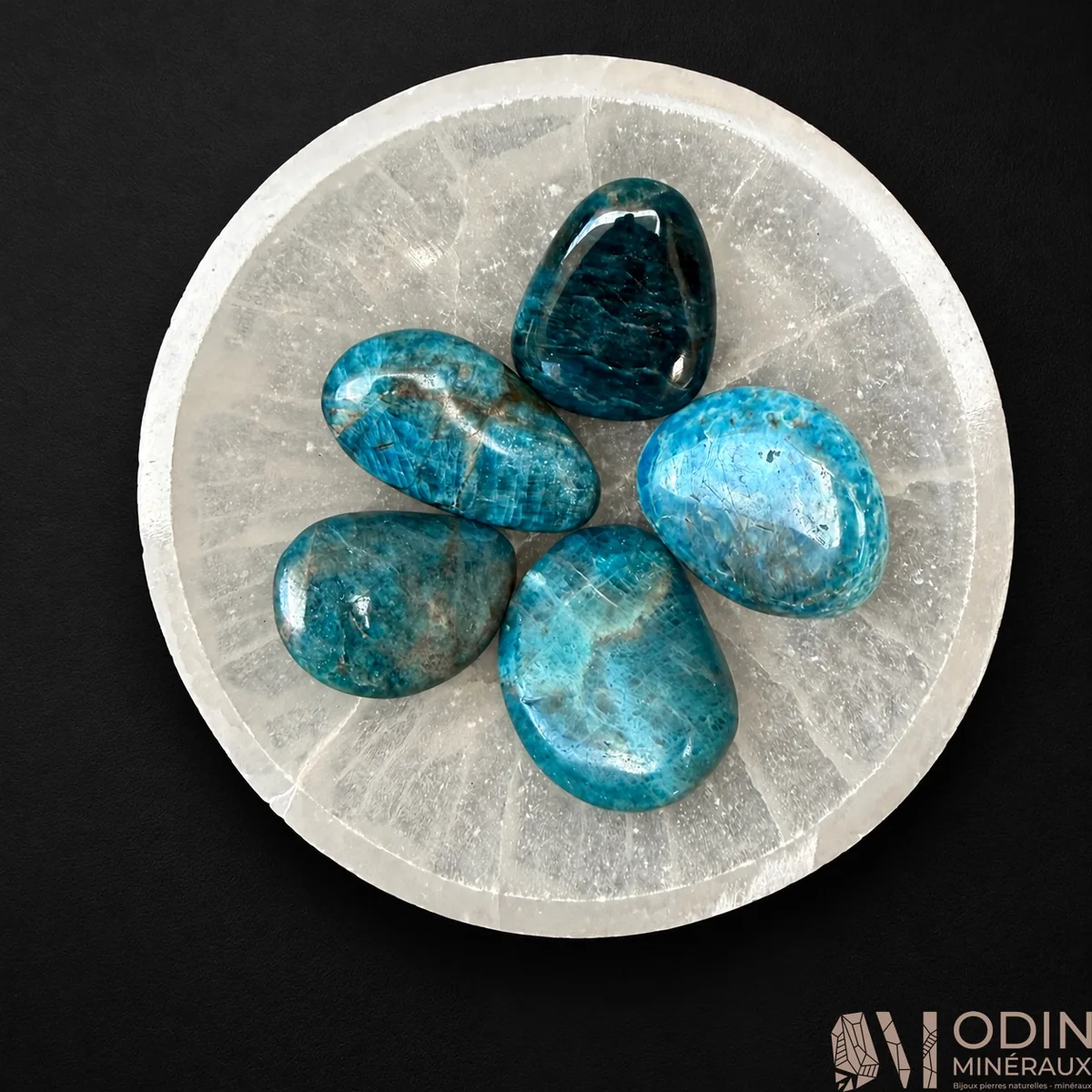
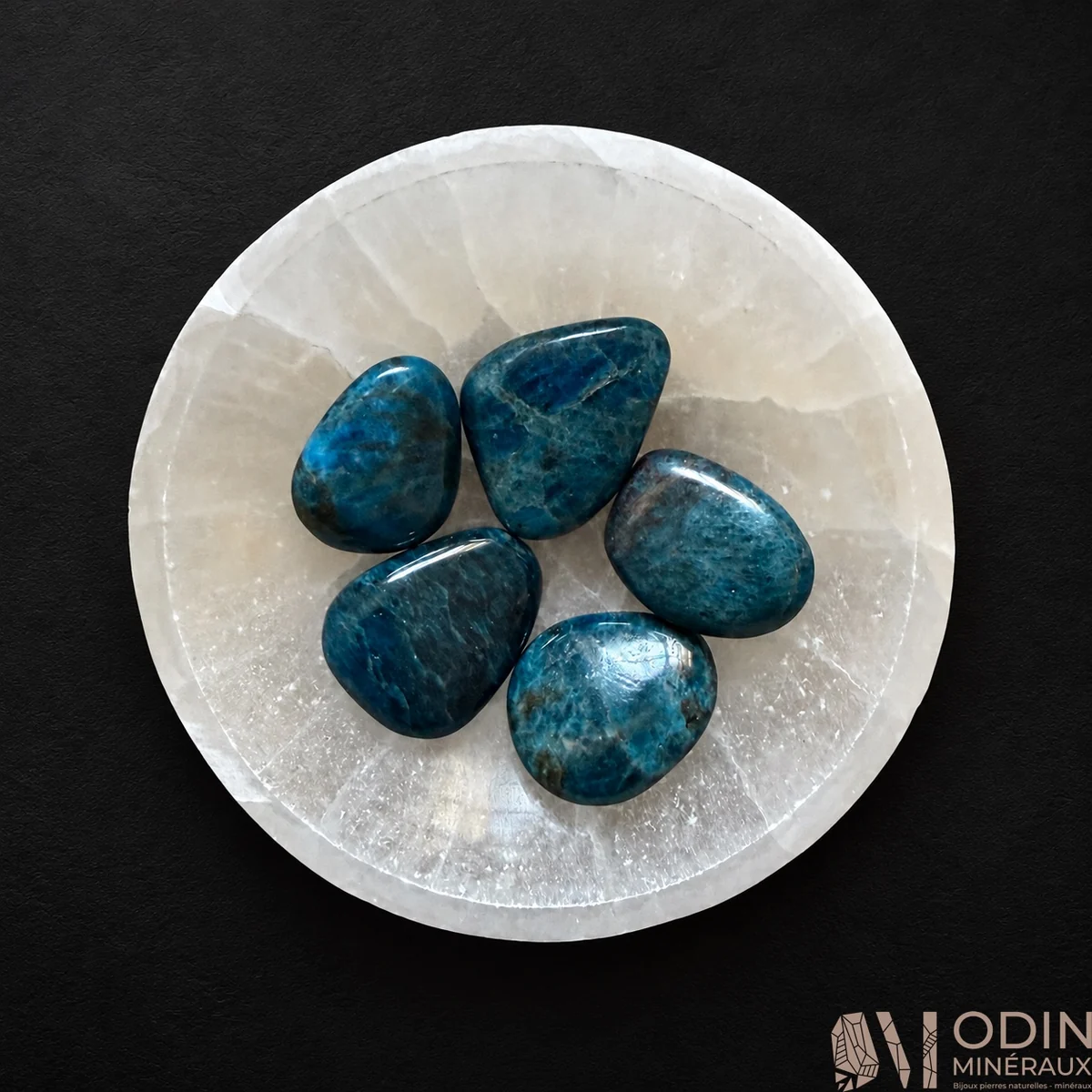
Apatite tumbled stone
9,00 € incl. VAT
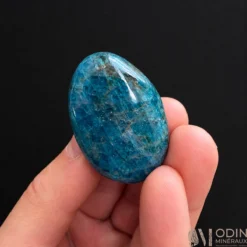
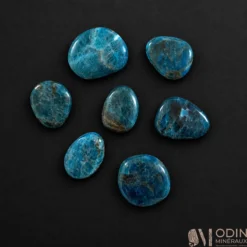
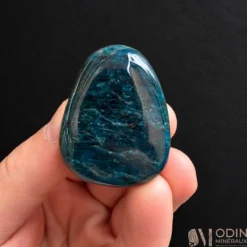
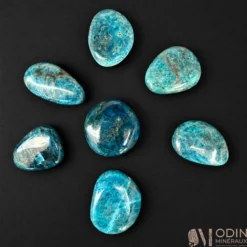
Blue apatite tumbled stone. We love the intensity of its color. Each stone is unique, its color varies slightly from one piece to another.
In stock
Stone(s): Apatite
Dimensions: 4 to 5 cm
Approximate weight: 20 to 60 g
Color: blue
Dimensions: 4 to 5 cm
Approximate weight: 20 to 60 g
Shape: tumbled stone – sold individually
Photos are not contractually binding.
Classification: phosphate group
Mohs hardness: 5
Density: 3.16
Origin: Madagascar, Brazil, Canada, South Africa, USA, France
Care instructions: apatite can be cleaned with a cloth and lukewarm water. Avoid all exposure to household products. As apatite scratches easily, store your tumbled stone in a separate pouch to avoid friction with other stones.
ORIGINS AND MINERALOGY
Blue apatite: origin, formation, and mineralogical properties
➤ Origin & formation of apatite
Apatite refers to a group of natural minerals belonging to the phosphate family. Relatively unknown to the general public, it stands out for its remarkable diversity of colors, ranging from intense blue to deep green, including violet, yellow, pink, or even brown.
Among these different colors, blue apatite is particularly appreciated for its shades ranging from light blue to turquoise blue, sometimes close to those of aquamarine or certain tourmalines.
From a mineralogical point of view, the term apatite groups together several species of calcium phosphates, the three main ones being:
- Fluorapatite: containing fluorine, it is the most common species in nature.
- Hydroxyapatite: characterized by the presence of hydroxyl groups (OH).
- Chlorapatite: containing chlorine, it is much rarer.
These minerals share a similar crystal structure, but their chemical composition varies depending on the elements present.
Apatite forms in very diverse geological environments. It is notably present in magmatic rocks, where it crystallizes during the cooling of magmas, as well as in certain metamorphic rocks.
It is also found in pegmatites, hydrothermal veins, and phosphate-rich sedimentary formations.
In magmatic rocks, apatite frequently constitutes an accessory mineral, present in small quantities alongside other minerals. However, certain geological conditions favor the formation of well-developed crystals, sometimes transparent and colorful enough to be used in gemology.
Gem-quality apatites are particularly sought after for their colors and vitreous luster.
Blue apatite: where does its color come from?
Color is one of the most remarkable characteristics of apatite.
While some apatites are colorless or show yellow and green tones, others reveal magnificent blue shades, sometimes particularly intense.
These variations depend on the chemical composition of the crystal, the presence of certain trace elements, and the particularities of its internal structure.
Blue apatite can also exhibit a phenomenon called pleochroism, which corresponds to a variation in the color observed depending on the orientation of the crystal relative to the light.
Certain gem-quality blue apatites can thus show different shades when observed from several angles.
Polishing highlights their color and luster, notably in the creation of tumbled stones, cabochons, beads, and jewelry.
It is however important to distinguish the natural color of the stone from any gemological treatments. Some commercialized apatites may undergo heat treatment intended to modify or intensify their coloration.
Color alone therefore does not allow one to determine with certainty if a stone has been treated.
Mineralogical characteristics
- Mineral family: phosphates
- Group: apatite
- Main species: fluorapatite, hydroxyapatite, and chlorapatite
- General chemical composition: Ca₅(PO₄)₃(F,Cl,OH)
- Crystal system: hexagonal for the main species
- Hardness: 5 on the Mohs scale
- Density: generally between 3.1 and 3.3
- Luster: vitreous to resinous
- Transparency: transparent to opaque depending on the specimen
- Colors: blue, green, yellow, violet, pink, brown, white, or colorless
- Cleavage: imperfect to indistinct
- Fracture: irregular to conchoidal
- Morphology: hexagonal prismatic crystals, sometimes tabular, or massive aggregates
With a hardness of 5 on the Mohs scale, apatite is less resistant to scratches than quartz or feldspars.
It therefore requires certain precautions, especially when used in jewelry.
Its aesthetic value rests mainly on the intensity and homogeneity of its color, its transparency, the quality of its polishing, and the absence of major defects.
Main apatite deposits
Apatite is present in many regions of the world. Some deposits are particularly known for their collector crystals, while others are exploited for their high phosphate concentrations.
Among the most remarkable origins are:
- Brazil: notably the state of Minas Gerais, renowned for its apatites of different colors, sometimes transparent and gem-quality.
- Madagascar: an important source for blue and blue-green apatites, some of which exhibit particularly intense colors.
- Mexico: the Durango region is notably known for its yellow and golden apatites.
- Russia: the Kola Peninsula is home to major apatite deposits associated with vast alkaline magmatic rock complexes.
- Canada: several regions, notably in Quebec and Ontario, contain apatites, sometimes in the form of well-developed crystals.
- Spain: the Logrosán region in Extremadura has an important geological and mining heritage linked to phosphate exploitation.
The color, size of the crystals, and their quality vary considerably depending on the geological conditions specific to each deposit.
Apatite: an essential mineral for industry and the environment
Beyond its aesthetic interest, apatite plays a major role in industry due to its richness in phosphorus.
Phosphate rocks, whose main mineral constituents often belong to the apatite group, represent an essential resource for the manufacture of phosphate fertilizers used in agriculture.
Phosphorus is indeed an indispensable element for the growth and development of plants.
Phosphates also intervene in other industrial applications, notably in the manufacture of certain materials and, more recently, in the production of components for lithium-iron-phosphate batteries.
Apatite is also the subject of research in the field of soil and water decontamination.
Certain forms of apatite, notably hydroxyapatite, can contribute to immobilizing contaminating metals such as lead, by promoting the formation of poorly soluble phosphate compounds.
This property is being studied to limit the mobility of certain pollutants in the environment.
Apatite thus illustrates the diversity of possible applications for the same mineral group, from jewelry to industry and environmental sciences.
➤ Discovery & history through the ages
🌍 18th century: the recognition of a mineral long confused with other stones
The scientific history of apatite is closely linked to the development of European mineralogy in the 18th century.
Due to its great diversity of colors and crystal forms, this mineral was long confused with other stones, notably beryl, tourmaline, and certain varieties of quartz.
At that time, chemical analysis and mineralogical determination techniques were still limited. Naturalists identified minerals mainly by their visible characteristics: color, crystal shape, luster, and hardness.
In 1786, the German mineralogist Abraham Gottlob Werner introduced the name apatite, derived from the ancient Greek apatao, meaning “to deceive.”
This name refers directly to the ease with which this mineral could be confused with other species.
At the end of the 18th century, progress in chemistry gradually allowed apatite to be recognized as a calcium phosphate.
These discoveries marked an important step in the understanding of its composition and mineralogical classification.
🏛️ 19th century: the rise of phosphate mining
During the 19th century, interest in apatite gradually moved beyond the scope of mineralogical collections.
The development of industrial agriculture led to a growing demand for fertilizers and phosphate resources.
Apatite and phosphorite deposits then took on considerable economic importance.
In Europe, certain operations became particularly important, notably in Spain.
The Logrosán region in Extremadura has a remarkable history linked to phosphate mining.
The geological formations of Cerro de San Cristóbal notably house veins rich in fluorapatite, associated with quartz and other minerals.
As early as the 18th century, the phosphate rocks of this region attracted the attention of naturalists. Their economic interest developed especially in the following century, with the increase in fertilizer needs.
In 1863, the exploitation of the La Costanaza vein began on an industrial scale.
The extracted phosphates were then mainly intended for the manufacture of fertilizers, in a context of developing European agriculture.
At the beginning of the 20th century, exploitation continued at depth thanks to the opening of shafts and underground galleries.
⛏️ 20th century: the history of the Logrosán mines
The La Costanaza mine constitutes one of the most interesting testimonies to the mining history of phosphates in Spain.
During the first decades of the 20th century, exploitation developed progressively, with mining and industrial facilities intended for the extraction and processing of the ore.
In 1922, the Fosfatos de Logrosán company was formed to continue the development of this activity.
However, competition from larger and less costly phosphate deposits to exploit gradually led to the decline of the site.
The mine closed permanently in 1946.
Today, part of the old facilities has been restored and developed to welcome the public.
The Logrosán Geological and Mining Museum and the La Costanaza mine allow visitors to discover the old galleries, extraction methods, and the historical importance of the phosphate industry in this region.
This heritage serves as a reminder that apatite is not only a collector’s or jewelry mineral, but also a resource that played an important role in industrial and agricultural history.
🔬 Modern era: new scientific applications
During the 20th century, progress in crystallography and mineral chemistry allowed for a deeper understanding of the apatite group.
Scientists notably study the differences in composition between fluorapatite, hydroxyapatite, and chlorapatite, as well as their structural properties.
Hydroxyapatite occupies a special place in this research, since a related biological form constitutes an essential part of the mineral matter of the bones and teeth of vertebrates.
This proximity of composition explains the interest in apatites in the fields of biomaterials and medical research.
At the same time, the discovery of crystals with particularly intense colors, notably the blue-green apatites from Madagascar, contributes to the development of their use in gemology and jewelry.
Today, blue apatite is appreciated by collectors and natural stone enthusiasts for its colors, luster, and diversity of forms.
It is found in the form of raw crystals, tumbled stones, cabochons, beads, and jewelry.
➤ Care of apatite: natural stones and jewelry
With a hardness of 5 on the Mohs scale, apatite is a stone relatively sensitive to scratches and shocks.
Proper care is therefore important to preserve its polish, color, and natural luster.
Care of tumbled stones and polished minerals
To clean a blue apatite tumbled stone, preferably use a soft, slightly damp cloth.
In case of dirt, a quick cleaning with lukewarm water and a little mild soap can be done, provided the stone is dried immediately and carefully.
Avoid prolonged immersion, aggressive chemicals, acid solutions, as well as ultrasonic or steam cleaning.
It is also recommended to protect apatite from shocks and significant temperature variations.
To store your tumbled stones, opt for storage separate from harder minerals, such as quartz, which could scratch their surface.
Care of apatite jewelry
Apatite jewelry requires special attention due to the relative fragility of this mineral.
For bracelets, pendants, and necklaces, use a soft, slightly damp cloth.
Avoid prolonged contact with water, especially when the jewelry includes elastic threads, metal components, or glued elements.
Perfumes, cosmetics, and household products should also be kept away from the stone.
When you are not wearing your jewelry, ideally store it in a soft pouch or an individual case.
These simple precautions help to durably preserve the appearance and polish of the apatite.
➤ Well-being & energies: the symbolism of apatite
In contemporary lithotherapy traditions, apatite is mainly associated with communication, creativity, and personal expression.
Its diversity of colors gives it different symbolic interpretations according to practices.
🔷 Blue apatite: communication and self-expression
Blue apatite is traditionally associated with communication and mental clarity.
It notably symbolizes:
- Personal expression: it would encourage expressing thoughts and emotions with greater ease.
- Self-confidence: it would be associated with assurance and the ability to speak up.
- Creativity: it would symbolically favor imagination and the emergence of new ideas.
- Emotional balance: it would represent soothing and the search for serenity.
- Communication: it would be traditionally linked to listening, dialogue, and mutual understanding.
In certain energy practices, blue apatite is associated with the throat chakra, symbolically linked to expression and communication.
🟡 Yellow apatite: vitality and optimism
Yellow apatite is traditionally associated with energy, motivation, and personal confidence.
It would symbolize vitality, optimism, and the ability to approach changes with more enthusiasm.
In certain traditions, it is associated with the solar plexus chakra, symbolically linked to will and self-assertion.
🟢 Green apatite: balance and renewal
Green apatite is associated, in contemporary beliefs, with harmony, nature, and renewal.
It would symbolize inner balance, openness to others, and the ability to approach periods of change with serenity.
It is traditionally linked to the heart chakra, associated with emotional balance and affective relationships.
Warning: the energy properties mentioned fall under lithotherapy beliefs. They are not scientifically proven. The use of minerals for well-being purposes does not constitute medical treatment and cannot substitute for medical advice or follow-up.
Cleansing and recharging apatite in lithotherapy
In lithotherapy traditions, cleansing and recharging correspond to symbolic rituals, distinct from the physical maintenance of the mineral.
Cleansing:
Apatite can be symbolically cleansed by smudging with white sage or palo santo.
Burn a sage or palo santo stick, then gently pass your stone near the smoke, without exposing it directly to the flame.
Be sure to perform this operation in a well-ventilated room.
Recharging:
In lithotherapy practices, apatite is traditionally associated with moonlight.
It is common to place it for a few hours in a place lit by soft light, avoiding high heat and prolonged exposure to direct sunlight.
Other symbolic practices consist of placing the stone:
- In a quartz geode
- On a quartz cluster
- On an amethyst druse
- On a selenite plate
These practices belong to lithotherapy traditions and do not modify the physical or chemical properties of the mineral.
Expédition : 48 à 72 heures, hors week-ends et jours fériés, après confirmation du paiement.
Livraison offerte dès 60 € en France métropolitaine.
Droit de rétractation : 14 jours pour nous signaler votre décision.
You may also like…


Anti-Stress Stones


Anti-Stress Stones


Purification and recharging


Related products


Anti-Stress Stones


Anti-Stress Stones


Minerals


Anti-Stress Stones