

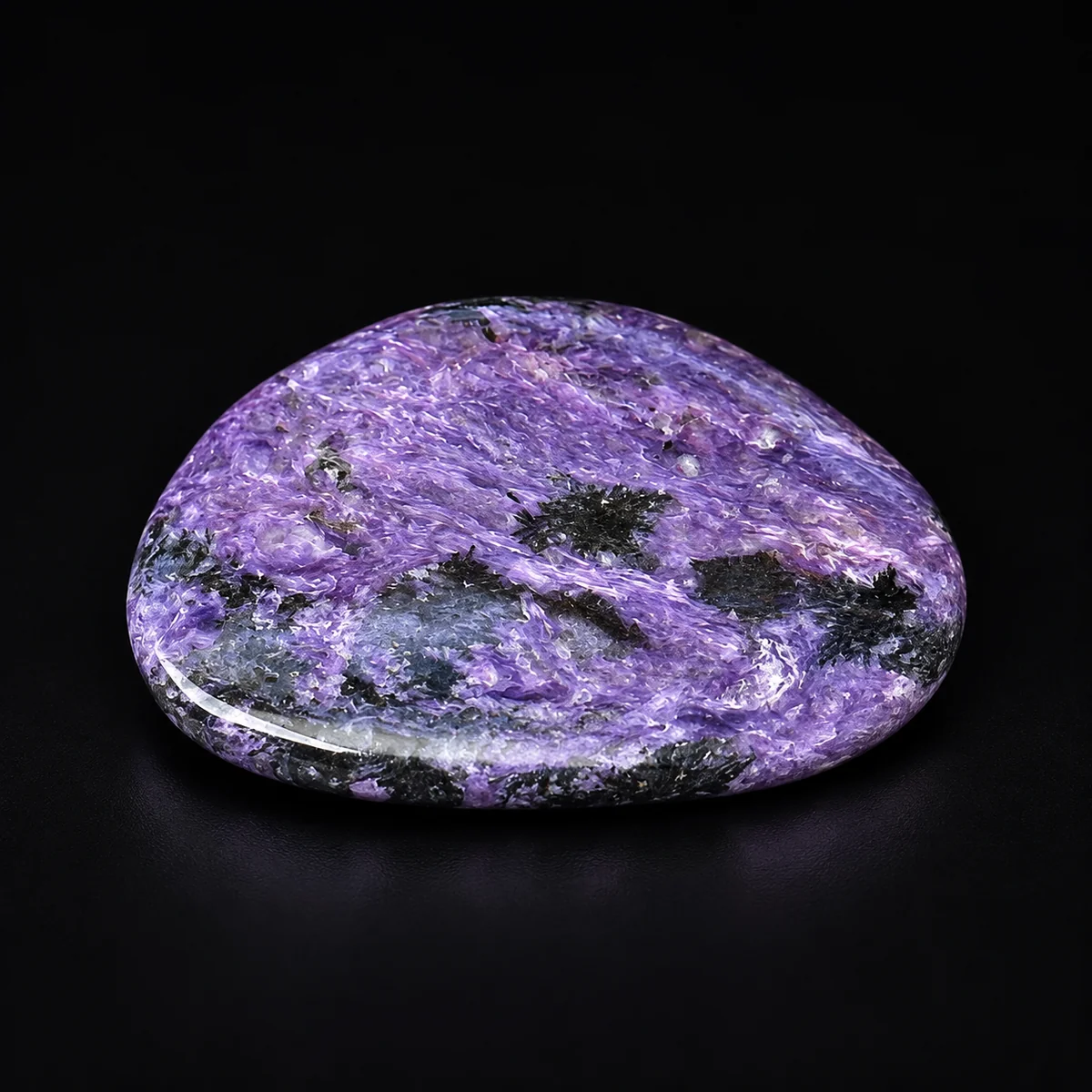
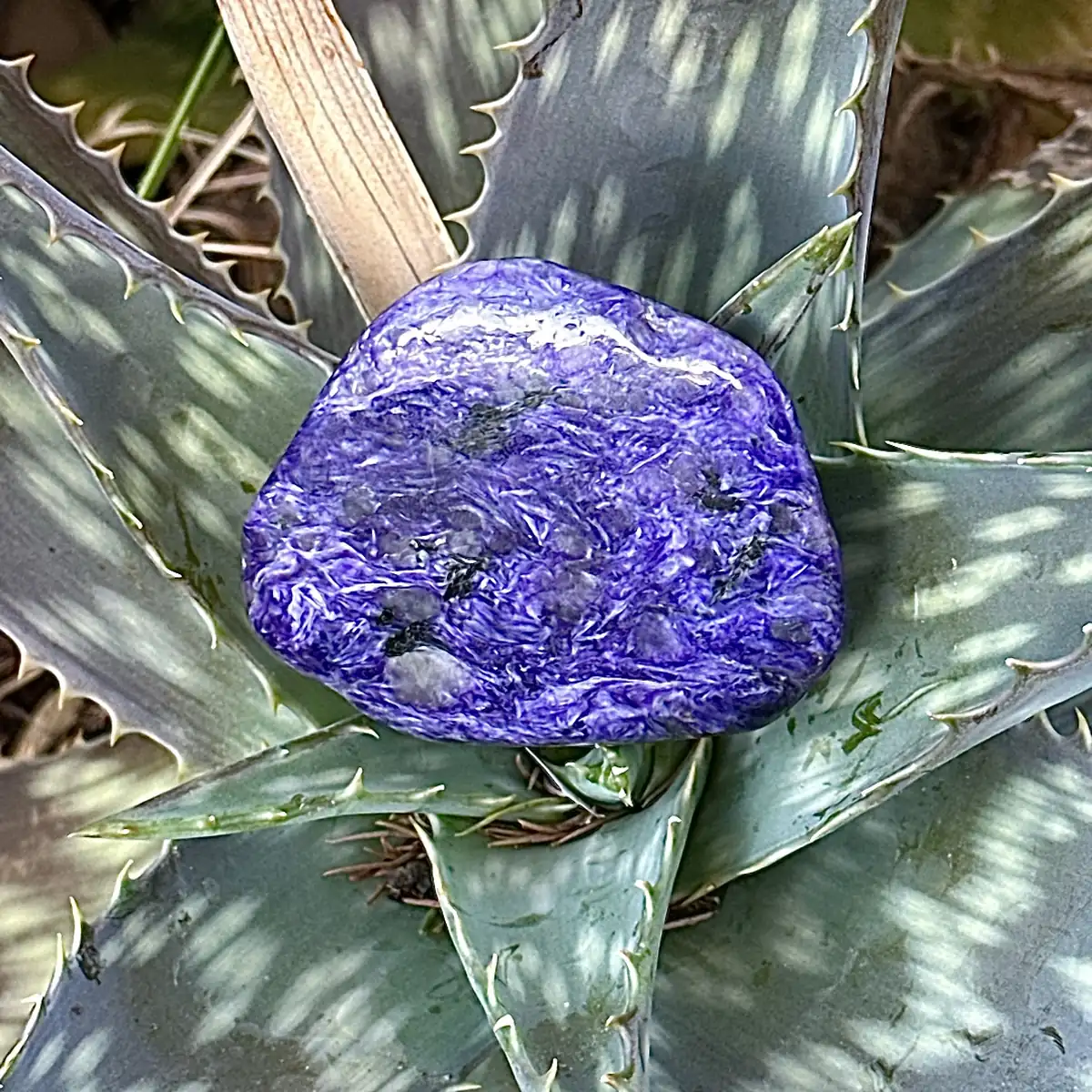
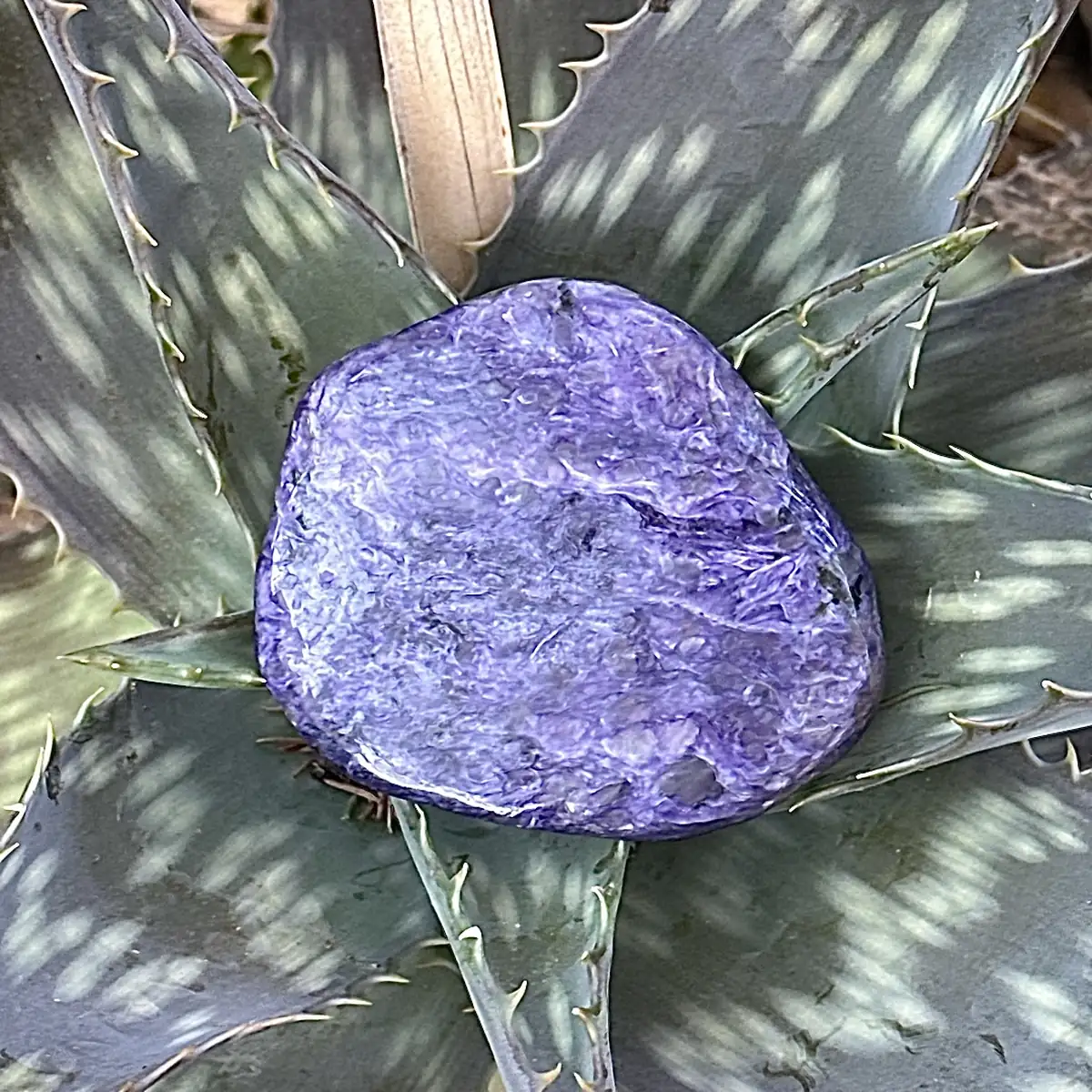
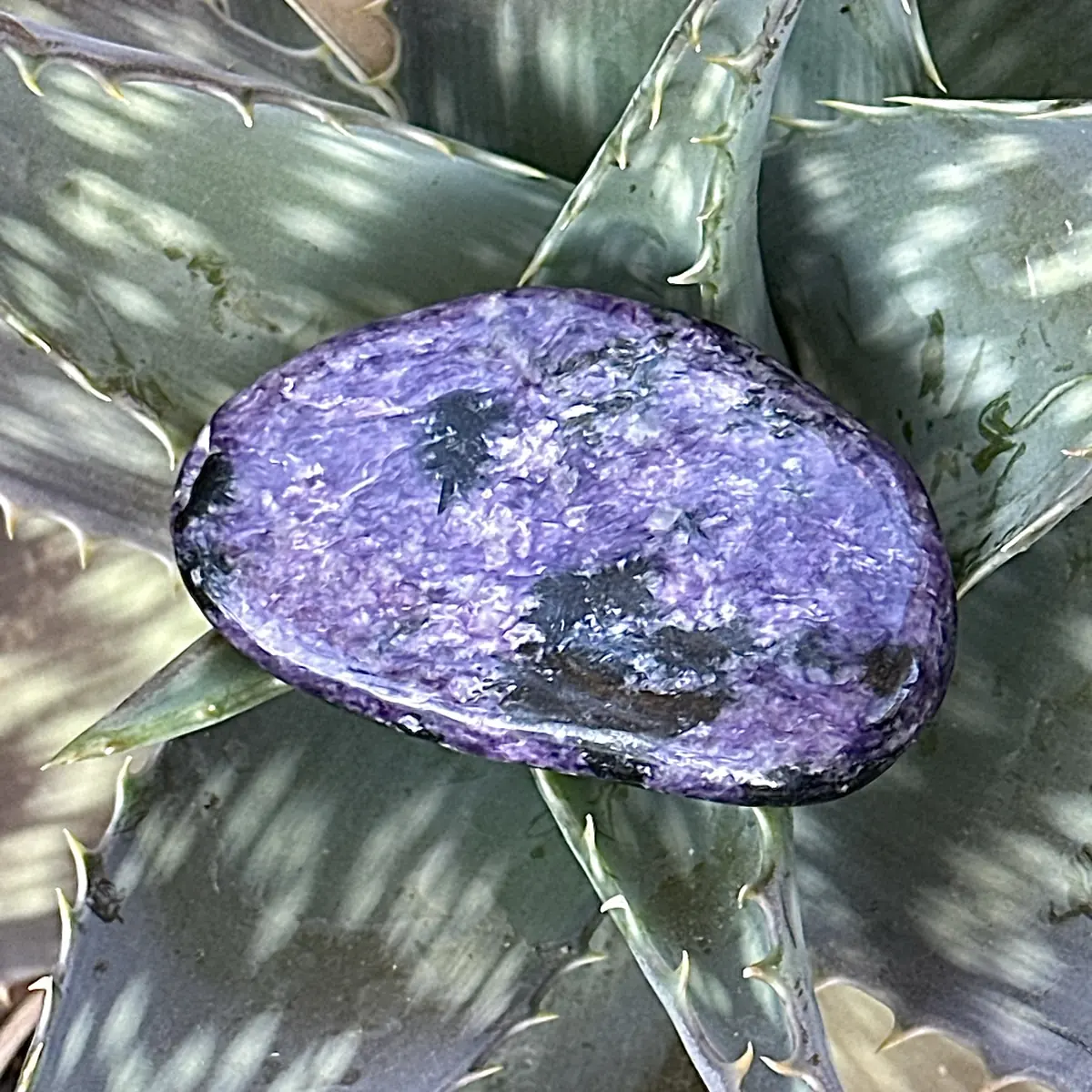
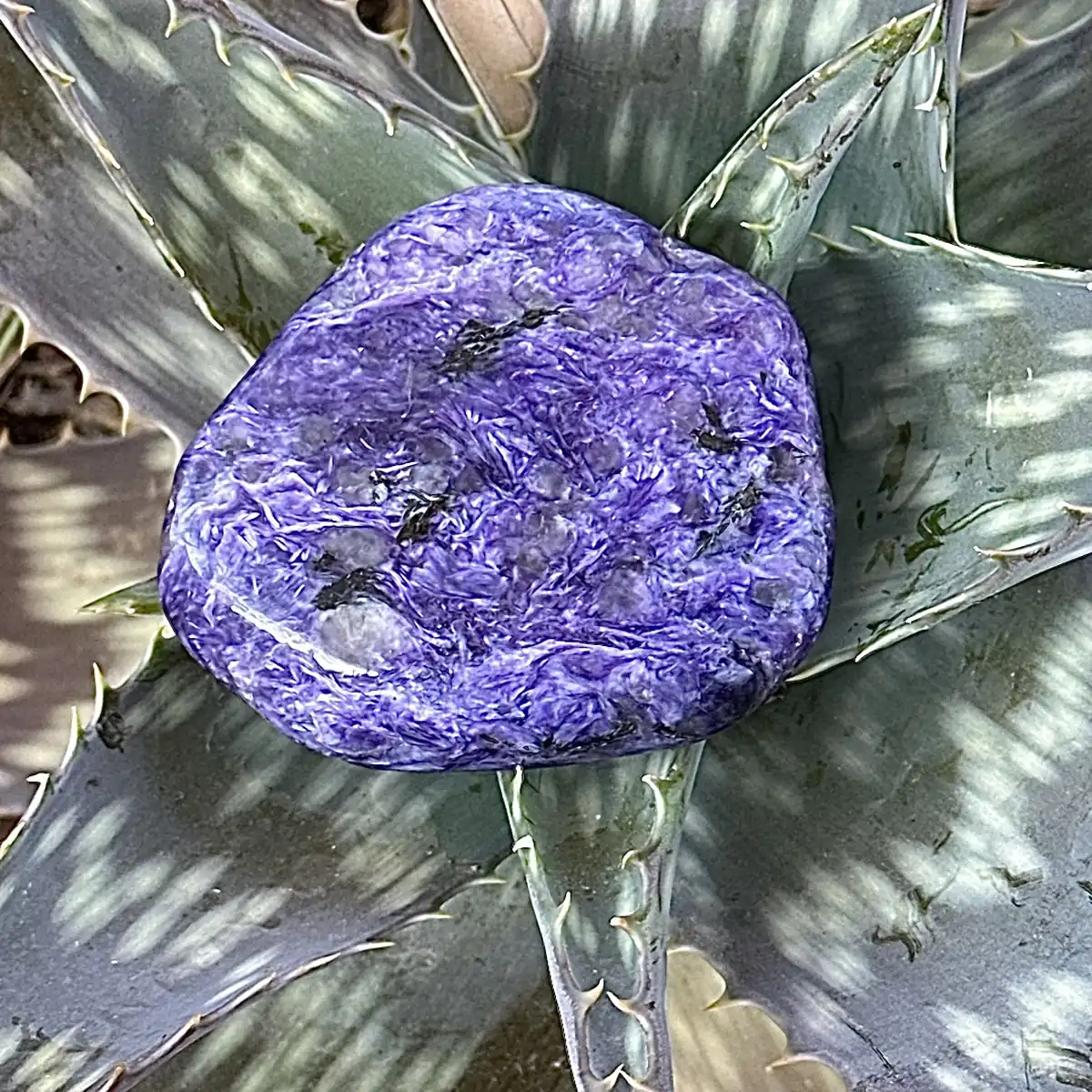
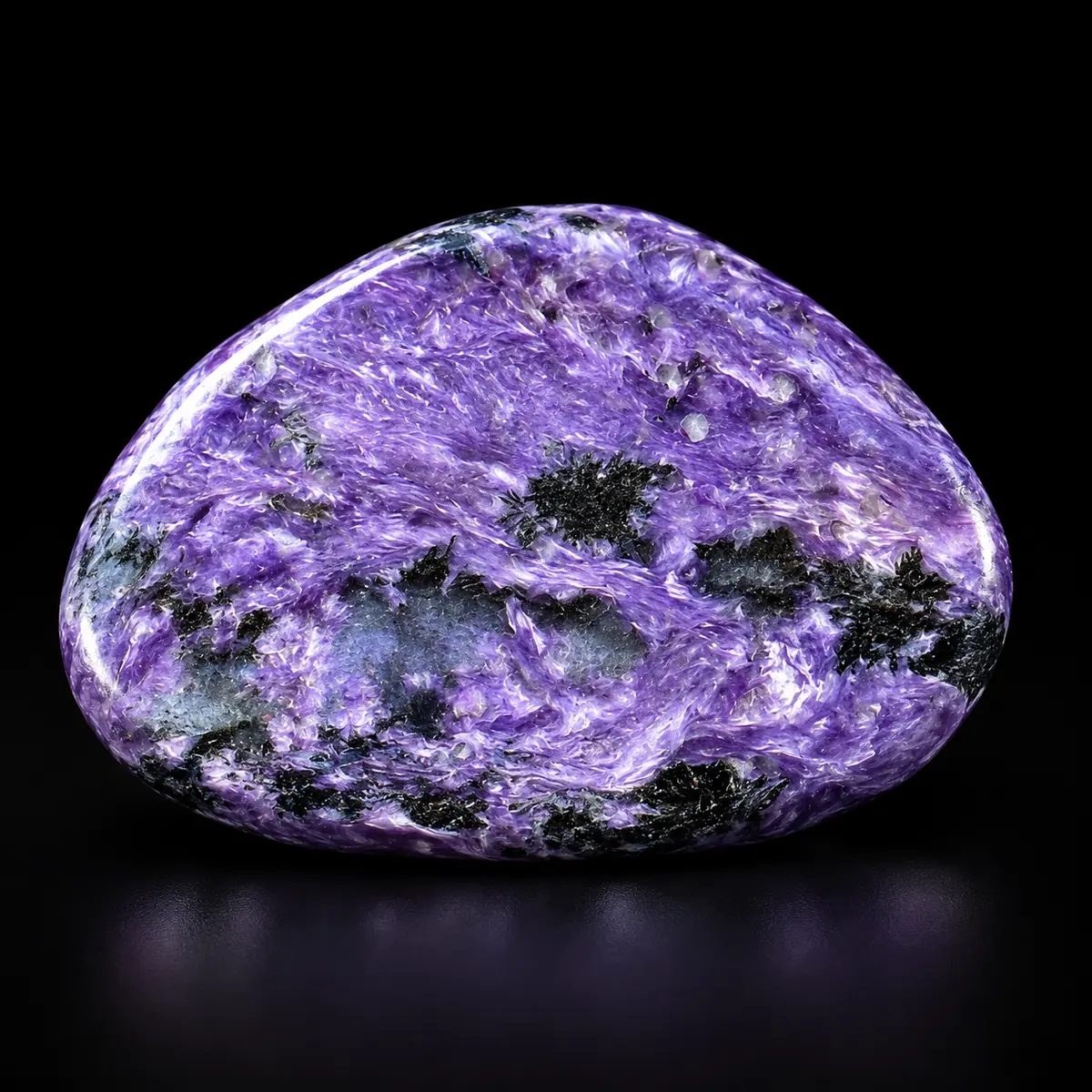
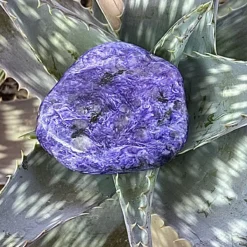
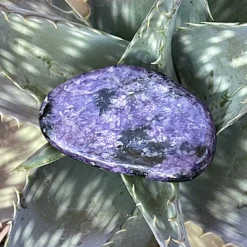
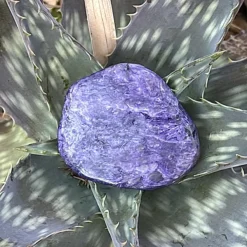
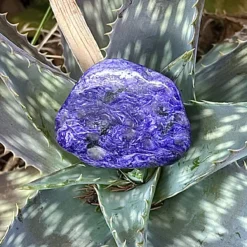
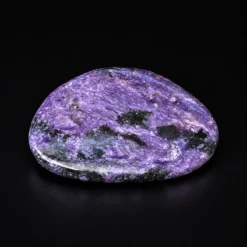
Premium Quality Flat Charoite Palm Stone
134,00 € incl. VAT
Large charoite palm stone. Piece measuring 7–7.5 cm x 4.5–6 cm. Charoite is a rare stone, the ideal piece to complete your mineral collection.
In stock
Stone(s): charoite
Color: purple, black
Dimensions: 7–7.5 cm x 4.5–6 cm
Approximate weight: 63 to 84 g
Shape: freeform – polished stone
Classification: feldspar group
Mohs hardness: 6–6.5
Density: 2.7
Origin: Russia
Care instructions: no specific care is required. To preserve the stone, you can rinse it periodically with clean water and dry it with a soft cloth.
Non-contractual photos.
Flat Charoite Palm Stone, in Detail
Dimensions: 7–7.5 cm x 4–5 cm, weight approx. 63 to 84 g. Shape: freeform, polished stone.
This listing belongs to the palm stones category, featuring similar pieces.
ORIGINS AND MINERALOGY
Charoite: origin, formation, and mineralogical properties
Origin and formation
Charoite is a rare mineral belonging to the silicate family, more specifically the inosilicate subclass. It is recognizable by its colors ranging from lilac to deep violet and its wavy patterns, formed by the interlacing of fine mineral fibers.
Its purple shades are frequently associated with black, gray, or whitish areas, creating contrasts that are especially visible after polishing.
Charoite has a remarkable geographic origin: its main and only recognized natural deposit is located in the Murun massif, in eastern Siberia, Russia.
Its formation results from specific geological conditions, linked to the interaction between alkaline igneous rocks and limestone formations.
How does charoite form?
Charoite forms mainly through a process called metasomatism, which corresponds to a chemical transformation of rocks under the action of fluids circulating underground.
In the Murun massif, intrusions of alkaline igneous rocks, notably syenites, came into contact with carbonate-rich formations such as limestones.
Fluids from magmatic activity transported various chemical elements—especially potassium and silica—into the surrounding rocks.
Under the effect of these fluid circulations, the mineralogical composition of the original rocks was gradually modified.
New minerals then developed, including charoite, in areas with particularly favorable chemical and thermal conditions.
Proposed formation temperatures for charoite are around 200 to 250 °C, which corresponds to relatively moderate conditions for an environment associated with a magmatic intrusion.
The specific chemical composition of the fluids, the presence of calcium and potassium, and the massif’s complex geological history explain the rarity of this mineral.
The origin of its purple color
Charoite shows a range of colors from pale lilac to intense violet, sometimes with mauve, bluish, or brownish tones.
Its coloration is linked to light-absorption phenomena within its crystal structure.
Mineralogical studies notably highlight the role of low concentrations of manganese and iron in the mechanisms responsible for its purple hues.
The exact nature of the color centers and their respective contributions can nevertheless vary depending on the mineral’s composition and formation conditions.
The intensity of the shades also depends on charoite’s fibrous structure and how light interacts with the different crystal aggregates.
Some pieces show a relatively uniform deep violet, while others offer alternations of pale mauve, rich violet, and almost white areas.
Swirling patterns and a silky appearance
One of charoite’s most recognizable features is its fibrous structure.
It generally occurs as compact masses made up of aggregates of elongated crystals, arranged in different orientations.
These fibers can form tangles, waves, or radiating structures that become especially visible on polished surfaces.
Variations in fiber orientation cause differences in light reflection, sometimes giving the stone a silky or slightly shimmering appearance.
This organization explains charoite’s characteristic patterns, often compared to swirls or fluid movements.
Each polished piece therefore shows a unique distribution of colors and mineral structures.
Inclusions and associated minerals
Stones sold as charoite are often made up of an assemblage of several minerals. The rock containing mostly charoite is called charoitite.
These mineral associations largely contribute to the characteristic appearance of polished pieces.
Notably found:
- Aegirine: a mineral generally very dark green to black, which can form spots, elongated crystals, or dark aggregates contrasting with the violet.
- Tinaksite: a rare silicate that can show yellow, orange, or brownish tones.
- Microcline: a potassium feldspar that may form light, white, or grayish areas.
- Quartz: sometimes present as light or translucent areas.
- Canasite: another rare silicate that may be associated with charoite in the Murun massif.
The presence of these different constituents explains why some stones show large, almost uniform purple areas, while others contain significant black inclusions or highly contrasting patterns.
These associations are natural and reflect the rock’s geological history.
Composition and mineralogical properties
Charoite is a complex hydrated silicate, mainly composed of silicon, calcium, potassium, and sodium.
Its structure also contains variable proportions of barium, strontium, manganese, and fluorine.
Unlike many common minerals, charoite has a particularly complex chemical composition, whose understanding required several crystallographic studies.
Its general chemical formula currently used is:
(K,Sr,Ba,Mn)₁₅₋₁₆(Ca,Na)₃₂Si₇₀(O,OH)₁₈₀₄·nH₂O
This formula reflects the possible substitutions between different chemical elements within its crystal structure.
Main mineralogical properties
- Classification: silicates
- Subclass: inosilicates
- Chemical composition: complex hydrated silicate of potassium, calcium, and sodium, containing notably barium, strontium, and manganese
- Crystal system: monoclinic
- Mohs hardness: 5 to 6
- Density: approx. 2.54 to 2.78
- Refractive index: approx. 1.550 to 1.559
- Luster: vitreous to silky
- Transparency: opaque to translucent depending on structure and thickness
- Colors: lilac, mauve, violet, deep violet, sometimes grayish or brownish
- Cleavage: good in several directions in the mineral
- Fracture: variable, can be irregular or fibrous in aggregates
- Morphology: mainly massive and fibrous
- Main origin: Murun massif, eastern Siberia, Russia
Crystal structure and specific features
Charoite belongs to the monoclinic crystal system.
Its structure consists of complex assemblages of silica tetrahedra organized into chains and specific structural units.
It differs from simpler silicates by the diversity of its crystallographic sites, which can accommodate several chemical elements.
This structure partly explains the complexity of its chemical formula and the difficulties encountered during its first mineralogical studies.
In nature, charoite occurs mainly as fibrous or massive aggregates. Well-formed individual crystals are extremely unusual.
Its fibrous structure can produce silky light effects that are especially visible on cabochons, pebbles, and carefully polished objects.
Charoite and charoitite: what’s the difference?
The term charoite refers to a mineral species defined by its chemical composition and crystal structure.
The term charoitite refers to a rock made up mostly of charoite, but also containing other associated minerals.
In the natural stone trade, the name charoite is generally used to refer to both the mineral and the ornamental stones made of charoitite.
This distinction is particularly important for specimens with large black, white, or orange inclusions.
The dark areas visible on some polished charoites may notably correspond to aegirine, a mineral naturally associated with charoite.
Charoite and sugilite: how to tell them apart?
Charoite can sometimes be confused with sugilite, another mineral sought after for its purple colors.
The main difference lies in their composition and appearance.
Charoite generally shows fibrous, wavy, or swirling patterns, with alternations of violet, mauve, and dark areas.
Sugilite also belongs to the silicates, but has a different chemical composition and crystal structure. It can show a more uniform purple or violet color, although some specimens are also marbled.
Charoite is often distinguished by its silky structures and by the presence of associated minerals such as aegirine or tinaksite.
Accurate identification may nevertheless require gemological or mineralogical analyses.
Deposits
Russia – Murun massif, eastern Siberia
Charoite has an exceptionally limited geographic distribution.
Its recognized natural deposit is located in the Murun alkaline massif, within the Aldan Shield, in a region of eastern Siberia near the territories of the Sakha Republic (Yakutia) and Irkutsk Oblast.
This region is characterized by a complex assemblage of igneous and metamorphic rocks, some of which have been deeply transformed by hydrothermal fluid circulation.
Charoite is mainly found in metasomatism zones associated with contacts between alkaline rocks and carbonate formations.
These specific conditions favored the formation of an association of rare minerals, several of which were studied and described from this massif.
Charoite is notably associated there with aegirine, tinaksite, canasite, and various feldspars.
The massif is known for the diversity of its minerals, but charoite is present there only in certain specific geological zones.
An exceptional geographic origin
Unlike many minerals found on several continents, charoite has no recognized commercial natural deposits in other countries.
This very restricted location is one of its main mineralogical features.
It also contributes to its appeal among collectors and lovers of ornamental stones.
Specimens with a rich violet color, a clearly visible fibrous structure, and a quality polish are especially appreciated.
Some pieces also stand out for the distribution of their black inclusions, which create contrasting natural patterns.
History and uses
The discovery of charoite
Charoite is a mineral whose scientific recognition is relatively recent.
The first observations of purple materials from the Murun massif region date back to the mid-20th century, in the context of Soviet geological exploration campaigns in Siberia.
However, the exact mineralogical nature of these materials was not immediately established.
Charoite’s particularly complex structure and composition required extensive investigation before it was recognized as a distinct mineral species.
Charoite was approved by the International Mineralogical Association in the late 1970s, with an approval recorded in 1977.
Its official scientific description was published in 1978 by a team of Soviet researchers including V. P. Rogova, Y. G. Rogov, V. A. Drits, and N. N. Kuznetsova.
This publication helped make charoite known in international mineralogical and gemological circles.
The origin of its name
The name charoite refers to the Chara River, located in the region of its Siberian deposit.
This link to a geographic name highlights the close connection between the mineral and its territory of origin.
The Chara region is characterized by mountainous landscapes, vast forest areas, and a particularly harsh continental climate.
Charoite remains closely associated today with this part of eastern Siberia.
A recent ornamental use
Because it was recognized relatively late, charoite does not have a long documented history in ancient jewelry traditions.
Its use as an ornamental stone mainly developed in the second half of the 20th century.
Its purple colors and fibrous structure quickly attracted the attention of lapidaries.
It is now worked in different forms:
- Pebbles and polished stones.
- Cabochons for jewelry.
- Beads for bracelets and necklaces.
- Pendants and rings.
- Decorative spheres and eggs.
- Sculptures and ornamental objects.
- Mineral collector’s pieces.
Polish quality plays an essential role in its visual appearance.
A carefully polished surface reveals the violet variations, the movement of the fibrous structure, and the contrasts created by associated minerals.
A stone sought after by collectors
Interest in charoite is based on several characteristics: its geographic rarity, its unusual colors, and the complexity of its formation.
Collectors particularly appreciate specimens showing a beautiful distribution of purple shades and well-defined fibrous structures.
Associations with black aegirine, orange tinaksite, or other silicates can also be of mineralogical interest.
Each piece has its own arrangement of fibers and natural inclusions.
Care
With a Mohs hardness of 5 to 6, charoite has moderate scratch resistance.
It is suitable for making jewelry and decorative objects, but requires certain precautions.
Its fibrous structure and the possible presence of several minerals in the same piece can create fragile areas.
For routine care, it is recommended to use a soft, dry cloth, or slightly damp if needed.
Occasional cleaning with lukewarm soapy water is possible for suitable pieces, provided they are not left to soak and are dried carefully.
Avoid:
- Impacts and rubbing against harder minerals.
- Abrasive cleaning products.
- Solvents and harsh chemicals.
- Sudden temperature changes.
- Ultrasonic or steam cleaning.
For pebbles and polished objects, gentle cleaning with a cloth is generally enough to maintain their appearance.
Well-being and energies
Properties traditionally attributed to charoite
In lithotherapy, charoite is mainly associated with personal transformation, emotional soothing, and intuition.
Its purple color is symbolically linked to the search for serenity, inner reflection, and personal growth.
In contemporary energy practices, it is notably associated with:
- Emotional soothing: traditionally used to support periods of tension and symbolically encourage inner calm.
- Personal transformation: associated with accepting change and the ability to move into new stages of life.
- Letting go: linked to gaining perspective on worries and difficult situations.
- Intuition: considered a stone that supports personal reflection and listening to oneself.
- Self-confidence: associated with the courage to take action and embrace new situations.
- Mental clarity: traditionally used to support focus and gaining perspective.
- Emotional balance: linked to the search for harmony and inner stability.
- Energy protection: associated, in some lithotherapy traditions, with the intention of symbolically protecting oneself from negative influences.
Associated chakras
- Third eye chakra – AJNA: associated with intuition, inner perception, and mental clarity.
- Crown chakra – SAHASRARA: associated with consciousness, spiritual reflection, and the search for inner harmony.
Associated astrological signs
- Scorpio
- Sagittarius
- Pisces
These correspondences are symbolic and may vary depending on lithotherapy traditions.
Purification and recharging
Purification
In contemporary energy practices, charoite can be symbolically purified by fumigation with a palo santo stick or with white sage.
Simply pass the stone or jewelry gently through the smoke for a few moments, making sure to ventilate the room well.
This method avoids prolonged immersion in water and is especially suitable for jewelry with metal elements or setting materials.
Recharging
In lithotherapy, charoite can be symbolically recharged in moonlight for a few hours.
It can also be placed in a room with soft natural light, away from high temperatures.
Other practices involve placing the stone near a quartz geode or on a selenite plate.
The energetic properties attributed to charoite are based on contemporary lithotherapy traditions and practices. They are not scientifically proven effects and do not replace medical advice or treatment.
Expédition : 48 à 72 heures, hors week-ends et jours fériés, après confirmation du paiement.
Livraison offerte dès 60 € en France métropolitaine.
Droit de rétractation : 14 jours pour nous signaler votre décision.
You may also like…




Purification and recharging


Related products

Minerals


Fluorescent Minerals


Massage Wands, Pebbles, and Sticks