

History & Culture
VIKING STONES: BETWEEN ARCHAEOLOGY, TRAVELS, AND NORDIC LEGENDS
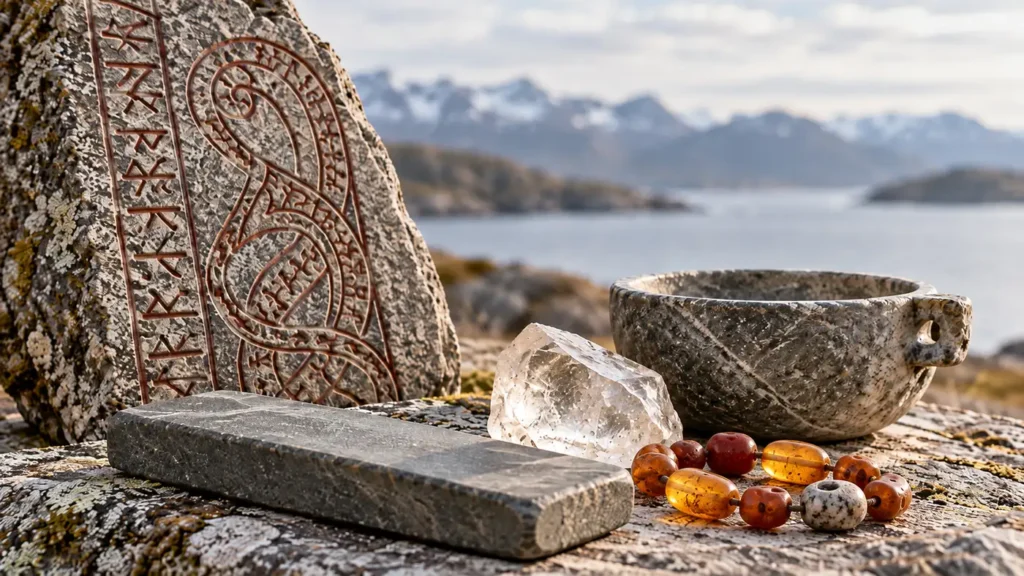
At Odin Minéraux, it’s hard to resist a detour into the Nordic world. Which stones did the Vikings actually use, and what can they teach us about their daily lives, their trade, or their religion?
When we think of Vikings, we first imagine the wood of ships, the iron of weapons, and the silver of treasures. Yet, stone accompanied almost every aspect of Nordic life: it was used to sharpen a blade, cook a meal, make a container, adorn oneself, commemorate the dead—and, in a completely different register, it also appears in the mysterious tale of the “sunstone.”
Excavations show above all that these materials circulated. Some came from Scandinavian quarries exploited on a large scale; others, such as carnelian and certain rock crystals, reached the great merchant centers of the North through networks linking the Baltic, Eastern Europe, the Caucasus, the Byzantine world, and beyond.
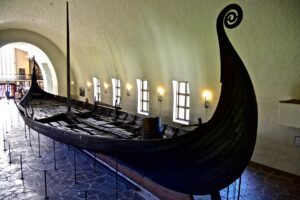
Photograph: the Oseberg ship, on display at the Viking Ship Museum in Oslo.
Credit: Larry Lamsa, Wikimedia Commons — CC BY 2.0 license.
At a glance
| Material / object | Usage | What archaeology shows | What it tells us |
|---|---|---|---|
| Schist / whetstone | Maintenance of weapons and tools | Quarries and origins sometimes identifiable | An economy capable of transporting an everyday object very far. |
| Soapstone | Pots and domestic objects | Spread from Western Scandinavia | Heavy and practical objects also circulate through Northern networks. |
| Amber | Beads, pendants, amulets | Craftsmanship and adornments attested | Adornment expresses taste, status, and sometimes religious references. |
| Carnelian / rock crystal | Beads and jewelry | Materials imported to Birka, Kaupang, and elsewhere | Jewelry reveals the extent of long-distance trade. |
| Runestones | Memory and public display | Dated commemorative monuments | Stone becomes a lasting medium for memory, prestige, and power. |
| “Sunstone” | Orientation hypothesis | Plausible physical principle; direct archaeological proof absent | At the crossroads of medieval text, science, and hypothesis. |
1. Whetstones: an everyday tool that travels far
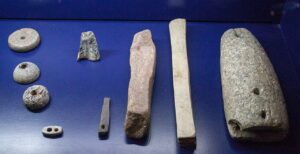
Photograph: whetstones and other lithic objects on display at Reykjavík 871±2 (Iceland).
Credit: Szilas, Wikimedia Commons — public domain.
A sword, an axe, a knife, or an iron tool is only truly useful if its edge can be maintained. Whetstones are therefore among the most ordinary objects of the Viking Age—and it is precisely their commonness that makes them valuable to archaeologists. They break, get lost, and are abandoned in ports, workshops, and homes.
They weren’t necessarily made of granite. The major Norwegian supplies studied for the Viking period are mainly linked to fine, abrasive rocks: schists, phyllites, or quartz-mica-schists. Stones from Eidsborg in Telemark and those from Mostadmarka in Trøndelag can thus present mineralogical signatures characteristic enough to be compared to those from the quarries.
In Ribe, Denmark, analyses show that whetstones from Norway were already being imported even before the traditional start of the Viking Age at the end of the 8th century. The oldest discoveries notably show a supply from the Mostadmarka quarries in Norway. From the 9th century onwards, stones from Eidsborg, another Norwegian extraction center, gradually took a more important place in trade, a trend that continued into the Middle Ages.
These objects circulated between the major commercial centers of the Scandinavian world. A simple whetstone, a few dozen centimeters long, thus testifies to the existence of commercial networks linking quarries, ports, markets, and sea routes.
AN ORDINARY OBJECT THAT MAPS OUT ROUTES
The geological origin of a whetstone can sometimes be traced back to a known quarry. An everyday tool then becomes a concrete marker of supply networks and maritime trade.
2. Soapstone: the stone of Northern kitchens
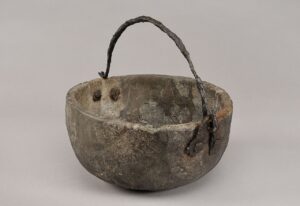
Photograph: Viking-era soapstone pot, partially restored, discovered at Birka (grave Bj 879).
Credit: Gabriel Hildebrand / Historiska museet, Wikimedia Commons — CC BY 2.5 license.
Soapstone—or steatite—is a rock rich in talc and other magnesium minerals. It is soft, easy to carve, and capable of withstanding temperature variations. These qualities made it a particularly popular material for pots, bowls, and other containers.
Its weight does not prevent its circulation. Containers weighing several kilograms were imported to Denmark; the National Museum of Denmark even points out that these objects show that Viking trade did not only transport luxury goods, but also perfectly everyday utensils.
From the 9th century onwards, soapstone containers from Western Scandinavia appear in different areas of the Nordic world: Denmark, Birka, Shetland, Faroe Islands, and Iceland. In some regions, Scandinavian settlers also exploited local deposits, so the study of the material must always be done object by object.
WHY SOAPSTONE?
Because it is easily carved, resists heat well, and retains temperature. It therefore combines ease of manufacture and domestic efficiency—a combination useful enough to justify its transport over long distances.
3. Amber: worn, worked, traded

Photograph: amber pendant in the shape of Thor’s hammer, from Birka (Sweden).
Credit: Historiska museet, Wikimedia Commons — CC BY 2.5 license.
Amber is not a mineral: it is fossilized plant resin. However, in an article dedicated to Viking “stones,” it would be hard to ignore. In the Viking Age, it was carved, polished, and pierced like gemstones, and was used in the manufacture of many decorative objects.
Amber was notably collected on the coasts of the Baltic Sea and the North Sea, particularly in Jutland, Denmark, and on the shores of the Baltic countries. Washed up on beaches by the waves, it was a sought-after raw material. It could be worked on-site or circulate through Nordic commercial networks. In Ribe, Denmark, archaeological excavations have revealed traces of it being worked as early as the 8th century.
In the Viking world, jewelry did not only serve a decorative function. Brooches, bracelets, necklaces, beads, and pendants could complete an outfit, signal social status, or hold symbolic value. In Birka and other Scandinavian sites, amber was also used to make small pendants and amulets.
A small amber Thor’s hammer, discovered in Birka, Sweden, offers a concrete example. Now kept at the Swedish History Museum (Historiska museet), this object is considered probably unfinished: it was perhaps intended to become a pendant. Thor’s hammer pendants were also made of iron and silver.
Check out our selection of amber jewelry and tumbled stones at Odin Minéraux.
FROM RAW AMBER TO WORKSHOPS
As early as the 8th century, at the Ribe marketplace (Denmark), archaeologists found waste from amber working. Less spectacular than a finished piece of jewelry, these remains show that amber was also shaped on-site, amidst other crafts. They give a concrete glimpse into the activity of the workshops that brought the merchant ports of the North to life.
4. Carnelian and rock crystal: beads from afar

Photograph: rock crystal and carnelian beads, collection of the Swedish History Museum.
Credit: Gabriel Hildebrand / Swedish History Museum, Wikimedia Commons — CC BY 2.0 license.
It is with stone beads that travels become particularly visible. In Birka as in Kaupang, sets combine orange-red carnelian, transparent rock crystal, amber, and glass.
The Swedish History Museum (Historiska museet) presents, for example, a necklace discovered in a 9th-century grave in Birka, composed notably of rock crystal and carnelian. The museum links these stones to Eastern and Caucasian networks. Other sets studied in Birka or Kaupang show varied origins and circuits: Eastern Europe, the Black Sea, the Caucasus, the Mediterranean, and even more distant networks.
We must therefore nuance the often-repeated phrase that “Vikings brought their carnelian from India.” Discoveries clearly prove the existence of long-distance trade, but they do not allow us to automatically attribute each bead to a specific deposit.
ADORNMENT CAN BE A TRADE MAP
When several materials of different origins are found in the same grave, the jewelry doesn’t just tell us about its owner’s taste: it also becomes a clue to the routes, intermediaries, and markets linking Scandinavia to other regions of the world.
And garnet?
Garnet does appear in discoveries linked to the Viking world, but here again, the context must be specified. In Kaupang, excavations yielded five unworked garnet crystals. The study published on the site’s gems indicates that they were not suitable for jewelry and may have served as an abrasive. Garnet is therefore one of the attested materials, but it does not play the same role here as the many carnelian or rock crystal beads.
5. Runestones: memory, power, and religion
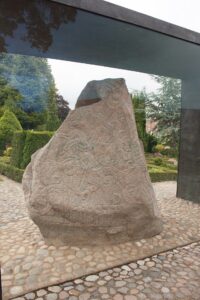
Photograph: the large Jelling stone, a monument commissioned by Harald Bluetooth (Denmark).
Credit: Szilas, Wikimedia Commons — CC0 1.0 license.
Not all Viking stones fit in one hand. Runestones bring rock into the public space. Erected in visible places, they commemorate the dead, family ties, travels, constructions, or acts deemed worthy of being remembered.
Runes are first and foremost a Germanic writing system. The preserved inscriptions show very varied uses: names, ownership, family memory, events, travels, prayers, or formulas. At the end of the Viking Age, the monuments also show Christianity more clearly, sometimes alongside motifs inherited from Nordic tradition.
In Denmark, the large Jelling stone, erected by Harald Bluetooth in the 10th century, is one of the most famous examples. Its inscription combines dynastic memory, royal power, and Christianization. The monument is located at the heart of a royal complex including burial mounds and a church: the stone therefore does not transmit a private message, but a visible assertion in a landscape of power.
Runestones were not all carved from the same rock. Carvers used locally available blocks—granites, gneisses, sandstones, or other rocks durable enough depending on the region. The large Jelling stone itself is an imposing natural block of gray granite, engraved on three faces.
Runes and magic: what can we really say?
Mythological tradition associates runes with Odin. In the Hávamál, a poem from the Poetic Edda preserved in a 13th-century Icelandic manuscript, Odin tells of hanging for nine nights from a tree, wounded by a spear, before gaining knowledge of the runes at the end of this sacrifice. Beyond this mythological account, inscriptions and texts also show that runes could be used in formulas for protection, healing, or cursing.
But not all runic inscriptions had a magical purpose. A large part of the preserved inscriptions fall under more ordinary uses: commemorations, dedications, property marks, travels, Christian prayers, or messages. For the people of the time, the same writing could therefore serve ordinary functions as well as ritual uses.
And the small divinatory runes used today?
Runes were reinterpreted long after the Viking Age. As early as the beginning of the 17th century, the Swedish scholar Johannes Bureus (1568–1652), one of the pioneers of runology, attributed an esoteric dimension to them. He developed a personal system, sometimes called Adulruna or “Gothic Kabbalah,” in which he mixed runes, Nordic traditions, Kabbalah, astrology, and hermeticism. He considered runes to be the repositories of hidden ancient knowledge. This interpretation, however, belongs to modern Europe, several centuries after the Viking Age.
Other esoteric currents would later take up and transform the runes, notably in the Germanic world at the end of the 19th and beginning of the 20th century. But the modern set of small stones, pieces of wood, or pebbles engraved with runes and then drawn to answer a question is even more recent. This practice became popular mainly at the end of the 20th century, especially in the English-speaking world. Ralph Blum’s book, The Book of Runes, published in 1982, contributed significantly to spreading this modern form of runic divination.
6. The sunstone: is the story true?
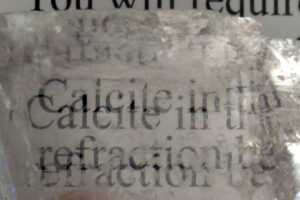
Photograph: calcite crystal (Iceland spar) showing double refraction / birefringence.
Credit: Furrfu, Wikimedia Commons — public domain.
This is undoubtedly the most famous stone associated with the Vikings—and the most delicate to present. The Old Norse term sólarsteinn, “sunstone,” appears in medieval Icelandic texts. The most frequently cited account is the Rauðúlfs þáttr, a story dedicated to Saint Olaf and written down several generations after the Viking Age.
In the episode, the weather is overcast and snowy. The king asks Sigurðr to indicate where the Sun is. A “sunstone” is then brought; the king uses it to check the proposed direction. The passage thus clearly describes a stone used in relation to locating the Sun, but it belongs to a literary and religious narrative, not a contemporary nautical manual for 9th-century navigators.
How could a crystal “find” the Sun?
In the 1960s, Danish archaeologist Thorkild Ramskou proposed that the sólarsteinn might have been a crystal capable of helping to analyze the polarization of skylight. Light scattered in the atmosphere is partially polarized according to a pattern linked to the Sun’s position. Even if its disk is hidden by clouds, some of this optical information can remain.
Several minerals have been proposed, notably cordierite, tourmaline, and especially transparent calcite, or Iceland spar. Calcite is birefringent: it doubles the image observed through the crystal. Modern experiments have shown that by correctly using a polarizing crystal, it is possible to estimate the direction of sky polarization and thus obtain information on the Sun’s direction under certain conditions.
Interested in the optical phenomena of minerals? Discover also ulexite, nicknamed the “television stone.” Different from optical calcite, it has a fibrous structure capable of transmitting an image from one face to the other. Discover our polished ulexite.
What archaeology allows us to affirm
No crystal unambiguously identified as a Viking Age navigation instrument has been found to date. The famous calcite crystal discovered in the Alderney shipwreck is indeed associated with a ship, but it sank in the 16th century, several centuries after the Viking period.
Physics therefore makes the hypothesis credible, and medieval texts show that a “sunstone” did exist in the imagination—and perhaps in some uses—of medieval Iceland. On the other hand, no direct archaeological evidence currently allows us to affirm that a Viking navigator actually used a calcite crystal as a navigation instrument.
Even in this hypothesis, such a stone would not have given a complete position at sea. It would have provided additional information to be combined with the navigator’s experience, wind and swell direction, stars, birds, water color, coastal features, and possibly other solar instruments.
MYTH AND REALITY
The sólarsteinn exists in medieval texts; certain crystals can indeed analyze sky polarization; but we do not currently possess direct archaeological proof of a Viking navigation instrument based on this principle.
Main sources and references
- Baug, I., Skre, D., Heldal, T. et al. — The Beginning of the Viking Age in the West, Journal of Maritime Archaeology 14 (2019), 43–80.
- Baug, I. et al. — research on Norwegian whetstones and long-distance networks.
- Historiska museet — The Viking World: objects from Birka, soapstone, carnelian, rock crystal, and Thor’s hammers.
- Historiska museet — The Viking World, “Amulet,” small amber Thor’s hammer blank from Birka (inv. 914273_HST): https://vikingar.historiska.se/object_details.php?e=&l=en&object=FED319B3-30A1-4334-99B2-2FB9AEB4A88A
- National Museum of Denmark — Runes and Jelling monuments.
- Ribe VikingeCenter — “The Marketplace 710–750 AD,” remains of amber working workshops in Ribe: https://www.ribevikingecenter.dk/en/explore/the-marketplace
- UNESCO — Jelling Burial Mounds, Runestones and Church.
- Resi, H. G. — Gemstones: Cornelian, Rock Crystal, Amethyst, Fluorspar and Garnet, in Things from the Town: Artefacts and Inhabitants in Viking-Age Kaupang.
- Horváth, G. et al. — On the trail of Vikings with polarized skylight, Philosophical Transactions B (2011).
- Ropars, G. et al. — The sunstone and polarised skylight: ancient Viking navigational tools?, Contemporary Physics 55 (2014).
Image credits
Opening visual: image generated by AI for Odin Minéraux, October 2026.
Oseberg ship — Larry Lamsa, “Oseberg Ship – Viking Ship Museum (Oslo)”, Wikimedia Commons, CC BY 2.0 license.
Whetstones and lithic objects — Szilas, “Whetstone and other stone objects”, Wikimedia Commons, public domain.
Birka soapstone pot — Gabriel Hildebrand / Historiska museet, Wikimedia Commons, CC BY 2.5 license.
Amber Thor’s hammer — Historiska museet, Wikimedia Commons, CC BY 2.5 license.
Carnelian and rock crystal beads — Gabriel Hildebrand / Swedish History Museum, Wikimedia Commons, CC BY 2.0 license.
Large Jelling stone — Szilas, Wikimedia Commons, CC0 1.0 license.
Calcite showing birefringence — Furrfu, Wikimedia Commons, public domain.