

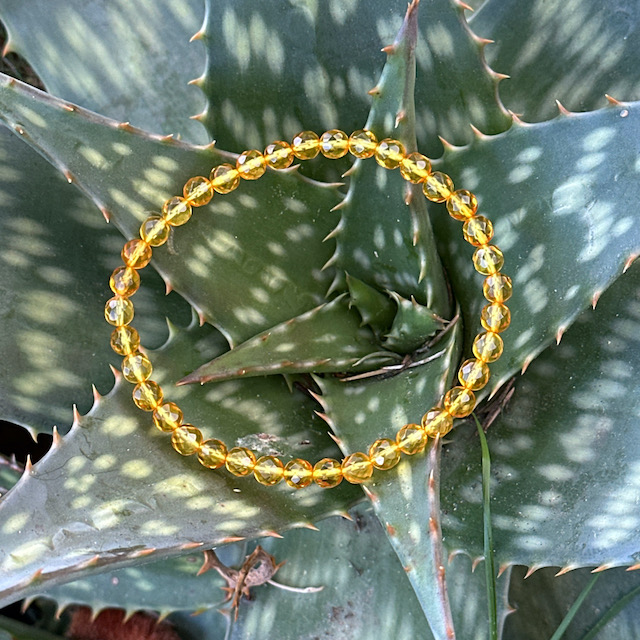
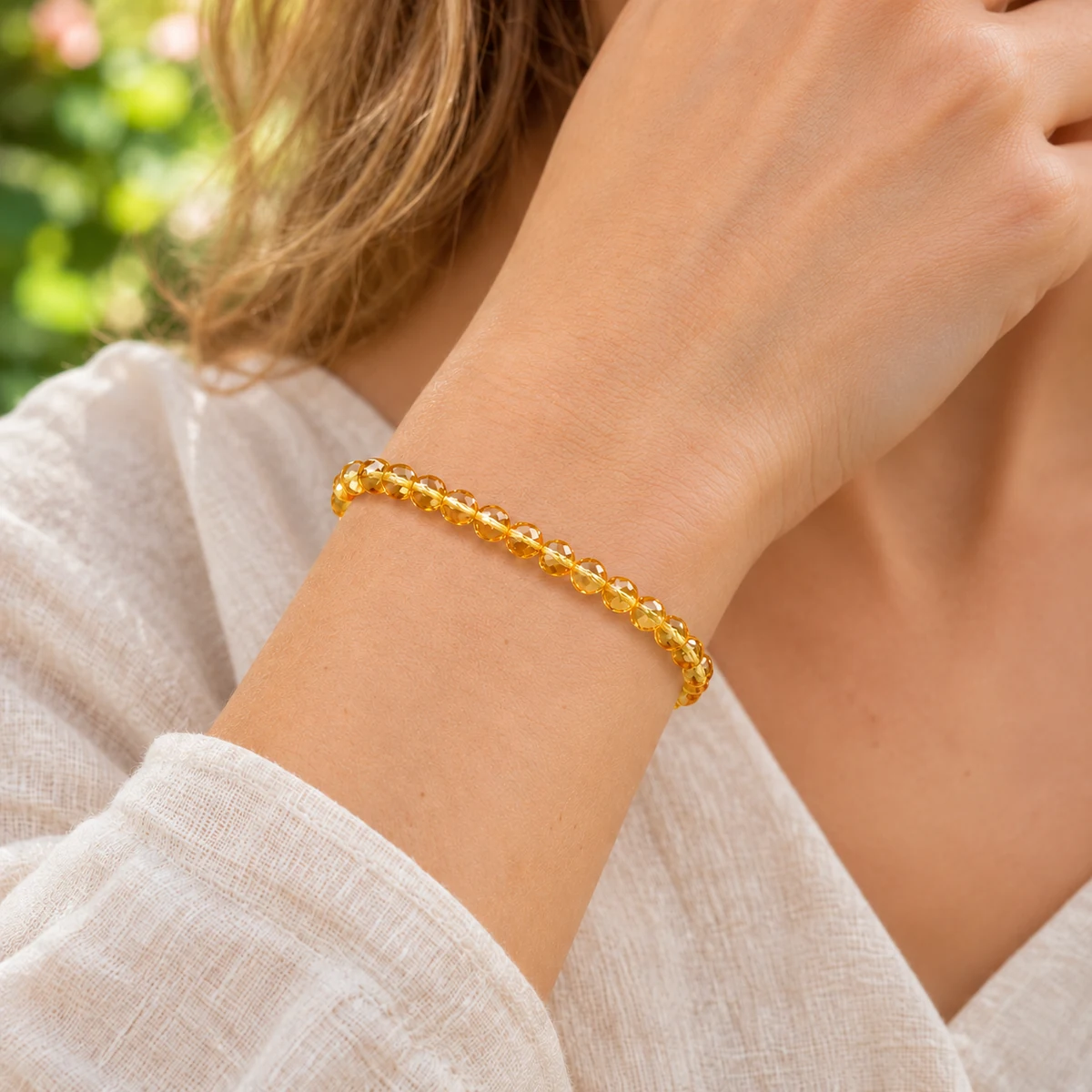
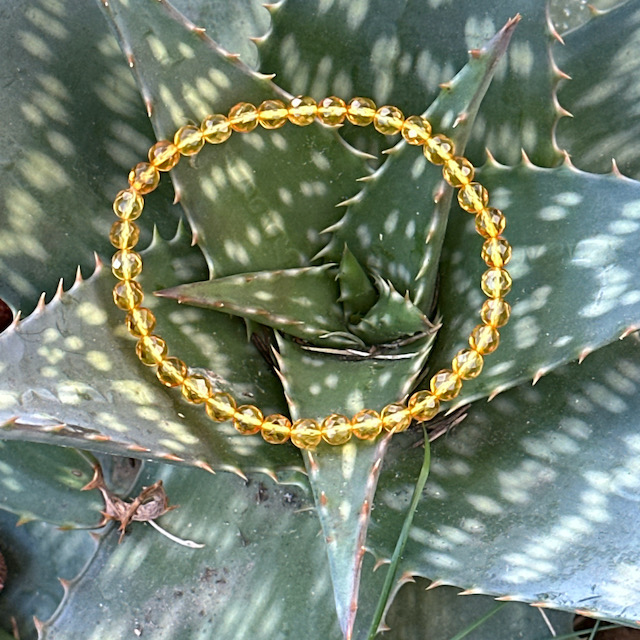
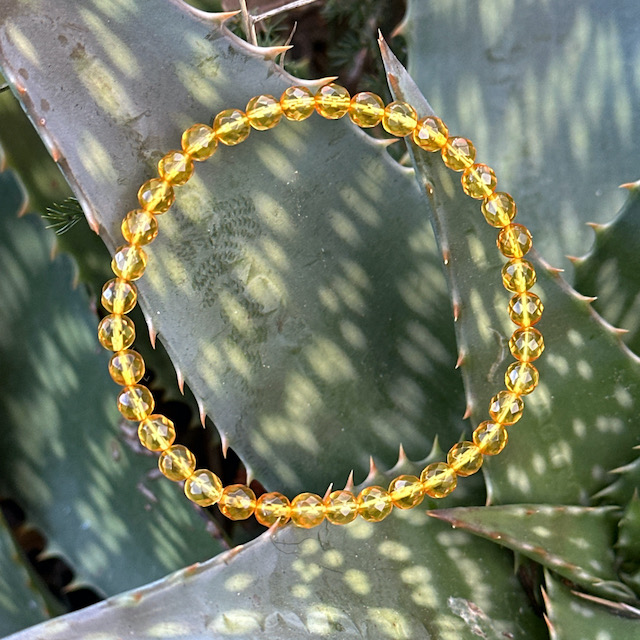
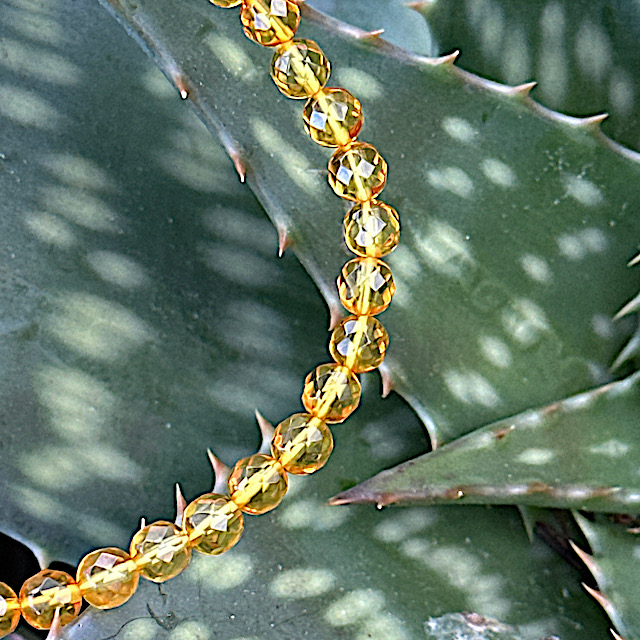
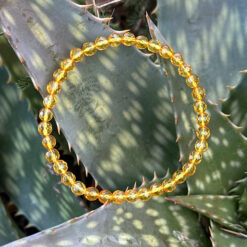
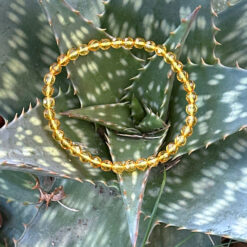
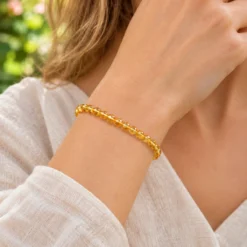
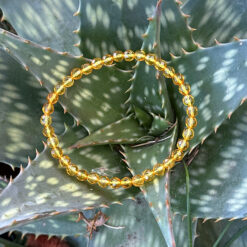
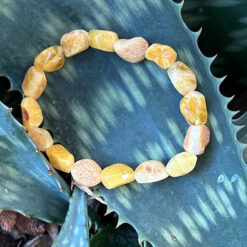
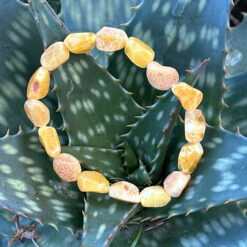
4mm faceted yellow amber bracelet
56,16 € incl. VAT
Baltic yellow amber bracelet made of small faceted round beads with golden highlights. A delicate, luminous bracelet that’s easy to wear every day, on its own or stacked with other bracelets.
In stock
Stone: genuine amber (fossil resin)
Color: yellow
Precious metal: none
Wrist size: 16–18 cm
Strung on elastic cord.
Sold individually.
Amber bead size: 4 mm
Shape: round – faceted beads
Classification: Organic compounds (fossil resin)
Mohs hardness: 2-2.5
Density: 1 to 1.2
Origin: Lithuania
Care instructions: Clean amber with a damp cloth. Since amber is a soft resin, avoid contact with abrasive items that could scratch it. Also avoid repeated exposure to soap/shower gel, cosmetics, or household products, as amber may turn cloudy or turn white.
Non-contractual photos.
Faceted yellow amber bracelet, in detail
Amber is fossilized plant resin, organic in origin and not a mineral.
This bracelet is made of faceted round amber beads.
Discover more styles in our Faceted stone bracelets category.
Origins and minéralogy
Amber
Origin and formation
Amber is a fossilized plant resin produced by trees millions of years ago. Unlike minerals, it is organic in origin.
Originally, resin seeped from tree trunks and branches, primarily sealing wounds and shielding against external threats. Buried in sediments, it gradually hardened and underwent chemical transformations that led to its fossilization.
During this process, the resin sometimes trapped insects, plant matter, or other organisms. Preserved over millions of years, these inclusions offer invaluable glimpses into ancient ecosystems.
Baltic amber, among the most renowned, formed during the Eocene epoch, roughly 35 to 40 million years ago.
Characteristics and composition
Amber falls under the category of fossil organic matter. It lacks a crystalline structure, and its chemical composition varies based on its botanical and geological origin.
- Classification: organic matter, fossil resin
- Structure: amorphous, non-crystalline
- Hardness: 2 to 2.5 on the Mohs scale
- Density: generally 1.05 to 1.10
- Luster: resinous
- Transparency: transparent, translucent to opaque
- Colors: yellow, honey, orange, cognac, brown, reddish, white, and rarely green or blue appearances
- Special features: possible plant or animal inclusions, low density, and electrostatic properties
Baltic amber consists primarily of a fossil resin called succinite, distinguished by the presence of succinic acid.
It differs from copal, a resin that is typically younger and less advanced in the fossilization process.
Main deposits
Amber is found in several parts of the world, with unique characteristics reflecting each origin.
Europe and the Baltic region
The Baltic Sea region is one of the world’s primary sources of amber. Deposits are mainly spread across Russia (Kaliningrad), Poland, Lithuania, and neighboring regions.
Dominican Republic
Dominican amber is particularly known for its clarity, fossil inclusions, and rare varieties that show blue fluorescence.
Mexico
The Chiapas deposits yield amber in yellow, orange, and reddish-brown shades.
Myanmar
Burmese amber is much older than Baltic amber. Some deposits date back to the Cretaceous period and contain fossil inclusions of immense scientific value.
Other deposits are also found in Indonesia, Ukraine, and various parts of Africa.
Amber throughout history
Prehistory and Antiquity
Amber has been used since prehistoric times to craft ornamental items, beads, and pendants.
During the Bronze Age, it moved along extensive trade networks connecting Northern Europe to the Mediterranean.
In ancient Greece, amber was called elektron. Its ability to attract small particles when rubbed played an early role in the discovery of electrostatic phenomena.
The Etruscans and Romans also crafted jewelry, decorative items, and amulets from amber. Trade between the Baltic and the Roman world spurred the development of what are known today as the Amber Roads.
Middle Ages and the Nordic world
Amber held an important place in Northern European craftsmanship and trade.
In the Viking Age, it was fashioned into beads, pendants, decorative objects, and occasionally amulets. Archaeological finds across Scandinavia reflect its use in personal ornaments and items of symbolic value.
Modern era
Amber continued to be cherished in jewelry, carving, and the decorative arts.
One of its most famous masterworks is the Amber Room, crafted in Prussia during the early 18th century and later installed in Russia.
Today, amber remains prized both for jewelry making and for its fossil inclusions, which are closely studied by paleontologists.
Caring for amber
Amber is a relatively soft material, sensitive to scratches, heat, and certain chemicals.
To preserve its beauty:
- Wipe with a soft, slightly damp cloth.
- Avoid household cleaners, perfumes, cosmetics, and solvents.
- Limit repeated contact with soaps and body washes.
- Avoid prolonged exposure to direct sunlight and high heat.
- Store amber jewelry separately from harder stones and jewelry to avoid scratching.
Amber requires no special treatments to retain its natural look.
Well-being and energy
In crystal healing, amber is traditionally associated with vitality, joy, and positive energy.
It is believed to encourage optimism, emotional soothing, and self-confidence. Its sunny yellow and orange tones naturally inspire its symbolic link with warmth and solar energy.
In modern energy practices, amber is often connected to the solar plexus chakra.
Purification and recharging
For energetic cleansing, gentle smudging or exposure to indirect light is commonly preferred. Because amber is vulnerable to heat and abrasive substances, keep it away from salt water, prolonged sunlight, and any harsh methods that could harm its surface.
The energetic properties associated with amber are rooted in crystal healing traditions and beliefs. They are not scientifically proven and should never replace professional medical advice or treatment.
Expédition : 48 à 72 heures, hors week-ends et jours fériés, après confirmation du paiement.
Livraison offerte dès 60 € en France métropolitaine.
Droit de rétractation : 14 jours pour nous signaler votre décision.
You may also like…
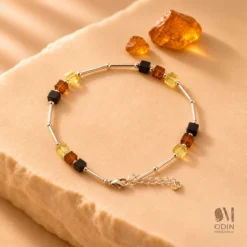
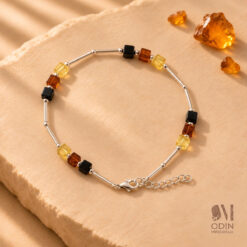
Amber and Silver Bracelets
Bracelets
Bracelets
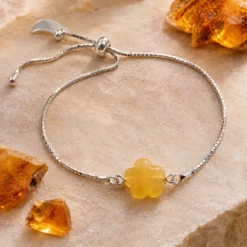
Amber and Silver Bracelets
Related products


Bracelets
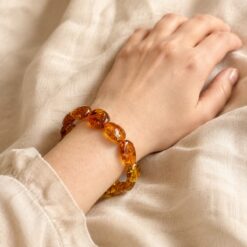
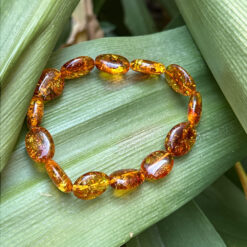
Bracelets