

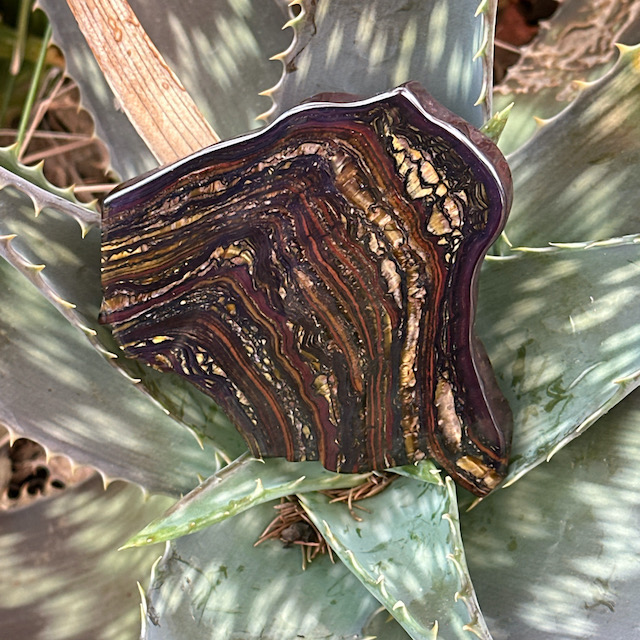
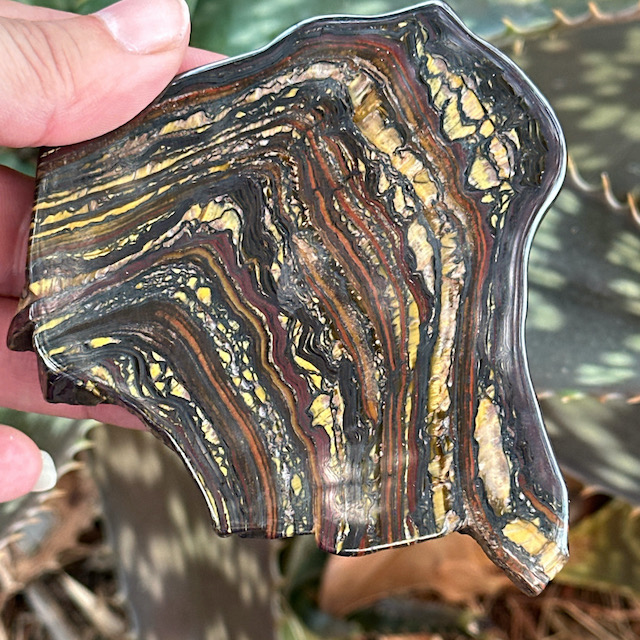
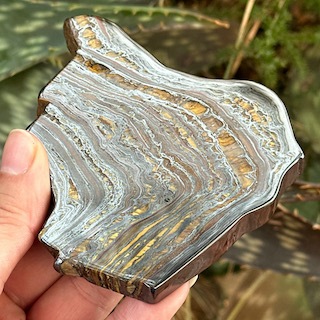
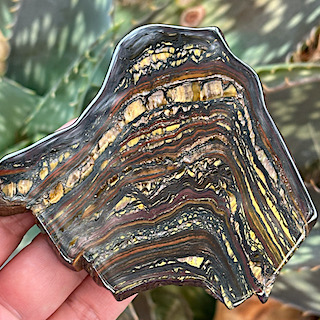
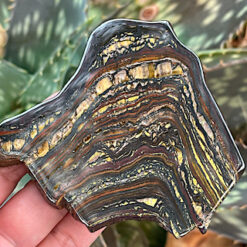
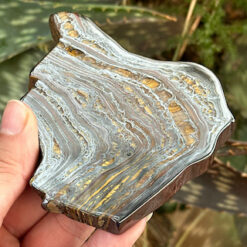
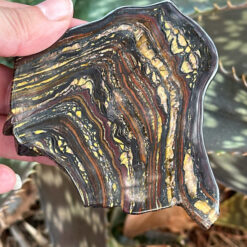
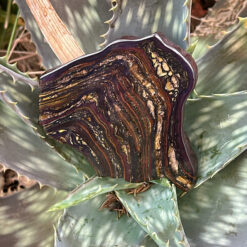
Premium tiger iron slab – medium size
38,40 € incl. VAT
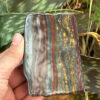
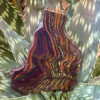
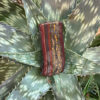
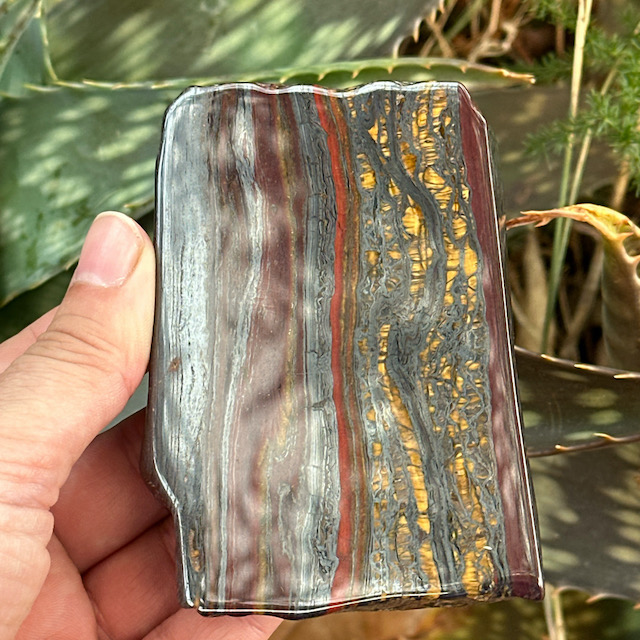
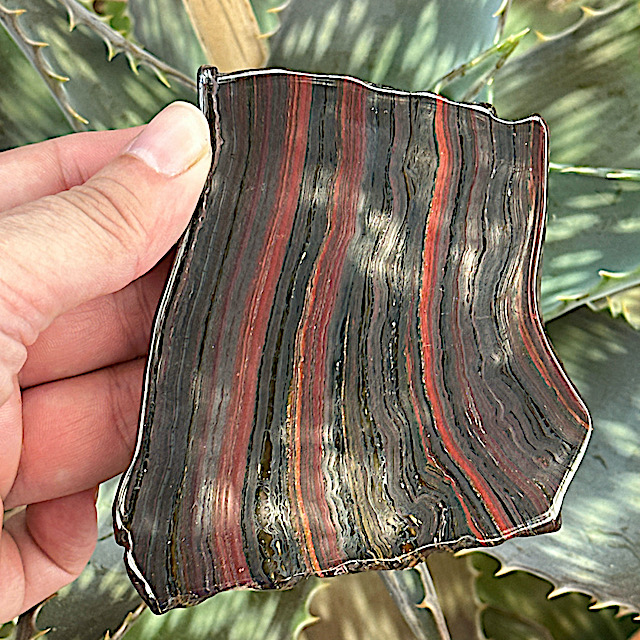
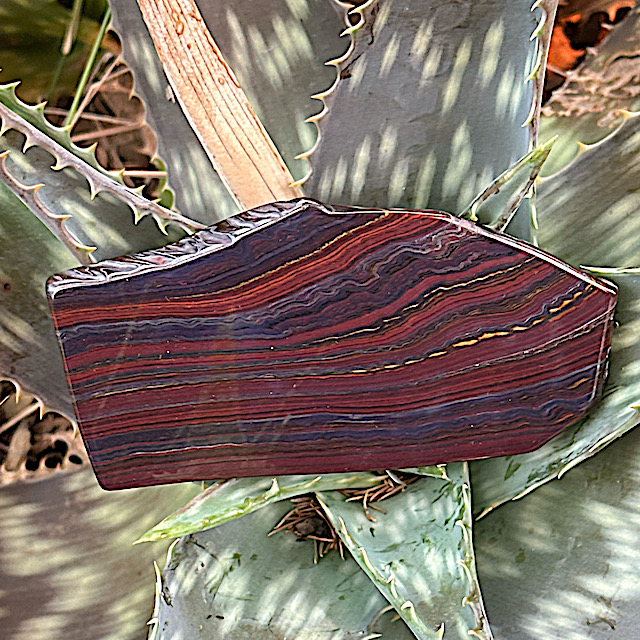
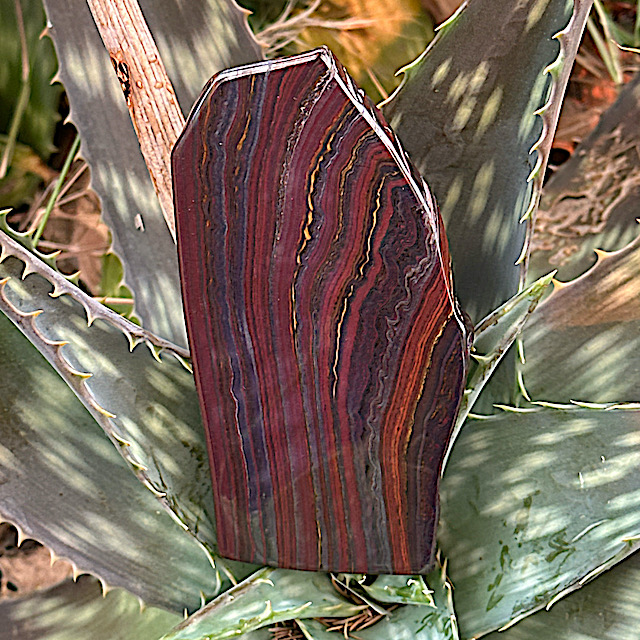
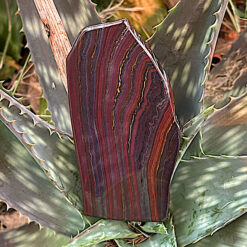
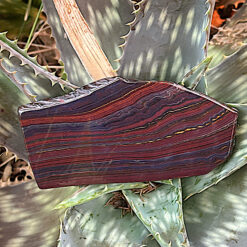
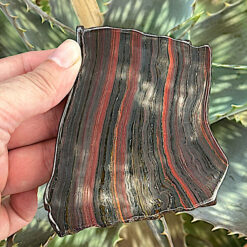
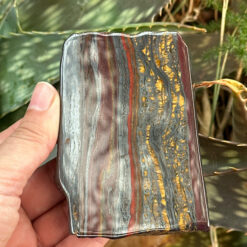
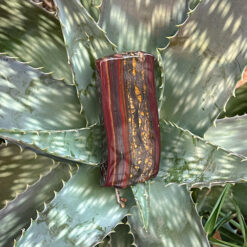
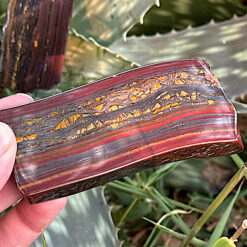
Premium Australian tiger iron slab, 9 to 10 cm. Naturally made up of tiger’s eye, red jasper and hematite, it shows beautiful contrasting bands in reddish-brown, golden yellow and metallic grey. The tiger’s eye gives it shimmering highlights that seem to move with the light.
Each slab is unique, with its own patterns and color variations, making it a lovely decor or collector’s piece.
In stock
Stone(s): tiger iron
Color: brown with shimmering red and metallic gray reflections
Dimensions: 9–10 cm x 7–9 cm
Approx. weight: 123g to 215g
Number of stones: sold individually
Shape: polished plate
Photos are non-contractual. The photos show a sample of the slabs shipped. Each slab has unique patterns.
Classification: composite rock consisting of quartz (tiger’s eye and red jasper) and hematite.
Mohs hardness: 5.5 to 7 depending on constituents
Density: variable depending on the proportion of hematite, generally around 2.7 to 3.5.
Origin: Australia
Care instructions: Tiger iron is not a fragile stone. No specific maintenance required. Clean the stone with a soft cloth.
Premium 9 to 10 cm tiger iron slab, in detail
Tiger iron, also called Tiger Iron, is a natural rock made up of three elements: tiger’s eye, red jasper and hematite. It features alternating bands in reddish-brown, golden yellow and metallic grey. The tiger’s eye areas show shimmering highlights that appear under the light.
Features: slab shape, 9–10 cm x 7–9 cm, weight 123g–215g.
Find more items in the Slabs category.
ORIGINS AND MINERALOGY
Tiger iron: origin, formation, and mineralogical properties
Origin and formation
Tiger iron, also called Tiger Iron, is a natural rock consisting mainly of tiger’s eye, red jasper, and hematite. It belongs to the family of banded iron formations, very ancient rocks characterized by alternating layers rich in silica and iron oxides.
Its formation dates back several billion years, when iron- and silica-rich sediments accumulated in primitive oceans. The gradual oxygenation of these environments favored the precipitation of iron oxides, creating the dark layers of hematite.
Throughout their geological history, these formations underwent transformations under the effect of pressure, temperature, and tectonic movements. The circulation of silica-rich fluids in certain fractures also favored the formation of fibrous structures that created the tiger’s eye.
These different processes explain the contrasting bands, sometimes folded or wavy, characteristic of tiger iron.
Composition and mineralogical properties
Tiger iron is a composite rock and not a distinct mineral species. Its main constituents are:
- Tiger’s eye: a variety of fibrous quartz (SiO₂), recognizable by its golden-yellow reflections and chatoyancy.
- Red jasper: a variety of microcrystalline quartz, whose red to reddish-brown shades are linked to the presence of iron oxides.
- Hematite: an iron oxide (Fe₂O₃), responsible for the dark bands with metallic gray reflections.
The chatoyancy of tiger iron comes from its tiger’s eye parts. It results from the interaction of light with parallel-oriented fibrous structures, producing a light reflection that seems to move when the stone is tilted.
The proportion of each of these constituents varies naturally, which explains the diversity of colors and patterns observed from one piece to another.
Deposits
Western Australia is particularly famous for its tiger iron deposits, notably in the Pilbara region and the Hamersley Ranges.
This region is home to some of the oldest known banded iron formations, several of which date back about 2.5 billion years. Australian deposits are prized for their alternations of red jasper, dark hematite, and golden tiger’s eye.
Tiger iron is notably present in the geological formations of the Ord Ranges, near Port Hedland.
History and use
Tiger iron is a witness to Earth’s ancient geological history. The iron formations to which it belongs allow geologists to study the evolution of primitive oceans and the gradual changes in their chemical composition.
Due to its contrasting bands and ability to take a high polish, tiger iron is also used as an ornamental material.
It is worked into pebbles, cabochons, spheres, decorative objects, and collector’s pieces. Polishing reveals the different mineral layers and accentuates the contrasts between the shimmering parts and the metallic zones.
Care
Tiger iron is a relatively resistant rock, but its heterogeneous composition requires some precautions.
A soft cloth, slightly damp if necessary, is sufficient for cleaning. It is best to avoid abrasive products, aggressive chemical cleaners, and prolonged immersion.
Well-being and energies
In lithotherapy, tiger iron is associated with grounding, vitality, and determination.
It is notably associated with:
- Grounding: stability and emotional balance.
- Energy and vitality: dynamism and motivation.
- Self-confidence: courage and self-assertion.
- Perseverance: concentration and determination.
- Energetic protection: sense of security and stability.
Associated chakras
- Root Chakra – MULADHARA
- Solar Plexus Chakra – MANIPURA
- Sacred Chakra – SVADHISTHANA
Associated astrological signs
- Aries
- Leo
- Capricorn
- Sagittarius
The energetic properties mentioned are part of contemporary lithotherapy practices and are not based on established scientific evidence.
Expédition : 48 à 72 heures, hors week-ends et jours fériés, après confirmation du paiement.
Livraison offerte dès 60 € en France métropolitaine.
Droit de rétractation : 14 jours pour nous signaler votre décision.
You may also like…
Exceptional Slabs
Exceptional Slabs


Purification and recharging


Related products


Exceptional Slabs