

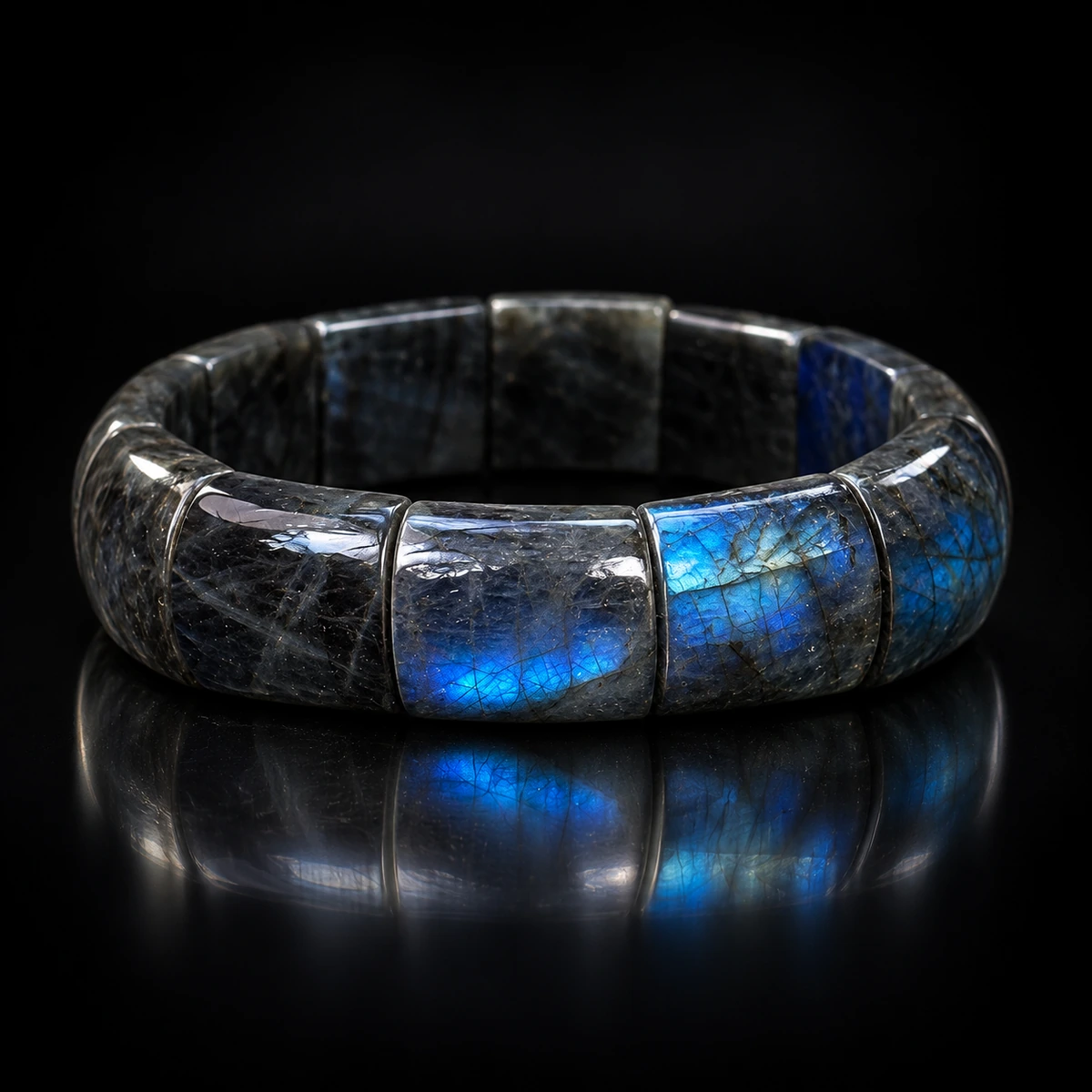

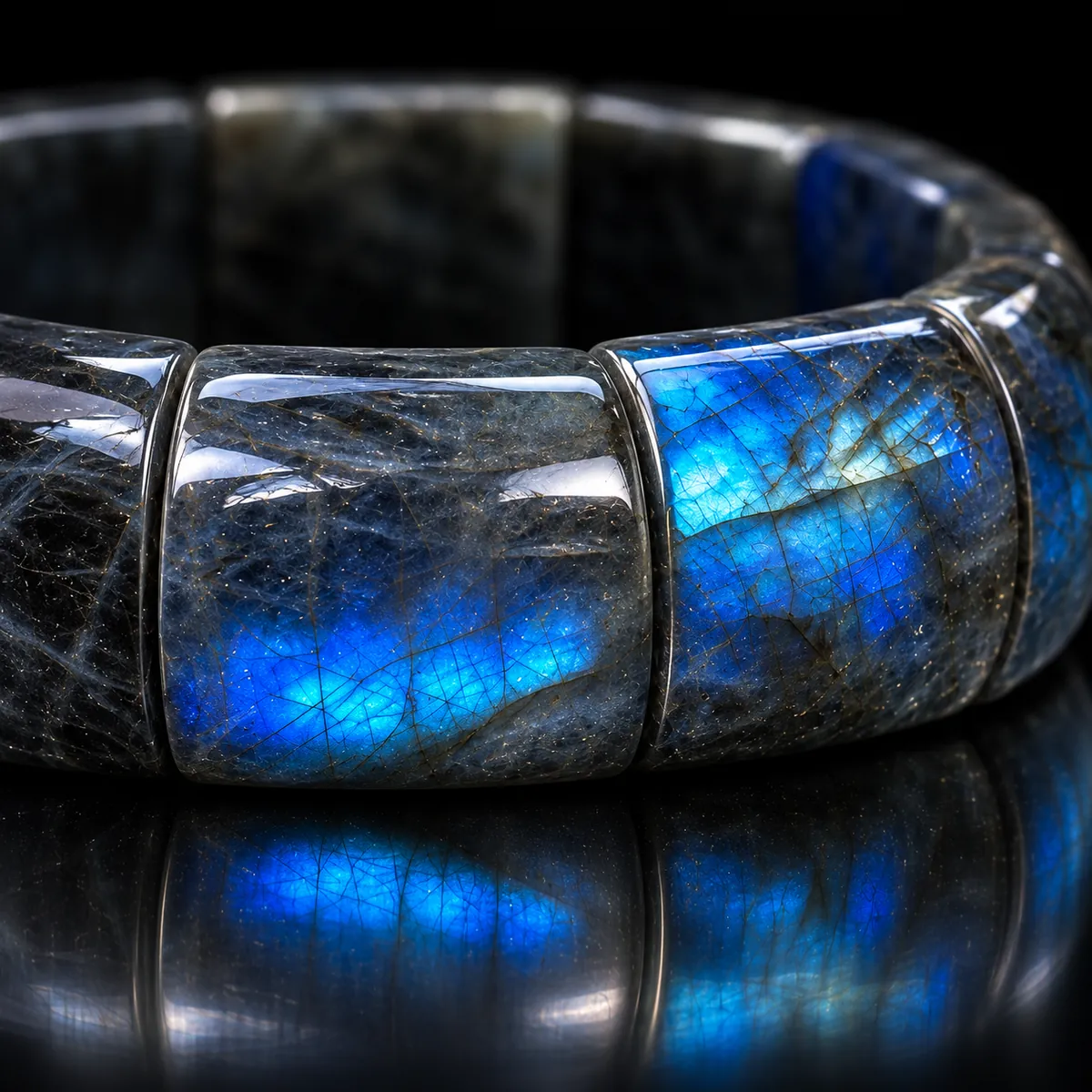



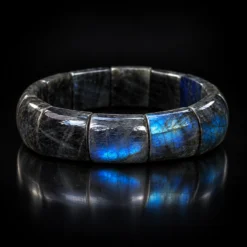
Premium blue labradorite bangle bracelet
132,00 € incl. VAT
Stunning premium blue labradorite bangle bracelet.
In stock
Stone(s): Labradorite
Color: grey with blue flashes
Bead type: rectangular plates
Thread type: durable elastic cord
Stone size: 2 cm x 1 cm
Wrist size: 16–18 cm
Photos are non-contractual
Classification: Feldspar group
Mohs hardness: 6–6.5
Density: 2.70
Origin: Madagascar
Care instructions: No specific care required. To preserve the bracelet’s elastic, avoid running the bracelet under water.
Premium labradorite bangle bracelet, in detail
Labradorite is a plagioclase feldspar, a sodium and calcium aluminosilicate. Its hardness is 6 to 6.5 on the Mohs scale. It is known for labradorescence: depending on the angle, blue, green, or golden flashes appear, caused by light interference in thin internal lamellae.
Bangle bracelet made of rectangular plates. Measurements: 2 cm x 1 cm rectangular plates; wrist size 16–18 cm.
You can browse the Square stone bracelets: plates category to see similar pieces.
ORIGINS AND MINERALOGY
Labradorite: Origin, Formation, and Mineralogical Properties
Origin and formation
Labradorite is a variety of feldspar belonging to the plagioclase series. This sodium and calcium aluminosilicate is especially known for its iridescent flashes, called labradorescence, which can reveal blue, green, golden, orange, or sometimes violet colors.
Its base color is generally grey to dark grey, sometimes almost black. The colored flashes are not pigments on the stone’s surface, but an optical phenomenon linked to its internal crystal structure.
Labradorite is found mainly in igneous rocks, notably anorthosites and gabbros, but it can also be present in certain metamorphic formations.
How does labradorite form?
Labradorite forms mainly during the cooling and crystallization of magmas containing calcium, sodium, aluminum, and silica.
It belongs to the plagioclase series, a family of feldspars with intermediate compositions between two minerals:
- Albite, sodium-rich.
- Anorthite, calcium-rich.
Labradorite corresponds to an intermediate composition, generally between 50 and 70% anorthite.
As the magma cools, feldspars crystallize gradually. Their composition depends in particular on temperature, the magma’s chemical composition, and crystallization conditions.
In some igneous rocks, plagioclase crystals can reach large sizes.
This is notably the case in anorthosites, rocks made mostly of plagioclase feldspars.
Labradorite can also form or recrystallize during metamorphic transformations affecting pre-existing rocks.
Labradorescence
Labradorescence is the characteristic optical phenomenon of certain labradorites.
When the stone is tilted under a light source, blue, green, golden, or orange flashes can appear suddenly, then disappear depending on the viewing angle.
This phenomenon results from the interaction of light with very fine internal structures in the feldspar.
As the crystal cools, variations in chemical composition can lead to the formation of microscopic feldspar lamellae with slightly different compositions.
These lamellae develop through a process called exsolution, during which an initially homogeneous structure separates into domains with distinct compositions.
When their dimensions are on the order of a few tens to a few hundreds of nanometers, they can cause light interference.
Some wavelengths are enhanced while others are reduced, producing the colors visible on the stone’s surface.
The thickness, spacing, and orientation of the lamellae determine the colors observed.
So the flashes are not identical on all labradorites, nor necessarily visible from every angle.
Why do some labradorites show more intense blue flashes?
The intensity of labradorescence mainly depends on the internal arrangement of the lamellae and the orientation of the polished surface.
A stone can have a very dark base color while revealing particularly intense blue flashes under suitable lighting.
Conversely, a labradorite can have a fine crystal structure without spectacular flashes if interference conditions are not favorable.
Cutting and polishing also play an important role.
Lapidaries orient surfaces to highlight areas with the best light effects.
That’s why cabochons, pebbles, and polished blocks can reveal different colors depending on their orientation.
The different labradorescence colors
The most commonly observed colors are blue and green, but some labradorites also show golden, yellow, orange, or more rarely violet tones.
Multicolored specimens can show several flashes on the same surface.
These variations are linked to the mineral’s internal structure and do not necessarily correspond to differences in overall chemical composition.
Some labradorites from Madagascar are especially valued for their intense blue flashes, while material from Finland can show a wide palette of colors.
Composition and mineralogical properties
Labradorite belongs to the feldspar group and the plagioclase series.
It is a sodium and calcium aluminosilicate whose composition varies between the albite and anorthite end-members.
Its general chemical formula can be represented as:
(Na,Ca)(Al,Si)₄O₈
The proportion of sodium and calcium varies depending on the crystal’s composition.
Labradorite is generally defined by an anorthite content between 50 and 70%.
Main mineralogical properties
- Classification: silicates, tectosilicate subclass
- Family: feldspars
- Series: plagioclases, albite–anorthite series
- Chemical composition: sodium and calcium aluminosilicate
- General chemical formula: (Na,Ca)(Al,Si)₄O₈
- Crystal system: triclinic
- Mohs hardness: 6 to 6.5
- Density: about 2.69 to 2.72
- Luster: vitreous
- Transparency: opaque to translucent
- Base color: light grey, dark grey, greenish grey, sometimes almost black
- Flashes: blue, green, golden, orange, sometimes violet
- Streak: white
- Cleavage: perfect in two directions
- Fracture: irregular
- Optical phenomenon: labradorescence
Crystal structure
Labradorite crystallizes in the triclinic system.
Its structure consists of a three-dimensional framework of silicon and aluminum tetrahedra, within which sodium and calcium ions are found.
Substitutions between these elements explain the composition variations within the plagioclase series.
Labradorite also shows cleavage properties characteristic of feldspars.
These cleavage planes correspond to directions along which the crystal can split more easily.
They must be considered during cutting and polishing, as they can be areas of weakness.
Labradorite, spectrolite, and moonstone: what’s the difference?
Labradorite is a plagioclase feldspar known for its iridescent flashes, especially visible on polished stones.
Spectrolite is a trade name traditionally associated with certain Finnish labradorites showing very broad and often intense color play. It is not a distinct mineral species.
Moonstone refers to feldspars that generally show an optical phenomenon called adularescence, characterized by a diffuse glow that seems to float beneath the surface.
Unlike labradorescence, which often produces relatively sharp colored flashes, adularescence appears more as a soft, moving halo of light.
Although these phenomena are linked to the internal structure of feldspars, their visual appearance and mechanisms can differ.
Deposits
Labradorite is found in several regions around the world. Some localities are especially renowned for the quality and intensity of their specimens’ flashes.
Canada – Labrador
The Labrador Peninsula in eastern Canada is the historic region that gave labradorite its name.
The first specimens that contributed to its mineralogical recognition came notably from Paul Island, in the Nain area.
The area is characterized by major anorthosite formations and other feldspar-rich igneous rocks.
Canadian labradorites can show blue, green, or golden flashes.
Madagascar
Madagascar is now a major source of labradorite for jewelry and ornamental objects.
Malagasy deposits provide material with base colors generally grey to dark grey, with sometimes very intense flashes.
Labradorites from Madagascar can notably show:
- Electric blue flashes.
- Green or turquoise tones.
- Golden or orange flashes.
- Multicolored color play.
The stones are worked into pebbles, polished blocks, spheres, cabochons, and beads for jewelry making.
Finland – Spectrolite
Finland is especially known for spectrolite, a labradorite renowned for the diversity of its colors.
The main historic deposits are in the southeast of the country, notably in the Ylämaa region.
Finnish spectrolite can show blue, green, yellow, orange, and sometimes red flashes.
Its trade name highlights the richness of its light play.
Other origins
Labradorite is also found in several other regions of the world, including:
- Norway: occurrences in feldspar-rich igneous formations.
- Russia: present in various igneous rocks.
- Ukraine: deposits associated with major anorthosite massifs.
- India: material used notably in the production of ornamental stones.
Flash quality varies depending on composition, internal structure, and the crystals’ formation conditions.
History and uses
The discovery of labradorite
Labradorite takes its name from the Labrador Peninsula in Canada, where it was recognized and described in the 18th century.
The first specimens from this region drew the attention of European naturalists because of their unusual colored flashes.
The mineral was then studied and integrated into feldspar classification as knowledge in crystallography and mineralogy advanced.
The study of labradorite also contributed to a better understanding of optical phenomena produced by microscopic mineral structures.
Labradorite in North American traditions
Labradorite is sometimes linked to traditional stories of Indigenous peoples of Labrador, in which its luminous flashes are compared to the Northern Lights.
These stories are now widely repeated in contemporary descriptions of the mineral.
They reflect the symbolic dimension attributed to its changing colors, but should not be confused with scientifically established mineralogical observations and properties.
A stone used in jewelry and decor
Labradorite is especially appreciated for making jewelry and ornamental objects.
It is notably worked into:
- Cabochons for rings and pendants.
- Beads for bracelets and necklaces.
- Polished plates for bracelets.
- Pebbles and pocket stones.
- Spheres and freeforms.
- Polished blocks and decorative pieces.
- Items for mineral collections.
The quality of the flashes, their distribution, and the polishing work contribute to the pieces’ aesthetic value.
Bracelets made of labradorite plates are especially effective at showcasing natural color variations between the different elements.
Care
With a Mohs hardness of 6 to 6.5, labradorite offers suitable resistance for jewelry making.
However, it remains sensitive to impacts, notably due to its cleavage planes.
To preserve its polish, it is recommended to clean labradorite with a soft cloth, slightly damp if needed.
Harsh chemicals, abrasive cleaners, and impacts should be avoided.
Ultrasonic and steam cleaning are not recommended as a precaution.
For bracelets: avoid prolonged immersion in water, especially when strung on elastic cord. It is also best to remove them before swimming or any activity likely to put excessive strain on the stringing.
Storing jewelry separately from other pieces helps limit rubbing and scratches.
Well-being and energies
Properties traditionally attributed to labradorite
In lithotherapy, labradorite is mainly associated with energetic protection, intuition, and emotional balance.
Its changing flashes are symbolically linked to inner perception and the ability to approach situations with greater perspective.
In contemporary energetic practices, it is often linked to:
- Energetic protection: traditionally considered a protective stone against negative influences.
- Emotional balance: associated with the search for harmony and inner stability.
- Intuition: symbolically linked to listening to oneself and inner perception.
- Self-confidence: traditionally used to support personal affirmation.
- Letting go: associated with gaining perspective on everyday concerns.
- Mental clarity: symbolically linked to focus and personal reflection.
Associated chakras
- Third eye chakra – AJNA: associated with intuition and inner perception.
- Throat chakra – VISHUDDHA: associated with communication and self-expression.
- Crown chakra – SAHASRARA: associated with consciousness and spiritual reflection.
Associated zodiac signs
- Cancer
- Sagittarius
- Pisces
These correspondences are symbolic and may vary depending on lithotherapy traditions.
Purification and recharging
Cleansing
In lithotherapy, labradorite can be symbolically purified by smoke cleansing with a palo santo stick or white sage.
Simply pass the stone or jewelry gently through the smoke for a few moments, making sure to ventilate the room well.
For bracelets, this method helps avoid prolonged immersion of elastic cords and findings.
Recharging
In contemporary energy practices, labradorite can be placed in moonlight for a few hours.
It can also be placed in a room with gentle natural light, without prolonged exposure to excessive heat.
Other practices include placing it near a quartz geode or on a selenite plate.
The energetic properties attributed to labradorite are based on lithotherapy traditions and contemporary practices. They are not scientifically proven effects and do not replace medical advice or treatment.
Expédition : 48 à 72 heures, hors week-ends et jours fériés, après confirmation du paiement.
Livraison offerte dès 60 € en France métropolitaine.
Droit de rétractation : 14 jours pour nous signaler votre décision.
You may also like…
Bracelets


Bracelets


Amber and Silver Bracelets
Related products

Bracelets
Amber and Silver Bracelets


Bracelets