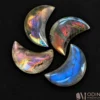


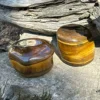
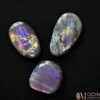
Labradorite Moon
25,00 € incl. VAT
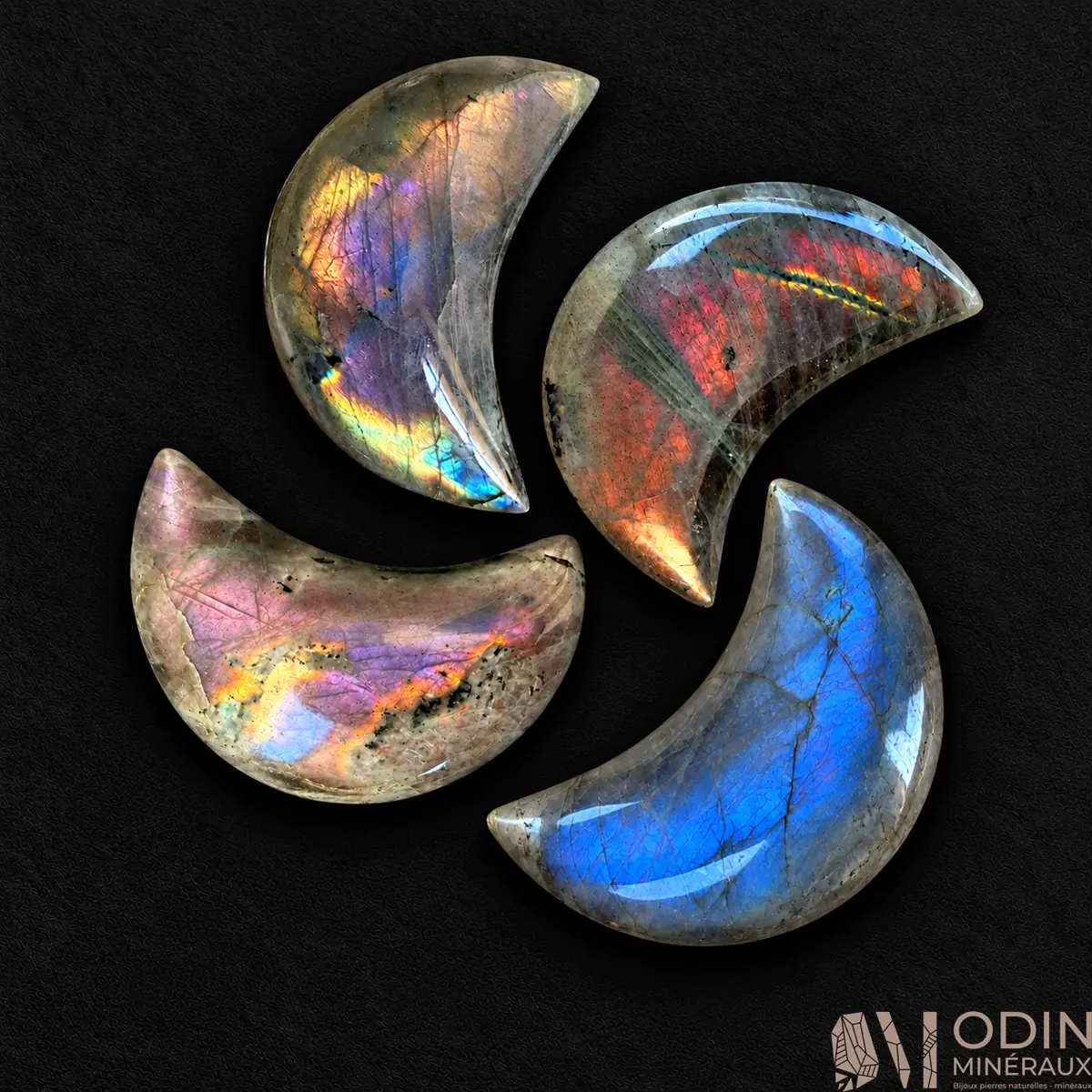
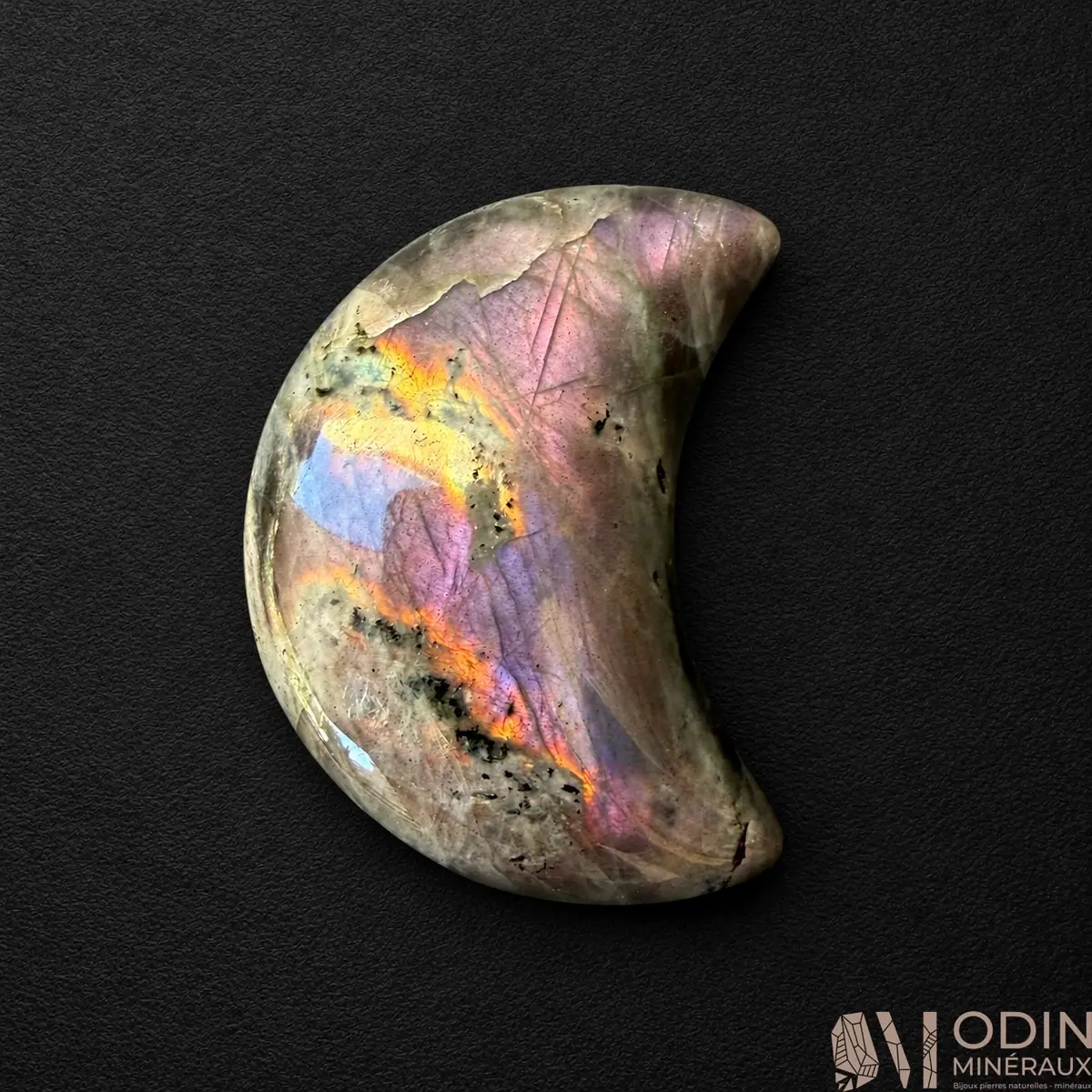
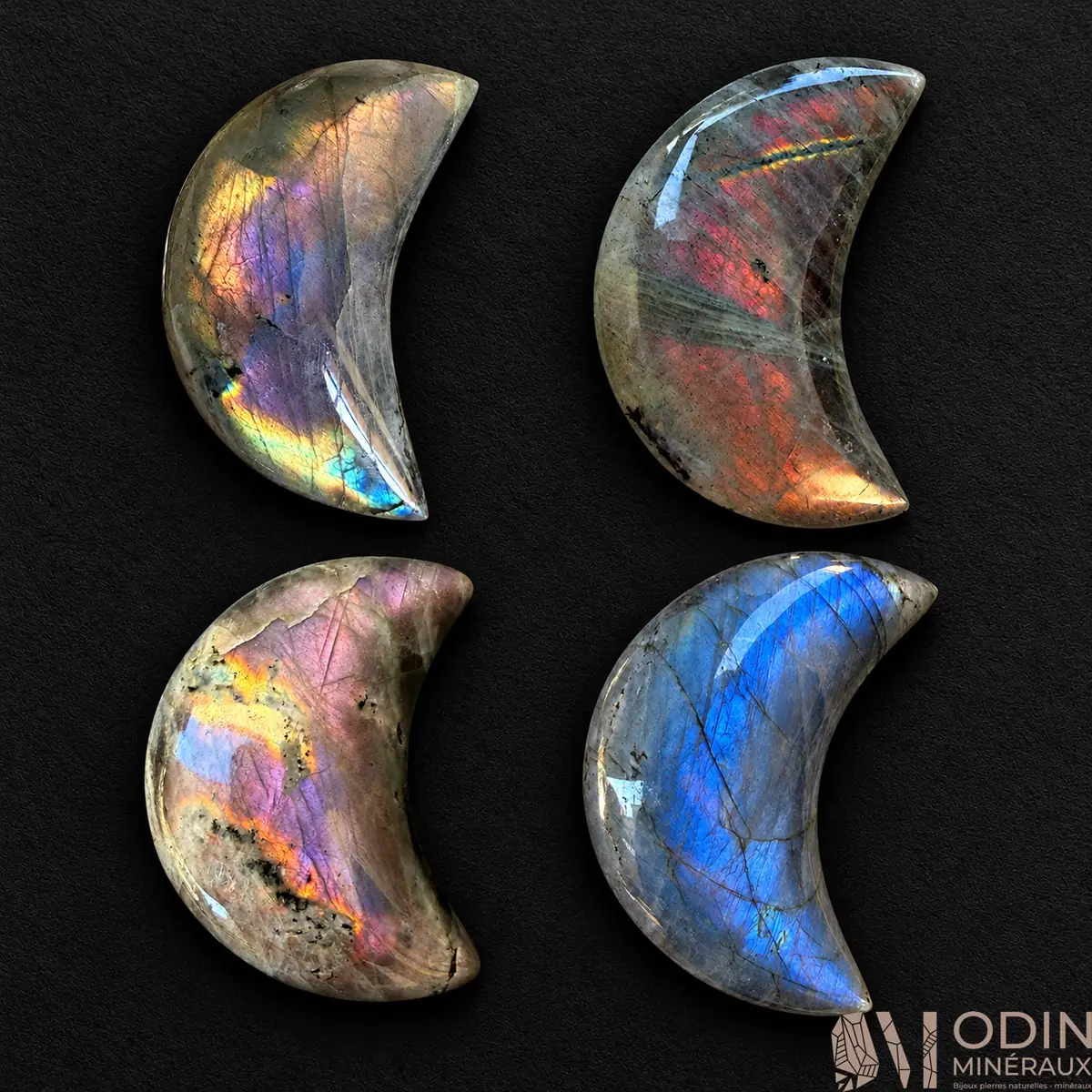
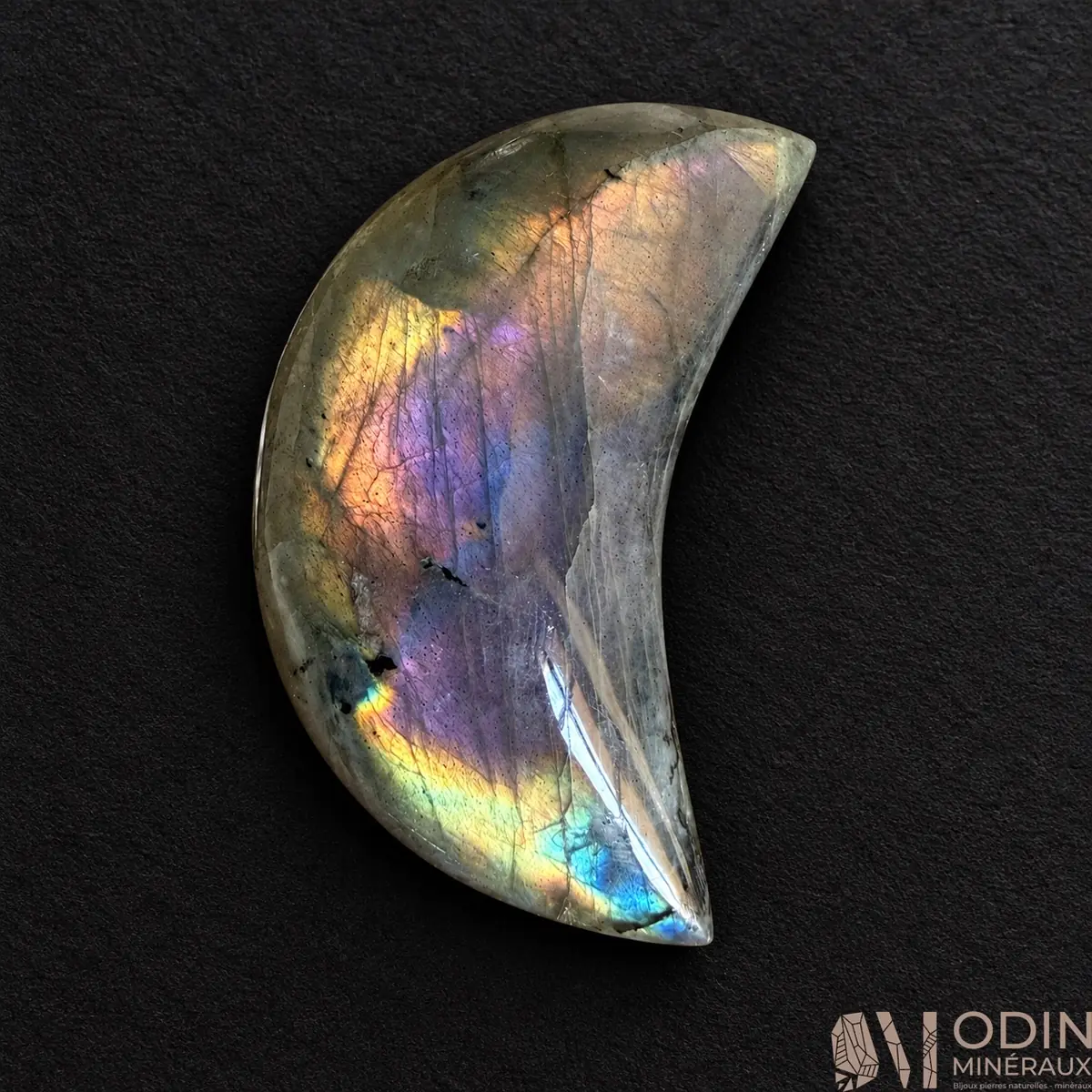
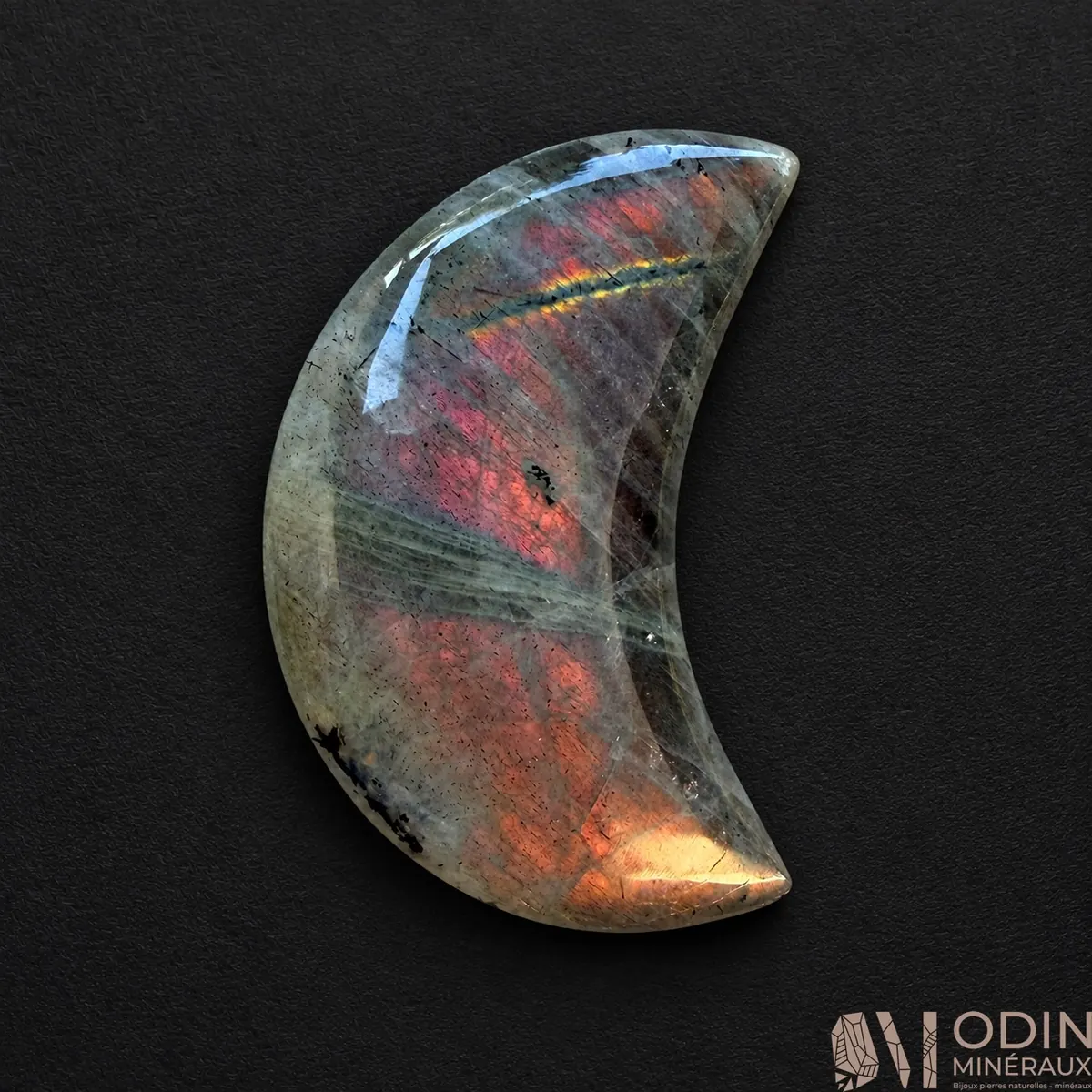
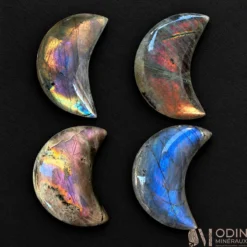
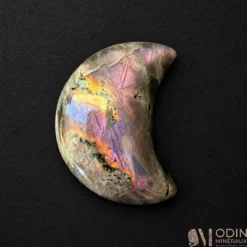
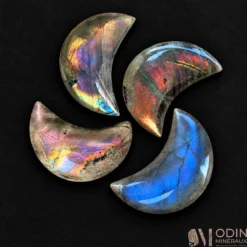
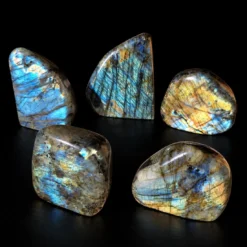
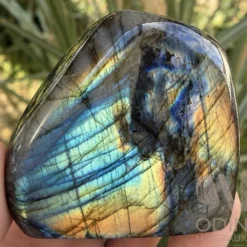
Polished labradorite moon that reveals its flashes when you tilt it in the light. Each moon has its own nuances and flashes of varying intensity.
In stock
Stone(s): labradorite
Color: gray with bluish, green, purple, or golden-yellow reflections
Dimensions: 6 to 7 cm
Approximate weight 75 to 150 g
Number of stones: sold individually
Shape: moon
Non-contractual photos.
Classification: Feldspar group
Mohs hardness: 6 – 6.5
Density: 2.70
Origin: Madagascar
Care instructions: no specific care is required. To preserve the labradorite’s reflections, you can rinse it periodically with clear water and dry it with a soft cloth.
Labradorite moon, in detail
Labradorite is a plagioclase feldspar, a sodium and calcium aluminosilicate. Its hardness is 6 to 6.5 on the Mohs scale. It is known for labradorescence: depending on the angle, blue, green, or golden reflections appear, due to light interference within thin internal lamellae.
Features listed on the sheet: moon shape, 6 to 7 cm.
To compare with other models, check the Labradorite Blocks category.
ORIGINS AND MINERALOGY
Labradorite: Origin, Formation, and Mineralogical Properties
➤ Origin & Formation of Labradorite
Labradorite is a natural mineral belonging to the feldspar family, more precisely to the plagioclase group, a series of minerals particularly widespread in the Earth’s crust.
Recognizable by its generally gray to dark color, it stands out with remarkable iridescent reflections, primarily blue and green, but also displaying golden, orange, or violet hues.
This optical phenomenon, called labradorescence, makes labradorite one of the most unique stones in the mineral world.
From a chemical perspective, labradorite is a sodium and calcium aluminosilicate, with a composition between two mineralogical poles: albite and anorthite.
It forms primarily during the cooling and crystallization of magmas, particularly in magmatic rocks such as gabbros, basalts, and anorthosites.
Anorthosites, composed mainly of plagioclase feldspars, are particularly known for containing magnificent labradorites with colorful reflections.
During the cooling of some of these rocks, microscopic transformations occur within the crystals. These can lead to the formation of extremely fine structures, responsible for labradorite’s spectacular play of colors.
Labradorescence: Why does labradorite display multicolored reflections?
Labradorescence is undoubtedly the most remarkable characteristic of this stone.
At first glance, a labradorite may appear relatively discreet, with a gray or brownish surface. However, when tilted under light, it sometimes reveals reflections of exceptional intensity.
This phenomenon results from the interaction of light with very fine internal lamellae, composed of feldspars with slightly different compositions.
These structures, formed during the cooling of the mineral, have extremely thin thicknesses, sometimes on the order of a few hundred nanometers.
When light penetrates the stone, certain wavelengths are enhanced by a phenomenon of light interference, while others are attenuated.
This mechanism produces the famous blue, green, golden, orange, and sometimes violet reflections of labradorite.
The intensity and colors observed depend notably on the thickness of the internal lamellae, their organization, and the orientation of the stone relative to the light source.
Therefore, not all labradorites exhibit visible or particularly intense labradorescence.
The lapidary’s work is also essential: appropriate cutting and polishing allow the stone to be oriented to best reveal its play of light.
This is why labradorite is particularly prized in the form of polished pebbles, cabochons, pendants, bracelets, spheres, and decorative objects.
Each stone possesses its own internal organization, making its reflections and patterns naturally unique.
Mineralogical Characteristics
- Mineral family: silicates, tectosilicate group
- Group: plagioclase feldspars
- Chemical composition: sodium and calcium aluminosilicate, intermediate between NaAlSi₃O₈ and CaAl₂Si₂O₈
- Crystal system: triclinic
- Hardness: 6 to 6.5 on the Mohs scale
- Density: generally between 2.69 and 2.72
- Luster: vitreous, sometimes pearly on certain surfaces
- Optical effect: labradorescence
- Transparency: transparent to opaque depending on the specimen, generally translucent to opaque for strongly iridescent stones
- Color: gray, dark gray, brown, greenish, or sometimes colorless, with variable iridescent reflections
- Cleavage: perfect in two main directions
- Fracture: irregular to conchoidal
- Morphology: generally tabular crystals or crystalline masses within rocks
Labradorite has suitable hardness for jewelry making and polished objects. However, its cleavage planes make it sensitive to significant impacts.
Its aesthetic value primarily relies on the intensity of its labradorescence, the extent of iridescent surfaces, the diversity of colors, and the quality of its polish.
Main Labradorite Deposits
Labradorite is found in many regions worldwide, primarily within magmatic formations rich in feldspars.
Among the best-known provenances are:
- Canada: The Labrador region, particularly around Nain, is the historical locality to which the mineral owes its name. The significant anorthosite formations in this region contain labradorites with characteristic reflections.
- Madagascar: One of the best-known provenances in the ornamental stone trade. Malagasy labradorites are particularly prized for their blue, green, and golden reflections, sometimes very extensive.
- Finland: The Ylämaa region, in the southeast of the country, is famous for spectrolite, a labradorite with particularly intense and multicolored iridescence.
- Norway: Certain magmatic formations contain feldspars exhibiting iridescent effects, used notably as ornamental stones.
- Ukraine: Several anorthosite massifs contain labradorescent feldspars, sometimes exploited in decorative rocks.
The quality and appearance of the stones can vary considerably depending on the geological conditions specific to each deposit.
Labradorite, Spectrolite, and Rainbow Moonstone: What are the differences?
These three names are often encountered in the mineral and jewelry trade, but they do not designate exactly the same presentations.
- Labradorite: A variety of plagioclase feldspar, generally gray to dark, which can exhibit blue, green, golden, or multicolored iridescent reflections.
- Spectrolite: A commercial name traditionally reserved for labradorite from Finland, particularly renowned for the intensity and diversity of its colors.
- Rainbow Moonstone: A commercial name generally designating a clear and translucent labradorite exhibiting colorful reflections, often blue. Despite its name, it is not classic moonstone in the mineralogical sense.
These distinctions are important, as commercial names do not always correspond to different mineral species.
Spectrolite remains a labradorite, while rainbow moonstone generally belongs to the plagioclase family, unlike classic moonstone, which is associated with alkali feldspars.
➤ Discovery & history through the ages
🌍 18th Century: The European Discovery of Labradorite
Although the people of Labrador naturally knew the rocks of their territory long before the arrival of Europeans, the documented mineralogical history of labradorite begins in the 18th century.
In the 1770s, Moravian missionaries established on the coasts of Labrador, in present-day Canada, noticed stones exhibiting remarkable bluish reflections.
Samples, particularly from Paul Island, near Nain, were brought back to Europe, where their unusual colors attracted the attention of naturalists and collectors.
The mineral gradually took the name labradorite, in reference to its region of origin.
Its denomination is traditionally attributed to the German mineralogist Abraham Gottlob Werner, around 1780.
At that time, the mechanisms responsible for its iridescent reflections were still poorly understood, but its particular appearance quickly contributed to its renown.
🏛️ 19th Century: Development of Mineralogy and Ornamental Uses
In the 19th century, the development of geological sciences deepened knowledge about feldspars and the large magmatic formations where labradorite is found.
Advances in mineralogy and crystallography gradually contributed to a better understanding of its composition and its place within the plagioclase family.
At the same time, stones with iridescent reflections attracted the interest of lapidaries and artisans, who exploited their optical properties for the creation of decorative objects.
Polishing notably revealed the depth of the blue and green reflections, giving some pieces an almost metallic appearance.
Labradorite thus found its place among ornamental materials appreciated for their originality, both as polished stones and in certain jewelry creations.
✨ The Northern Lights: A Symbolism Associated with the Far North
The reflections of labradorite naturally evoke the colors of the aurora borealis, particularly visible in the northern regions to which the stone owes its name.
This resemblance gave rise to many symbolic narratives associating the lights of the sky with colors trapped in the rock.
A frequently told legend today speaks of northern lights captured in the stone, whose fragments would have retained their brilliance.
This story is often presented as an Inuit legend. However, its exact origin and antiquity remain difficult to establish from reliable historical sources.
🔬 20th Century: The Discovery of Finnish Spectrolite
The history of labradorite saw a new episode in the early 1940s, in Finland.
In the Ylämaa region, construction work on a line of military fortifications uncovered a labradorite exhibiting particularly intense colors.
This discovery revealed a stone capable of displaying a wide palette of reflections, ranging from deep blue to green, yellow, orange, and sometimes red.
It would be marketed under the name spectrolite, a term evoking the richness of its light spectrum.
Spectrolite gradually became an emblematic ornamental stone of Finland, used in jewelry, sculpture, and various decorative objects.
During the 20th century, advances in microscopy and crystallography also led to a better understanding of the internal structures responsible for labradorescence.
The study of these structures reveals that the colored reflections do not result from surface pigmentation, but from an optical phenomenon related to the microscopic organization of the crystal.
Today, natural labradorite remains highly prized by collectors, jewelry designers, and mineral enthusiasts.
Its changing reflections and the diversity of its provenances make it a particularly sought-after stone for cabochons, jewelry, polished pebbles, spheres, and decorative pieces.
➤ Labradorite Care: Natural Stones and Jewelry
With a hardness of 6 to 6.5 on the Mohs scale, labradorite has good resistance to daily scratches, but remains relatively sensitive to impacts due to its cleavage planes.
Proper care helps preserve its polish and the brilliance of its iridescent reflections.
Care for Polished Pebbles and Minerals
To clean a labradorite pebble, use a soft, slightly damp cloth.
If necessary, you can use a little warm water and mild soap, then rinse the stone briefly before drying it thoroughly.
Avoid harsh chemicals, ultrasonic cleaning, steam, and significant impacts.
These simple steps help preserve the quality of the polish and allow you to enjoy the natural labradorescence of the mineral for a long time.
Care for Labradorite Jewelry
For bracelets, necklaces, pendants, and other labradorite jewelry, preferably use a clean, soft, and slightly damp cloth.
Avoid prolonged immersion, especially when jewelry contains elastic thread, metal elements, or glued parts.
It is also advisable to limit contact with perfumes, cosmetics, and household products.
When not wearing your jewelry, store it preferably in a soft pouch or a separate compartment to avoid friction with harder stones.
➤ Well-being & Energies: The Symbolism of Labradorite
In contemporary lithotherapy traditions, labradorite is primarily associated with protection, intuition, and emotional balance.
Its changing reflections and its ability to reveal colors under light give it a symbolism of transformation, inner discovery, and renewal.
According to lithotherapy practices, labradorite is particularly appreciated for:
- Protection: It symbolizes a shield against negative energies and external influences.
- Emotional balance: It is associated with appeasement, serenity, and the search for inner stability.
- Vitality: It symbolically accompanies periods of fatigue and decreased motivation.
- Intuition: It is traditionally linked to self-listening, perception, and the development of intuition.
- Creativity: It encourages imagination, inspiration, and the emergence of new ideas.
- Social relations: It symbolizes openness to others and, according to some beliefs, promotes exchanges and friendly ties.
- Change: It represents transformation, adaptation, and perseverance in the face of new life stages.
Labradorite is also associated, in certain energetic traditions, with the third eye chakra, symbolically linked to intuition, as well as the throat chakra, associated with expression and communication.
It is particularly appreciated in contemporary lithotherapy practices by people working in support roles, who attribute to it a symbolic role of protection against external influences.
Warning: The energetic properties mentioned are based on lithotherapy beliefs. They are not scientifically proven. The use of minerals for well-being does not constitute medical treatment and cannot replace medical advice or follow-up.
Purification and Recharging of Labradorite in Lithotherapy
In lithotherapy traditions, purification and recharging correspond to symbolic rituals, distinct from the physical maintenance of the mineral.
Purification:
Labradorite can be symbolically purified by fumigation with white sage or palo santo.
Burn a stick of sage or palo santo, then gently pass your stone near the smoke, without exposing it directly to the flame.
Be sure to perform this operation in a well-ventilated room.
Recharging:
In lithotherapy practices, labradorite is traditionally associated with the soft light of the sun or moon.
It is common to place it for a few hours in a bright spot, avoiding strong heat and prolonged direct sun exposure.
Other symbolic practices involve placing the stone:
- In a quartz geode
- On a quartz cluster
- On an amethyst druse
- On a selenite plate
These practices belong to the traditions of lithotherapy and do not modify the physical or chemical properties of the mineral.
Expédition : 48 à 72 heures, hors week-ends et jours fériés, après confirmation du paiement.
Livraison offerte dès 60 € en France métropolitaine.
Droit de rétractation : 14 jours pour nous signaler votre décision.
You may also like…


Labradorite Blocks


Labradorite Blocks


Purification and recharging


Related products
Labradorite Blocks


Labradorite Blocks
Minerals
Labradorite Blocks