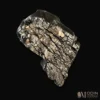


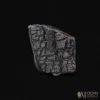
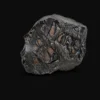
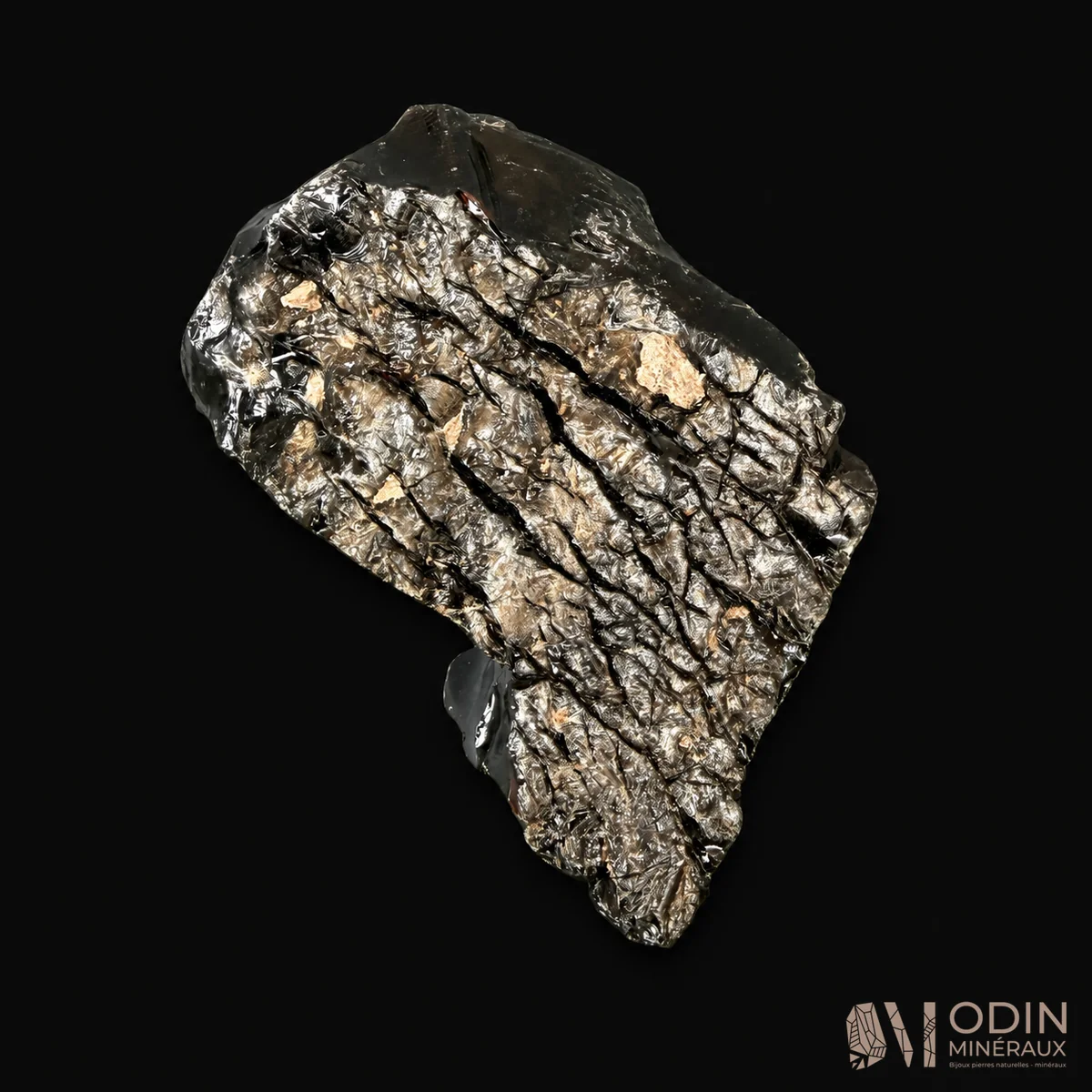
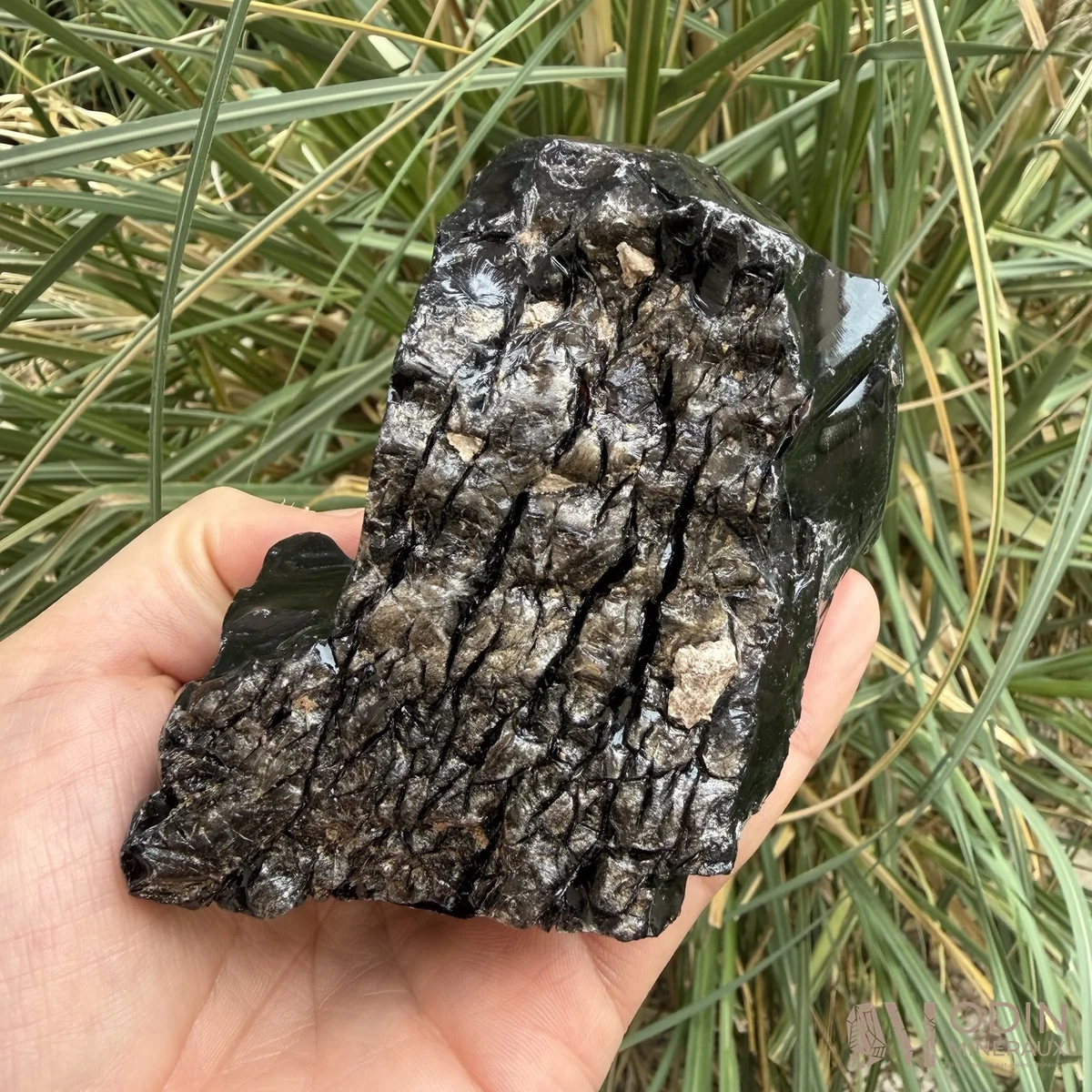
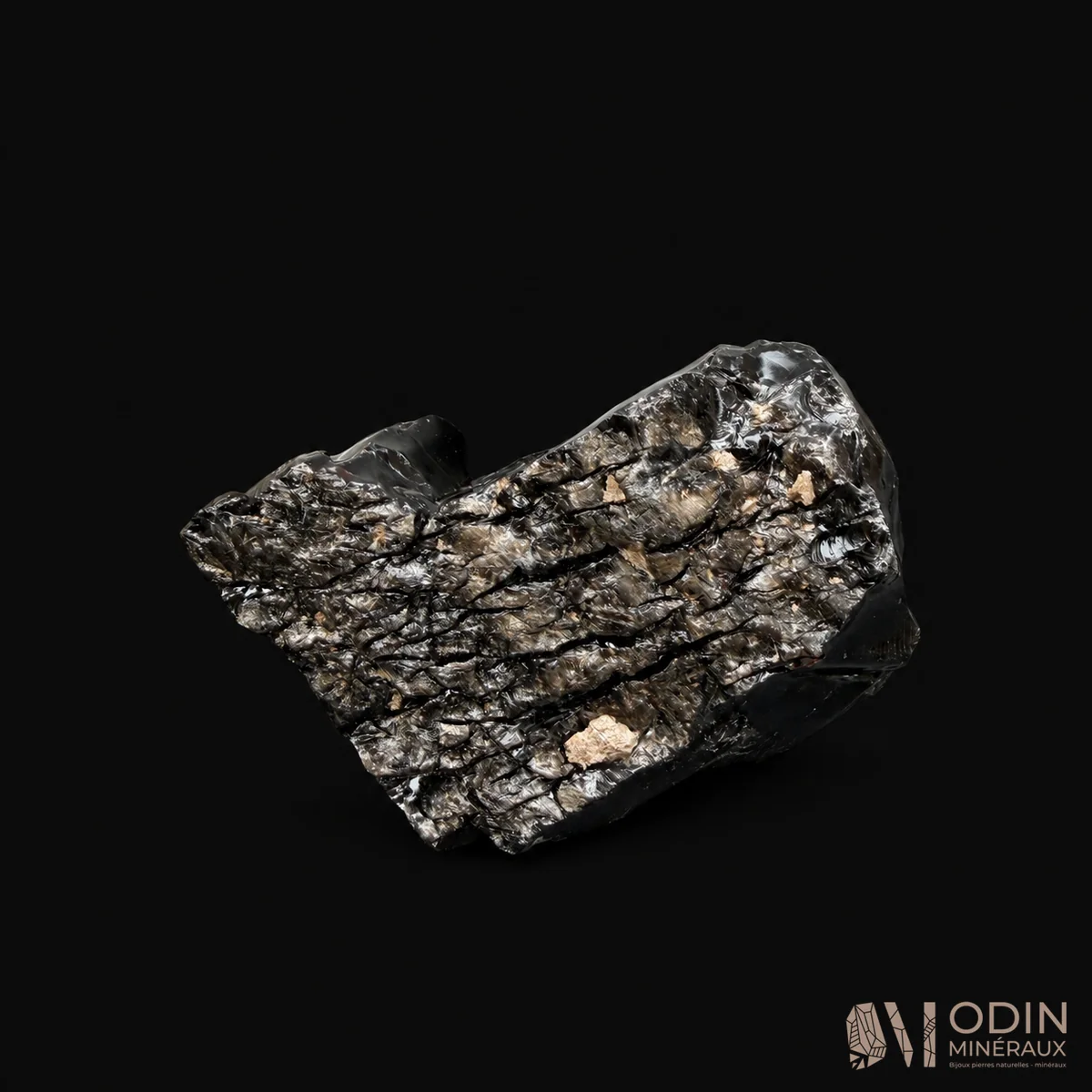
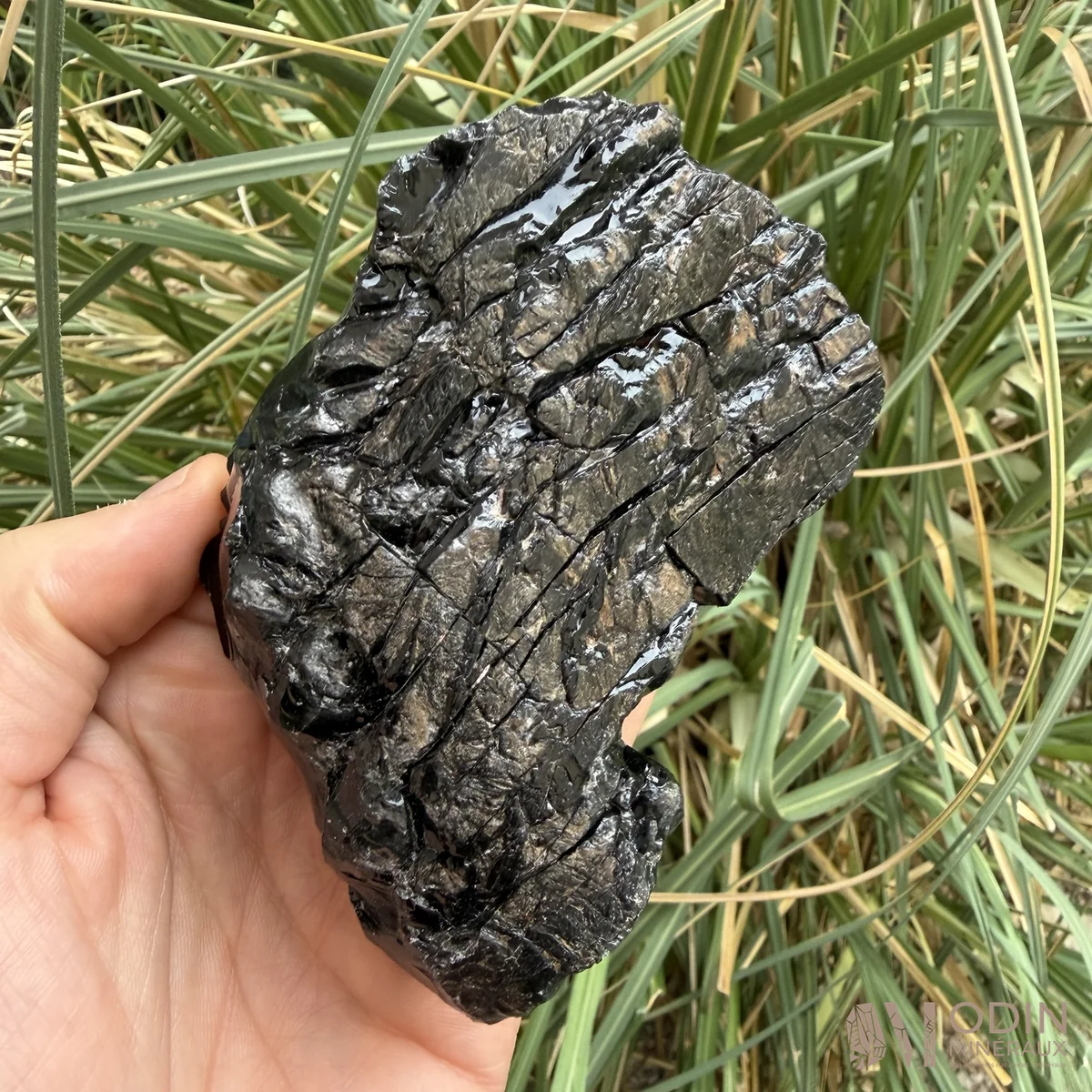
Dragon skin obsidian block 418g – Unique Piece
89,00 € incl. VAT
 Origin: Armenia
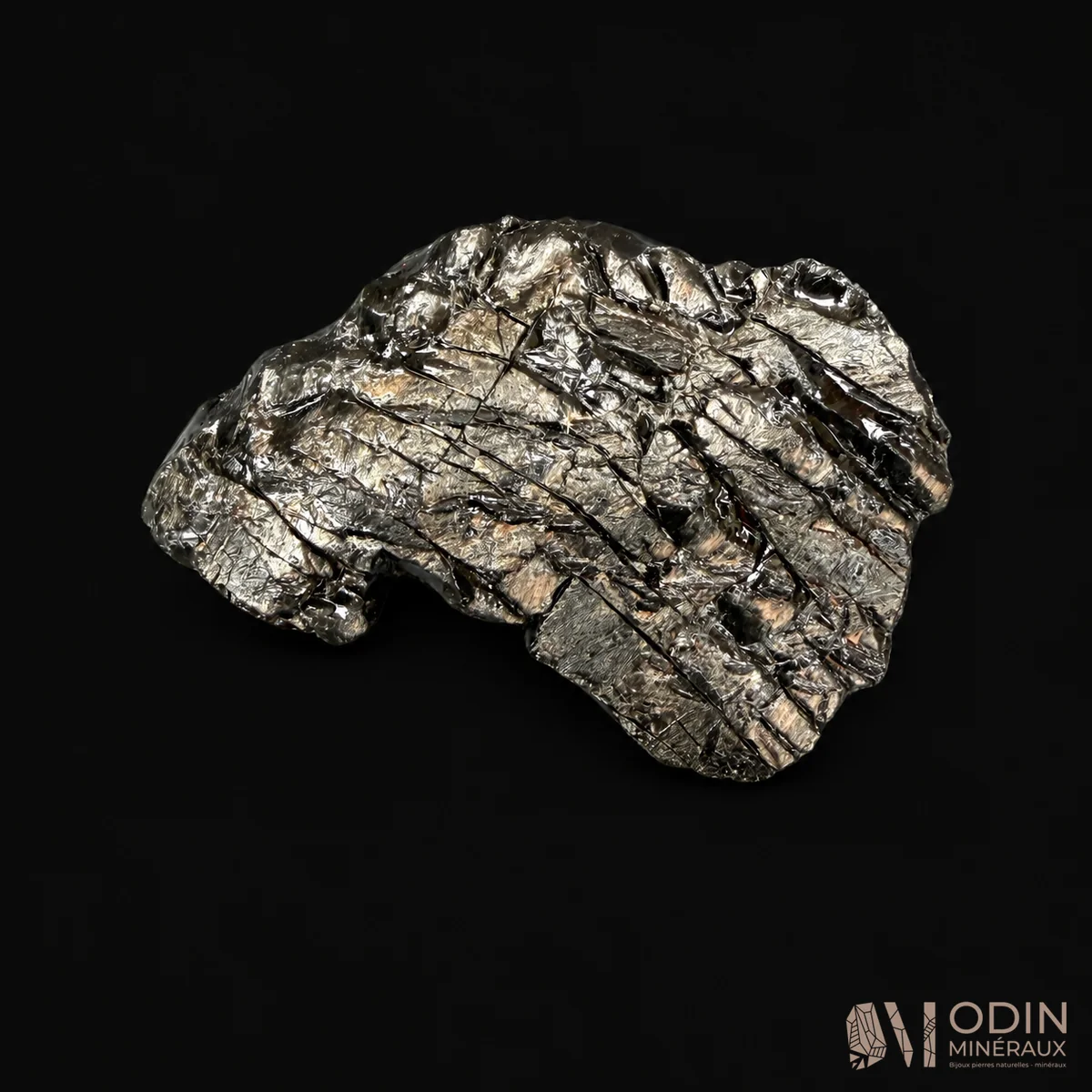
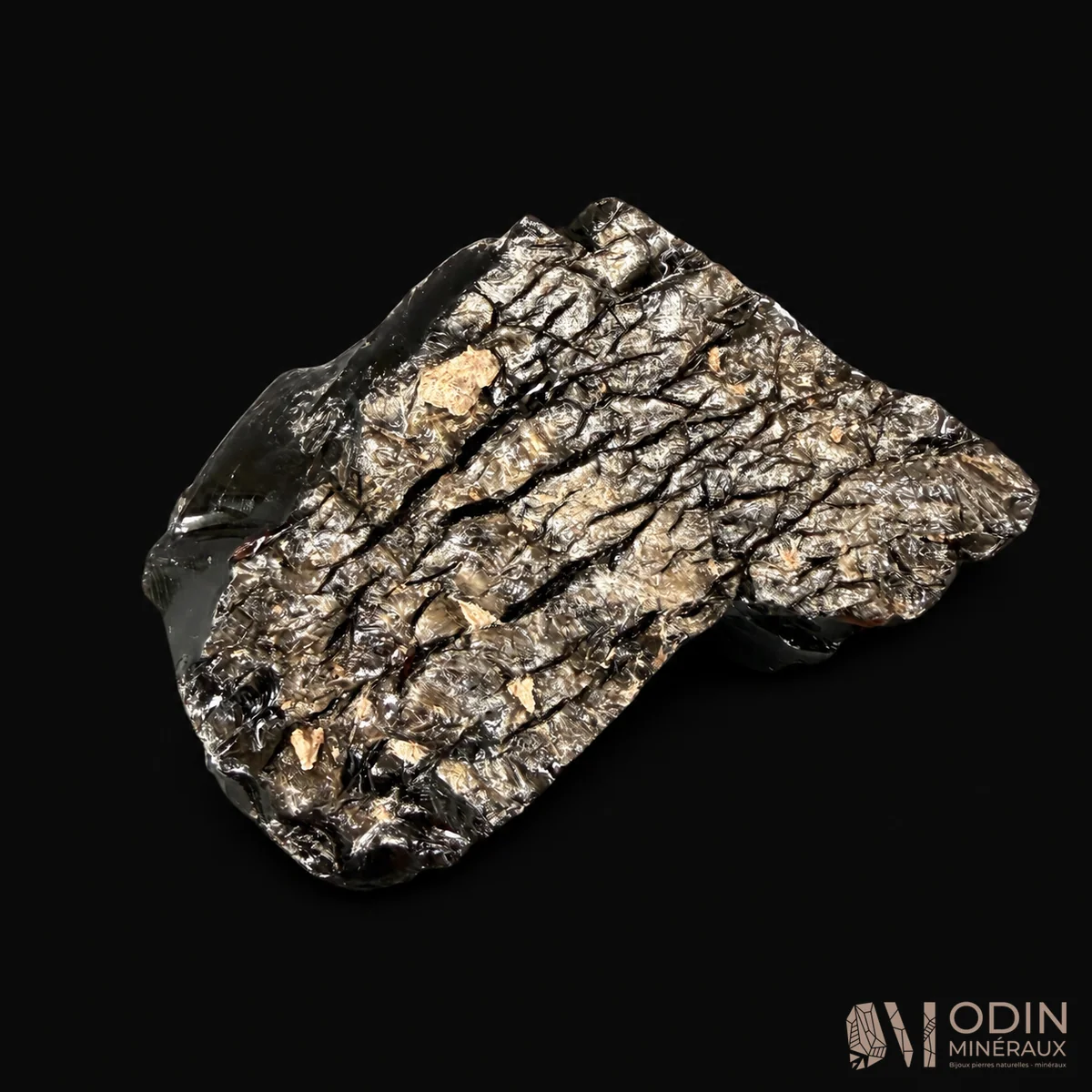
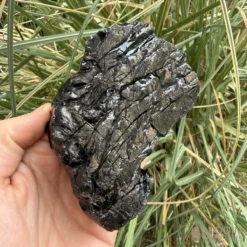
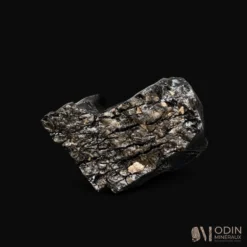
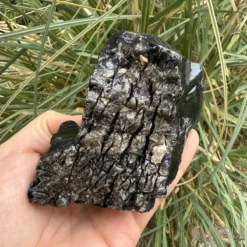
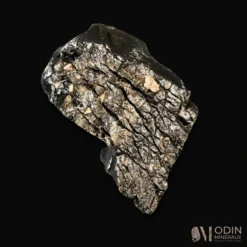
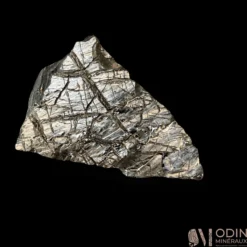
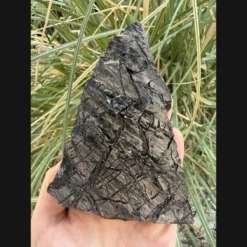
Raw “Dragon Skin” obsidian block of 418g, from Armenia. This obsidian stands out for its naturally irregular surface, with scaly reliefs reminiscent of dragon skin. The contrast between matte areas and glassy black surfaces gives it a particularly original look, ideal for a decorative piece.
In stock
Stone(s): “dragon skin” obsidian (trade name)
Special features: crust with visible fractures (“dragon skin effect”)
Color: black with silver and copper reflections
Dimensions: approx. W.6cm x H.10cm
Approximate weight: 418g
Stone size: rough
Contractual photos.
Classification: rhyolite group
Mohs hardness: 5-5.5
Density: 2.3-2.6
Origin: Armenia
Care instructions: no specific maintenance required. With its sharp edges, it is extremely sharp. Handle with care, preferably with gloves when removing from its packaging and transporting.
About this item: Dragon skin obsidian block 418g
Obsidian isn’t a mineral but a natural volcanic glass, formed by the rapid cooling of silica-rich lava. It therefore has no crystalline structure.
Size: approx. W.6cm x H.10cm, weight 418g.
The Free forms category brings together other listings of the same type.
Origins and minéralogy
Obsidian: origin, formation and mineralogical properties
➤ Origin & formation of obsidian
Obsidian is a natural volcanic glass, generally black, formed from silica-rich lava. Unlike crystallized minerals, it has an amorphous structure, with no regular long-range atomic organization.
It belongs to glassy volcanic igneous rocks and is found mainly in regions that have experienced silica-rich volcanic activity.
Obsidian stands out for its glassy luster, conchoidal fracture, and its ability to produce extremely sharp edges when it breaks.
Although black obsidian is the most common, there are different natural appearances: snowflake obsidian, golden, silver, rainbow, mahogany, and also materials with specific surface textures, such as Dragon Skin obsidian, also called dragon skin obsidian.
These names reflect differences in color, texture, or optical effects. They do not refer to separate mineral species.
How does obsidian form?
Obsidian mainly forms from silica-rich volcanic lavas, generally rhyolitic in composition.
Silica increases magma viscosity, which limits the mobility of chemical elements and can slow crystal growth.
When cooling and solidification conditions don’t allow significant crystallization, the material keeps a glassy structure.
This process is called vitrification.
Obsidian can notably form:
- In certain rhyolitic lava flows.
- Near the margins of volcanic flows.
- In silica-rich lava domes.
- In certain volcanic formations cooled in contact with air or water.
- In areas where magma solidifies without developing a significant crystalline structure.
The volcanic glass formed this way can contain small gas bubbles, mineral inclusions, and structures showing lava flow.
These features contribute to the different looks seen in natural obsidians.
So obsidian formation doesn’t depend only on cooling speed. Magma composition, viscosity, water content, and gas evolution also play an important role in preserving its glassy structure.
Why is obsidian generally black?
Obsidian’s black color is mainly linked to elements present in the volcanic glass, especially iron and very fine mineral particles.
These components absorb much of visible light, giving the material its dark appearance.
Depending on its composition and thickness, obsidian can still show brown, gray, or greenish tones.
Some fragments that look black can become partly translucent when viewed in a thin enough area with a light source behind them.
Color and transparency can also vary depending on the concentration and distribution of inclusions.
Why does obsidian have particularly sharp edges?
One of obsidian’s most remarkable features is its conchoidal fracture.
This type of fracture produces curved surfaces, generally smooth and reminiscent of the inside of a shell.
Without crystalline cleavage planes, volcanic glass breaks according to how mechanical stress propagates through the material.
This fracture can produce extremely fine, sharp edges.
That’s exactly why obsidian was highly sought after for making cutting tools in Prehistory.
Obsidian remains brittle and sensitive to impacts. Its ability to produce very fine edges shouldn’t be confused with high impact resistance.
Dragon Skin obsidian or dragon skin: a specific natural texture
Dragon Skin obsidian, also called Dragon Skin Obsidian or dragon skin obsidian, is a trade name used for certain obsidians with a naturally irregular surface.
It differs from classic black obsidian by a texture reminiscent of scales, plates, or reptile skin.
Blocks can show a network of reliefs, small cracks, and areas with sometimes polygonal outlines, giving the surface a cracked or scaly look.
These patterns aren’t necessarily regular and can vary greatly from one specimen to another.
Some pieces combine black, glassy areas with more matte, grayish, or slightly weathered parts.
This difference in appearance helps distinguish natural surfaces from fresh breaks, usually smoother and shinier.
Why does Dragon Skin obsidian have this scaly look?
The specific appearance of this obsidian could be linked to several physical and chemical processes during the cooling of volcanic glass and its later evolution.
1. Cooling and contraction of volcanic glass
When a mass of lava cools, it undergoes thermal contraction.
Mechanical stresses can then develop inside or on the surface of the material.
Under certain conditions, these stresses encourage the appearance of cracks organized into networks.
Cracks can meet and outline small surfaces with irregular edges.
When these structures become visible on the surface of obsidian, they can create a crackled look.
2. Hydration of volcanic glass
Obsidian can gradually absorb small amounts of water in contact with its environment.
This phenomenon is called volcanic glass hydration.
Water can penetrate surface areas and certain cracks, causing local changes in the structure and properties of the glass.
Under specific conditions, hydration can promote the development of curved, sometimes concentric fracture networks.
These structures are known in geology as perlitic fractures.
They are notably characteristic of perlite, a volcanic glass that has undergone hydration and certain transformations.
However, the presence of a crack network isn’t enough to establish that an obsidian has become a perlite.
3. Surface weathering and erosion
Over time, surfaces exposed to natural conditions can also change.
Temperature variations, water circulation, and weathering processes can act differently on fractured zones and on more compact parts of the glass.
This evolution can accentuate certain pre-existing reliefs or make crack networks more visible.
It can also contribute to matte areas or surface colorations different from fresh glass.
Can we determine exactly how Dragon Skin obsidian forms?
Mechanisms of thermal cracking, hydration, and weathering of volcanic glasses are well documented.
However, the exact origin of the texture sold under the name Dragon Skin obsidian isn’t established by a specific geological study identifying a single mechanism.
So it would be excessive to claim that all these obsidians formed exclusively through thermal contraction, hydration, or erosion.
These processes are geologically plausible explanations, but their relative importance depends on the material’s history.
Dragon Skin obsidian from Armenia
Armenia has major obsidian deposits, linked to its volcanic history and the diversity of its geological formations.
The country lies in the Lesser Caucasus region, marked by several episodes of volcanism during recent geological periods.
Volcanic formations produced obsidians of different colors and textures, including black, gray, brown, and sometimes translucent.
Blocks sold under the name Dragon Skin from Armenia are sought after for their scaly surface, especially visible when kept raw.
Unlike polished obsidians, their appeal mainly lies in:
- Natural reliefs.
- Networks of cracks and scaly patterns.
- Contrasts between matte and glassy surfaces.
- The block’s shape.
- How well its natural surface is preserved.
Large raw pieces make it possible to observe these features over a relatively wide surface.
The Dragon Skin texture doesn’t correspond to a new mineral species or a specific chemical composition. It’s a particular appearance of natural volcanic glass.
Mineralogical and geological characteristics of obsidian
- Nature: natural volcanic glass.
- Classification: glassy volcanic igneous rock.
- Type: generally rhyolitic in composition, silica-rich.
- Mineralogical family: not applicable to volcanic glass as a whole.
- Chemical composition: mainly silica, with oxides of aluminum, iron, sodium, potassium, and other elements.
- Chemical formula: no single formula, as composition varies.
- Silica content: generally around 70 to 77% for rhyolitic obsidians.
- Structure: amorphous, with no regular crystal lattice.
- Crystal system: not applicable.
- Mohs hardness: generally 5 to 5.5.
- Density: generally around 2.3 to 2.6 g/cm³.
- Luster: glassy, sometimes matte on weathered surfaces.
- Transparency: opaque to translucent depending on color and thickness.
- Colors: mainly black, gray, brown, reddish-brown, and sometimes dark green.
- Cleavage: none.
- Fracture: conchoidal.
- Tenacity: brittle.
- Possible inclusions: gas bubbles, microlites, and small mineral crystals.
- Possible textures: massive, banded, flow, spherulitic, or showing fracture networks.
- Main environments: silica-rich volcanic flows and domes.
These characteristics correspond to the general properties of obsidian.
The possible presence of crystals or inclusions doesn’t change the amorphous nature of its glassy matrix.
Main obsidian deposits
Obsidian is found mainly in regions that have experienced silica-rich volcanic activity.
Armenia
Armenia has many obsidian sources, notably in the volcanic areas of Arteni, Gutansar, Hatis, and the Gegham Mountains.
Other deposits are known in the Tsaghkunyats and Syunik ranges.
These formations provided materials used since Prehistory to make tools and worked objects.
Archaeological and geochemical studies show that some Armenian obsidians circulated over long distances.
Mexico
Mexico is especially known for its black, golden, silver, and rainbow obsidians.
The Pachuca region, in the state of Hidalgo, is one of the historically important sources.
Mexican obsidians were widely exploited by different Mesoamerican civilizations.
United States
The United States has several notable deposits, especially in California, Oregon, and the Yellowstone region.
Glass Mountain, the Mono Craters, and Davis Creek are known for different volcanic obsidians.
Italy
Italy has historic deposits on the volcanic islands of Lipari and Pantelleria.
Lipari obsidian played an important role in prehistoric exchanges in the Mediterranean.
Greece
The island of Milos, in the Cyclades, is a major historic source.
Its obsidian was exploited from Prehistory and distributed across several regions of the Aegean basin.
Iceland
Iceland has many volcanic formations, including certain rhyolitic flows and domes containing obsidian.
Turkey and the Caucasus region
Eastern Anatolia and the Caucasus also have major volcanic formations rich in natural glass.
These regions were important sources of raw materials for prehistoric populations.
Different varieties and appearances of obsidian
Several names help distinguish obsidians by color, texture, or observed optical effects.
Black obsidian
Black obsidian is the most common appearance.
It generally has a uniform dark look and a glassy luster that’s especially visible after polishing.
It’s used to make tumbled stones, spheres, jewelry, carvings, and decorative objects.
Snowflake obsidian
Snowflake obsidian stands out for its white or light gray patterns spread through a black matrix.
These designs correspond to crystalline aggregates developed within the volcanic glass, generally linked to cristobalite.
They result from a process of devitrification, during which parts of the glass evolve toward a crystalline organization.
Golden obsidian
Golden obsidian shows metallic yellow, gold, or bronze reflections.
These effects are linked to the presence of oriented microscopic structures and inclusions, notably very fine bubbles, which interact with light.
They’re especially visible under certain lighting angles.
Silver obsidian
Silver obsidian shows a similar phenomenon, with silvery-gray or metallic reflections.
Inclusion orientation and polishing quality influence how these reflections are perceived.
Rainbow obsidian
Rainbow obsidian shows iridescence that can reveal green, purple, blue, gold, or pink tones.
These colors are produced by interactions between light and certain microstructures or inclusions in the glass.
The exact mechanisms can vary depending on the material.
Celestial Eye obsidian
The trade name Celestial Eye is generally used for certain rainbow obsidians showing multiple color zones, sometimes arranged in concentric rings after polishing.
It’s not a distinct mineral species.
Mahogany obsidian
Mahogany obsidian shows black areas combined with brown or reddish tones, mainly linked to iron compounds.
Fire obsidian
Fire obsidian is known for particularly vivid, sometimes multicolored iridescence.
These effects depend on the glass’s internal structure, its inclusions, and the orientation of the polished surface.
Dragon Skin obsidian
Dragon Skin obsidian differs from these appearances by its scaly or crackled surface look.
Unlike snowflake obsidian, its patterns don’t necessarily correspond to crystalline aggregates developed within the mass of the glass.
Dragon Skin is characterized above all by reliefs and structures visible on the block’s natural surface.
This feature explains its appeal as a raw ornamental stone.
➤ Discovery & history through the ages
🪨 Prehistory: obsidian and the first cutting tools
Obsidian has been used since Prehistory to make tools.
Its conchoidal fracture makes it possible to obtain flakes with particularly fine edges.
Prehistoric populations used this property to make:
- Blades.
- Scrapers.
- Knives.
- Projectile points.
- Cutting and material-prep tools.
Making these objects required mastery of percussion techniques and, later, pressure flaking.
Archaeologists have identified obsidian industries in several regions of the world, notably the Near East, the Caucasus, the Mediterranean, and the Americas.
🌍 Prehistory of the Caucasus: the importance of Armenian obsidian
Armenia is a particularly important region for studying prehistoric exchange and human movement.
The presence of many obsidian deposits encouraged its exploitation as early as the Paleolithic.
Archaeological research has notably made it possible to determine the geographic origin of thousands of artifacts thanks to their chemical composition.
Provenance studies show that populations sometimes used several supply sources, including deposits far from where they lived.
In the Neolithic, obsidian was widely used to make blades and tools.
The site of Aknashen-Khatunarkh, in the Ararat valley, notably shows specialized production of long obsidian blades at the start of the 6th millennium BCE.
These discoveries highlight the economic and technical importance of volcanic glass in this region.
🏺 Mediterranean Neolithic: growth of trade
In the Mediterranean basin, obsidian played an important role in exchanges between different populations.
The deposits of Milos, Greece, and Lipari, Italy, are among the best documented sources.
Transporting obsidian to regions sometimes hundreds of kilometers away shows the existence of raw-material circulation networks.
The ability to identify deposits from their chemical signature now makes it possible to reconstruct part of these exchanges.
🏛️ Ancient Egypt: decorative objects and funerary uses
In Ancient Egypt, obsidian was used to make ornamental objects and certain decorative elements.
One of the best-known examples is the funerary mask of Tutankhamun, dating to the 14th century BCE.
The mask’s pupils are made of black obsidian, combined with other materials used to depict the eyes.
The color and luster of volcanic glass help reproduce the depth of the gaze.
Obsidian is also documented in certain funerary objects and amulets.
Amulets representing two fingers were notably placed near the incision made during mummification.
These objects were linked to protective beliefs and the symbolism of healing the wound.
However, their existence doesn’t allow us to claim that Egyptian priests systematically used obsidian knives to ward off negative energies.
📜 Roman Antiquity: origin of the name obsidian
The name obsidian is traditionally linked to the Latin expression obsianus lapis.
The Roman naturalist Pliny the Elder, in the 1st century CE, mentions a stone discovered in Ethiopia by a person named Obsius, sometimes given as Obsidius depending on interpretations.
This name gradually gave rise to the modern term obsidian.
The stone was then known for its dark color and its resemblance to certain artificial glasses.
🪞 Mesoamerican civilizations: mirrors and ceremonial objects
In pre-Columbian civilizations of Central America, obsidian held an important place.
Mesoamerican peoples used it notably to make blades, projectile points, adornments, and ceremonial items.
Among the Aztecs, obsidian is also associated with the god Tezcatlipoca, whose name is generally translated as “smoking mirror”.
Circular mirrors made of carefully polished obsidian have been found in different archaeological contexts.
Their reflective surface produced a dark, glossy image.
These mirrors had strong symbolic and religious value.
Some interpretations link them to divination practices or representations of power.
However, it’s important to distinguish these documented religious uses from claims that the mirrors truly made it possible to predict the future.
⚒️ Modern eras: evolution of knapping techniques
With the development of new materials and metallurgical techniques, the use of obsidian to make cutting tools gradually declined in many regions.
It still remains of strong interest for making decorative and adornment objects.
Improved sawing and polishing techniques make it possible to work different obsidians, especially those with specific optical effects.
Spheres, cabochons, carvings, and jewelry gradually highlight its reflections, colors, and visual depth.
🔬 20th century: geology, archaeology, and provenance analyses
During the 20th century, obsidian became a particularly important material for archaeological research.
Its chemical composition retains characteristics linked to its original volcanic environment.
Analysis methods make it possible to compare archaeological objects with different deposits.
Geochemical studies help reconstruct trade networks and movements of ancient populations.
Researchers also develop methods based on obsidian hydration, which can help with chronological study of certain artifacts under appropriate conditions.
At the same time, geological research helps better understand vitrification, devitrification, and weathering processes in volcanic glasses.
🌐 21st century: research and appreciation of different obsidians
Today, obsidian remains of strong scientific interest in several fields.
It’s notably studied to understand:
- The dynamics of silica-rich lavas.
- How volcanic glasses form.
- Hydration and devitrification processes.
- Interactions between light and microscopic inclusions.
- Raw-material exchanges in Prehistory.
At the same time, the different natural appearances of obsidian continue to be appreciated in jewelry, decor, and mineral collections.
Materials with unusual textures, like Dragon Skin obsidian from Armenia, illustrate the diversity of looks a single type of volcanic glass can have.
➤ Obsidian care: raw blocks, polished stones, and jewelry
Obsidian has a hardness generally between 5 and 5.5 on the Mohs scale.
Like other natural glasses, it’s brittle and sensitive to impacts.
Its conchoidal fracture can produce particularly sharp edges.
Proper care is therefore needed to preserve its surface and limit the risk of damage.
Caring for raw Dragon Skin obsidian blocks
Dragon Skin obsidian blocks have an irregular surface, made up of many reliefs and sometimes cracked areas.
These features require a few specific precautions.
To preserve raw blocks:
- Handle with care, as some edges can be particularly sharp.
- Avoid impacts and drops that could cause chips or fractures.
- Dust the surface gently with a soft, dry brush.
- Avoid hard brushes and abrasive products.
- Do not use ultrasonic or steam cleaning.
- Avoid strong temperature changes.
- Place large blocks on a stable support suited to their weight.
Scaly textures can trap dust in small cavities.
Dry cleaning is generally enough to preserve their look.
Prolonged immersion isn’t recommended for pieces with cracks or weathered areas.
For large blocks, it’s especially important to prevent any risk of tipping or falling.
Care for tumbled stones, spheres, and polished minerals
To clean a tumbled stone or an obsidian sphere, use a soft, slightly damp cloth.
A quick wash with lukewarm water and mild soap is generally possible for compact, untreated obsidian.
Then rinse gently and dry the surface carefully.
Avoid harsh chemicals, ultrasonic cleaning, and impacts.
Spheres should be placed on stable stands to limit the risk of falling.
Care for obsidian jewelry
For bracelets, necklaces, pendants, and other jewelry, use a soft cloth.
Avoid prolonged immersion, especially when jewelry includes elastic cords, metal parts, or glued elements.
Also limit repeated contact with perfumes, cosmetics, and household products.
When you’re not wearing your jewelry, store it in a soft pouch or an individual box.
These precautions help preserve the polish and limit scratches or chips.
➤ Well-being & energies: the symbolism of obsidian
In lithotherapy, obsidian is mainly associated with protection, grounding, introspection, and inner transformation.
Its black color and volcanic origin give it symbolism linked to strength, stability, and self-knowledge.
According to lithotherapy beliefs and practices, obsidian is notably appreciated for:
- Protection: it’s said to symbolize the ability to shield oneself from negative influences.
- Grounding: it’s said to be linked to stability and a symbolic connection with the Earth.
- Introspection: it’s said to represent self-knowledge and exploring emotions.
- Self-confidence: it’s said to symbolize inner strength and determination.
- Personal transformation: it’s said to be linked to periods of change and renewal.
- Serenity: it’s said to evoke refocusing and the search for balance.
- Meditation: it’s often used as a symbolic support for reflection and concentration.
In some practices, obsidian is placed in a living or work space as a symbol of protection and stability.
Black obsidian spheres are also used in some meditative or divinatory practices.
These associations are based on lithotherapy beliefs and don’t correspond to physical or therapeutic properties scientifically proven.
Symbolic properties of different obsidians
Black obsidian
In lithotherapy, black obsidian is mainly associated with protection, grounding, and introspection.
It’s said to symbolize inner strength, clarity, and the ability to step back.
Golden obsidian
Golden obsidian is associated with self-confidence, willpower, and personal reflection.
Its golden reflections also give it symbolism linked to prosperity and success.
Silver sheen obsidian
Silver obsidian is mainly linked to introspection, patience, and perseverance.
It’s said to symbolize clarity of mind and awareness.
Rainbow obsidian or Celestial Eye
In lithotherapy, these obsidians are associated with intuition, emotional harmony, and personal transformation.
Their colorful iridescence gives them symbolism linked to openness and inner exploration.
Snowflake obsidian
Snowflake obsidian is mainly associated with balance, moderation, and serenity.
Its white patterns on a black background are said to symbolically evoke harmony between contrasts and the search for stability.
Dragon Skin obsidian
In lithotherapy, Dragon Skin obsidian can be associated with the general symbolism of black obsidian: protection, grounding, and inner strength.
Its scaly texture can also symbolically evoke resilience and transformation.
These correspondences are contemporary interpretations linked to its appearance and don’t constitute specific energetic properties scientifically established for this appearance.
Obsidian and chakras
In contemporary energy practices, obsidian is mainly associated with the root chakra, also called Muladhara.
This symbolic center is linked to stability, security, and grounding.
Some obsidians, especially black, silver, and rainbow varieties, can also be associated with the third eye chakra, or Ajna, symbolically linked to intuition and introspection.
These associations vary depending on lithotherapy practices.
Obsidian and astrological signs
In lithotherapy, obsidian is often associated with the following signs:
- Scorpio: for introspection, transformation, and emotional depth.
- Capricorn: for stability, perseverance, and grounding.
- Sagittarius: for the search for knowledge and openness to new perspectives.
These correspondences are symbolic and can vary depending on the author.
Warning: the energetic properties mentioned are based on lithotherapy beliefs. They are not scientifically proven. Using minerals for well-being is not a medical treatment and cannot replace medical advice or follow-up.
Purification and recharging obsidian in lithotherapy
In lithotherapy, purification and recharging are symbolic rituals, separate from physical care of the material.
Purification:
Obsidian can be symbolically purified by smoke cleansing using white sage or palo santo.
Light a sage or palo santo stick, then gently pass the stone near the smoke, without exposing it directly to the flame.
Do this in a well-ventilated room.
Some practices also use a quick rinse under water.
For raw blocks with cracks or very irregular surfaces, like Dragon Skin obsidian, it’s best to choose a no-immersion method.
Recharging:
In lithotherapy, obsidian is generally associated with soft moonlight.
It is common to place it in a bright spot, avoiding high heat and sudden temperature changes.
Other symbolic practices involve placing the stone:
- In a quartz geode.
- Near an amethyst druse.
- On a selenite plate, taking care not to damage it.
- Near a decorative support featuring the flower of life symbol.
For large blocks of Dragon Skin obsidian, it is best to limit handling and choose a stable setup.
These practices belong to lithotherapy and do not alter the physical, chemical, or structural properties of the obsidian.
Expédition : 48 à 72 heures, hors week-ends et jours fériés, après confirmation du paiement.
Livraison offerte dès 60 € en France métropolitaine.
Droit de rétractation : 14 jours pour nous signaler votre décision.
You may also like…
Freeform Minerals


Freeform Minerals


Purification and recharging


Related products


Freeform Minerals


Freeform Minerals


Freeform Minerals


Minerals