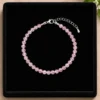


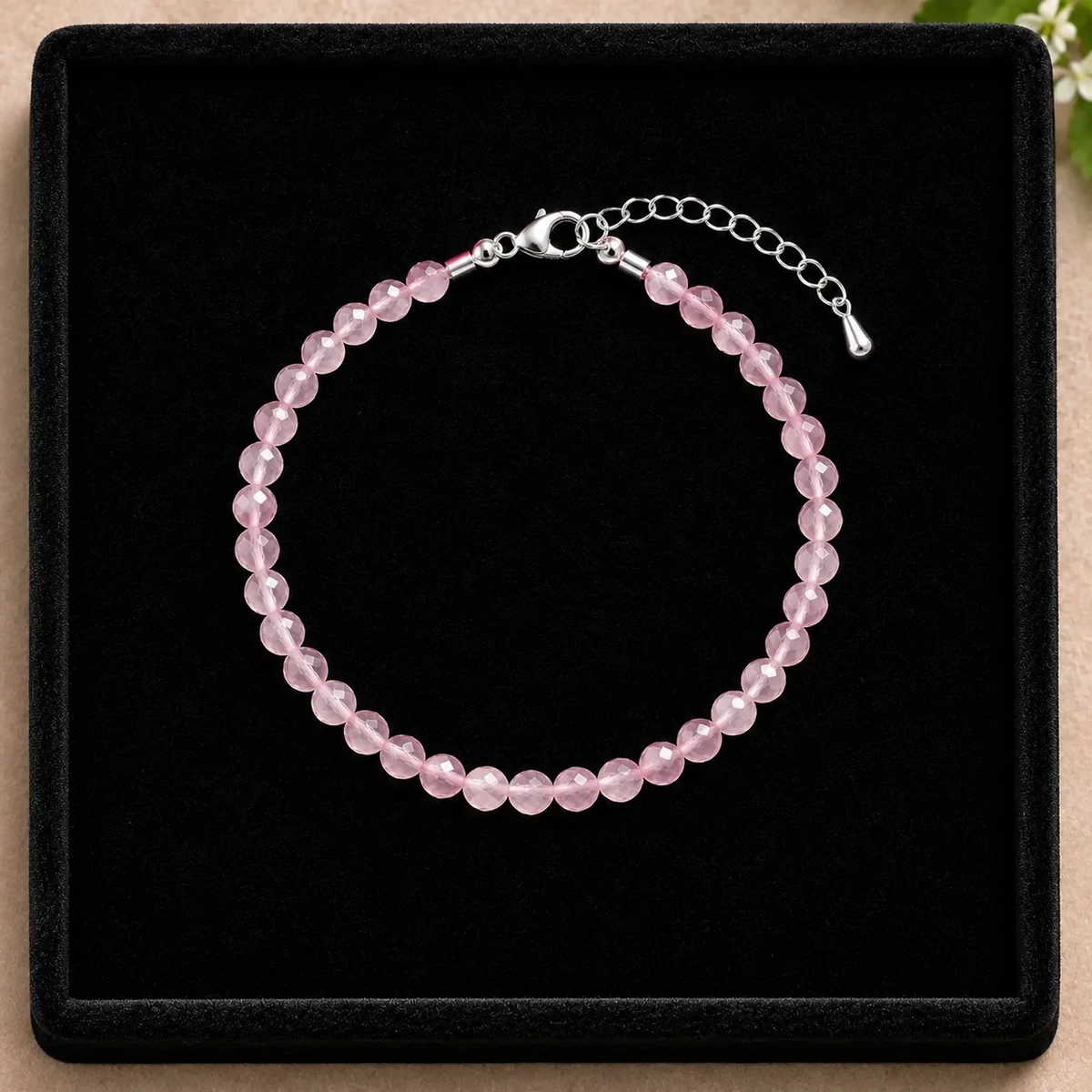
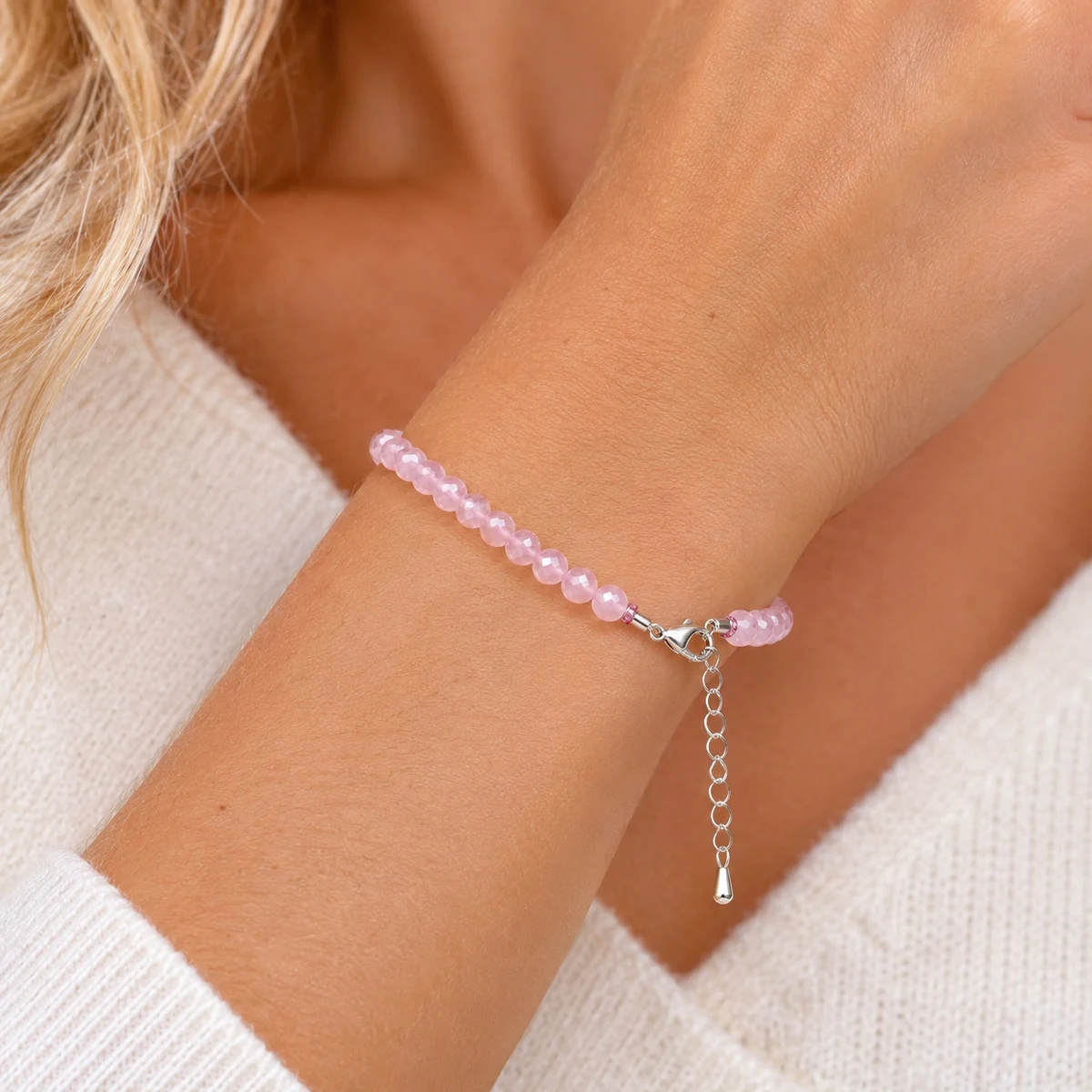
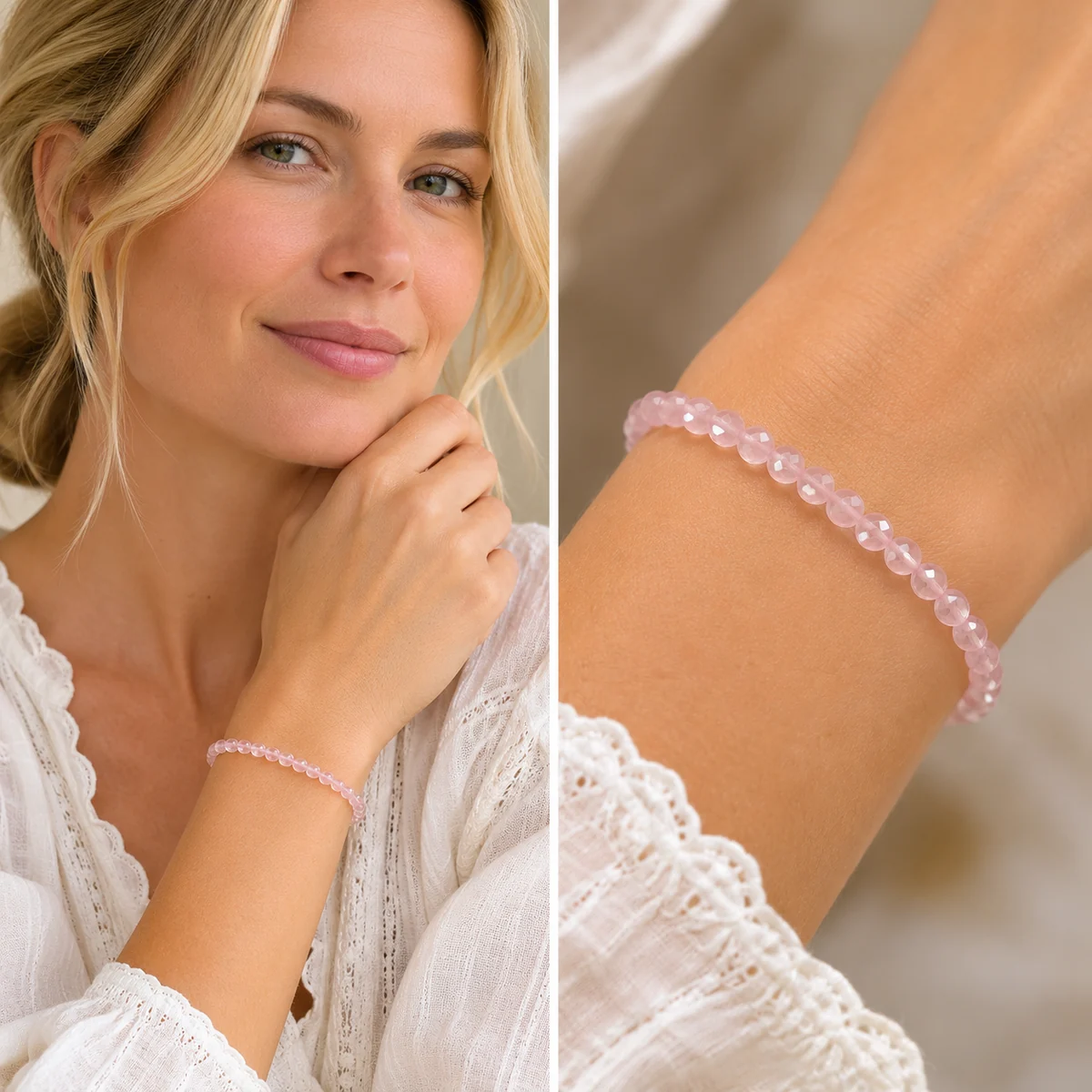
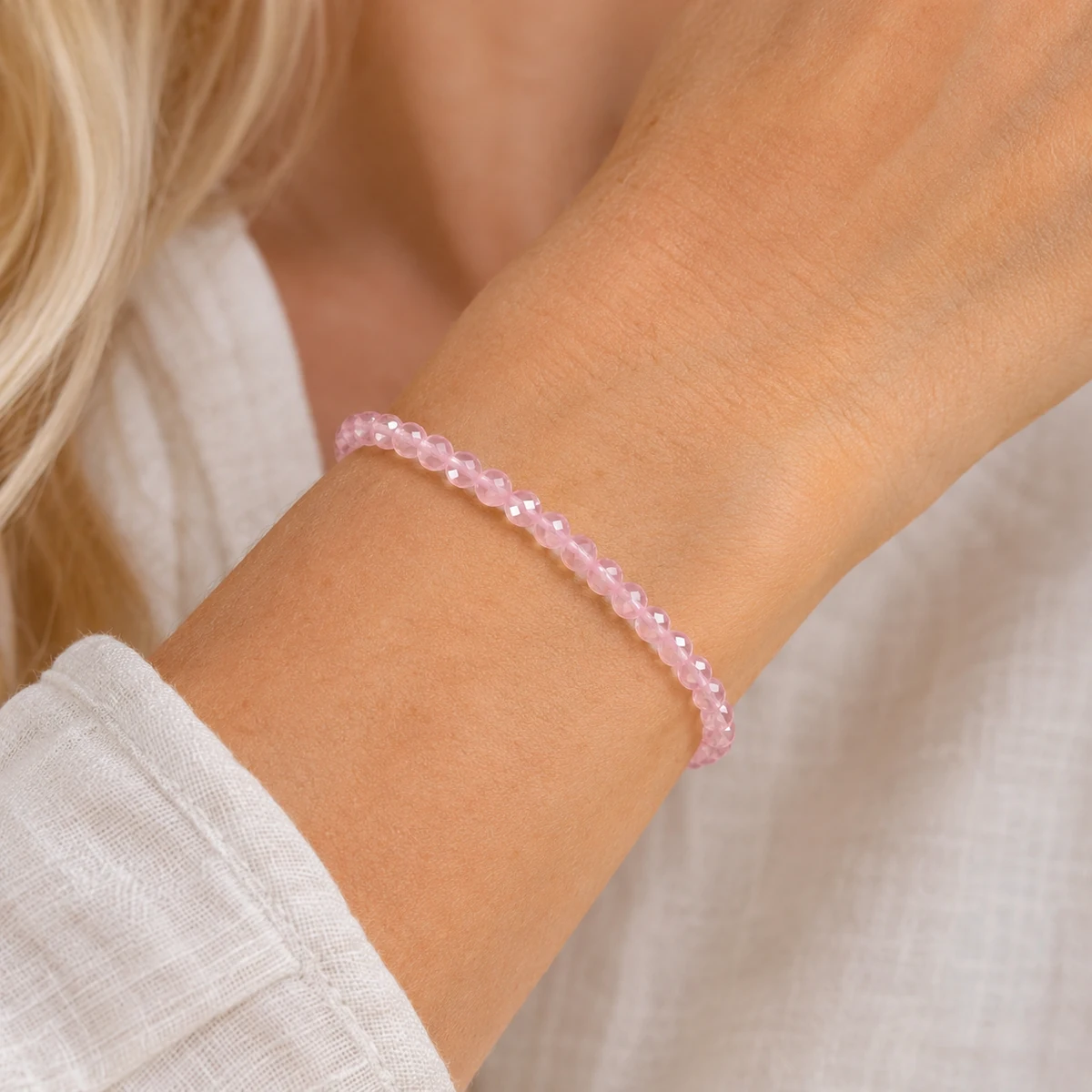
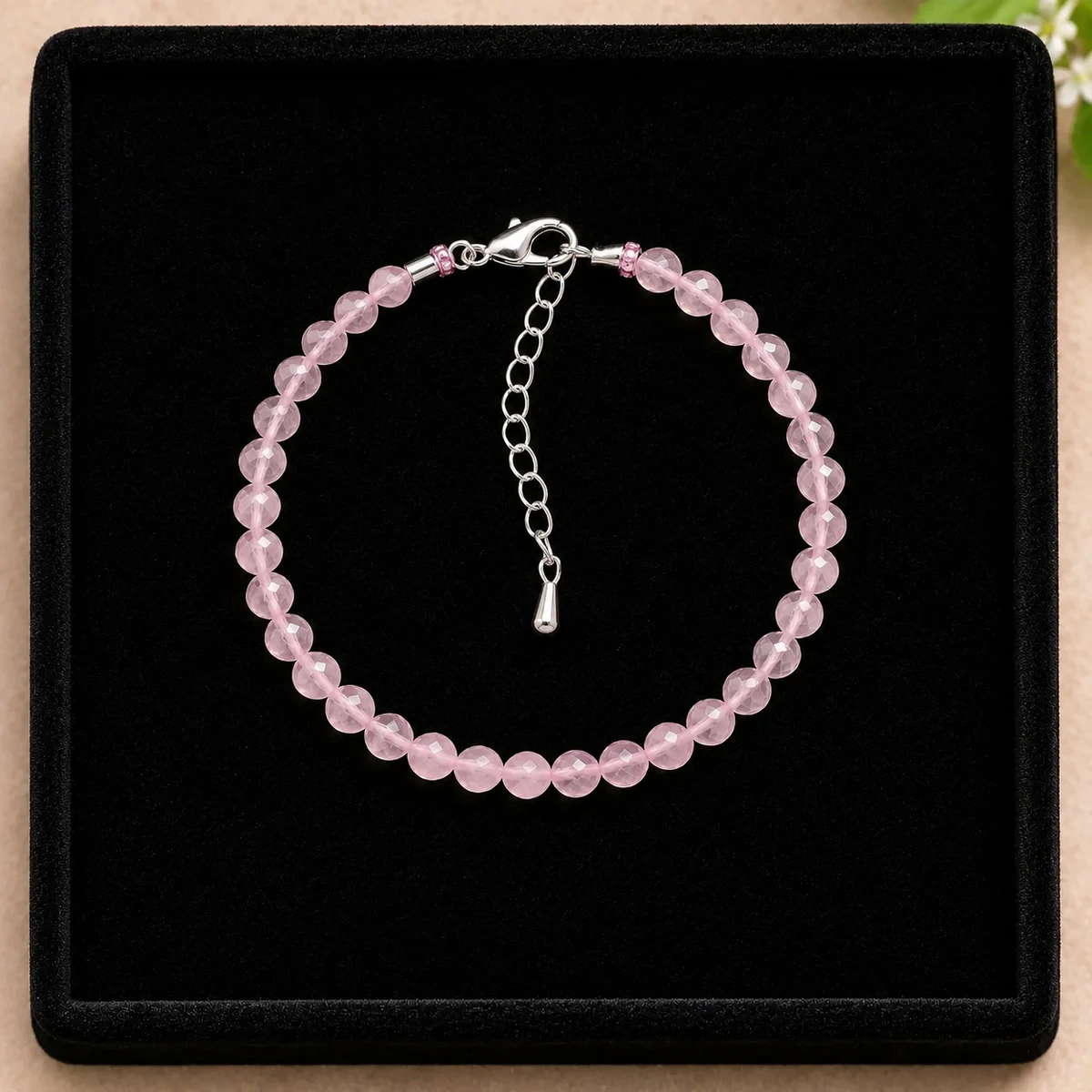
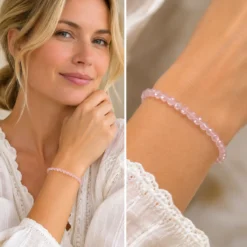
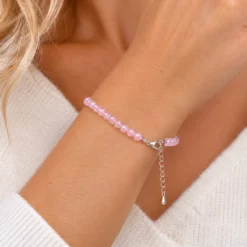
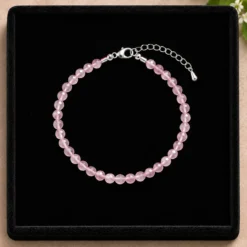
Adjustable faceted rose quartz bracelet, Grade A – 4mm
29,00 € incl. VAT
Faceted rose quartz bracelet, composed of 4 mm beads mounted on a non-elastic beaded wire. With a length of 16 cm, it is adjustable thanks to its extension chain and fits wrist sizes up to 21 cm.
In stock
Color: pink
Bead type: natural stone round beads
Wire type: non-elastic beaded wire
Stone diameter: 4 mm
Stone cut: faceted
Wrist size: 16cm, with 5cm extension chain
Photos are not contractually binding
Classification: Silicate group
Mohs hardness: 7
Density: 2.65
Origin: Brazil, Madagascar
Care instructions: Avoid exposing rose quartz to high temperatures or direct sunlight for prolonged periods, as the stone may fade. Avoid repeated exposure to soap/shower gel, cosmetic products (perfume, etc.), or household cleaners.
Adjustable faceted rose quartz bracelet, Grade A – 4mm, in detail
Rose quartz is a pink variety of quartz, a silicon dioxide (SiO2). Its pale, often milky color is attributed to trace chemical elements or fine inclusions. Its hardness is 7 on the Mohs scale.
Features noted on the sheet: faceted round natural stone beads, 4 mm diameter, wrist size 16-21 cm. Adjustable bracelet.
To compare with other models, see the Faceted Stone Bracelets category.
Origins and minéralogy
Rose quartz: origin, formation, and mineralogical properties
Origin and formation
Rose quartz is a variety of quartz belonging to the silicate family. Recognizable by its shades ranging from very pale pink to deep pink, sometimes slightly purplish, it is distinguished by its delicate color and variable transparency, from translucent to almost opaque.
Like other varieties of quartz, it is primarily composed of silicon dioxide (SiO₂).
Rose quartz forms mainly in granitic pegmatites, magmatic rocks resulting from the final stages of crystallization of a silica-rich magma.
During cooling, residual fluids concentrate various chemical elements and promote the growth of minerals, sometimes of large dimensions. Rose quartz then develops within these formations, often in association with feldspar, mica, and other minerals characteristic of pegmatites.
It is also found in certain hydrothermal veins, formed when silica-rich fluids circulate through rock fractures and gradually deposit the quartz.
Unlike rock crystal, which can form large, well-individualized prismatic crystals, rose quartz most often occurs in massive form, without apparent crystal faces.
This characteristic explains why it is frequently worked into pebbles, spheres, cabochons, and decorative objects.
The origin of its pink color
The color of rose quartz has long been the subject of various mineralogical hypotheses.
It has notably been attributed to the presence of traces of titanium, iron, or manganese in the crystal structure.
However, research conducted on massive rose quartz has shown that its coloration comes mainly from very fine fibrous inclusions, of microscopic dimensions, belonging to a mineral phase close to dumortierite.
These fibers contain iron and titanium in particular. Their structure and optical properties are responsible for the absorption of certain wavelengths of light, giving the quartz its characteristic pink coloration.
The presence of these inclusions also explains the sometimes slightly cloudy or milky appearance of rose quartz.
The concentration and distribution of the fibers influence the shades observed, from almost white pink to more intense pink.
Massive rose quartz and crystallized rose quartz
A distinction should be made between massive rose quartz and rose quartz forming well-individualized transparent crystals.
The former is the most common. Its coloration is mainly associated with the microscopic fibrous inclusions present in the mineral.
The second, sometimes called crystallized rose quartz or pink quartz, is much rarer. Its color is linked to other mechanisms, notably color centers associated with certain elements present in the quartz structure.
These transparent crystals can be sensitive to prolonged exposure to light, which may fade their coloration.
This distinction is important because the two materials have a similar appearance but different coloration mechanisms.
Composition and mineralogical properties
Rose quartz belongs to the quartz group, in the silicate class and the tectosilicate subclass.
Its chemical composition is silicon dioxide (SiO₂), consisting of silicon and oxygen atoms organized in a three-dimensional crystal structure.
It possesses the same fundamental characteristics as other varieties of quartz, including rock crystal, amethyst, citrine, and smoky quartz.
Main mineralogical properties
- Classification: silicates, tectosilicate subclass
- Family: quartz
- Chemical composition: silicon dioxide (SiO₂)
- Crystal system: trigonal
- Mohs hardness: 7
- Density: approx. 2.65
- Refractive index: 1.544 to 1.553
- Birefringence: approx. 0.009
- Luster: vitreous
- Transparency: translucent to transparent, sometimes opaque
- Colors: pale pink, deep pink, slightly purplish or salmon pink
- Cleavage: none
- Fracture: conchoidal
- Habit: massive, rarely in individualized crystals
Transparency, luster, and faceting
Rose quartz has a vitreous luster that shows particularly well after polishing.
Its transparency varies considerably depending on the presence and concentration of microscopic inclusions.
Some specimens have a milky appearance, while others allow more light to pass through.
The most transparent materials can be cut into faceted gems, while translucent varieties are generally worked into cabochons, pebbles, spheres, or beads.
Faceting multiplies the light-reflecting surfaces and highlights the shades of the rose quartz.
In jewelry composed of small faceted beads, the different facets produce discreet light reflections that emphasize the mineral’s natural color.
Star rose quartz: the phenomenon of asterism
Some rose quartz exhibits a particular optical phenomenon called asterism.
When a stone is correctly oriented and illuminated by a point light source, a star may appear on its surface or be visible through transparency.
The star usually has six rays, but some specimens may show more complex figures, sometimes with four or twelve rays.
This phenomenon results from the interaction of light with very fine fibrous inclusions oriented in several directions inside the quartz.
These structures reflect or scatter light and produce light bands that cross to form a star.
Asterism is particularly visible on rounded and polished surfaces, especially spheres and cabochons.
Crystals showing a clear and well-centered star are prized by collectors and fans of mineralogical optical phenomena.
It should be noted that not all rose quartz pieces exhibit asterism. The visibility of this phenomenon depends on the orientation, the distribution of inclusions, and the lighting conditions.
Deposits
Rose quartz is found in various regions of the world, mainly in silica-rich pegmatitic formations.
Brazil
Brazil is one of the world’s primary sources of rose quartz.
The state of Minas Gerais is particularly renowned for its many deposits of quartz and minerals associated with granitic pegmatites.
Brazilian rose quartz is appreciated for its varied shades, ranging from pale pink to deep pink, as well as for the quality of certain translucent materials.
The region provides blocks of various sizes, used for cutting gems, spheres, pebbles, and decorative objects.
Some Brazilian deposits are also known for their rare transparent crystals of crystallized rose quartz.
Madagascar
Madagascar is another important source of rose quartz, particularly valued for decorative pieces and polished objects.
Malgasy deposits provide materials ranging from light pink to deep pink, sometimes accompanied by slightly purplish shades.
Rose quartz from Madagascar is notably worked into spheres, pebbles, polished blocks, and carved objects.
Some pieces also exhibit remarkable asterism, visible under suitable lighting.
India
India has several rose quartz deposits associated with pegmatitic formations.
Production is notably intended for the manufacture of beads, cabochons, small decorative objects, and jewelry.
Namibia and Mozambique
Namibia and Mozambique also have occurrences of rose quartz.
These deposits provide materials with different intensities of coloration and transparency.
Other deposits
Rose quartz is also present in the United States, notably in South Dakota and Maine, as well as in Sri Lanka and several other regions with favorable geological formations.
The color, transparency, and quality of the materials vary according to the characteristics of each deposit.
History and use
Rose quartz in ancient civilizations
Rose quartz has been used for several millennia for the manufacture of ornaments and decorative objects.
Rose quartz beads dating back to approximately 7,000 BCE have been discovered in ancient Mesopotamia, corresponding notably to part of present-day Iraq.
The Assyrians also used rose quartz for making jewelry between the 8th and 6th centuries BCE.
In Antiquity, the Greek, Roman, and Egyptian civilizations placed particular importance on the different varieties of quartz.
The Romans notably used certain stones to create seals and engraved objects.
Rose quartz was also associated, in different traditions, with symbols of affection, beauty, and harmony.
These cultural associations have contributed to its reputation as a stone linked to love and human relationships.
A prized ornamental stone
Rose quartz possesses several characteristics that explain its lasting use in the decorative arts.
Its relatively high hardness allows it to be worked and polished, while its soft color adapts to different cutting shapes.
It is notably used to create:
- Round or faceted beads.
- Cabochons for rings and pendants.
- Pebbles and spheres.
- Carved objects and decorative pieces.
- Candle holders and decorative accessories.
Today, rose quartz is appreciated both in jewelry and for interior decoration.
The most sought-after pieces are distinguished notably by the homogeneity of their color, their transparency, or the presence of particular optical phenomena, such as asterism.
Care
With a hardness of 7 on the Mohs scale, rose quartz is relatively resistant to scratches and is suitable for regular use in jewelry.
However, it remains sensitive to shocks, which can cause fractures or damage polished surfaces.
For routine care, a soft cloth, slightly damp if necessary, is generally sufficient.
Occasional cleaning with lukewarm soapy water is possible for suitable pieces, followed by careful drying.
It is best to avoid abrasive products, aggressive chemical cleaners, ultrasonic or steam cleaning devices, and sudden temperature variations.
Prolonged exposure to intense sunlight is also discouraged as a precaution to preserve the coloration of sensitive pieces.
For jewelry composed of small faceted beads, it is advisable to limit repeated friction and to store them separately from harder jewelry.
Well-being and energies
Properties traditionally attributed to rose quartz
In lithotherapy, rose quartz is primarily associated with love, gentleness, and emotional balance.
Its pink color is symbolically linked to affection, tenderness, and harmony in relationships.
In contemporary energetic practices, it is notably associated with:
- Soothing: traditionally used to support the search for calm and serenity.
- Emotional balance: associated with inner stability and managing emotions.
- Self-love: considered a symbol of acceptance and kindness toward oneself.
- Harmony: associated with the quality of emotional relationships and openness to others.
- Self-confidence: traditionally linked to self-esteem and self-acceptance.
- Relaxation: used symbolically to accompany moments of relaxation and meditation.
Associated chakras
- Heart Chakra – ANAHATA
Associated astrological signs
- Taurus
- Libra
- Cancer
- Virgo
These correspondences vary according to lithotherapy traditions.
Purification and recharging
Purification
In lithotherapy, rose quartz can be symbolically purified by smudging using palo santo or white sage.
Simply pass the stone or jewelry gently through the smoke for a few moments, ensuring the room is well ventilated.
This method avoids prolonged immersion, especially for jewelry with mounting wire and metallic elements.
Recharging
In contemporary energetic practices, rose quartz is traditionally recharged symbolically by moonlight.
It can also be placed on an amethyst druse or near a quartz geode.
Gentle exposure to natural light is also possible, avoiding high heat and prolonged exposure to direct sun.
The energetic properties mentioned are based on contemporary lithotherapy traditions and practices. They do not correspond to scientifically proven effects and do not replace any medical treatment.
Expédition : 48 à 72 heures, hors week-ends et jours fériés, après confirmation du paiement.
Livraison offerte dès 60 € en France métropolitaine.
Droit de rétractation : 14 jours pour nous signaler votre décision.
You may also like…
Bracelets
Bracelets
Bracelets
Related products


Bracelets


Bracelets