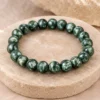


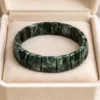
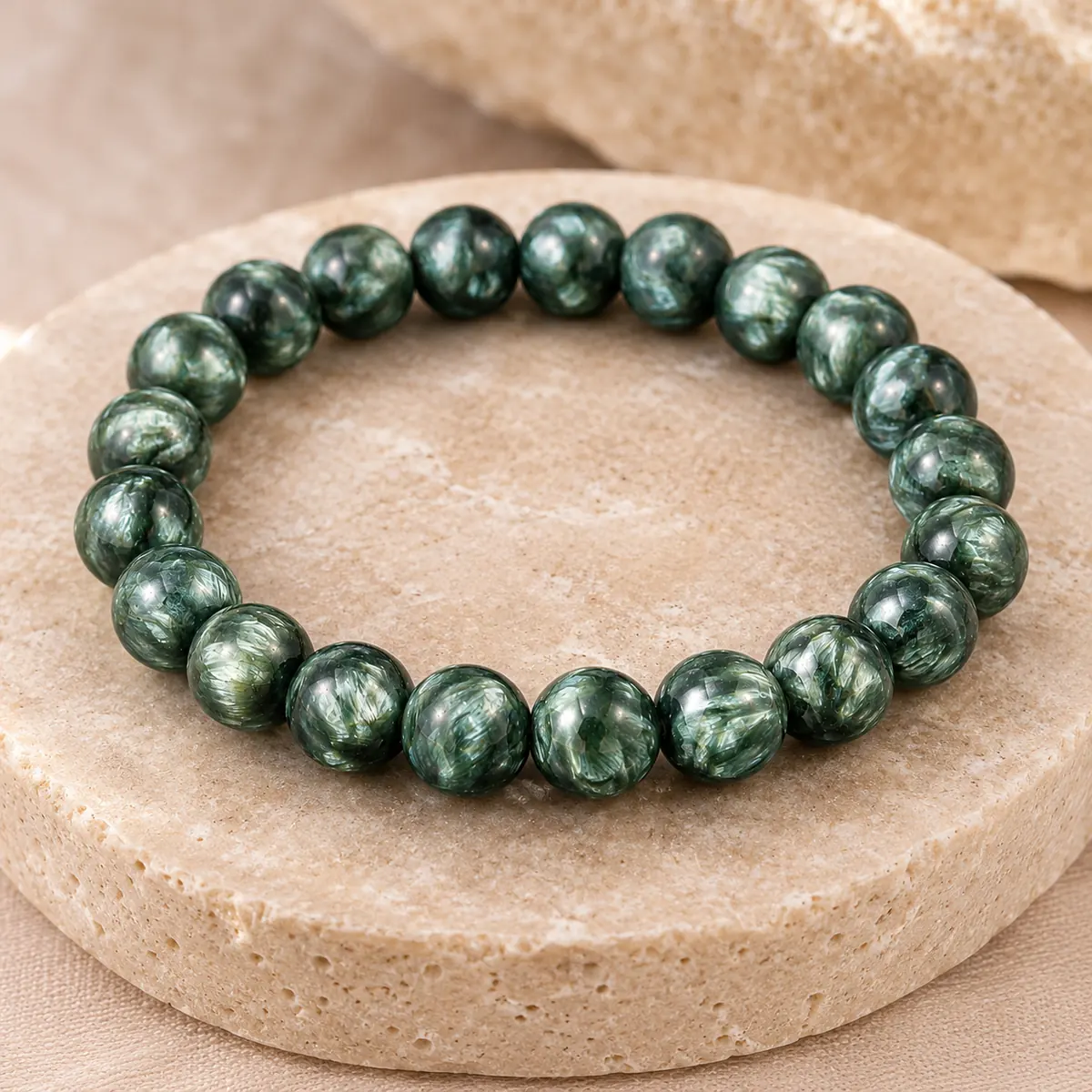
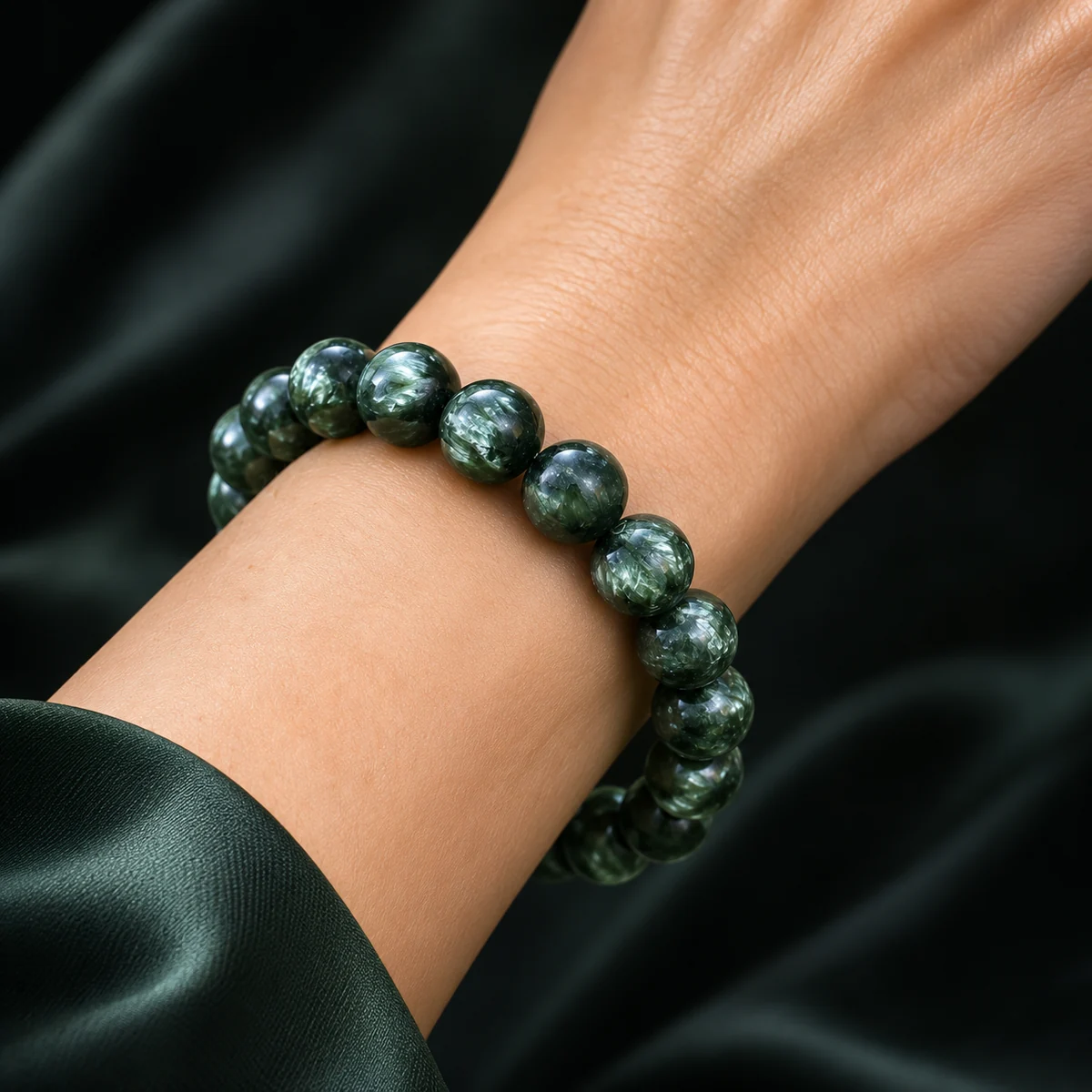

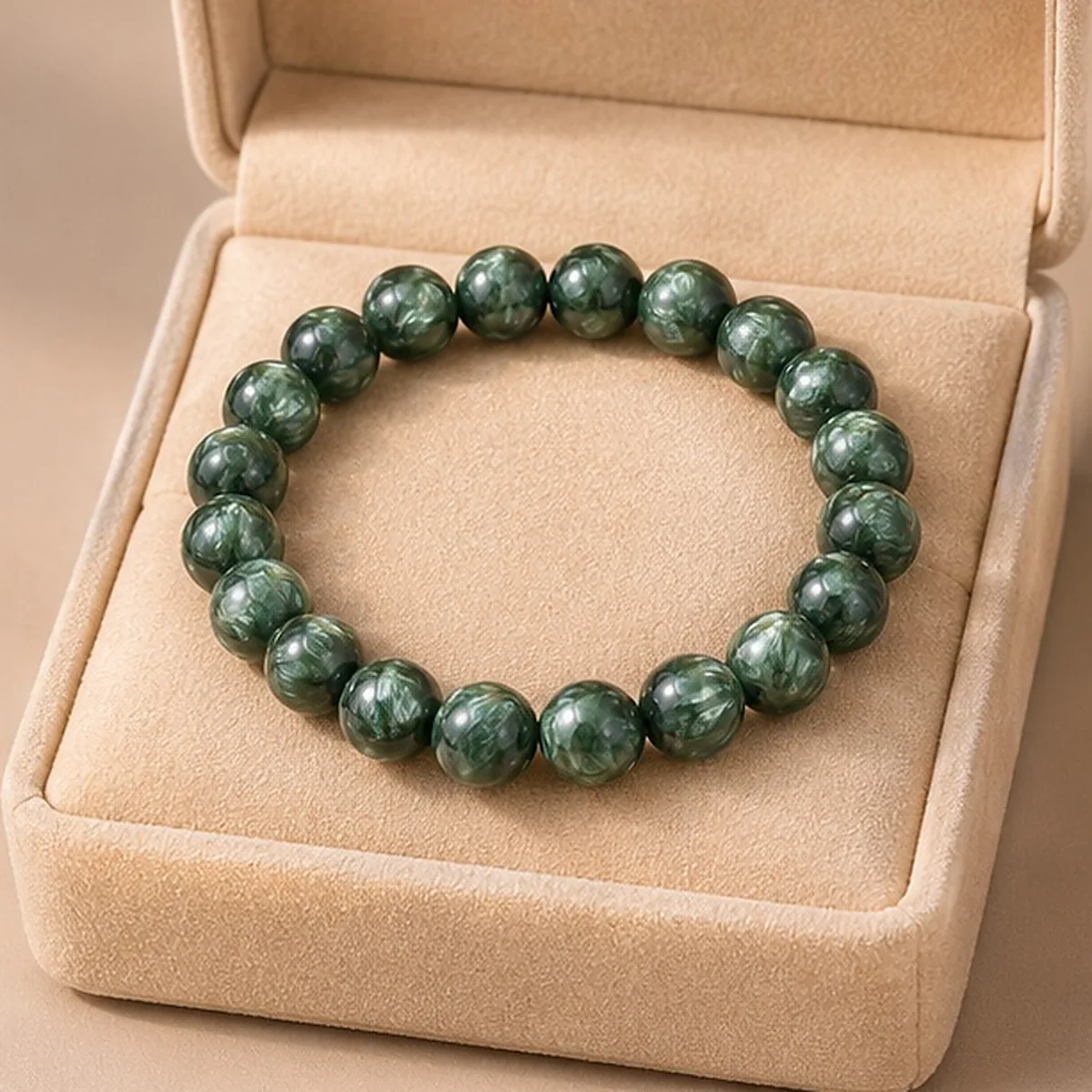
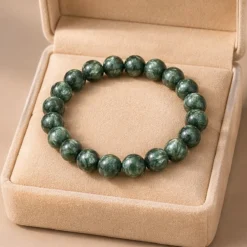

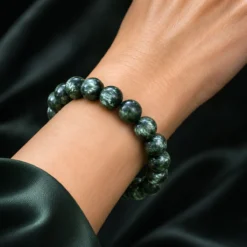
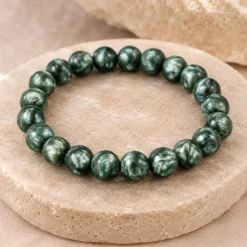
Seraphinite bracelet 8mm – AA quality
130,00 € incl. VAT
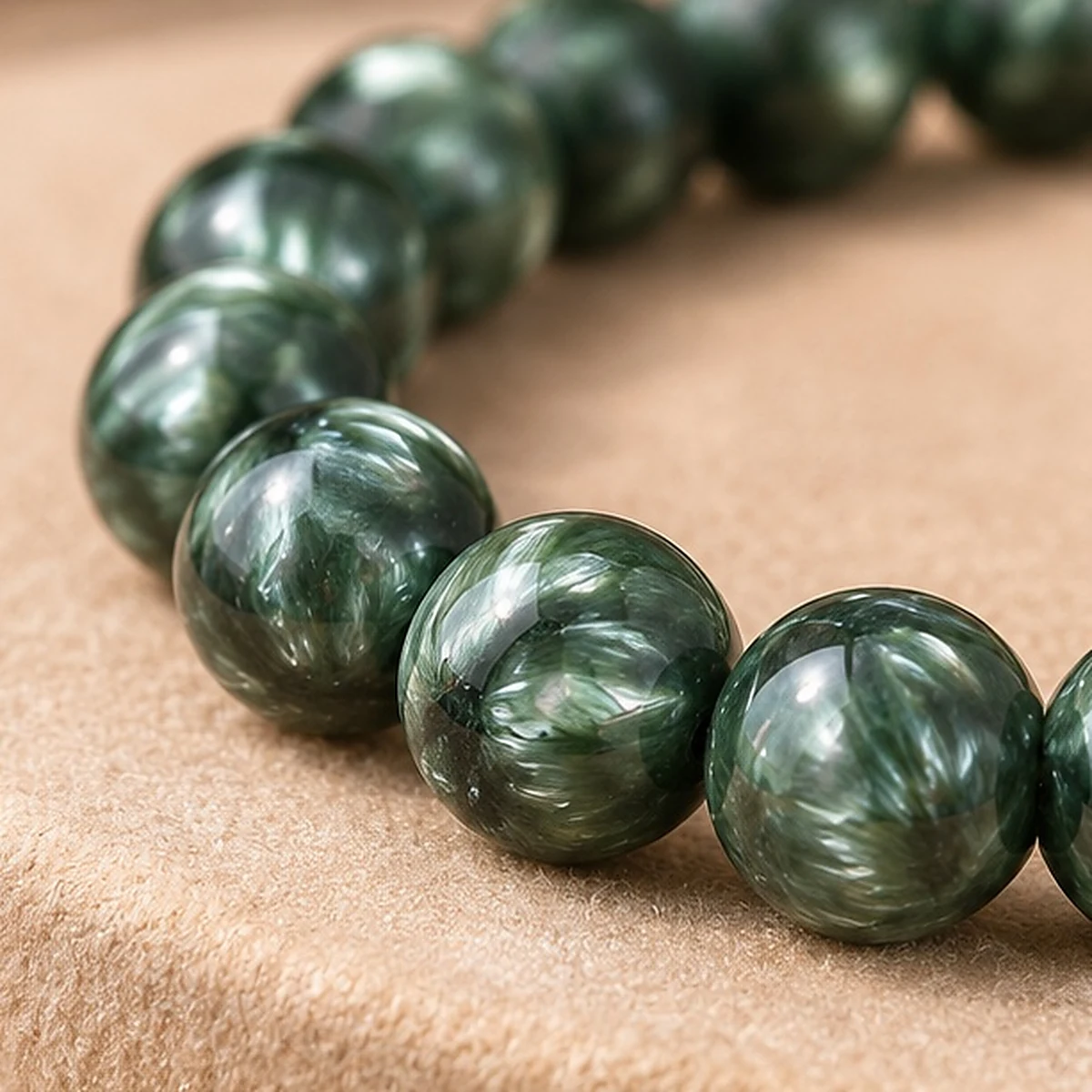
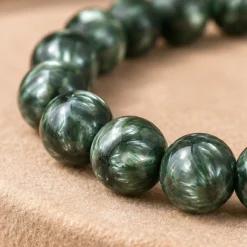
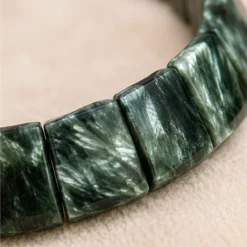
Round bead bracelet in AA quality seraphinite. 8mm beads. The stone’s natural patterns evoke angel wings or feathers. Each pattern is unique. Seraphinite is a rare stone.
In stock
Stone(s): seraphinite or chlorite jade
Color: green and white
Thread type: durable elastic thread
Wrist size: 16-18 cm
Stone dimensions: 8 mm
Weight: 27-32 g
Shape: round beads
Photos are not contractually binding.
Classification: chlorite group
Mohs hardness: 2-2.5
Density: 2.55–2.75
Origin: Russia, United States
Care instructions: Seraphinite is a very fragile stone. Avoid bumping it, as it could crack or break. It is quite rare. To preserve its luster, do not expose the stone to soap, cosmetic, or household products.
ORIGINS AND MINERALOGY
Seraphinite: origin, formation, and mineralogical properties
Origin and formation
Seraphinite is an ornamental variety of clinochlore, a mineral belonging to the chlorite group and the phyllosilicate family. It is recognizable by its dark green color and its white to silvery fibrous patterns, which evoke feathers or wings.
These structures become particularly visible after polishing and give the stone its silky appearance and characteristic sheen.
Seraphinite comes mainly from eastern Siberia, Russia, where it is associated with the geological formations of the Irkutsk region, west of Lake Baikal.
Although chlorites are relatively common minerals in the Earth’s crust, the variety displaying seraphinite’s characteristic patterns is much less common.
How does seraphinite form?
Seraphinite forms in metamorphic and hydrothermal environments, when pre-existing rocks undergo transformation under the effects of temperature, pressure, and fluid circulation.
Clinochlore, of which it is a variety, is a mineral that frequently appears during the alteration of rocks rich in magnesium and iron.
It can develop in particular from minerals such as amphiboles, pyroxenes, and certain varieties of mica.
Under the action of hydrothermal fluids, these minerals become unstable and gradually transform. The chemical elements released then contribute to the formation of new minerals, including chlorites.
Clinochlore can also form during the metamorphism of igneous or sedimentary rocks, particularly when chemical conditions favor the presence of magnesium, aluminum, and silica.
In the Siberian deposit of Korshunovskoye, seraphinite is associated with metasomatic formations linked to an iron ore-rich environment.
Geological transformations favored the crystallization of clinochlore into fibrous, radiating aggregates, responsible for its distinctive appearance.
The origin of its green color
Seraphinite’s color ranges from grayish green to dark green, sometimes nearly black.
This coloration is mainly related to the chemical composition of clinochlore, particularly the presence of iron in its crystal structure.
Clinochlore is a silicate mainly composed of magnesium, aluminum, silicon, and hydroxyl groups.
Some of the magnesium can be replaced by iron, whose presence helps modify the mineral’s optical properties and coloration.
Depending on the proportion and oxidation state of the iron, chlorites can display different shades of green.
In seraphinite, these colors are generally associated with lighter areas and silvery fibrous structures.
The characteristic silvery patterns
One of seraphinite’s most remarkable features lies in its fibrous patterns.
Clinochlore can crystallize in the form of thin lamellae and aggregates arranged in different orientations.
In seraphinite, these structures frequently take on a radiating or feather-like arrangement.
When polished, they reflect light differently depending on their orientation, creating white, silvery, or slightly pearly reflections.
These effects are related to the mineral’s lamellar structure and the reflection of light on its many crystalline surfaces.
The visual effect can sometimes resemble chatoyancy, although the reflections generally appear as broad feather-like patterns rather than a single band of light.
Some pieces reveal fine fan-shaped structures, while others show broader patterns evoking interwoven feathers.
The distribution of these aggregates is natural and varies from stone to stone.
Why do some seraphinites display more silvery reflections?
The intensity of the reflections mainly depends on the structure of the crystalline aggregates, their orientation, and the polishing work.
When the fibers are particularly well developed and favorably oriented, they can produce broad silvery areas contrasting with the dark green.
Conversely, some pieces display a more uniform green color, with more subtle patterns.
The direction of light also plays an important role.
By tilting a polished tumbled stone, the silvery areas can become brighter or, conversely, fade depending on the viewing angle.
This property explains seraphinite’s appeal for making cabochons, tumbled stones, and decorative items.
Composition and mineralogical properties
Seraphinite is a variety of clinochlore with a particularly well-developed fibrous, radiating structure.
Clinochlore belongs to the chlorite group, itself classified among the phyllosilicates, also known as sheet silicates.
Its ideal chemical formula is:
Mg₅Al(AlSi₃O₁₀)(OH)₈
Iron can replace part of the magnesium, which allows certain natural compositions to be represented by the simplified formula:
(Mg,Fe²⁺)₅Al(AlSi₃O₁₀)(OH)₈
Seraphinite is therefore not an independent mineral species, but a variety of clinochlore prized for its ornamental qualities.
Main mineralogical properties
- Classification: silicates, phyllosilicate subclass
- Mineral group: chlorites
- Mineral species: clinochlore
- Variety: seraphinite
- Chemical composition: hydrated magnesium and aluminum silicate, may contain iron
- Ideal chemical formula: Mg₅Al(AlSi₃O₁₀)(OH)₈
- Crystal system: monoclinic for common clinochlore
- Mohs hardness: 2 to 2.5
- Density: approximately 2.6 to 3.02 for clinochlore
- Refractive index: approximately 1.571 to 1.599, depending on composition
- Luster: pearly, silky to slightly greasy
- Transparency: opaque to translucent depending on the area
- Colors: grayish green, dark green, near-black green
- Reflections: white, silvery, sometimes slightly pearly
- Streak: white to greenish white
- Cleavage: perfect along the basal plane
- Fracture: generally irregular or micaceous
- Morphology: massive, lamellar, fibrous, and radiating aggregates
- Main origin: Irkutsk region, eastern Siberia, Russia
Crystal structure
Clinochlore has a sheet-like crystal structure, characteristic of phyllosilicates.
This structure consists of alternating layers of silicate tetrahedra and layers containing mainly magnesium and aluminum.
The sheets are bound together by interactions that allow the mineral to separate relatively easily along certain directions.
This organization explains its perfect cleavage, as well as its relatively low hardness.
Clinochlore crystals can occur as small lamellae resembling mica.
In seraphinite, these crystalline elements combine into more complex structures, often fibrous or radiating.
The interweaving of the fibers and their orientation explain the feather-like patterns observed on polished surfaces.
Seraphinite, clinochlore, and chlorite: what are the differences?
The terms seraphinite, clinochlore, and chlorite are closely related, but do not designate exactly the same thing.
Chlorite refers to a group of silicate minerals with a sheet structure and variable chemical compositions.
Clinochlore is a mineral species belonging to this group. It is mainly composed of magnesium, aluminum, and silica, with possible chemical substitutions, notably by iron.
Seraphinite is a name used for an ornamental variety of clinochlore displaying a generally dark green color and radiating aggregates with silvery reflections.
Not all clinochlore therefore displays the characteristic appearance of seraphinite.
The distinction is mainly based on the visible structure and the ornamental qualities of the material.
Seraphinite and serpentine: how to tell them apart?
Seraphinite is sometimes confused with certain serpentines, notably because of their green color and sometimes silky appearance.
These minerals, however, belong to different mineralogical groups.
Seraphinite is a variety of clinochlore, belonging to the chlorite group. It generally displays particularly characteristic white to silvery radiating patterns.
Serpentine refers to a group of minerals including antigorite, lizardite, and chrysotile. Serpentines have compositions and structures different from those of clinochlore.
Although some materials may show visual similarities, their precise identification is based on their mineralogical properties.
Deposits
Russia – Eastern Siberia
Ornamental seraphinite is mainly associated with the Korshunovskoye deposit, located near Zheleznogorsk-Ilimsky, in the Irkutsk Oblast, eastern Siberia.
This region lies west of Lake Baikal and belongs to a complex geological formation comprising sedimentary, metamorphic, and igneous formations.
The Korshunovskoye deposit is mainly known for its significant iron ore resources.
The geological transformations that affected the rocks in this region also favored the formation of magnesium-rich silicates, including clinochlore.
In certain areas, this mineral developed into radiating aggregates displaying the characteristic structures of seraphinite.
These materials can be worked into polished slabs, cabochons, tumbled stones, or decorative objects.
An uncommon ornamental variety
Clinochlore is found in many regions of the world, notably in metamorphic or hydrothermal formations.
It is thus found in various European countries, in North America, and in several regions of Asia.
However, occurrences of clinochlore displaying the feather-like patterns and silvery reflections characteristic of seraphinite are much less common.
The Siberian deposit of Korshunovskoye remains the main documented source for this ornamental variety.
It is therefore important to distinguish between the relatively wide distribution of clinochlore and the much more limited distribution of seraphinite sold in jewelry and decoration.
History and use
The recognition of clinochlore
The mineralogical history of seraphinite is linked to that of clinochlore and the chlorite group.
Chlorites have been studied since the late 18th century, at a time when mineralogical classifications were mainly based on external appearance and certain physical properties of minerals.
The name clinochlore was introduced in 1851 by the American mineralogist William Phipps Blake.
It combines two terms of Greek origin:
- Klinein, meaning to incline, in reference to the mineral’s optical properties.
- Chloros, meaning green, in reference to its usual coloration.
Understanding of the composition and structure of chlorites was later refined thanks to advances in crystallography and chemical analysis methods.
The origin of the name seraphinite
The name seraphinite is derived from the term seraph, used in religious traditions to designate a category of angelic beings.
In Christian iconography, seraphim are notably depicted with multiple wings.
The connection between this name and the stone comes from its silvery patterns, which evoke feathers or outstretched wings.
Seraphinite is thus sometimes called the “angel stone” in the mineral trade and in contemporary lithotherapy practices.
This is a symbolic and commercial name, not a scientific classification.
An ornamental stone prized for its patterns
The use of seraphinite as a decorative stone developed mainly with the marketing of materials from Siberia.
Its silvery fibrous structures and dark green color make it a stone prized for its natural contrasts.
It is notably used for the manufacture of:
- Tumbled stones and polished stones.
- Cabochons for pendants and earrings.
- Beads for bracelets and necklaces.
- Spheres and free forms.
- Small sculptures and decorative objects.
- Polished slabs for mineral collections.
Seraphinite’s low hardness requires delicate cutting and polishing work.
The most prized pieces generally display well-developed radiating patterns and a marked contrast between the dark green areas and the silvery reflections.
A stone with unique natural patterns
Seraphinite’s particular structure explains the great diversity of patterns observed on polished stones.
Some pieces display broad feather-like structures, while others show networks of fine silvery fibers.
The distribution of colors and reflections varies according to the orientation of the crystalline aggregates.
Each tumbled stone or polished object thus has a distinctive appearance, directly linked to its mineralogical formation.
Care instructions
With a hardness of only 2 to 2.5 on the Mohs scale, seraphinite is a relatively soft mineral.
It is more sensitive to scratches and impacts than many stones used in jewelry.
Its lamellar structure and perfect cleavage also require certain precautions.
For routine care, it is recommended to use a soft, dry cloth, preferably microfiber.
A very slightly damp cloth can be used occasionally if needed, provided the stone is dried immediately.
It is best to avoid prolonged immersion in water and not to use harsh cleaning products.
It is also advisable to avoid:
- Impacts against hard surfaces.
- Rubbing against other minerals.
- Sudden temperature changes.
- Prolonged exposure to intense heat.
- Contact with perfumes, household products, and cosmetics.
For jewelry, it is recommended to store seraphinite separately from other stones to limit scratches.
For polished tumbled stones and decorative objects, gentle cleaning with a cloth is generally enough to preserve their appearance.
Well-being and energies
Properties traditionally attributed to seraphinite
In lithotherapy, seraphinite is mainly associated with harmony, serenity, and emotional balance.
Its green color is symbolically linked to the heart, while its silvery patterns are associated, in certain contemporary energy practices, with meditation and the search for inner peace.
It is notably associated with:
- Serenity: traditionally used to support the search for calm and inner tranquility.
- Emotional harmony: associated with emotional balance and the search for personal stability.
- Compassion: symbolically linked to kindness, empathy, and openness to others.
- Communication: associated with the expression of feelings and the quality of relationships.
- Self-confidence: traditionally used to support people wishing to develop their self-assurance.
- Letting go: associated with stepping back and seeking relaxation.
- Meditation: used symbolically to support contemplative practices and inner reflection.
- Intuition: associated with self-listening and inner perception.
In certain contemporary lithotherapy traditions, seraphinite also carries a spiritual dimension linked to angel symbolism.
It is notably associated with meditative practices and the search for a spiritual connection.
These interpretations are based on symbolic beliefs and do not correspond to scientifically established mineralogical properties or effects.
Associated chakras
- Heart chakra – ANAHATA: mainly associated with love, compassion, and emotional harmony.
- Crown chakra – SAHASRARA: secondary association linked to meditation and spiritual seeking.
Associated astrological signs
- Virgo
- Libra
- Pisces
These associations are symbolic and may vary depending on lithotherapy traditions.
Purification and recharging
Purification
In contemporary energy practices, seraphinite can be symbolically purified by smudging with a palo santo stick or white sage.
Simply pass the stone or jewelry gently through the smoke for a few moments, making sure to ventilate the room well.
Due to its low hardness and lamellar structure, this method is preferable to immersion in water.
Recharging
In lithotherapy, seraphinite can be symbolically recharged by placing it for a few hours in a room filled with soft natural light.
It is best to avoid prolonged exposure to direct sunlight or a strong heat source.
Other practices involve placing seraphinite near a quartz geode, on a quartz cluster, or near an amethyst druse.
To avoid scratches, it is recommended to place seraphinite on a soft surface rather than in direct contact with quartz crystal points.
The energetic properties attributed to seraphinite are part of contemporary lithotherapy traditions and practices. They are not scientifically proven effects and do not replace medical advice or treatment.
Expédition : 48 à 72 heures, hors week-ends et jours fériés, après confirmation du paiement.
Livraison offerte dès 60 € en France métropolitaine.
Droit de rétractation : 14 jours pour nous signaler votre décision.
You may also like…

Bracelets
Bracelets


Bracelets
Related products


Amber and Silver Bracelets

Bracelets
Amber and Silver Bracelets