

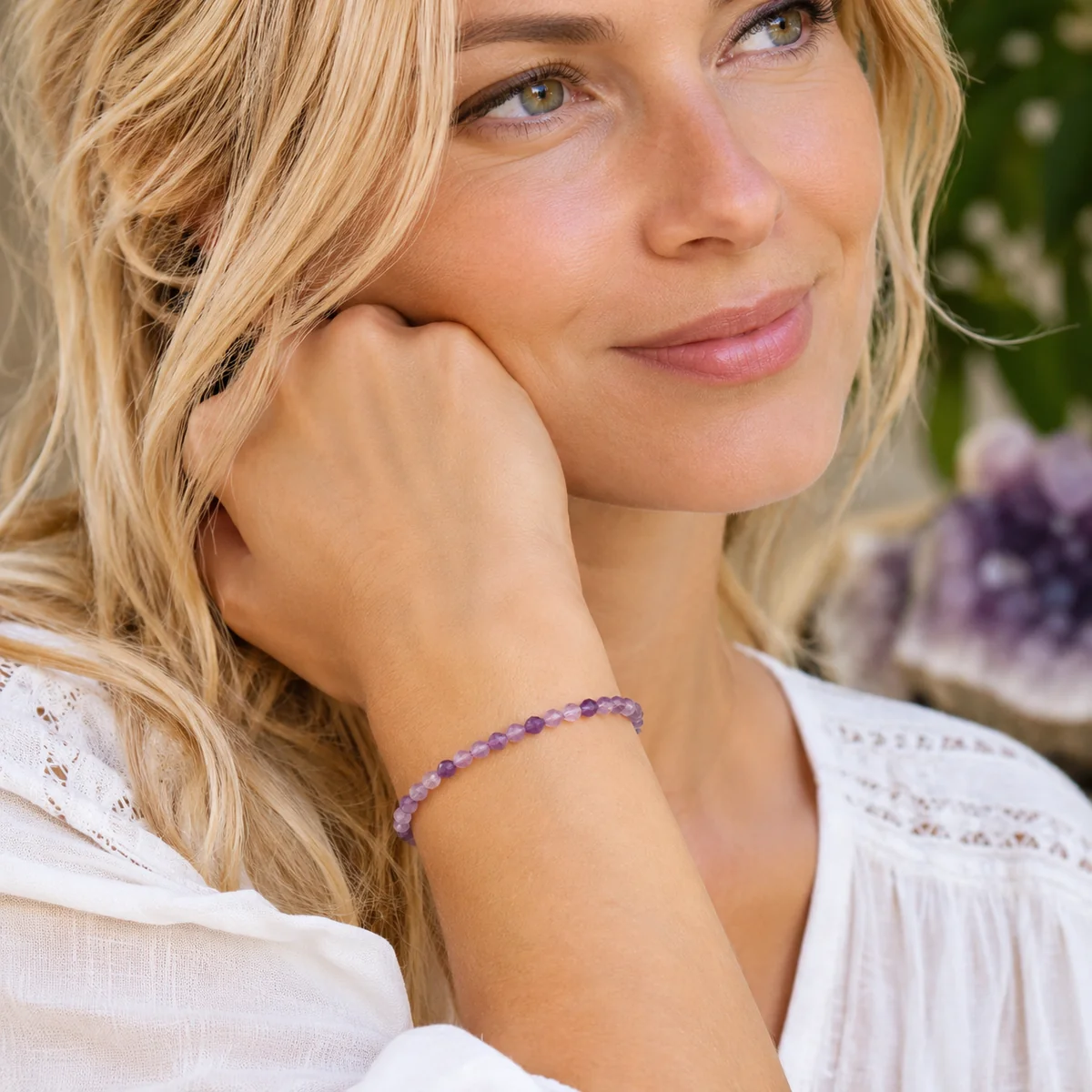
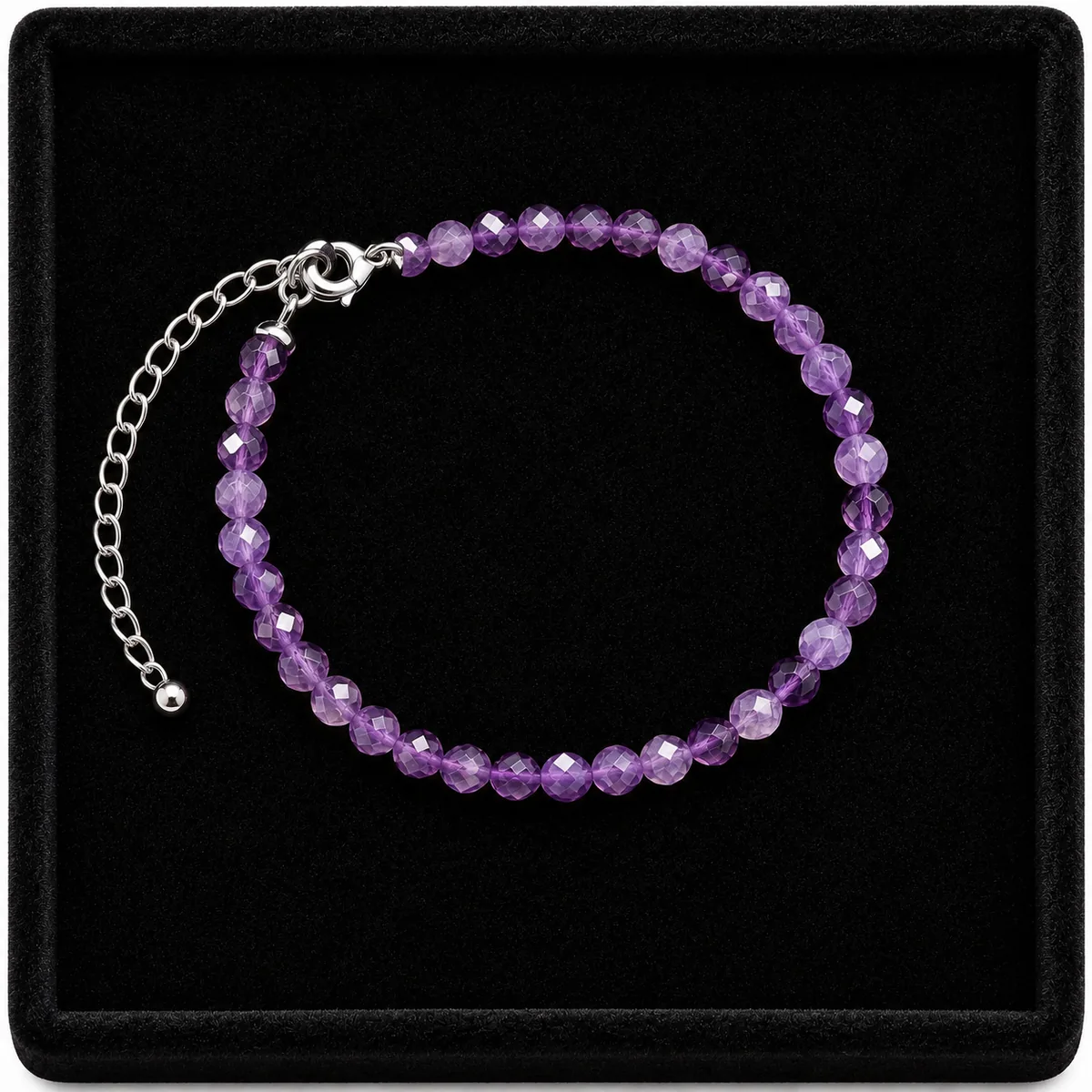
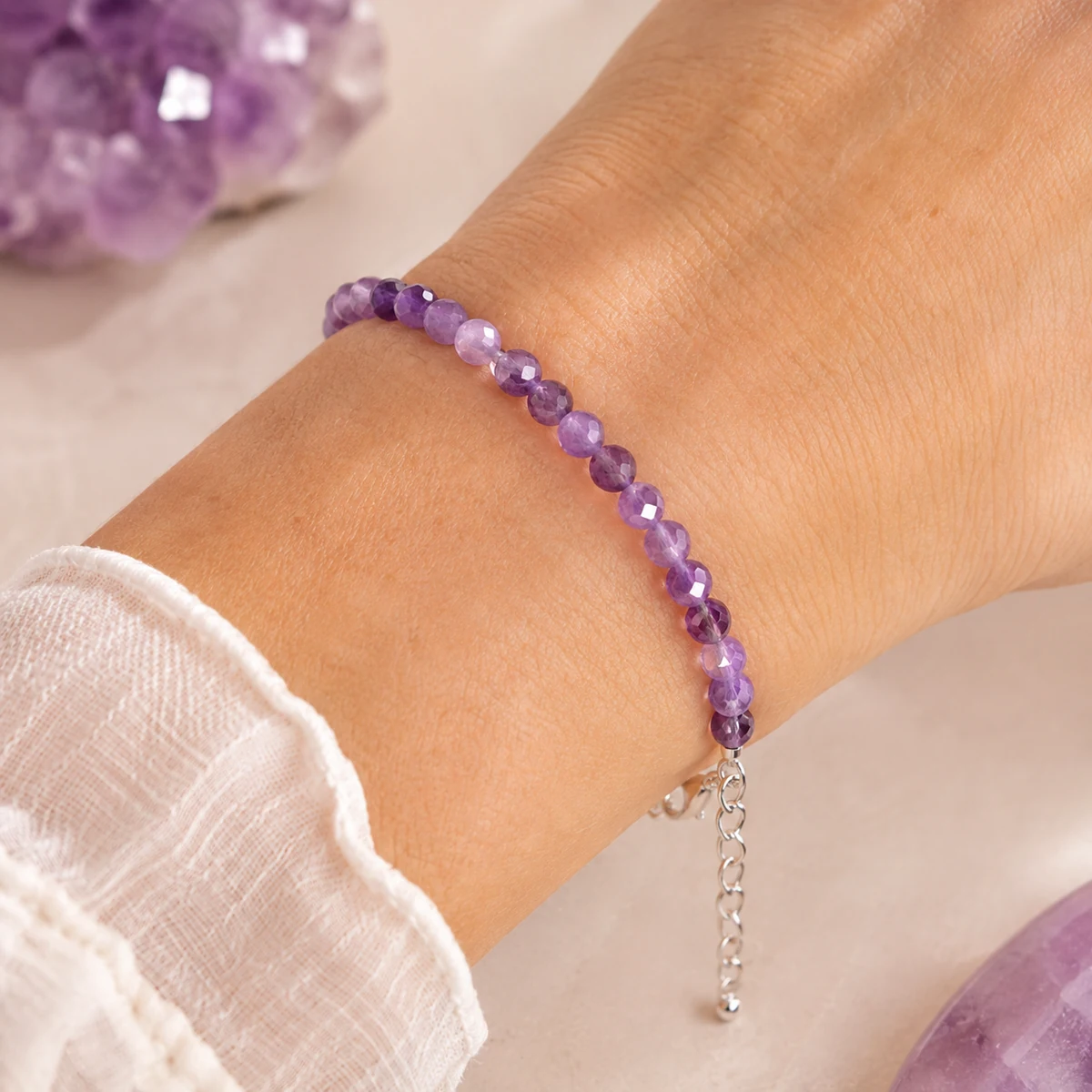
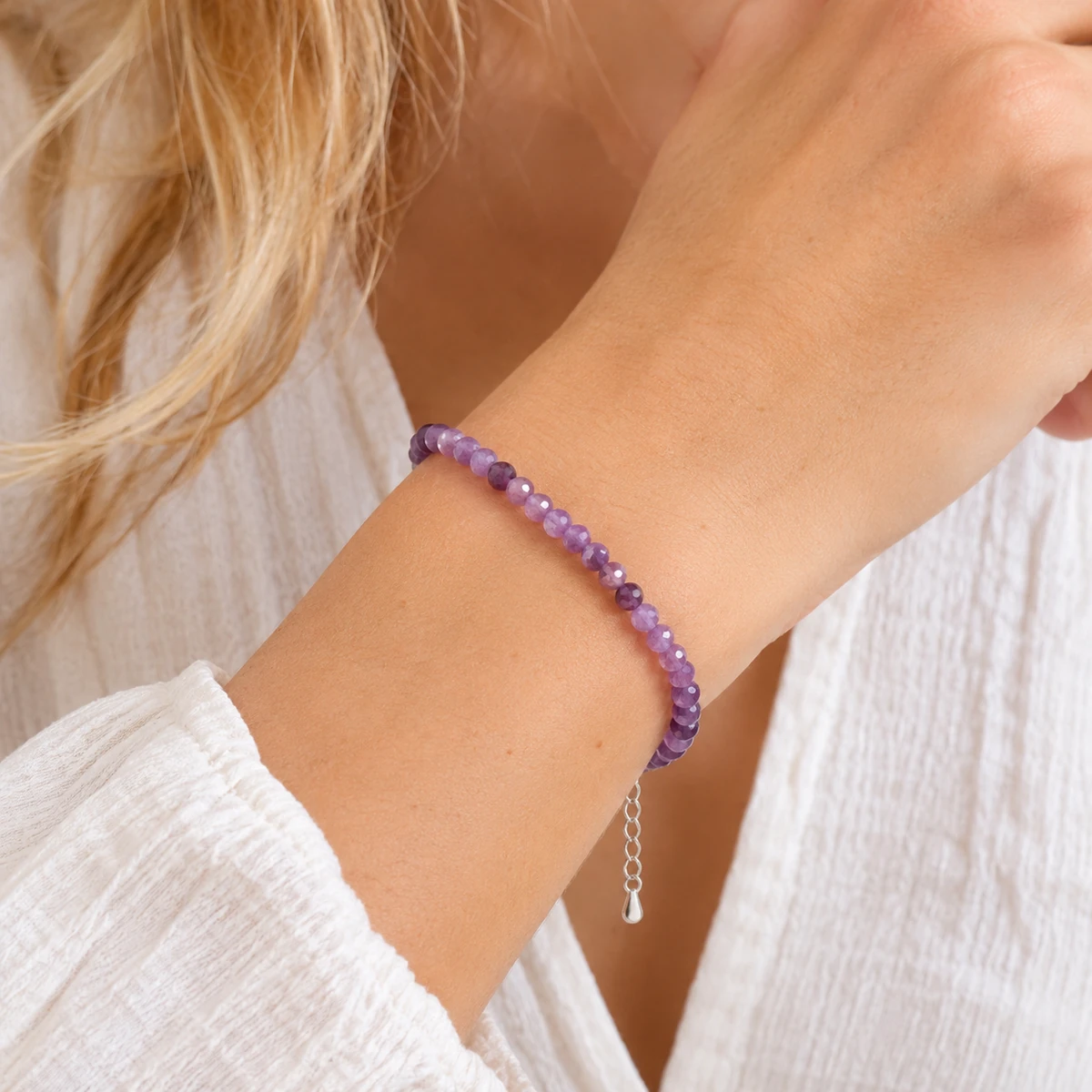
Light Brazilian amethyst bracelet 6 mm AAA quality (Copie)
29,00 € incl. VAT
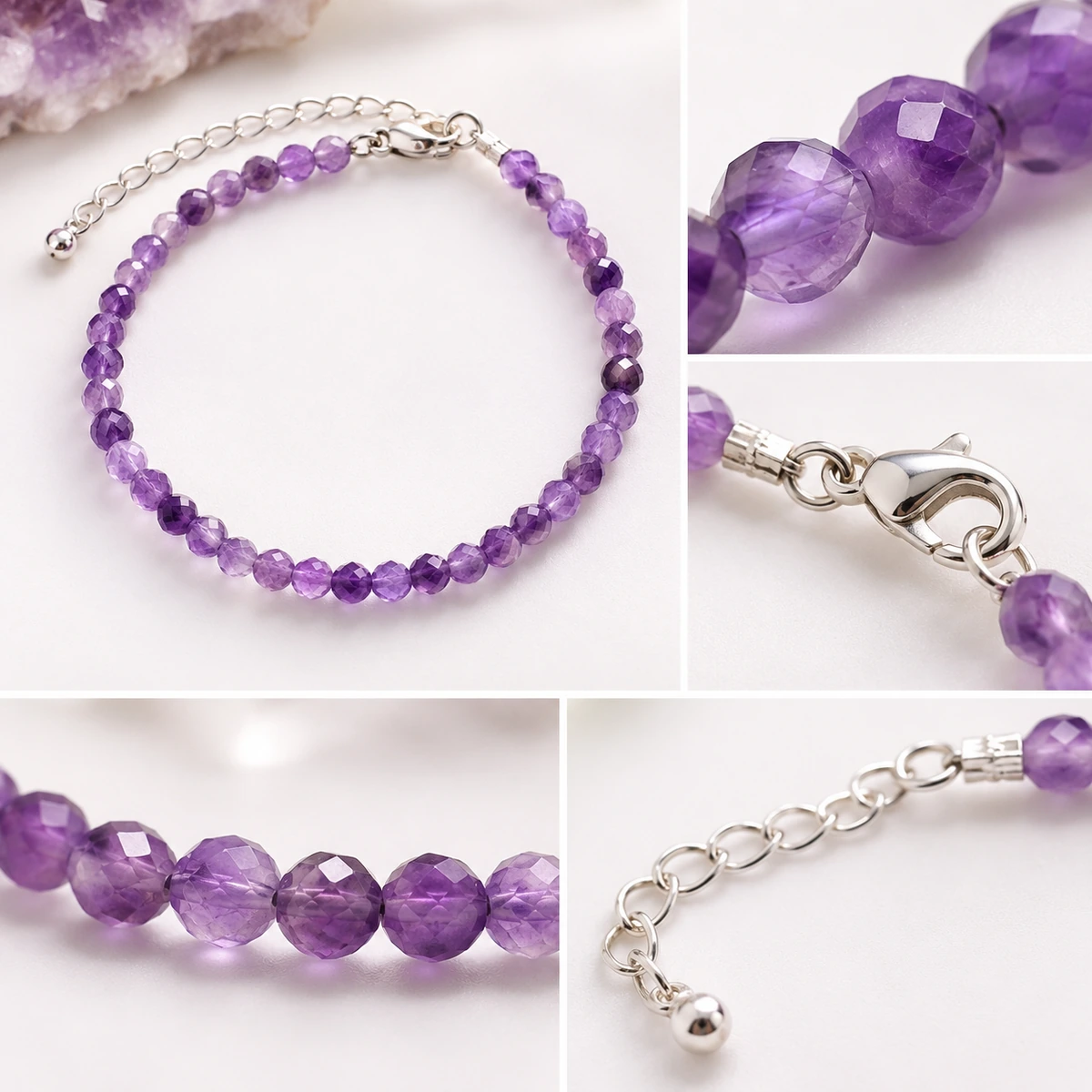
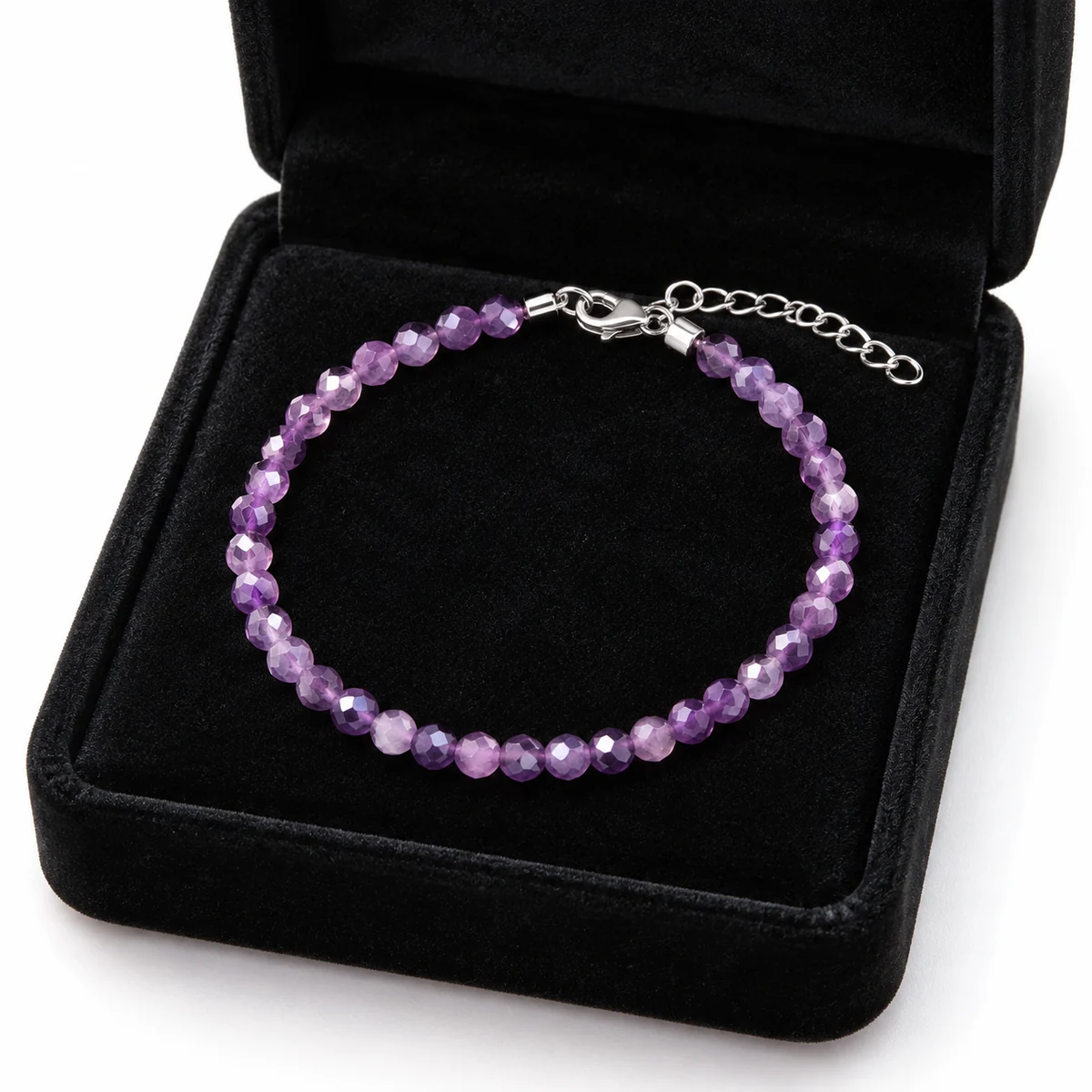
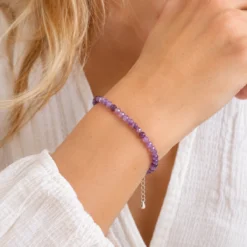
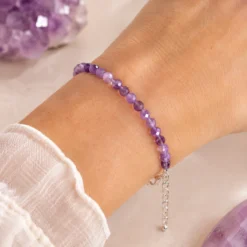
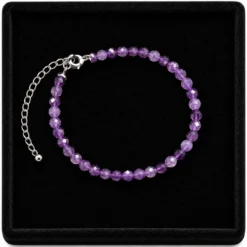
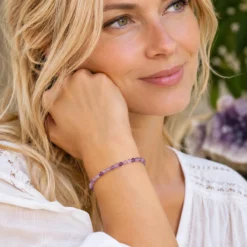
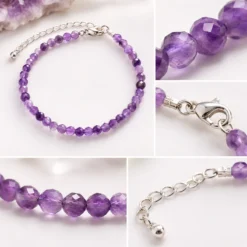
Adjustable faceted amethyst bracelet, made of 4 mm beads in shades of purple. The beads are strung on non-elastic coated wire.
A delicate, elegant piece whose small facets highlight the amethyst’s beauty. Its 5 cm extension chain makes it easy to adjust to your wrist size.
In stock
Color: mauve to purple
Bead type: round natural stone beads
Cord type: non-elastic coated wire
Stone diameter: approx. 4 mm
Wrist size: 16cm, with 5cm extension chain
Photos for illustration only
Classification: Silicate group
Mohs hardness: 7
Density: 2.65
Origin: Brazil
Care instructions: avoid prolonged exposure to strong light or high heat, which could alter the stone’s color.
About this listing: Adjustable 4mm faceted amethyst bracelet
Amethyst is the purple variety of quartz, a crystallized silicon dioxide (SiO2) in the trigonal system. Its color comes from traces of iron in the crystal. With a hardness of 7 on the Mohs scale, it resists everyday scratches.
Round natural stone beads: approx. 4 mm diameter, 16 cm wrist size, with 5cm extension chain.
You’ll find other similar items in the Faceted Stone Bracelets category.
Origins and minéralogy
Amethyst: origin, formation, and mineralogical properties
Origin and formation
Amethyst is a purple variety of quartz belonging to the silicate family. Recognizable by its shades ranging from very pale lilac to deep purple, sometimes with bluish or reddish highlights, it stands out for its transparency and glassy luster.
Like other quartz varieties, it’s mainly composed of silicon dioxide (SiO₂).
Amethyst forms when silica-rich fluids circulate through the fractures and cavities of certain rocks. As they cool or undergo chemical changes, these fluids gradually deposit silica, allowing crystals to grow.
It’s particularly found in the cavities of volcanic rocks, especially basalts, as well as in certain hydrothermal veins.
Crystals can grow along the walls of cavities, forming crystal clusters called druses, or gradually fill larger spaces.
Amethyst can also crystallize in certain granitic and pegmatitic formations, as well as in geological environments linked to hydrothermal fluid circulation.
The formation of amethyst geodes
Amethyst geodes are one of the most remarkable expressions of this quartz variety.
They form mainly in cavities within ancient basaltic lava flows.
As the lava cools, spaces can remain within the rock, often due to trapped gas and the contraction or evolution of the volcanic material.
During later geological transformations, silica-rich fluids circulate through these cavities.
Silica is gradually deposited on the walls, sometimes forming several successive mineral layers:
- A first layer of secondary minerals linked to basalt alteration.
- Deposits of chalcedony or agate.
- A layer of microcrystalline quartz or small crystals.
- More developed quartz crystals, sometimes purple when they display the characteristics of amethyst.
Crystallization continues toward the center of the cavity.
When the cavity isn’t completely filled, crystals remain visible on the inner walls, forming a hollow geode.
Some geodes reach several meters in height and can weigh several tons.
The size, shape, and coloration of the crystals depend on the crystallization conditions, the composition of the fluids, and the geological history of the deposit.
The origin of its purple color
Amethyst’s purple color is mainly linked to small amounts of iron within quartz’s crystal structure and to natural irradiation over its geological history.
In quartz, certain iron atoms can occupy specific positions within the crystal lattice.
Under the effect of natural radiation present in rocks, the electronic state of these elements can change, leading to the formation of color centers.
These centers absorb certain wavelengths of visible light, producing amethyst’s characteristic purple color.
The intensity of the color depends in particular on the distribution of trace elements, the conditions of natural irradiation, and the arrangement of color centers within the crystal.
This is why a single amethyst can show areas of deep purple, others that are lighter, and sometimes nearly colorless sections.
This uneven color distribution is known as color zoning.
It’s especially visible in certain rough crystals and in cut amethysts.
The effects of heat on color
Amethyst’s color can change when exposed to high temperatures.
Under the effect of heat, the color centers responsible for its purple hue can be transformed.
Some amethysts turn yellow, orange, or brownish, while others lose part of their color.
A large share of quartz sold as citrine actually comes from heat-treated amethyst.
It’s worth distinguishing natural citrine from heat-treated material.
Amethyst’s response to heat varies depending on its origin, composition, and the characteristics of its color centers.
Composition and mineralogical properties
Amethyst belongs to the quartz group, in the silicate class and the tectosilicate subclass.
Its chemical composition is silicon dioxide (SiO₂), made up of silicon and oxygen atoms arranged in a three-dimensional crystal lattice.
It shares the same fundamental physical characteristics as rock crystal, rose quartz, citrine, and smoky quartz.
Main mineralogical properties
- Classification: silicates, tectosilicate subclass
- Family: quartz
- Chemical composition: silicon dioxide (SiO₂)
- Crystal system: trigonal
- Mohs hardness: 7
- Density: approx. 2.65
- Refractive index: 1.544 to 1.553
- Birefringence: approx. 0.009
- Luster: glassy
- Transparency: transparent to translucent
- Colors: lilac, light purple, deep purple, bluish or reddish purple
- Cleavage: none
- Fracture: conchoidal
- Morphology: prismatic crystals often terminated by rhombohedral faces
Crystal structure and morphology
Amethyst crystals generally appear as six-sided prisms, terminated by sloped crystal faces.
This characteristic geometry results from the internal arrangement of atoms within quartz’s crystal lattice.
Crystals can be isolated or grouped in larger clusters.
In geodes, they often grow side by side, with their points facing the inside of the cavity.
Some amethysts also show crystal twinning, meaning crystal sections joined along precise geometric orientations.
These structures can affect the color distribution and certain optical properties of the mineral.
Transparency, inclusions, and faceting
Amethyst has a glassy luster that really stands out after polishing.
Gem-quality crystals can be perfectly transparent, while others show inclusions or cloudier areas.
Notable internal features include:
- Fluid inclusions, sometimes with small bubbles.
- Mineral inclusions, notably hematite or goethite.
- Growth zones with varying intensities of purple.
- Internal fractures and crystallization veils.
Color distribution is an important factor when cutting gems.
Lapidaries orient the crystals to highlight the most colorful areas and achieve a visually balanced result.
Amethyst can be cut into faceted gems, cabochons, beads, spheres, and ornamental objects.
Faceting multiplies the light-reflecting surfaces and highlights the stone’s various purple shades.
The main varieties and forms of amethyst
Purple amethyst
This is the best-known form.
Its shades range from pale lilac to deep purple, sometimes with bluish or reddish tones.
Crystals with a rich, even color and good transparency are especially prized in jewelry.
Some amethysts can appear almost black under dim lighting, while revealing intense colors under suitable light.
Chevron amethyst
Chevron amethyst is a natural form combining zones of purple amethyst with zones of white or colorless quartz, arranged in bands or angular patterns.
These structures result from different growth phases of the quartz and variations in coloring conditions.
The alternating colors often form characteristic V-shaped patterns, especially visible on polished surfaces.
Chevron amethyst is mainly shaped into tumbled stones, points, spheres, and decorative objects.
It isn’t a distinct mineral species, but rather a particular form of quartz.
Ametrine: the combination of amethyst and citrine
Ametrine is a bicolor quartz variety that naturally combines purple amethyst zones and yellow to orange citrine zones within a single crystal.
The color differences relate to growth conditions and the state of the color centers in the different parts of the quartz.
The Anahí mine, in Bolivia, is the main commercial source of natural ametrine.
This mineral combination is especially prized in jewelry for its color contrasts.
Ametrine differs from a simple combination of two stones: the purple and yellow zones belong to the same quartz crystal.
Deposits
Amethyst is found in many regions around the world, mainly in volcanic formations, hydrothermal veins, and certain magmatic rocks.
Brazil
Brazil is among the world’s leading amethyst producers.
The state of Rio Grande do Sul, in the south of the country, is particularly well known for its large geode formations.
The Ametista do Sul region produces many geodes containing amethyst crystals, sometimes of very large size.
The crystals range in shade from light to deep purple.
Brazilian deposits are mined for druses, geodes, faceted gems, and decorative objects.
Minas Gerais also has several amethyst occurrences linked to different geological formations.
Uruguay
Uruguay is known for its amethyst geodes, particularly in the Artigas department, in the north of the country.
The Los Catalanes district is one of the main producing regions.
Uruguayan amethysts are especially prized for their often deep purple crystals.
Some geodes show a high concentration of small, well-formed crystals, creating an intensely colored, sparkling surface.
The region is also known for its very large geodes.
Zambia
Zambia is among the leading African sources of amethyst.
The Kariba region is especially known for crystals with intense purple colors, sometimes with reddish tones.
Zambian amethysts are used in jewelry for cutting gems and beads.
Some display beautiful color saturation, even in relatively small crystals.
Bolivia
Bolivia has several amethyst deposits, including the famous Anahí mine.
This mine is especially known for producing natural ametrine, but also yields amethyst and citrine crystals.
The crystals can show significant color variation depending on their growth zones.
Madagascar
Madagascar has various amethyst deposits linked to diverse geological formations.
The crystals range from light to deeper purple and can be shaped into points, tumbled stones, spheres, beads, or faceted gems.
Other deposits
Amethyst is also found in Russia, Namibia, Morocco, India, Mexico, and the United States.
Russia, particularly the Ural regions, has long been an important historical source.
In the United States, the Four Peaks deposit in Arizona is notably known for amethysts with particularly deep reddish-purple tones.
The characteristics of the crystals vary depending on the geological conditions specific to each deposit.
History and use
Amethyst in antiquity
Amethyst has been used for several millennia to make jewelry and ornamental objects.
Its name comes from the ancient Greek amethystos, generally translated as ‘not intoxicated.’
In ancient Greece, amethyst was associated with sobriety and self-control. According to certain beliefs, it was thought to protect against the effects of intoxication.
This association was notably linked to its purple color, reminiscent of wine.
The Greeks and Romans used amethyst to make jewelry, intaglios, seals, and various decorative objects.
These ancient beliefs reflect the symbolic place held by the stone, without corresponding to proven medical properties.
Amethyst in European jewelry
In the Middle Ages, amethyst gained an important place in religious ornamentation and European aristocratic collections.
Its purple color is notably associated with certain religious traditions and ecclesiastical dignity.
It’s used to adorn rings, crosses, liturgical objects, and jewelry.
Over the centuries, amethyst also became a stone favored by European royal families.
Large transparent gems, especially those with a deep purple color, can be set in prestigious jewelry.
The development of Brazil’s major deposits
Until the 19th century, amethyst was a relatively expensive gem, largely due to the limited availability of fine-quality crystals.
The discovery and mining of vast deposits in Brazil profoundly changed its market.
The increase in available quantities allowed this quartz variety to become more widely available.
Amethyst gradually became a commonly used gem in jewelry, without losing its mineralogical and ornamental appeal.
A stone used in many forms
Today, amethyst is prized both for jewelry-making and for decoration and mineral collecting.
It’s notably shaped into:
- Faceted gems for rings, pendants, and earrings.
- Round or faceted beads for bracelets and necklaces.
- Tumbled stones and cabochons.
- Decorative spheres and eggs.
- Points and crystal clusters.
- Druses and geodes.
- Carved objects and collector’s pieces.
Amethyst is also recognized as the traditional birthstone for February.
Care
With a hardness of 7 on the Mohs scale, amethyst is fairly resistant to scratches and suits regular use in jewelry.
It remains sensitive to impact, however, particularly at crystal points and any internal fractures.
To keep it looking its best, clean jewelry with a soft cloth, slightly damp if needed.
Occasional cleaning with lukewarm soapy water is also fine, followed by careful drying.
Avoid harsh chemicals, abrasives, and sudden temperature changes.
Prolonged exposure to intense sunlight should also be avoided, as some amethysts can gradually lose part of their color under strong light.
Wellness and energies
Properties traditionally attributed to amethyst
In lithotherapy, amethyst is mainly associated with serenity, calm, and mental clarity.
Its purple color is symbolically linked to meditation, introspection, and inner balance.
In contemporary energy practices, it’s notably associated with:
- Calm: traditionally used to support the search for peace and serenity.
- Emotional balance: associated with inner stability and gaining perspective.
- Relaxation: seen as a symbolic support for moments of rest.
- Mental clarity: associated with focus and organized thinking.
- Intuition: traditionally linked to introspection and personal reflection.
- Sleep: used symbolically in some relaxation practices before bedtime.
- Meditation: associated with centering and the search for inner harmony.
Associated chakras
- Third eye chakra – AJNA
- Crown chakra – SAHASRARA
Associated astrological signs
- Aquarius
- Pisces
- Virgo
- Sagittarius
These correspondences may vary depending on lithotherapy traditions.
Purification and recharging
Purification
In lithotherapy, amethyst can be symbolically purified through smudging with palo santo or white sage.
Simply pass the stone or piece of jewelry gently through the smoke for a few moments, making sure to properly ventilate the room.
This method helps avoid prolonged water immersion, especially for jewelry made with beads strung on thread and featuring metal elements.
Recharging
In contemporary energetic practices, amethyst can be symbolically recharged under moonlight.
It can also be placed on a quartz cluster or near a quartz geode.
Gentle exposure to natural light is fine, but it’s best to avoid prolonged direct sunlight, which may alter the color of some amethysts.
The energetic properties mentioned are based on traditional and contemporary lithotherapy practices. They do not correspond to scientifically proven effects and are not a substitute for medical treatment.
Expédition : 48 à 72 heures, hors week-ends et jours fériés, après confirmation du paiement.
Livraison offerte dès 60 € en France métropolitaine.
Droit de rétractation : 14 jours pour nous signaler votre décision.
You may also like…
Bracelets
Bracelets
Bracelets
Related products


Bracelets


Bracelets