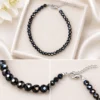



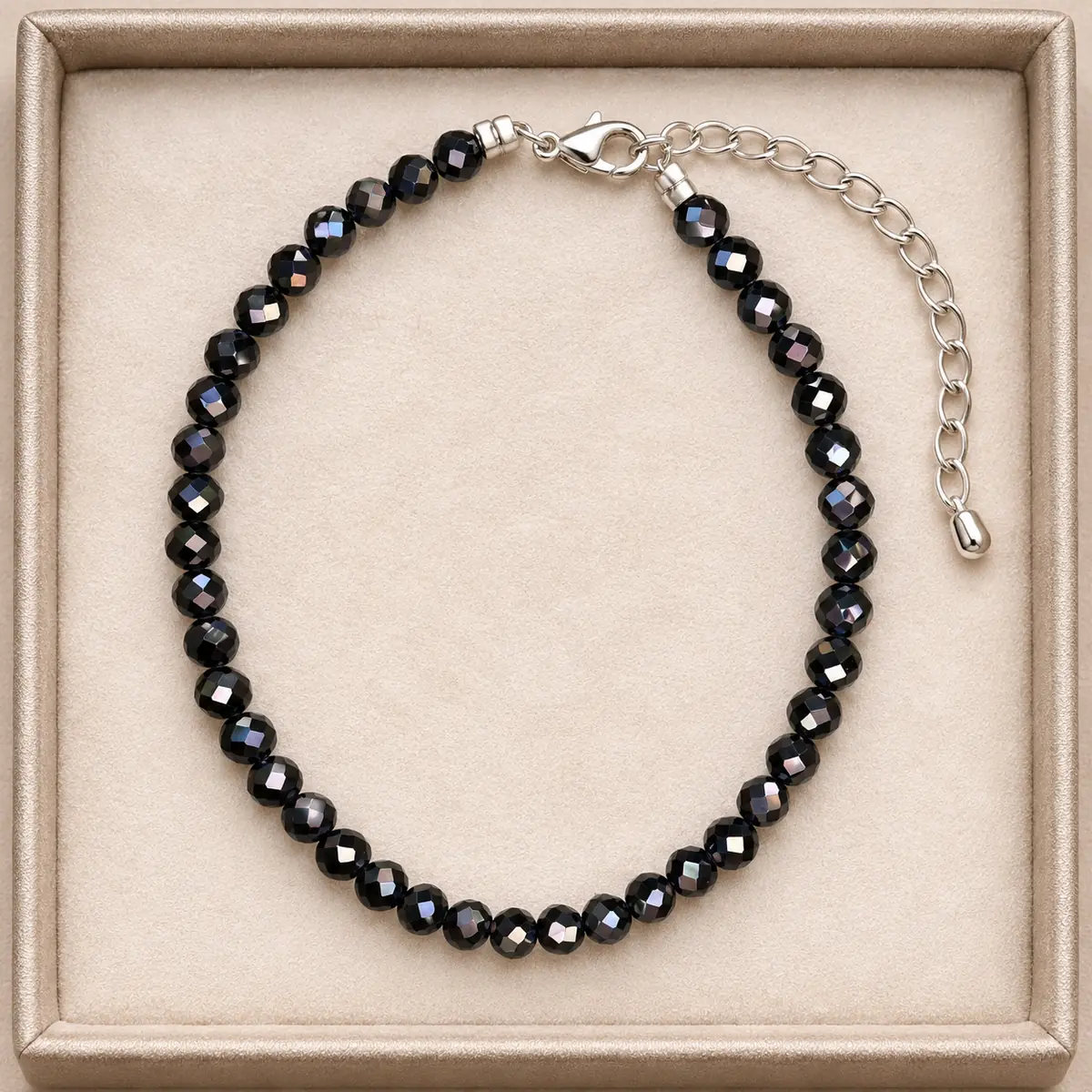
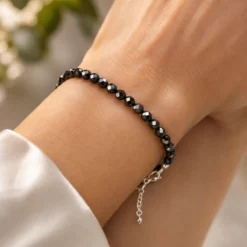
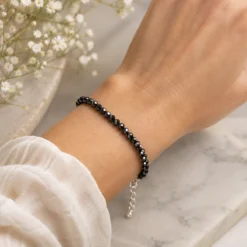

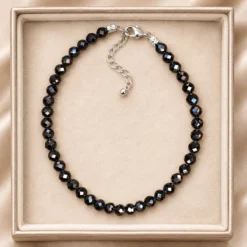
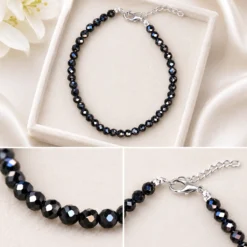
Faceted black spinel bracelet 4mm – premium quality
35,00 € incl. VAT
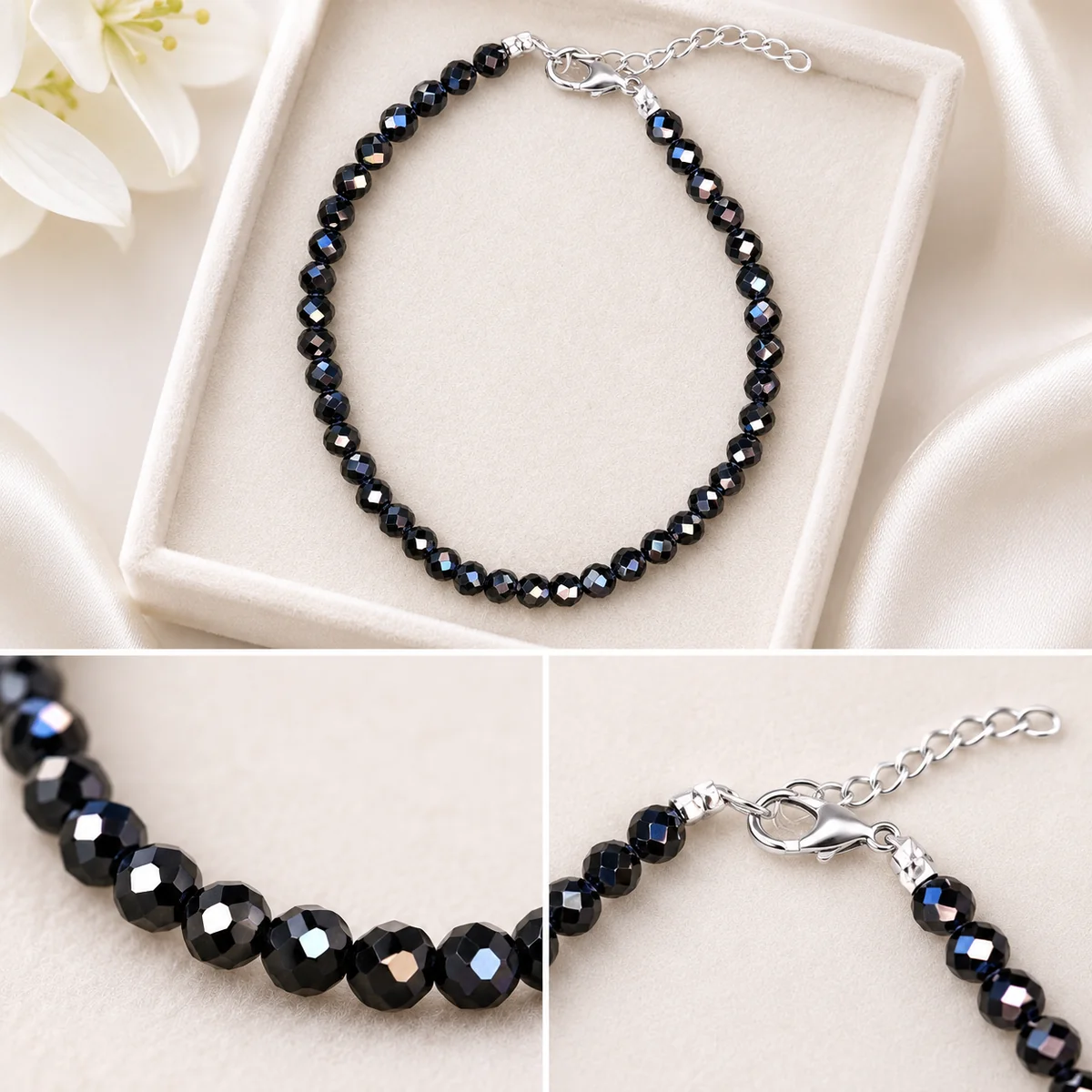
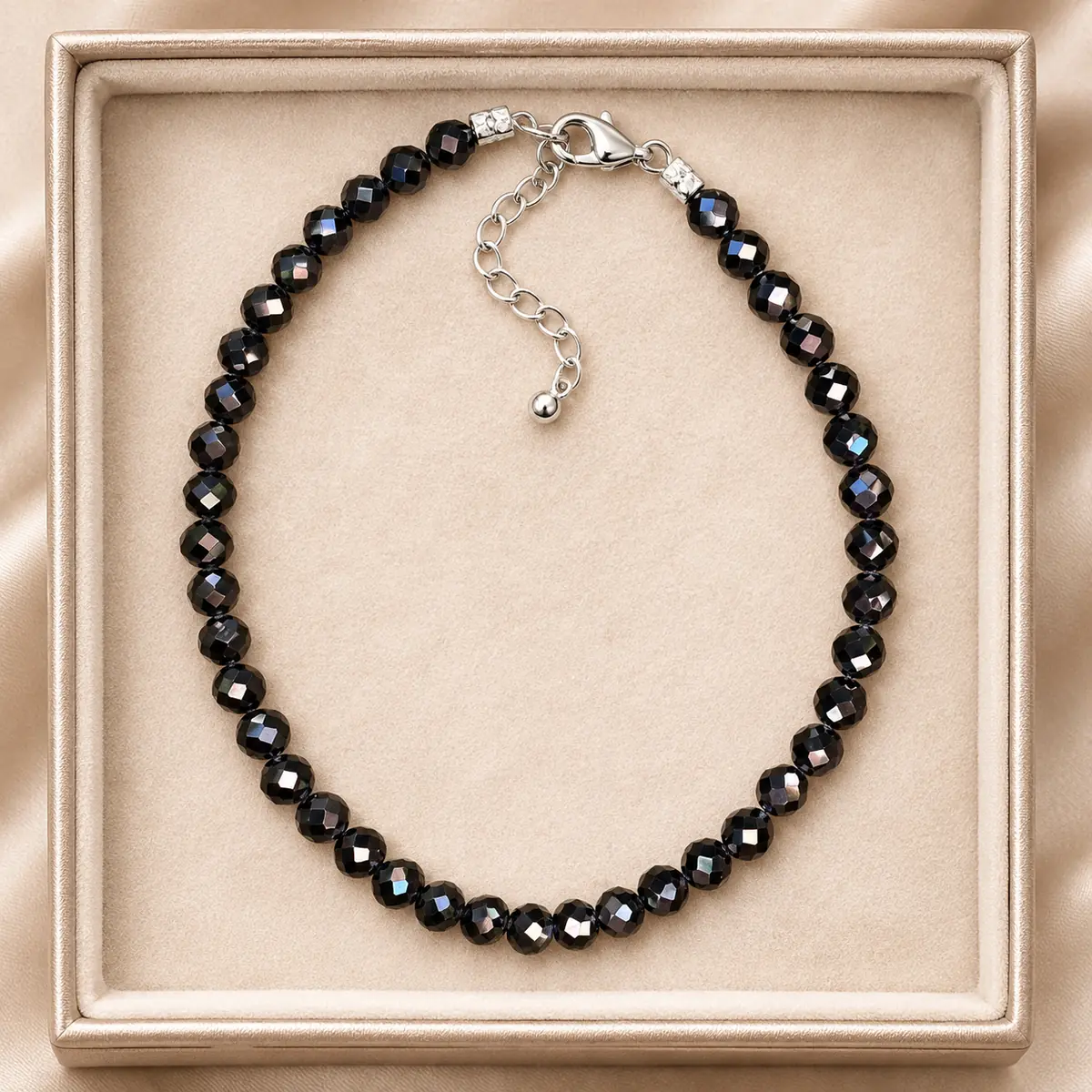
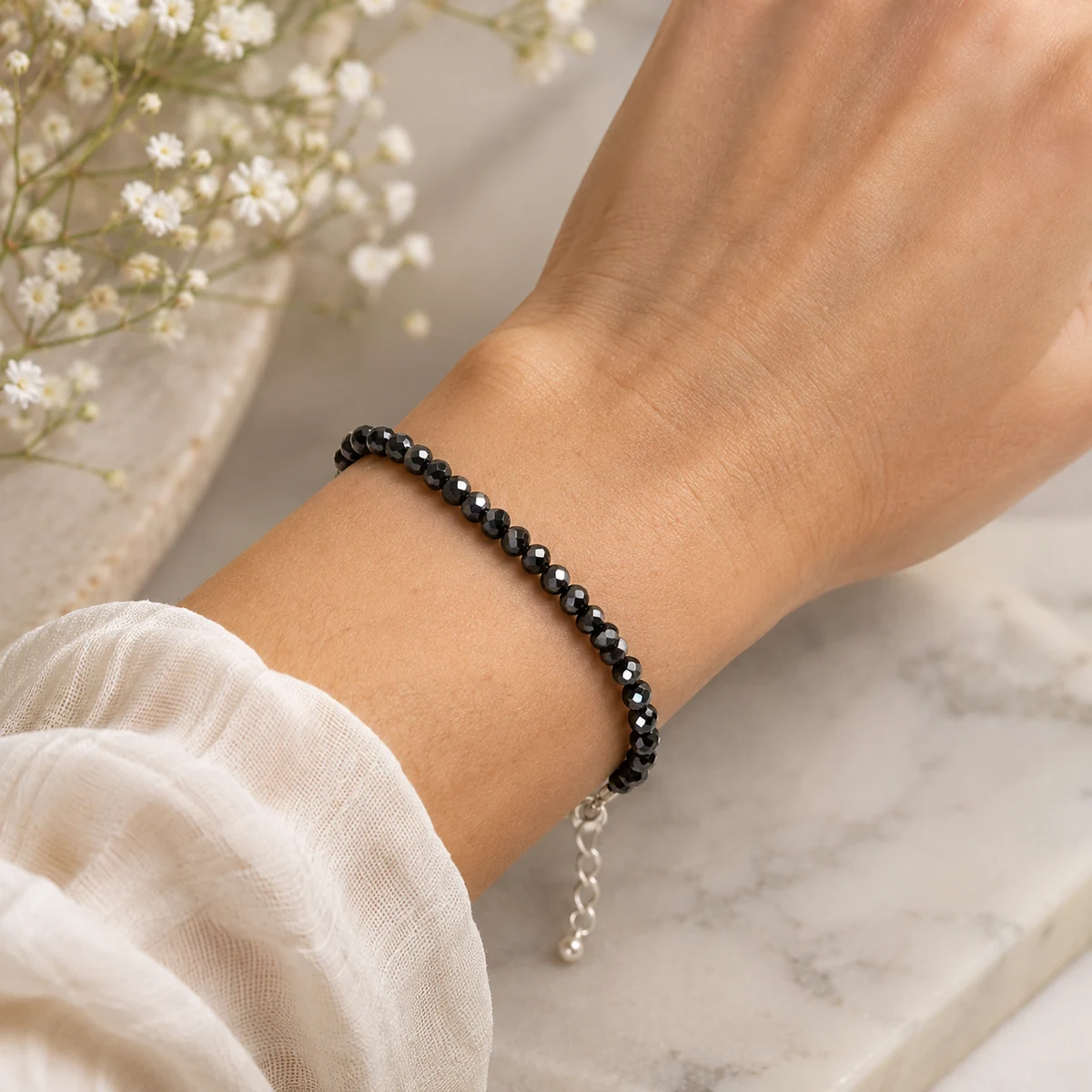
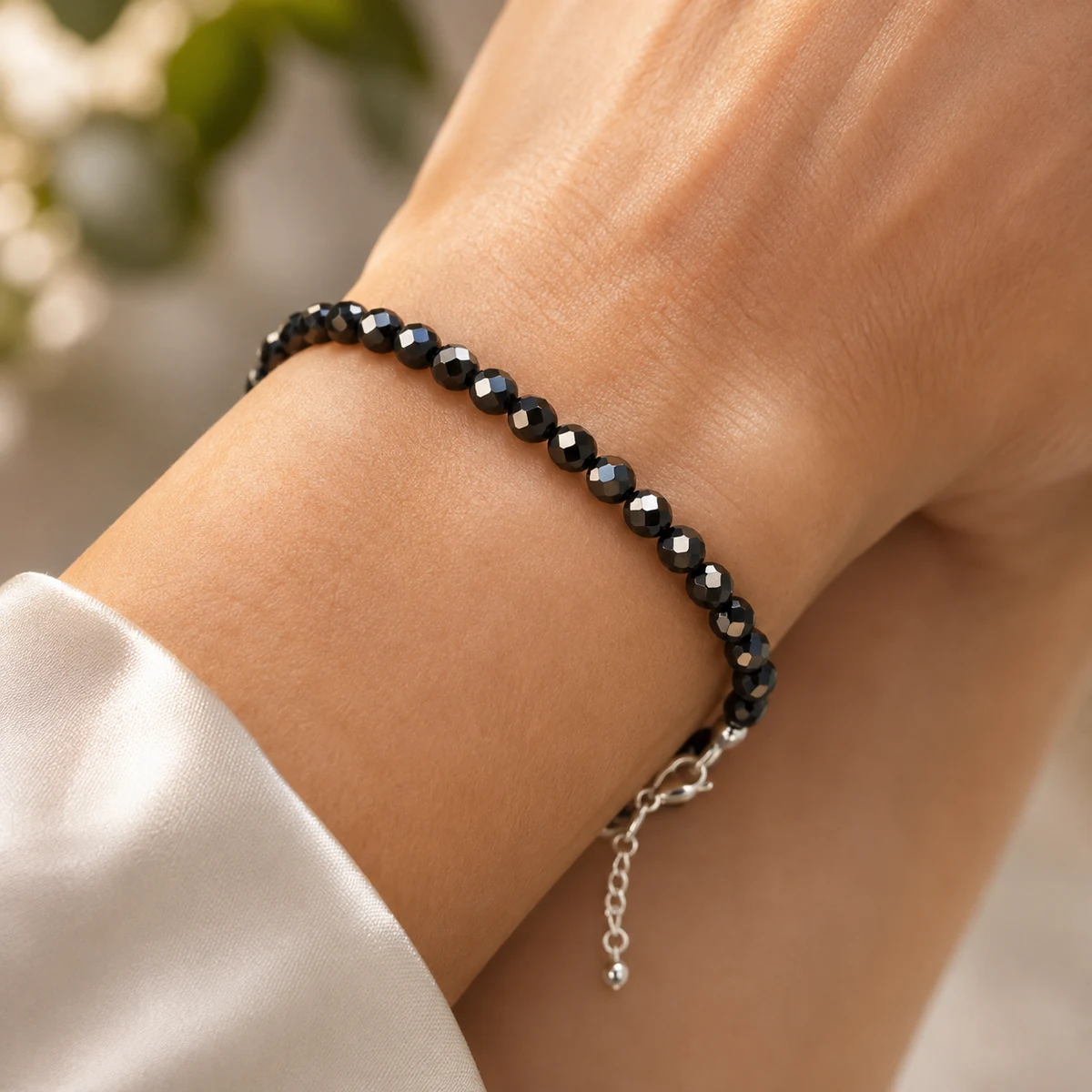
Premium quality faceted spinel bracelet, made of 4 mm beads. Its extension chain allows you to easily adjust its length to your wrist size.
In stock
Color: black
Bead shape: round
Thread type: non-elastic beading wire
Cut: faceted
Bead diameter: 4mm
Precious metal: none – steel clasp and chain
Bracelet dimensions: 16 cm, with 5cm extension chain
Weight: 4.1 g
Non-contractual photos
Classification: aluminum and magnesium oxides group
Mohs hardness: 7.5-8
Density: 3.58-3.63
Origin: USA, Sri Lanka, Russia, Vietnam, Afghanistan, Madagascar
Care instructions: Spinel is a hard stone, resistant to scratches. As with all natural stones, it is advisable to avoid repeated exposure to soap/shower gel, cosmetic products (perfume, etc.) or household cleaners.
Non-contractual photos.
Faceted black spinel bracelet, in detail
Spinel is a magnesium aluminum oxide (MgAl2O4) that crystallizes in octahedrons. Its hardness is 7.5 to 8 on the Mohs scale.
Wrist size: 16cm, 5cm extension chain; faceted; 4mm diameter. Approximate weight: 4.1 g.
The Faceted Stone Bracelets category contains other items of the same type.
Origins and minéralogy
Spinel: origin, formation and mineralogical properties
Origin and formation
Spinel is a mineral belonging to the oxide family, composed mainly of magnesium and aluminum. Valued in jewelry for its brilliance, resistance, and variety of colors, it comes in shades of red, pink, purple, blue, orange, gray, and black.
Long confused with ruby, spinel nevertheless has a distinct chemical composition and crystal structure.
Spinel forms mainly in geological environments subject to high temperatures and pressures, particularly in certain metamorphic rocks.
It is particularly present in magnesium-rich marbles, resulting from the transformation of carbonate rocks such as dolomitic limestones.
During metamorphism, the minerals present in these rocks react with each other and recrystallize. When chemical conditions are favorable, particularly in the presence of magnesium and aluminum, spinel crystals can develop.
Spinel can also appear in certain magmatic rocks rich in magnesium and iron, notably basalts and ultramafic rocks.
Over time, the erosion of the rocks containing it releases the crystals. These can be transported by waterways and then accumulate in alluvial deposits, where they are extracted along with other gems.
Remarkable natural crystallization
Spinel crystallizes in the cubic system, also called the isometric system.
Its crystals frequently show an octahedral shape, consisting of eight triangular faces.
This natural geometry is one of the most recognizable characteristics of raw spinel.
Some crystals also exhibit twinning, which are associations of several crystals following precise geometric orientations.
The shape of the crystals, their transparency, and their vitreous luster contribute to the interest in spinel in mineralogy and jewelry.
Composition and mineralogical properties
Spinel has the chemical formula MgAl₂O₄. It is a magnesium aluminum oxide belonging to the spinel group.
Its crystal structure can accommodate small amounts of other chemical elements, notably chromium, iron, cobalt, or vanadium.
These elements influence the coloring and certain optical properties of the crystals.
Main mineralogical properties
- Classification: oxides
- Group: spinels
- Chemical composition: MgAl₂O₄
- Crystal system: cubic
- Mohs hardness: 8
- Density: approximately 3.55 to 3.63 for common gem spinel
- Refractive index: approximately 1.718
- Birefringence: none in optically isotropic crystals
- Luster: vitreous
- Transparency: transparent to opaque
- Colors: red, pink, orange, purple, blue, gray, brown, and black; some greenish or yellowish shades are exceptional
- Cleavage: none
- Fracture: conchoidal to irregular
- Morphology: frequently octahedral crystals
Transparency and luster
Spinel has a vitreous luster that is particularly valued in jewelry.
Transparent gem-quality crystals can show beautiful brilliance when correctly cut and polished.
Unlike ruby and sapphire, which belong to the trigonal crystal system, spinel belongs to the cubic system. It is therefore generally optically isotropic and does not exhibit birefringence.
Some spinels contain natural inclusions, notably small mineral crystals, cavities, or growth-related structures.
The presence of these inclusions varies according to the deposits and formation conditions.
The most transparent spinels are used for gem cutting, while opaque varieties, especially black ones, are frequently worked into cabochons or beads.
Natural, synthetic spinel and treatments
Spinel has also been produced artificially in laboratories since the beginning of the 20th century.
Synthetic spinels can come in a wide variety of colors and be used in jewelry or as imitations of other gems.
They have a composition and physical properties close to those of natural spinel, but their origin is different.
Some natural spinels may also undergo treatments intended to modify their color or improve their appearance.
Precise identification of a natural or synthetic spinel may require an in-depth gemological examination.
The different colors of spinel
The diversity of colors is one of the most appreciated characteristics of spinel.
The shades result mainly from the presence of certain chemical elements in its crystal structure.
Red spinel
Red spinel is one of the most sought-after varieties.
Its color comes mainly from the presence of chromium, which can produce shades ranging from slightly orangey red to deep red, sometimes accompanied by pinkish or purplish highlights.
Crystals showing an intense red color and beautiful transparency are particularly valued in jewelry.
Due to its resemblance to ruby, red spinel was long confused with this variety of corundum.
The distinction between the two is based notably on their chemical composition, crystal structure, hardness, and optical properties.
Pink spinel
Pink spinel shows shades ranging from pale pink to bright pink, sometimes slightly purplish.
As with red spinel, its coloring is mainly linked to the presence of chromium.
Transparent crystals with intense pink colors are particularly sought after for jewelry making.
Some gems show very luminous shades, sometimes marketed under names evoking their neon pink color.
Purple spinel
Purple spinel shows colors ranging from very light lilac to deep purple, sometimes with grayish or bluish shades.
These variations result notably from the presence of different chromogenic elements and their interactions in the crystal structure.
Lilac, mauve, and purple spinels are valued for their delicate colors, particularly visible in transparent gems.
Blue spinel
Blue spinel is a particularly sought-after variety, especially when it shows an intense blue color and beautiful transparency.
Its coloring can be linked to the presence of iron and, in some gems, cobalt.
Cobalt blue spinels with particularly vivid colors are among the most appreciated varieties.
Shades can vary from light gray-blue to deep blue, sometimes slightly purplish.
Blue spinel can resemble sapphire, but its composition and optical characteristics allow them to be distinguished.
Black spinel
Black spinel is an opaque or nearly opaque variety, characterized by its intense black color and vitreous luster.
Its coloring is mainly linked to the presence of iron and other elements in its structure.
It is used for making beads, cabochons, jewelry, and ornamental objects.
Its shiny black appearance allows for the creation of jewelry with sober and contemporary lines.
Black spinel is distinguished from black tourmaline by its chemical composition, crystal structure, and physical properties.
Yellow spinel
Spinels showing yellow or yellowish shades are particularly unusual.
Unlike red, pink, purple, or blue varieties, pure yellow is not a commonly observed color in natural spinel of MgAl₂O₄ composition.
Some stones marketed under this name may show orangey-yellow or yellowish-brown shades.
Gemological identification is recommended to confirm their nature, as some colors are also found in neighboring minerals or synthetic materials.
Green spinel
Green-colored spinels are also uncommon, especially when they show a clear and deep green.
The spinel group includes several mineral species of different compositions, some of which naturally show green colors.
This is notably the case for gahnite, a zinc aluminum oxide (ZnAl₂O₄), which can show green to blue-green shades.
There are also rare natural spinels showing greenish shades, but color alone does not allow for certain determination of their classification.
For pieces marketed as green spinels, precise identification allows for distinguishing spinel proper from other species in its group.
Deposits
Spinel is present in several regions of the world, within metamorphic, magmatic, or alluvial geological formations.
Afghanistan and Tajikistan – Badakhshan
The historical region of Badakhshan, located in Central Asia and covering territories corresponding today to Afghanistan and Tajikistan, has been known for several centuries for its red and pink spinel deposits.
Ancient gems from this region were frequently marketed under the name balas rubies.
The Kuh-i-Lal deposit, located in present-day Tajikistan near the Afghan border, is one of the most famous historical sources of red spinel.
These crystals develop in magnesium-rich metamorphic formations.
Myanmar
Myanmar, formerly Burma, is among the main producing regions of gem-quality spinel.
The Mogok region is particularly renowned for its red, pink, and orange crystals.
Spinels there are notably associated with metamorphic marble formations, sometimes in the presence of rubies.
Some crystals show a very intense color and remarkable transparency.
Sri Lanka
Sri Lanka has important alluvial gemstone deposits.
Spinel is present there in different colors, notably pink, purple, blue, gray, and red.
Crystals are frequently extracted from gem-bearing gravel deposits, where they are found associated with other minerals.
Vietnam
Vietnam is renowned for its pink, red, purple, and blue spinels.
The Luc Yen and An Phu regions have deposits associated with metamorphic formations.
Some Vietnamese blue spinels are particularly sought after for their intense color linked to the presence of cobalt.
Tanzania
Tanzania has several spinel deposits, notably in the Mahenge and Tunduru regions.
Tanzanian spinels can show red, pink, orange, or purplish shades.
The Mahenge region is particularly known for its luminous pink and red spinels.
Madagascar
Madagascar has various spinel deposits, notably in metamorphic formations and alluvial deposits.
Colors and transparency vary according to localities and geological conditions.
Other deposits
Spinel is also present in the United States, Australia, and several other regions of the world.
Geological conditions influence crystal size, composition, color, and transparency.
History and use
Spinel, long confused with ruby
Spinel has a long history in the gemstone trade.
For several centuries, red spinels were often confused with rubies due to their similar colors and the lack of sufficiently precise mineralogical identification methods.
Red spinels from Central Asia were notably known as balas rubies.
This confusion explains the presence of several famous spinels in European royal collections.
The Black Prince’s Ruby
The famous Black Prince’s Ruby, set in the Imperial State Crown of the British Crown Jewels, is actually a red spinel of about 170 carats.
This gem has been associated with the history of the British monarchy since the Middle Ages.
It owes its name to Prince Edward of Woodstock, nicknamed the Black Prince.
Its intense red color explains why it was long considered a ruby.
The Timur Ruby
The Timur Ruby, also kept among the British Crown Jewels, is another historic red spinel.
Weighing about 361 carats, it features several Persian inscriptions engraved on its surface, testifying to its passage between different rulers.
Despite its traditional name, it is not a ruby, but a spinel.
Recognition of spinel as a distinct mineral
Progress in crystallography and mineralogy in the 18th century allowed for the gradual distinction of spinel from ruby.
In 1783, mineralogist Jean-Baptiste Louis Romé de l’Isle notably participated in establishing this distinction.
The name spinel is generally linked to the Latin spinella, meaning “little thorn,” in reference to the pointed shapes of its octahedral crystals.
Today, spinel is recognized as a gemstone in its own right.
Use in jewelry
With a hardness of 8 on the Mohs scale and good resistance to wear, spinel is suitable for many jewelry creations.
It is notably used for the manufacture of:
- Rings and pendants.
- Earrings.
- Beaded necklaces and bracelets.
- Faceted gems.
- Cabochons and ornamental jewelry.
Its different colors allow for jewelry in varied styles, from red and pink gems to more sober black spinels.
Care
With a hardness of 8 on the Mohs scale, spinel is a relatively resistant gem suitable for regular use in jewelry.
It can be cleaned with a soft cloth, slightly damp if necessary.
Occasional cleaning with lukewarm soapy water is generally possible, followed by careful drying.
It is best to avoid harsh chemicals, significant shocks, and sudden temperature variations.
For jewelry with inclusions or internal fractures, ultrasonic and steam cleaning are discouraged as a precaution.
For bracelets and necklaces composed of small faceted beads, the mounting thread and metal elements should also be preserved.
Well-being and energies
Properties traditionally attributed to spinel
In lithotherapy, spinel is mainly associated with vitality, grounding, emotional balance, and self-confidence.
In contemporary energy practices, symbolic associations vary according to the color of the stone.
Red spinel
Red spinel is traditionally associated with energy, willpower, and courage.
It notably symbolizes:
- Vitality and dynamism.
- Courage and determination.
- Self-confidence.
- Motivation and perseverance.
Associated Chakra: root chakra – MULADHARA.
Black spinel
Black spinel is associated with grounding and energetic protection.
It notably symbolizes:
- Emotional stability.
- Grounding.
- Protection against external influences.
- Inner strength.
Associated Chakra: root chakra – MULADHARA.
Purple spinel
Purple spinel is traditionally associated with soothing and intuition.
It notably symbolizes:
- Serenity.
- Mental clarity.
- Introspection.
- Emotional balance.
Associated Chakras: third eye – AJNA and crown – SAHASRARA.
Blue spinel
Blue spinel is associated with communication and personal expression.
It notably symbolizes:
- Communication.
- Creativity.
- Clarity of mind.
- Intuition.
Associated Chakras: throat – VISHUDDHA and third eye – AJNA.
Yellow spinel
In lithotherapy traditions, stones marketed as yellow spinels are associated with optimism and vitality.
They notably symbolize:
- Joy.
- Motivation.
- Self-confidence.
- Dynamism.
Associated Chakra: solar plexus – MANIPURA.
These associations are symbolic and do not imply precise mineralogical identification of the yellow stones concerned.
Green spinel
In contemporary energy practices, stones marketed as green spinels are associated with harmony and emotional balance.
They notably symbolize:
- Openness to others.
- Benevolence.
- Emotional balance.
- Harmony in relationships.
Associated Chakra: heart – ANAHATA.
These correspondences remain independent of the exact mineralogical identification of the stones concerned.
Pink spinel
Pink spinel is associated with gentleness and emotional balance.
It notably symbolizes:
- Affection.
- Self-love.
- Soothing.
- Emotional harmony.
Associated Chakra: heart – ANAHATA.
Orange spinel
Orange spinel is traditionally associated with creative energy and enthusiasm.
It notably symbolizes:
- Creativity.
- Motivation.
- Vitality.
- Spontaneity.
Associated Chakras: sacral – SVADHISTHANA and solar plexus – MANIPURA.
Associated astrological signs
The most commonly proposed correspondences in lithotherapy include:
- Aries
- Leo
- Scorpio
- Capricorn
These associations may vary according to the color of the spinel and different energy traditions.
Purification and recharging
Cleansing
In lithotherapy, spinel can be symbolically purified by fumigation using palo santo or white sage.
Simply pass the stone or jewelry gently through the smoke for a few moments, making sure to ventilate the room well.
This method avoids prolonged immersion, particularly for jewelry with stringing wire or metal elements.
Recharging
In contemporary energy practices, spinel can be symbolically recharged in moonlight or soft natural light.
It can also be placed near a quartz geode or on a selenite plate.
It is best to avoid prolonged exposure to high heat or direct sunlight, especially for stones whose color might be sensitive to exposure conditions.
The energetic properties mentioned stem from lithotherapy traditions and contemporary practices. They do not correspond to scientifically proven effects and do not replace any medical treatment.
Expédition : 48 à 72 heures, hors week-ends et jours fériés, après confirmation du paiement.
Livraison offerte dès 60 € en France métropolitaine.
Droit de rétractation : 14 jours pour nous signaler votre décision.
You may also like…


Bracelets


Bracelets
Bracelets
Bracelets
Related products

Bracelets


Bracelets