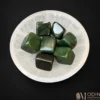


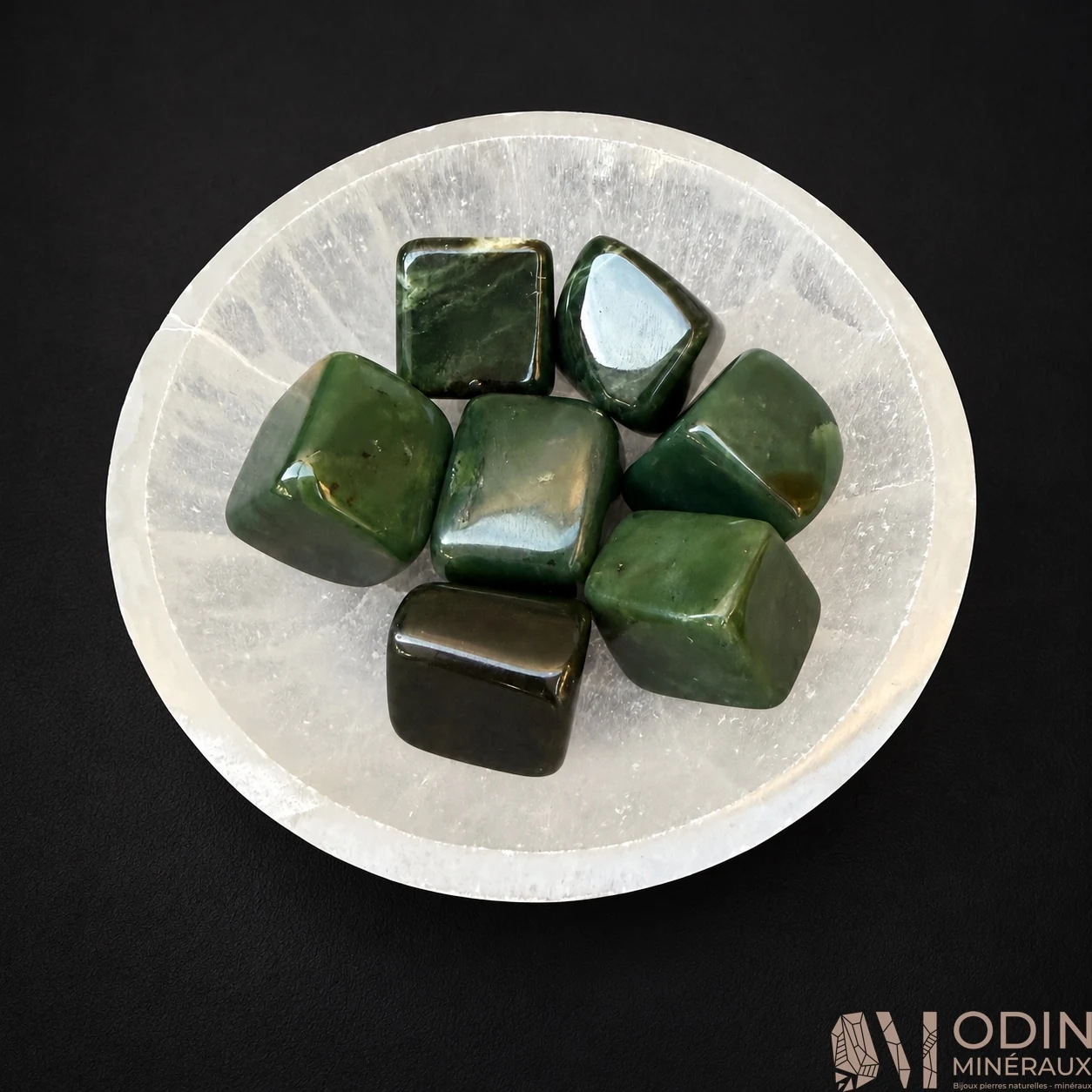
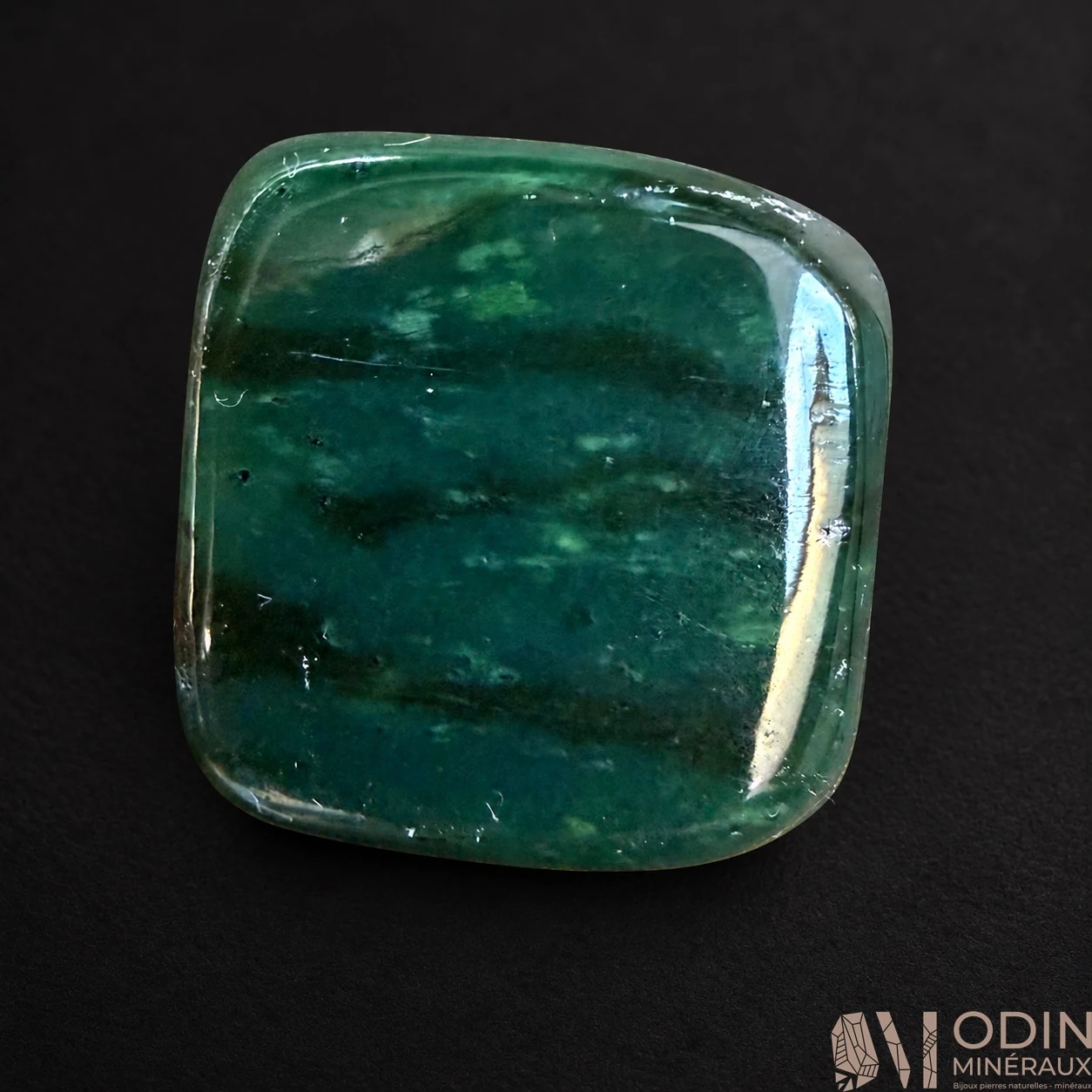
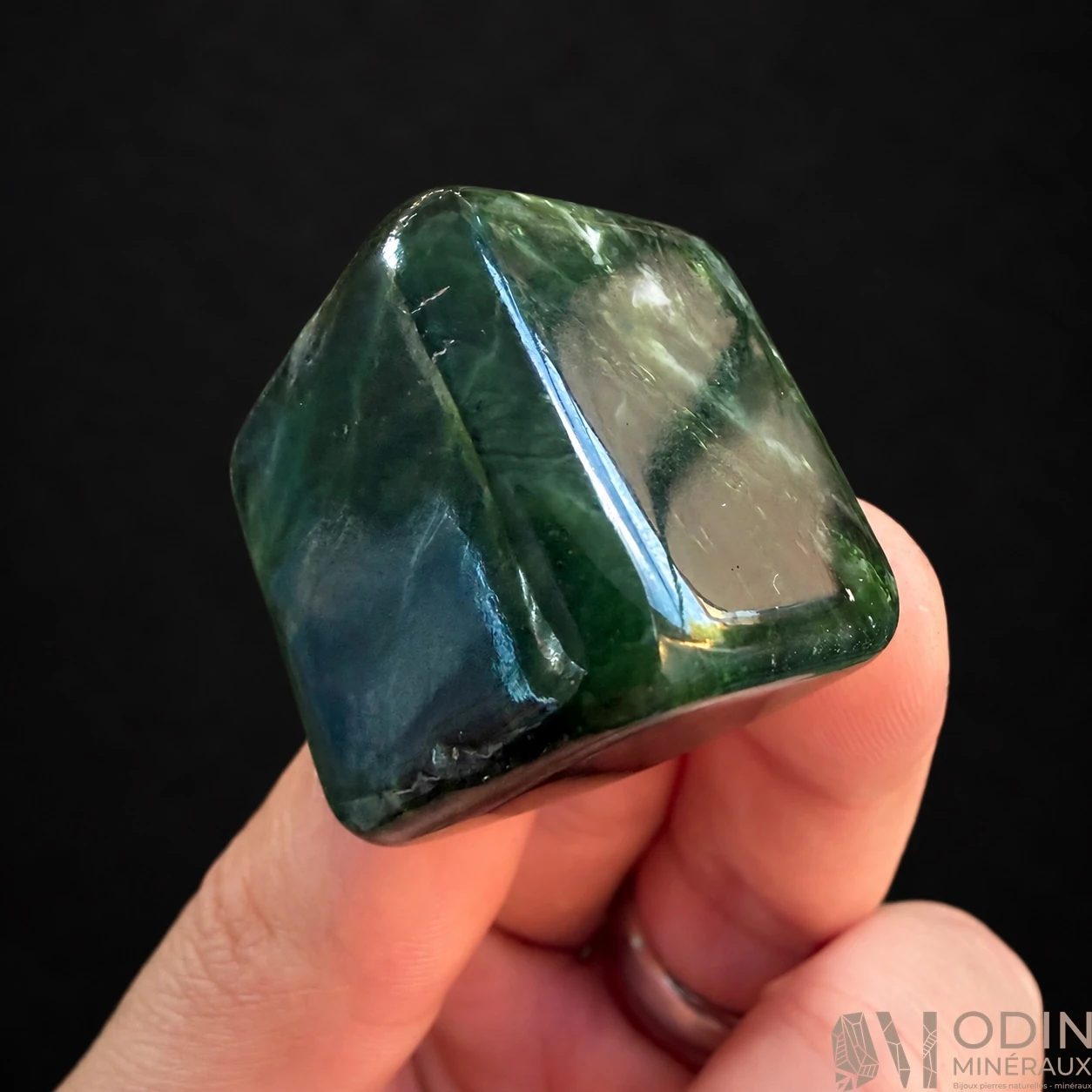
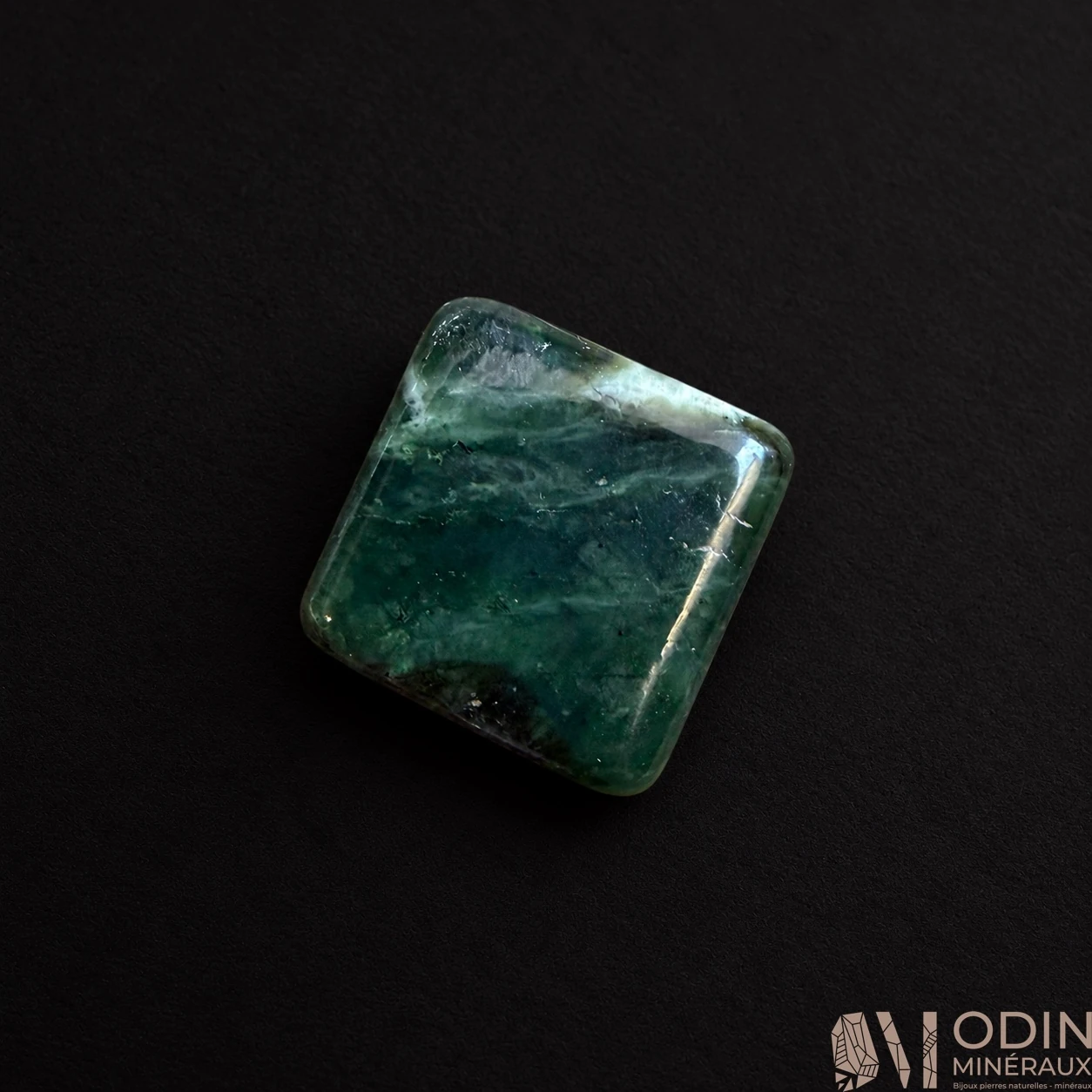
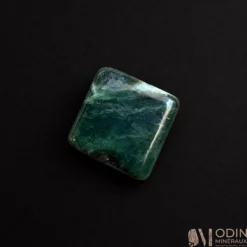
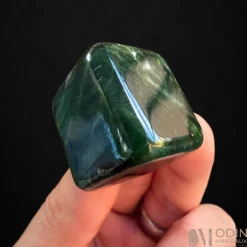
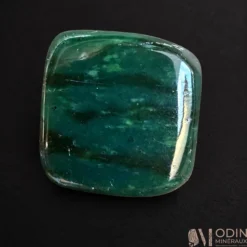
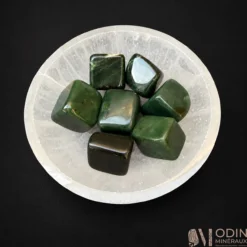
Nephrite Jade Cube 2 to 3 cm
19,00 € incl. VAT
Premium-quality nephrite jade cube.
In stock
Stone: Nephrite Jade
Color: green
Dimensions: 2-3cm
Approximate weight: 40-80 g
Number of stones: stone sold individually
Shape: square polished stone
Non-contractual photos.
Classification: silicate group
Mohs hardness: 6 – 6.5
Density: 2.90 to 3.10
Origin: Canada, Pakistan
Care instructions: no specific care is required. Jade can be rinsed periodically with clear water and dried with a soft cloth.
About this listing: Nephrite jade cube 2 to 3 cm
Details noted on the listing: square polished stone shape, 2–3 cm, weight 40–80 g.
Find other items in the Cubes/Bricks category.
ORIGINS AND MINERALOGY
Jade: origin, formation, and mineralogical properties
➤ Origin & formation of jade
Jade is a natural stone used for millennia in the manufacture of jewelry, ornamental objects, sculptures, and tools.
Contrary to popular belief, jade does not correspond to a single mineral species. This appellation primarily refers to two distinct materials: nephrite jade and jadeite jade.
Although they sometimes exhibit similar colors and appearances, their chemical composition, crystalline structure, and geological formation conditions are different.
Jade is particularly known for its green hues, ranging from pale green to emerald green, but there are also white, yellow, brown, grayish, almost black varieties, and, in the case of jadeite, lavender, pink, or orange-red shades.
Its appearance can range from opaque to translucent, with a vitreous to slightly greasy luster after polishing.
Jade is especially distinguished by its remarkable toughness, meaning its resistance to impact and breakage, which has largely contributed to its use in various civilizations.
Nephrite jade and jadeite jade: two distinct materials
Nephrite jade
Nephrite jade is a rock primarily composed of microscopic amphibole crystals belonging to the tremolite–actinote series.
These extremely fine and interlocked crystals form a compact and particularly resistant structure.
Nephrite occurs in various shades of green, but also in white, cream, greenish-yellow, brown, or almost black.
The dark green variety is notably found in deposits in Canada, Pakistan, China, and Russia.
Nephrite generally has a hardness of 6 to 6.5 on the Mohs scale.
It is particularly valued for its mechanical resistance, its polish, and the depth of its colors.
Jadeite jade
Jadeite jade is mainly composed of jadeite, a mineral belonging to the pyroxene group.
Its chemical composition is different from that of nephrite, and its structure is generally more granular.
Jadeite exhibits a wide diversity of colors, including green, white, lavender, pink, orange-yellow, and reddish.
The most sought-after varieties can display a particularly intense emerald green color and strong translucency.
Exceptional quality jadeite is notably known by the trade name imperial jade.
It is important to note that this appellation refers to a specific gemological quality and not a distinct mineral species.
How is nephrite jade formed?
Nephrite jade is primarily formed during metamorphic and metasomatic processes, during which pre-existing rocks undergo chemical transformations due to temperature, pressure, and fluid circulation.
Metamorphism corresponds to the mineralogical and structural transformations of a rock in a solid state.
Metasomatism also involves chemical exchanges between the rock and the fluids passing through it.
Two major geological contexts favor the formation of nephrite.
Formation associated with serpentinites
Serpentinites are rocks resulting from the transformation of certain magnesium- and iron-rich magmatic rocks, particularly peridotites.
When calcium-rich fluids circulate in contact with these rocks, chemical reactions can promote the formation of minerals belonging to the amphibole group.
Under certain conditions, these minerals develop as an extremely fine and interlocked aggregate, characteristic of nephrite.
This type of formation is particularly important for green nephrite deposits.
It is found notably in different areas of British Columbia, Siberia, and certain regions of China.
Formation associated with carbonate rocks
Nephrite can also form when silica-rich fluids interact with carbonate rocks, particularly dolomites.
These reactions can lead to the formation of tremolite, whose organization into very fine fibers contributes to the compact structure of nephrite.
These formations notably produce certain varieties of white or very light jade, sometimes particularly sought after in Chinese lapidary traditions.
The final color and properties of the material depend on its mineralogical composition, the chemical elements present, and the conditions of its formation.
Why is nephrite jade so resistant?
The exceptional resistance of nephrite comes from the organization of its microscopic crystals.
Unlike some minerals composed of relatively individualized crystals, nephrite exhibits a dense entanglement of mineral fibers.
This structure helps distribute mechanical stresses and limit the propagation of fractures.
Two properties should be distinguished:
- Hardness: it measures a material’s resistance to scratching.
- Toughness: it corresponds to its ability to resist impacts, breakage, and crack propagation.
With a hardness of 6 to 6.5 on the Mohs scale, nephrite is less hard than quartz.
Nevertheless, it possesses very high toughness, which explains its historical use for making blades, axes, adzes, and various tools.
This property also makes it suitable for carving, jewelry making, and decorative objects.
How is jadeite jade formed?
Jadeite forms in geological environments different from those of most nephrites.
It is primarily associated with conditions of high pressure and relatively low temperature, characteristic of certain subduction zones.
Subduction corresponds to one tectonic plate sinking beneath another.
In these environments, rocks undergo significant mineralogical transformations.
Fluid circulation and chemical reactions can promote the formation of sodium- and aluminum-rich minerals, including jadeite.
These formations are notably known in Myanmar and Guatemala.
Jadeite can appear in compact masses, sometimes associated with other pyroxenes or metamorphic minerals.
Its appearance and color depend on its composition, texture, and the chemical elements present.
Why does jade exhibit different colors?
The color of jade primarily depends on its mineralogical composition and the presence of certain chemical elements.
In the case of nephrite, color variations are notably linked to the proportion of iron in amphiboles and the presence of accessory minerals.
Materials rich in tremolite can exhibit white, cream, or very light hues.
An increase in the proportion of iron can promote the appearance of more intense green shades.
Inclusions of graphite, chromite, or other minerals can also contribute to the appearance of dark areas.
In the case of jadeite, different chemical elements contribute to the material’s color.
Chromium can notably be responsible for certain very intense emerald-green shades.
Iron and other elements also play a role in color variations.
The main aspects encountered are:
- Light green to dark green: present in both nephrite and jadeite.
- White to cream: particularly known in certain tremolite-rich nephrites.
- Yellow to brown: shades that can result from the composition or alteration of certain mineral constituents.
- Very dark green to almost black: common in certain nephrites rich in iron or dark inclusions.
- Lavender to pale purple: primarily associated with certain varieties of jadeite.
- Orange-red: found in certain jadeites exhibiting colorations linked notably to iron compounds.
So the color of a stone alone isn’t enough to determine whether it’s nephrite or jadeite.
Mineralogical characteristics of jade
Nephrite jade
- Nature: compact metamorphic rock with a fibrous texture.
- Classification: silicates, inosilicates.
- Mineralogical group: amphiboles, tremolite–actinote series.
- Composition: mainly calcium amphiboles rich in magnesium and iron.
- Indicative chemical formula: Ca₂(Mg,Fe)₅Si₈O₂₂(OH)₂.
- Crystal system: monoclinic for the constituent amphiboles.
- Hardness: 6 to 6.5 on the Mohs scale.
- Density: generally 2.90 to 3.10 g/cm³.
- Luster: vitreous to slightly greasy.
- Transparency: opaque to translucent.
- Colors: white, cream, greenish-yellow, light green, dark green, brown, and almost black.
- Structure: microscopic fibrous and interlocked crystals.
- Toughness: particularly high.
- Cleavage: not clearly observable in massive rock.
- Fracture: generally irregular to splintery.
- Main provenances: China, Canada, Russia, Pakistan, New Zealand, and other regions.
Jadeite jade
- Nature: rock composed mainly of jadeite.
- Classification: silicates, inosilicates.
- Mineralogical group: pyroxenes.
- Chemical formula: NaAlSi₂O₆ for pure jadeite.
- Crystal system: monoclinic.
- Hardness: 6.5 to 7 on the Mohs scale.
- Density: generally 3.30 to 3.40 g/cm³.
- Luster: vitreous to slightly greasy.
- Transparency: opaque to translucent, sometimes very translucent for superior qualities.
- Colors: green, white, yellow, orange, lavender, pink, and reddish.
- Structure: compact aggregate of generally fine crystals.
- Toughness: very high.
- Main provenances: Myanmar, Guatemala, and other geological occurrences.
These values are indicative. Physical properties may vary depending on the exact composition and associated minerals.
Main jade deposits
Jade is found in different regions of the world. Its geographical distribution depends on the type of jade considered and the geological conditions necessary for its formation.
China
China has a long history of mining and working jade, especially nephrite.
The Hotan (Hetian) region in Xinjiang is especially renowned for its pale and white nephrite.
The Kunlun mountains and several nearby formations are associated with significant occurrences.
The Manasi area, also in Xinjiang, is known for its green nephrites.
These materials hold a major place in the history of Chinese sculpture and craftsmanship.
Canada
Canada is one of the important producers of green nephrite.
The main deposits are located in British Columbia, in geological formations associated with serpentinized rocks.
Canadian jade exhibits different shades, ranging from medium green to very dark green, sometimes almost black.
Some varieties have a relatively homogeneous color, while others show veins, inclusions, or natural variations in texture.
Canadian nephrite is particularly used for making jewelry, sculptures, spheres, and ornamental objects.
Pakistan
Pakistan has green nephrite deposits, notably in the Mohmand region, Khyber Pakhtunkhwa.
The Hamid and Siraj mines are among the documented operations in this region.
The materials can exhibit intense green shades, sometimes close to those of certain nephrites from British Columbia.
Pakistani nephrite is subject to international trade, particularly for the Chinese market.
Russia
Russia has important nephrite deposits, particularly in Siberia.
The areas around Lake Baikal and the Republic of Buryatia are known for their green nephrites and, in some deposits, lighter materials.
New Zealand
New Zealand has nephrite deposits particularly known in the South Island, especially on the west coast.
Nephrite is one of the main materials grouped under the Māori name pounamu.
It holds significant cultural importance in Māori traditions and craftsmanship.
Myanmar
Myanmar is one of the world’s leading sources of jadeite jade.
The deposits in the north of the country, particularly in the Hpakant and Hkamti regions, are renowned for their materials of various qualities and colors.
Some very translucent emerald green jadeites are among the most sought-after ornamental stones on the international market.
Guatemala
Guatemala has jadeite deposits in the Motagua Valley region.
These materials hold major historical and gemological interest, particularly due to the use of jade in Mesoamerican civilizations.
Dark green nephrite jade from Canada and Pakistan
Dark green nephrite jade is a particularly appreciated variety for its deep shades and compact structure.
Materials from Canada and Pakistan can have very similar visual characteristics.
They’re notably distinguished by:
- Dark green to almost black-green shades.
- A generally compact texture.
- A vitreous to slightly greasy luster after polishing.
- Variable translucency, sometimes visible on thin edges.
- Inclusions or natural color variations.
- Very high mechanical resistance linked to their fibrous structure.
The green color is mainly linked to the amphibole composition and the presence of iron.
Canadian and Pakistani nephrites can be worked into pebbles, bracelets, beads, pendants, spheres, and carvings.
However, the exact origin can’t be determined from color or visual appearance alone.
Reliable geographic identification requires traceability information or specialized analyses.
White jade, green jade, lavender jade: what are the differences?
Several trade names are used to distinguish the different colors of jade.
Green jade
Green jade is the most widely known variety to the general public.
It can be either nephrite or jadeite.
Colors vary from pale green to very intense green, sometimes with whitish or dark areas.
The commercial name “Chinese green jade” should not be confused with a mineralogical identification: Chinese provenance alone does not determine the nature of the material.
Nephrite jade
Nephrite jade corresponds to a material mainly composed of amphiboles belonging to the tremolite–actinolite series.
It is known for its exceptional toughness and for its shades ranging from white to dark green.
It is the material historically used in many ancient Chinese productions.
White jade
White jade can be nephrite or jadeite.
Some high-quality white nephrites, particularly those historically associated with the Hotan region, are highly prized for their homogeneity and fine texture.
The traditional English term mutton fat jade refers to certain white nephrites with a slightly greasy appearance.
Lavender jade
Lavender jade is generally a variety of jadeite exhibiting pale purple to mauve shades.
It’s especially used in jewelry.
However, some stones sold under this name may be dyed or may correspond to other materials, so gemological identification may be needed.
Black jade
The name black jade often refers to very dark nephrite.
Some nephrites that look black in ambient light can reveal a dark green color when viewed in transmitted light through a thin enough area.
How to tell natural jade from an imitation?
Jade is a sought-after material, which explains the many imitations and ambiguous trade names.
Some green stones may be presented as jade without being nephrite or jadeite.
Materials sometimes sold under misleading names include:
- Serpentine.
- Green aventurine.
- Some natural or dyed quartzites.
- Some artificially colored materials.
Their color can be close to that of jade, but their composition and properties differ.
Telling them apart may require gemological analysis covering density, refractive index, structure, and mineral composition.
The possible presence of dyes or treatments should also be taken into account.
For valuable materials, identification by a specialized lab helps ensure safe trading.
➤ Discovery & history through the ages
🪨 Prehistory: jade and the first tools
The use of jade goes back several millennia.
Its remarkable toughness quickly caught the interest of prehistoric peoples for making tools and worked objects.
Nephrite was especially suited to making blades, axes, and adzes.
Making these objects required extensive cutting, abrasion, and polishing work.
Jade was also used to create ornaments and decorative elements.
These early uses demonstrate the progressive mastery of hard stone working techniques.
🏺 Chinese Neolithic: the first great jade traditions
In China, jade held significant importance from the Neolithic period.
Several ancient cultures developed specialized techniques for cutting, carving, and polishing nephrite.
The Liangzhu culture, active approximately between 3300 and 2300 BCE, is particularly known for its jade objects.
Artisans notably created pierced circular discs, called bi, as well as tubular or prismatic objects called cong.
These pieces are often found in funerary and ceremonial contexts.
Their manufacture testifies to remarkable technical expertise and the symbolic value attributed to the material.
Jade gradually became associated with prestige, power, and certain spiritual representations.
🏛️ Ancient China: wisdom, virtue, and harmony
In ancient Chinese civilization, jade acquired a meaning that far surpassed its decorative use.
It is associated with several moral qualities, notably uprightness, wisdom, benevolence, and integrity.
In Chinese philosophical texts, certain physical properties of jade serve as metaphors to evoke human virtues.
Its resistance, texture, color, and luster became symbolic references.
Jade is particularly linked to representations of moral nobility and harmony.
It is used in jewelry, court ornaments, ceremonial objects, and sculptures.
Nephrite was then the main material worked under the name of jade.
🌎 Pre-Columbian Civilizations: jade in Mesoamerica
In Mesoamerica, jade also held considerable cultural and symbolic importance.
The Olmec, Maya, and several other ancient societies used it to make jewelry, masks, ceremonial objects, and adornments.
The material used was primarily jadeite, unlike the nephrite traditionally used in ancient China.
In some Mesoamerican cultures, the green color of jade is associated with vegetation, water, fertility, and renewal.
Jadeite thus held an important place in representations of power and in ceremonial practices.
These uses illustrate how two distant civilizations attributed strong cultural value to materials that are mineralogically different but are now grouped under the name of jade.
🌿 Māori traditions: New Zealand pounamu
In New Zealand, pounamu holds an important place in Māori culture.
This term refers to several local green stones, including nephrite.
Māori artisans notably work pounamu to create tools, ceremonial weapons, pendants, and various valuable objects.
Among the best-known objects are the hei tiki, carved pendants representing stylized human figures.
The toki, or adzes, also demonstrate the practical use of nephrite for woodworking.
Pounamu possesses a particular cultural value, linked to family ties, identity, and the transmission of objects from generation to generation.
📜 16th Century: origin of the word jade
The name jade is linked to the Spanish expression piedra de ijada, which roughly means “stone of the flank.”
Spanish explorers reportedly used this name due to beliefs observed in Central America, where certain stones were associated with the kidney region.
The word nephrite comes from the Greek nephros, meaning “kidney.”
These names reflect the historical importance of medicinal beliefs associated with jade.
However, these are old interpretations, with no scientific proof of any therapeutic effect of the mineral on the kidneys.
💎 18th Century: the arrival of jadeite in China
For several millennia, the jade traditionally worked in China was mainly nephrite.
From the second half of the 18th century onward, jadeite from Myanmar took on a growing role in Chinese trade.
Its intense green colors and translucency sparked particular interest among artisans and elites.
Under the Qing dynasty, some jadeite varieties were especially prized for making jewelry and carved objects.
The growth of this trade gradually helped shift the place of the different jade varieties on the market.
🔬 19th Century: scientific distinction between nephrite and jadeite
In the 19th century, advances in mineralogy made it possible to distinguish the different materials grouped under the name jade.
French mineralogist Alexis Damour played an important role in this development.
In 1846, he established the mineralogical nature of nephrite, linked to amphiboles of the tremolite–actinote series.
In 1863, he showed that jadeite has a chemical composition and structure different from those of nephrite.
This distinction was an important step in the scientific classification of jade.
It made it possible to separate two materials long associated due to their visual similarities and uses.
🌐 20th Century: growth of international trade
During the 20th century, jade mining and trade expanded internationally.
Nephrite from China, Canada, Russia, and New Zealand played an important role in the production of ornamental stones.
Modern sawing and polishing techniques made it easier to produce objects in different sizes.
Jade became especially common in jewelry, carvings, spheres, pebbles, and decorative objects.
Asian markets remain key in the valuation of certain qualities of nephrite and jadeite.
🔬 21st Century: identification, traceability, and gemology
Today, modern analysis methods make it easier to tell the two main categories of jade apart.
Spectroscopy, X-ray diffraction, and various chemical analysis techniques make it possible to specify their mineralogical composition.
These analyses also help identify certain treatments, artificial colorations, and imitation materials.
Studies on nephrites from Canada, Pakistan, and Russia notably help to better understand their geological specificities and their place in international trade.
The distinction between nephrite jade and jadeite jade remains essential for correctly presenting these materials.
➤ Jade care: natural stones and jewelry
Jade is appreciated for its high mechanical resistance.
Both nephrite and jadeite exhibit high toughness, but their surface can nevertheless be scratched or damaged by certain harder materials.
Proper care helps preserve their polish and appearance.
Care for tumbled stones, pebbles, and polished minerals
To clean a natural jade pebble or polished stone, preferably use a soft, slightly damp cloth.
Occasional cleaning with lukewarm water and a small amount of mild soap is generally possible for untreated materials.
Rinse gently, then dry thoroughly.
It is recommended to avoid:
- Harsh chemicals.
- Acidic solutions.
- Steam cleaning.
- Sudden temperature changes.
- Impacts against hard surfaces.
- Repeated rubbing against harder minerals.
Natural nephrite is generally light-stable, but it’s best to avoid prolonged exposure to high temperatures.
Caring for jade jewelry
For jade bracelets, pendants, necklaces, and other jewelry, go for cleaning with a soft cloth.
Avoid prolonged soaking, especially when jewelry includes metal parts, elastic cords, or glued sections.
It’s also recommended to limit contact with perfumes, creams, cosmetics, and household products.
Jades that have undergone certain treatments, especially impregnation or dyeing, may be particularly sensitive to heat or chemicals.
So it’s best not to use an ultrasonic or steam cleaner when the exact nature of the material and any treatments are unknown.
For storage, choose a soft pouch or an individual case.
These precautions help preserve the look of the stones and the quality of their polish over time.
➤ Wellbeing & energies: the symbolism of jade
In lithotherapy, jade is mainly associated with wisdom, balance, serenity, and harmony.
Its place in the history of several civilizations also gives it symbolism linked to protection, prosperity, and longevity.
In contemporary energetic practices, different symbolic properties are attributed to it depending on its color and variety.
Jade is said to be valued for:
- Wisdom: it symbolizes discernment and the ability to step back.
- Inner harmony: it is associated with temperance and inner stability.
- Serenity: it represents the search for calm and gentleness.
- Tolerance: it symbolizes openness to others, understanding, and benevolence.
- Self-confidence: it is associated with assurance and determination.
- Luck and prosperity: it is traditionally considered a symbol of success and abundance.
- Harmony: it evokes balance in personal relationships and interactions.
- Protection: it is symbolically associated with stability and warding off negative influences.
These interpretations are mainly derived from cultural beliefs and contemporary lithotherapy practices.
Symbolic properties of jade according to its varieties
Green jade
In lithotherapy, green jade is primarily associated with harmony, serenity, and inner balance.
It is said to symbolize temperance, patience, and the ability to remain serene in relationships.
Its color also evokes renewal, growth, and prosperity.
Nephrite jade
Nephrite jade is particularly associated with inner strength, courage, determination, and stability.
It symbolizes self-mastery and the ability to make thoughtful decisions.
It is also associated with moderation, personal discipline, and the search for balance in daily choices.
Dark green nephrite jade is often symbolically linked to grounding, perseverance, and emotional stability.
White jade
White jade is primarily associated with clarity of mind, serenity, and the search for inner harmony.
It symbolizes discernment and the ability to focus on what is essential.
In some practices, it is used as a symbolic support during moments of meditation or reflection.
Lavender jade
Lavender jade is generally associated with gentleness, inner peace, and emotional balance.
Its mauve shades symbolically evoke gentleness, compassion, and self-acceptance.
Jade and the chakras
In contemporary energetic practices, green jade is primarily associated with the heart chakra, also known as Anahata.
This symbolic center is traditionally linked to feelings, compassion, and the harmony of relationships.
Dark green nephrite jade can also be associated with the root chakra, or Muladhara, symbolically linked to stability and grounding.
White jade is sometimes linked to the crown chakra, while lavender jade is associated, depending on the practices, with the third eye chakra or the crown chakra.
These correspondences vary according to lithotherapy interpretations.
Jade and zodiac signs
In lithotherapy, jade is frequently associated with several zodiac signs, including:
- Taurus: for stability, harmony, and perseverance.
- Libra: for balance, temperance, and harmonious relationships.
- Cancer sign: for gentleness, serenity, and emotional security.
These associations are symbolic, are not based on mineralogical properties, and may vary according to different authors.
Disclaimer: the energetic properties mentioned are based on lithotherapy beliefs. They are not scientifically proven. Using minerals for wellbeing does not constitute medical treatment and cannot replace medical advice or follow-up.
Cleansing and recharging jade in lithotherapy
In lithotherapy, cleansing and recharging jade correspond to symbolic rituals, distinct from the physical maintenance of the mineral.
Cleansing:
Jade can be symbolically cleansed by smudging with white sage or palo santo.
Burn a sage or palo santo stick, then gently pass the stone near the smoke without exposing it directly to the flame.
It is recommended to do this in a well-ventilated room.
Some practices also involve a quick rinse under water or in demineralized water.
For jewelry with fragile elements or for jade where potential treatments are unknown, it is better to choose a non-immersion method.
Recharging:
In lithotherapy, jade is generally associated with soft sunlight or moonlight.
It is common to place it in a bright spot for a short period, avoiding high heat.
Other symbolic practices involve placing the stone:
- In a quartz geode.
- On a quartz cluster.
- On an amethyst druse.
- On a selenite plate, with care to preserve the latter.
These practices belong to lithotherapy and do not change the physical, chemical, or crystallographic properties of jade.
Lithotherapy is traditional and does not replace medical advice.
Expédition : 48 à 72 heures, hors week-ends et jours fériés, après confirmation du paiement.
Livraison offerte dès 60 € en France métropolitaine.
Droit de rétractation : 14 jours pour nous signaler votre décision.
You may also like…


Cubes/Bricks


Minerals


Purification and recharging


Related products


Minerals


Massage Wands, Pebbles, and Sticks


Massage Wands, Pebbles, and Sticks


Massage Wands, Pebbles, and Sticks