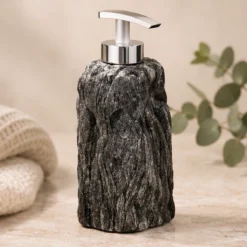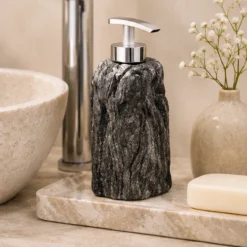


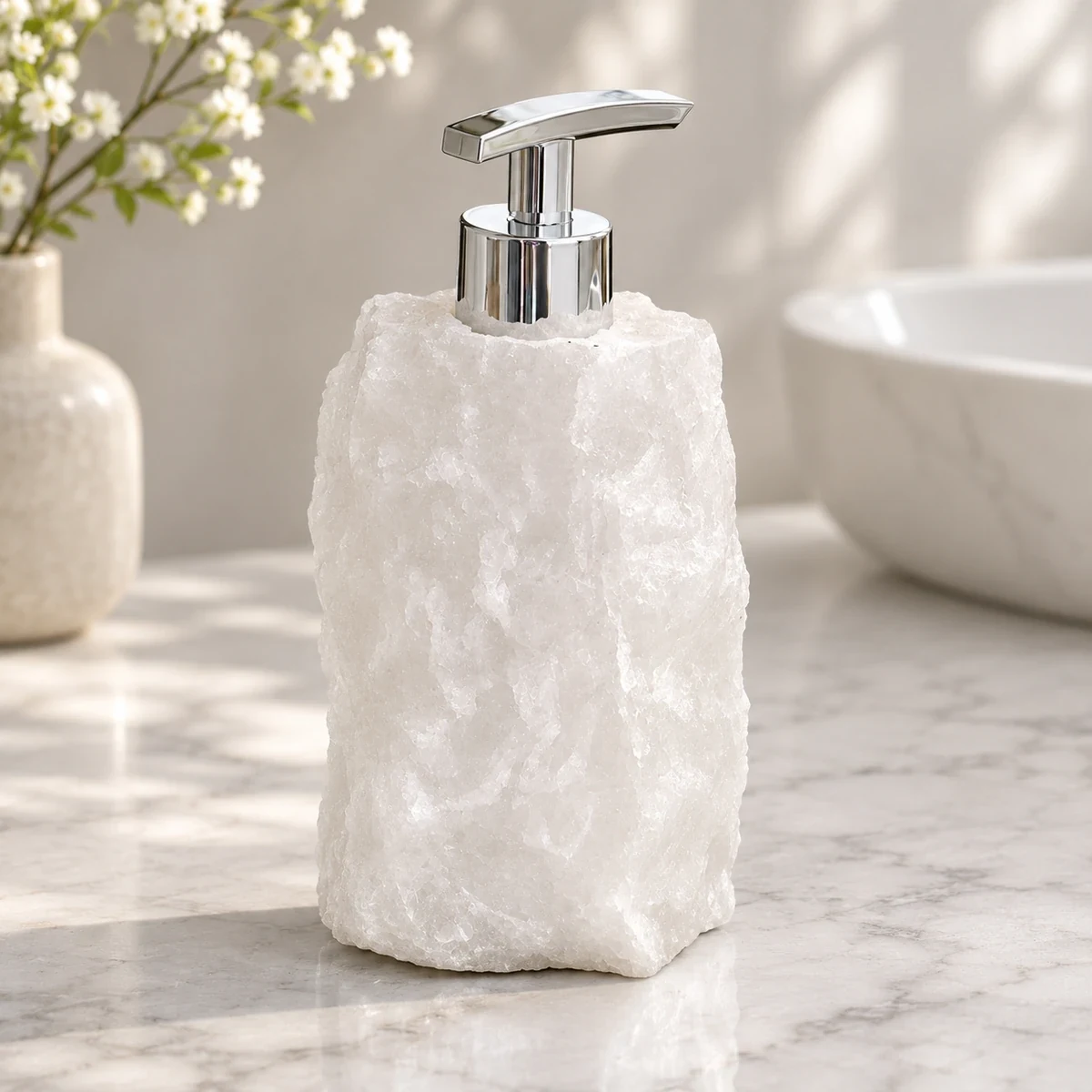
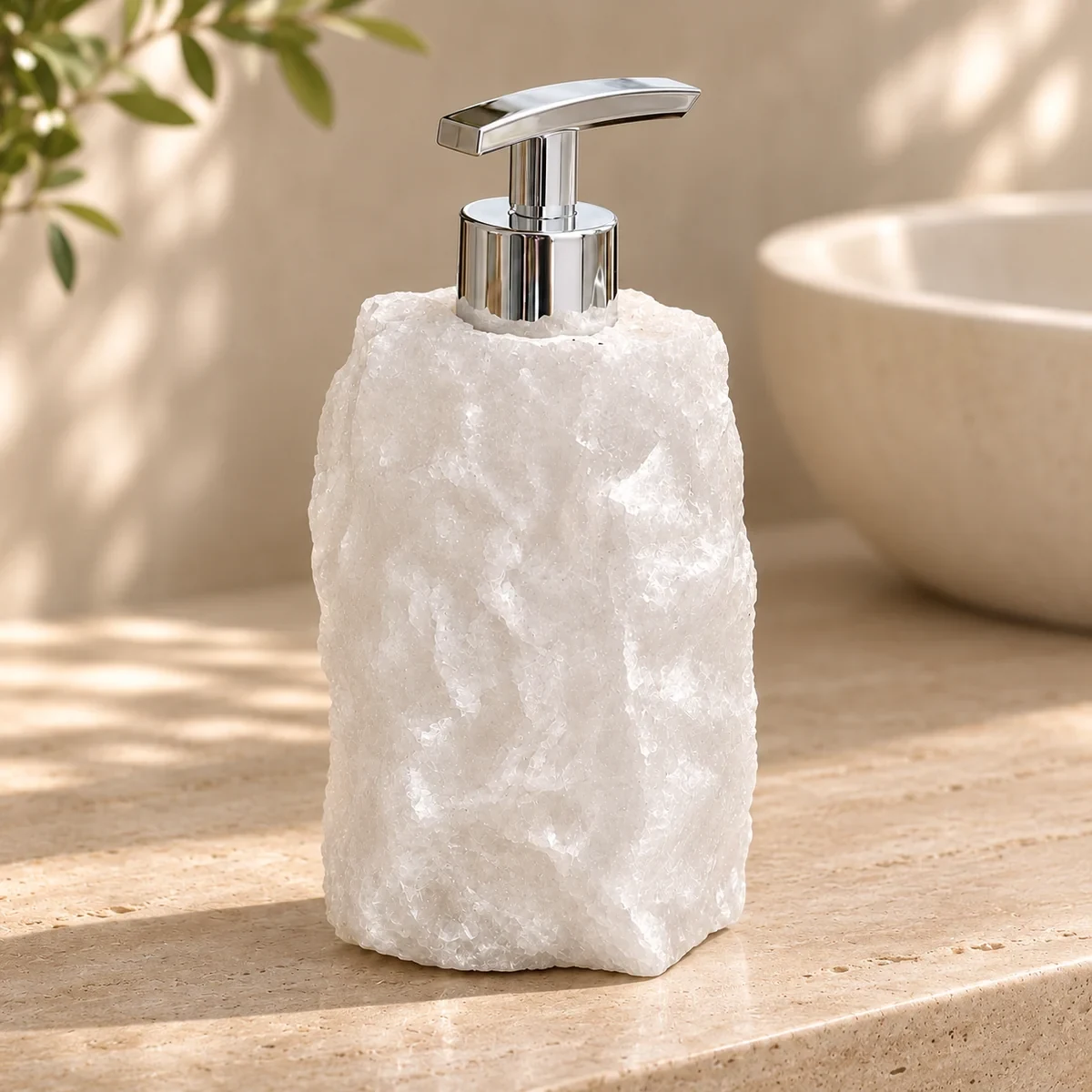
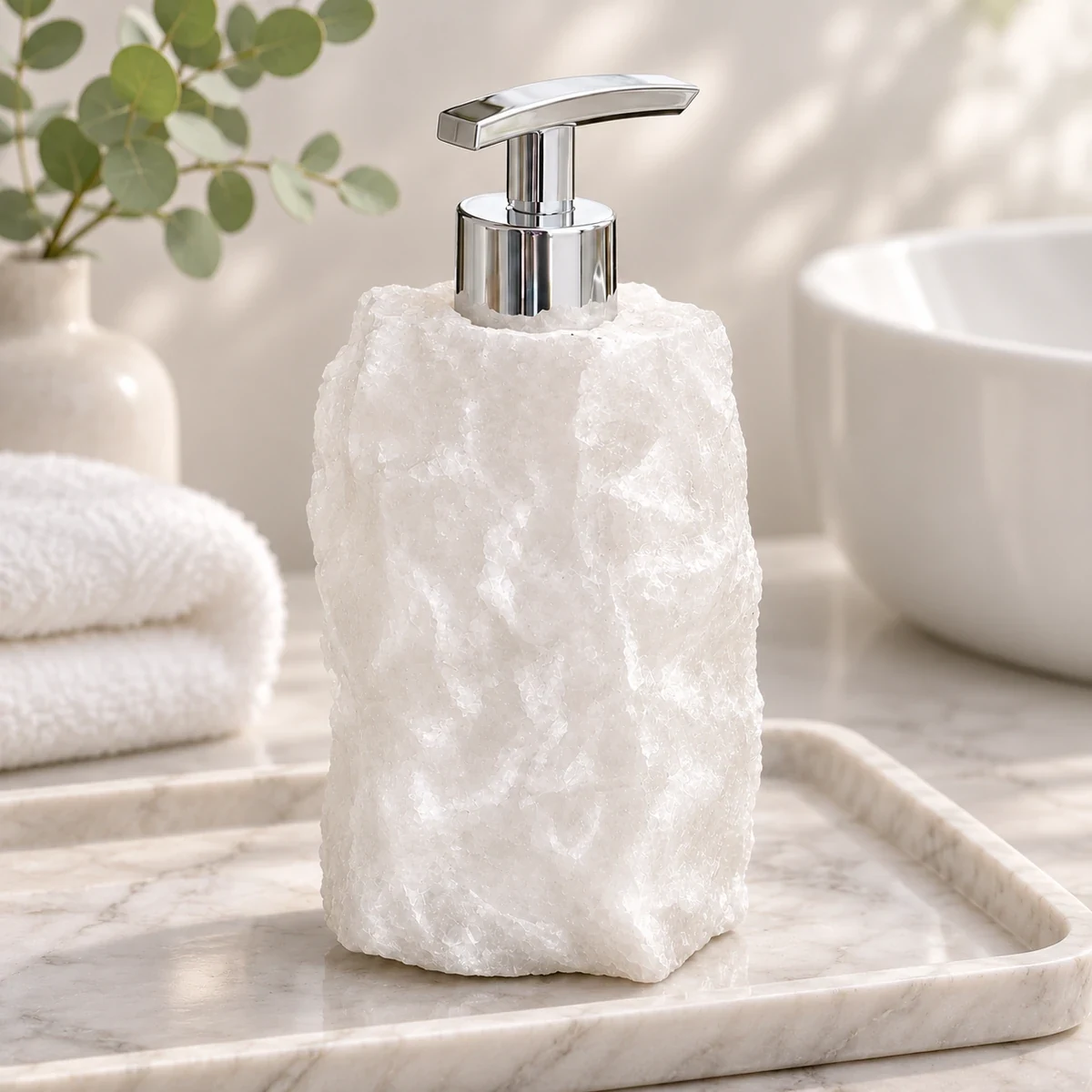
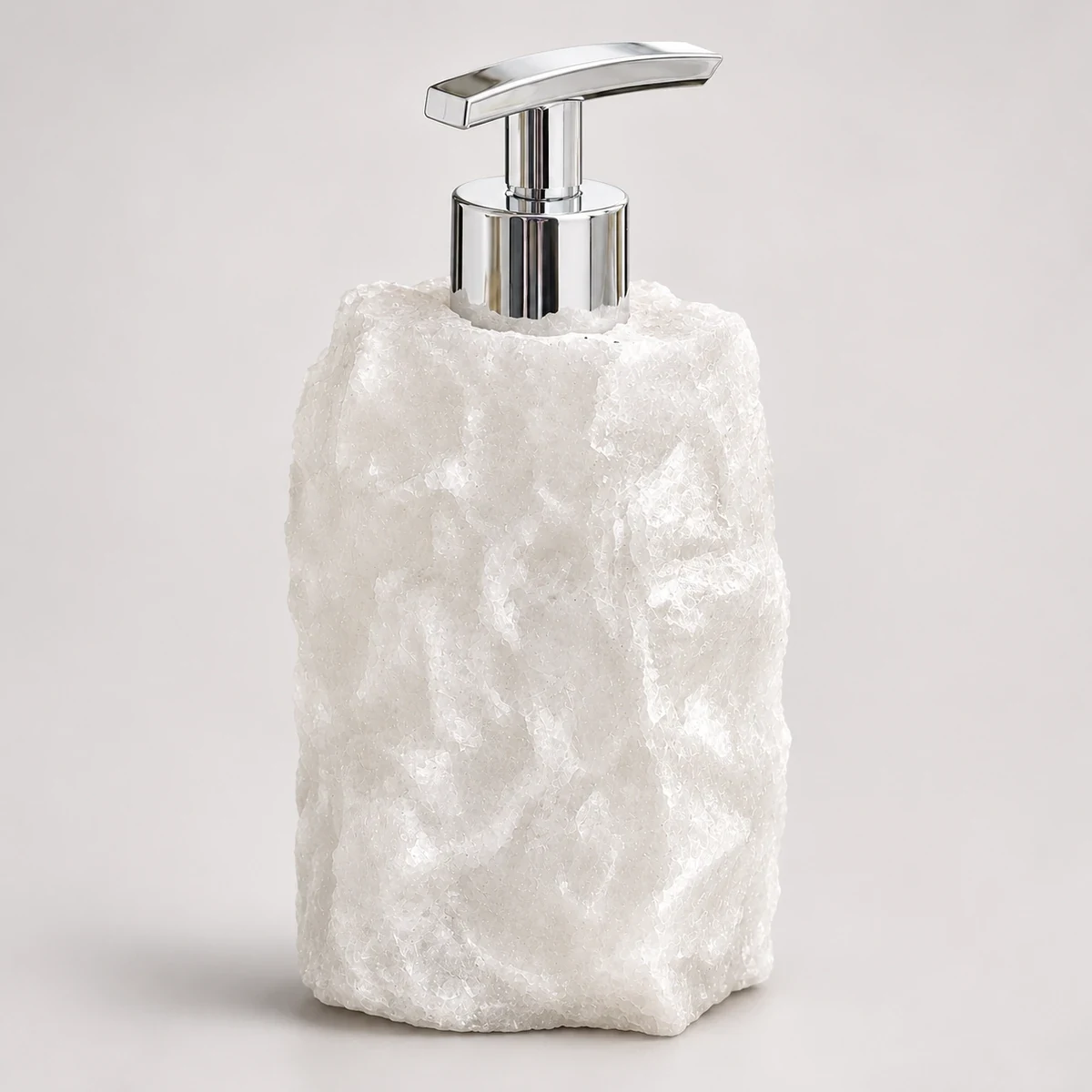
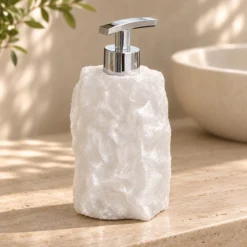
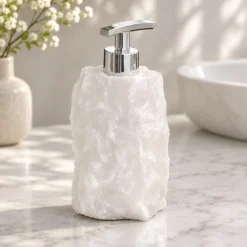
Raw rock crystal soap dispenser
54,00 € incl. VAT
Raw rock crystal soap dispenser. An elegant, mineral touch for your bathroom or kitchen.
In stock
Stone(s): rock crystal
Color: White
Dimensions: H 15 cm – Base: approx. 8 cm
Approximate weight: 1.5 to 1.7 kg
Number of pieces: sold individually
Shape: freeform
Photos are non-contractual.
Classification: quartz group
Mohs hardness: 7
Density: 2.65
Origin: Brazil
Care instructions: No specific care required
Raw rock crystal soap dispenser, in detail
Rock crystal is the colorless, transparent variety of quartz, a silicon dioxide (SiO2) with a trigonal crystal system. Its hardness is 7 on the Mohs scale. Its density is around 2.65.
Features listed on the sheet: freeform shape, H 15 cm – Base: approx. 8 cm, weight 1.5 to 1.7 kg.
This piece is classified in the Decoration category.
ORIGINS AND MINERALOGY
Rock crystal: origin, formation and mineralogical properties
➤ Origin & formation of rock crystal
Rock crystal is the colorless, transparent variety of natural quartz, one of the most widespread minerals in the Earth’s crust. Made of silicon dioxide (SiO₂), it belongs to the silicate family and stands out for its transparency, glassy luster, and remarkable crystal structure.
Its formation results from natural geological processes, notably the circulation of silica-rich hydrothermal fluids through cracks and cavities in rocks. When physico-chemical conditions become favorable, dissolved silica gradually crystallizes, creating crystals whose size, clarity, and shape depend on their growth environment.
Rock crystal can develop in hydrothermal veins, alpine fissures, pegmatites, and certain geodes. When space allows, it forms magnificent prismatic crystals, often finished with natural pyramidal faces.
Mineralogical characteristics
- Mineral family: silicates, tectosilicate group
- Chemical composition: silicon dioxide (SiO₂)
- Crystal system: trigonal
- Hardness: 7 on the Mohs scale
- Density: approx. 2.65
- Luster: vitreous
- Transparency: transparent to translucent depending on the specimen
- Color: colorless, sometimes slightly veiled by inclusions or micro-fractures
- Cleavage: none
- Fracture: conchoidal, typical of quartz
Crystals often show a six-sided prism, a geometric feature visible on many natural specimens.
Perfectly clear rock crystal is especially sought after, but crystals with mineral inclusions, internal veils, or growth marks are also of great mineralogical interest. These features reflect the natural conditions in which the mineral developed.
Main rock crystal deposits
Rock crystal is found in many regions around the world. Some particularly well-known sources include:
- Brazil: especially the state of Minas Gerais, known for its quartz crystals and major mineral formations.
- Madagascar: known for its natural crystals, raw pieces, and inclusion quartz.
- United States: especially Arkansas, famous for its well-formed quartz crystals.
- Switzerland: the Swiss Alps are home to remarkable crystals formed in fissures within mountain massifs.
- France: the French Alps also have historic deposits, notably in the Oisans massif.
Each deposit has specific geological conditions that influence the shape, transparency, and characteristics of the extracted crystals.
➤ Discovery & history through the ages
🌍 Antiquity: a stone long associated with ice
Rock crystal has fascinated civilizations since Antiquity. Its name comes from the Ancient Greek krystallos, a term associated with ice.
The Greeks once considered this transparent material to be a form of ice that had become permanent. This interpretation reflects the amazement inspired by its clarity and naturally crystalline look.
In the Roman world, rock crystal was valued as an ornamental material. It could be worked and polished to create decorative objects, vessels, or jewelry elements.
🏛️ Middle Ages & Renaissance: a precious material
During the Middle Ages, rock crystal was used to make religious objects, reliquaries, and goldsmith pieces.
Its transparency gave it a special place in the decorative arts. Craftspeople used its optical qualities and polishability to create refined objects.
In the Renaissance, rock crystal craftsmanship reached a high level of sophistication in specialized workshops, especially in Italy. Vases, cups, and carved objects show the technical mastery needed to shape this particularly hard natural quartz.
🔬 Modern era: from mineralogy to science
The development of crystallography gradually made it possible to better understand quartz’s internal structure and the regular arrangement of its crystals.
In the 19th and 20th centuries, scientific research notably highlighted the piezoelectric properties of quartz, meaning its ability to produce an electrical response when subjected to certain mechanical stresses.
These characteristics explain its importance in various technical applications, including measuring devices, electronics, and frequency regulation systems.
Today, natural rock crystal remains sought after in mineralogy, collecting, jewelry, and décor, as much for its geological interest as for its aesthetics.
➤ Caring for rock crystal: jewelry and natural minerals
Rock crystal is a relatively scratch-resistant mineral thanks to its Mohs hardness of 7. Still, proper care helps preserve its transparency, natural shine, and the integrity of its crystal surfaces over time.
Care for raw and polished minerals
To clean a raw or polished rock crystal, use lukewarm water and a soft cloth, then dry the mineral carefully.
For pieces with fragile inclusions, assemblies, or major cracks, opt for dry cleaning or very light cleaning.
Avoid impacts, harsh chemicals, and sudden temperature changes, which can damage certain pieces.
Caring for rock crystal jewelry
Rock crystal jewelry needs a few extra precautions, especially when it includes elastic cord, metal settings, or glued elements.
We recommend cleaning it gently with a soft, clean, slightly damp cloth.
To preserve quality, avoid prolonged soaking, perfumes, household products, and repeated rubbing against harder materials.
➤ Well-being & energies: the symbolism of rock crystal
In contemporary lithotherapy traditions, rock crystal is often nicknamed the stone of light or the stone of clarity.
Its transparency and crystal structure give it symbolism linked to purity, balance, and harmony.
According to lithotherapy beliefs, rock crystal is said to be appreciated for:
- Mental clarity: it is said to symbolize lucidity, focus, and organized thinking.
- Inner harmony: it is said to be linked to emotional balance and serenity.
- Energy amplification: some traditions attribute to it the ability to symbolically boost the energy of other stones.
- Meditation: it is often used as a support for contemplation, introspection, and refocusing.
- Harmonizing spaces: its presence is appreciated in environments dedicated to relaxation and well-being.
Rock crystal is also widely used in mineral arrangements combining several varieties of natural stones.
Warning: the energetic properties mentioned are based on lithotherapy beliefs. They are not scientifically proven. Using minerals for well-being is not a medical treatment and cannot replace medical advice or follow-up.
➤ Cleansing and recharging rock crystal in lithotherapy
In lithotherapy traditions, cleansing and recharging rock crystal are symbolic practices meant to support its energetic use.
These rituals should be distinguished from physical care of the mineral.
Cleansing rock crystal jewelry
For jewelry, especially bracelets and necklaces strung on elastic cord, smoke cleansing with white sage or palo santo is a practice traditionally used in lithotherapy.
Light a palo santo stick or white sage, then gently pass your jewelry through the smoke, keeping it away from the flame and any excessive heat source.
Be sure to do this in a well-ventilated room.
Cleansing rock crystal minerals
For raw rock crystals, natural points, geodes, and polished stones, smoke cleansing is also a traditional method of symbolic purification.
You can gently pass your mineral through the smoke of white sage or palo santo, without exposing it directly to the flame.
This practice does not change the crystal’s physical or mineralogical characteristics.
Recharging rock crystal
In lithotherapy traditions, rock crystal is often associated with natural light.
It’s common to place it for a few hours in a bright spot or in gentle sunlight, avoiding excessive temperatures.
Other symbolic practices include placing rock crystal:
- In a quartz geode
- On a selenite plate
- In a calm space dedicated to meditation
These practices are part of traditional lithotherapy use and do not change the mineral’s physical or chemical properties.
Expédition : 48 à 72 heures, hors week-ends et jours fériés, après confirmation du paiement.
Livraison offerte dès 60 € en France métropolitaine.
Droit de rétractation : 14 jours pour nous signaler votre décision.
You may also like…


Related products