

Minerals
THE STONES OF GREENLAND
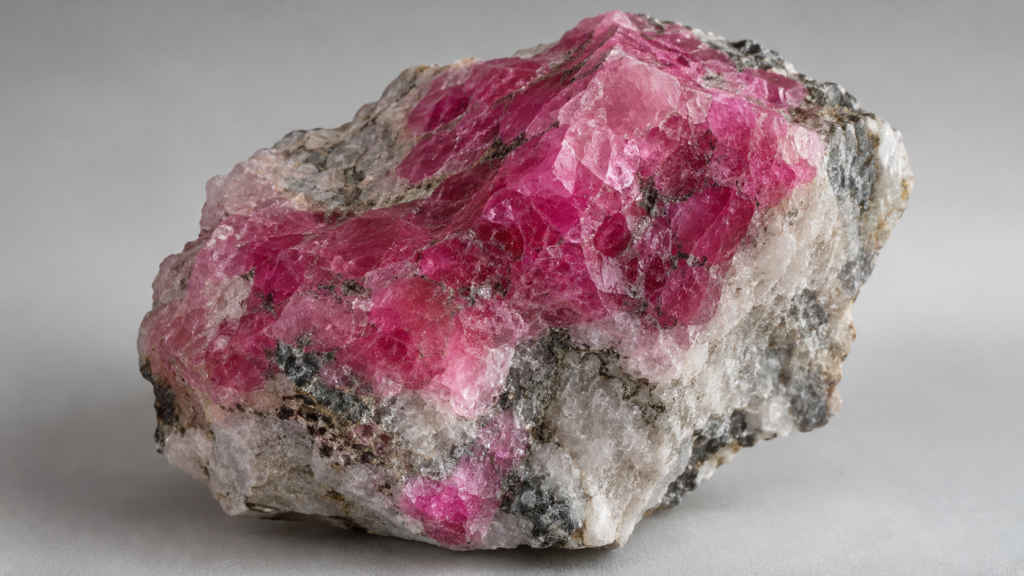
Five rare rocks and minerals, from Nuuk to the Ilímaussaq complex
Beneath the ice sheet and along rocky coastlines that are sometimes difficult to access, Greenland reveals astonishing materials. Nuummite sends out metallic flashes from a rock approximately three billion years old. Tugtupite reddens in the light. Ussingite offers an uncommon lilac hue. Naujaite and kakortokite each tell, in their own way, the story of the slow crystallization of an exceptional magma.
Five materials at a glance
| Material | Nature | Iconic location | What makes it unique |
| Nuummite | Metamorphic rock | Nuuk region | Iridescence that shifts with the viewing angle; an extremely ancient rock. |
| Tugtupite | Mineral species | Ilímaussaq, near Narsaq | Tenebrescence, fluorescence and sometimes phosphorescence. |
| Ussingite | Mineral species | Ilímaussaq | Rare lilac color |
| Naujaite | Igneous rock | Naajakasik / Ilímaussaq | Poecilitic texture: small crystals appear to float within larger ones. |
| Kakortokite | Layered igneous rock | Southern Ilímaussaq | Spectacular magmatic layering, resulting from the alternation of eudialyte-rich layers, layers rich in ferromagnesian minerals, and layers dominated by feldspar and nepheline |
Two geological worlds
These five materials come from two geological stories. Around Nuuk, nuummite belongs to a very ancient portion of the Earth’s crust. The original rock was later transformed deep underground by pressure and heat: this is metamorphism. The other four lead to the Ilímaussaq alkaline complex, near Narsaq, in southern Greenland. This vast magma reservoir, about 17 kilometers long and 8 kilometers wide, solidified approximately 1.16 billion years ago.
The term “alkaline” here refers to a magma particularly rich in sodium and potassium. As it cooled very slowly, it concentrated rare elements and produced mineral assemblages found in very few places on Earth. Ilímaussaq is therefore both an archive of magma crystallization and a natural laboratory for mineralogists.
| GOOD TO KNOW
Nuummite, naujaite and kakortokite are rocks: natural mosaics formed of several minerals. Tugtupite and ussingite are mineral species, each with its own crystal structure and chemical composition. |
Nuummite
The black rock with shifting flashes
 |
Nuummite is not a single mineral, but a dark metamorphic rock dominated by two amphiboles, anthophyllite and gedrite. Inside their crystals, very fine structures reflect light when oriented in the right direction. Golden, coppery, greenish or bluish flashes then appear against an almost black background: this is iridescence.
The color does not intensify after sun exposure: it only seems to shift because the angle changes. This phenomenon is therefore not tenebrescence. Comparable rocks exist elsewhere, but Greenland’s nuummite remains emblematic for its origin around Nuuk, the quality of its flashes and the age of the terrains that host it. |
Polished nuummite: the iridescence appears as the stone, the light or the viewer’s gaze moves. Photo: 122eregrgts, CC BY-SA 4.0 (Wikimedia Commons).
Nature: metamorphic rock mainly composed of amphiboles.
Signature property: directional iridescence; the flashes change with the viewing angle.
Rarity: an uncommon gem rock, especially famous in its Greenlandic quality.
Name and history: “nuummite” means “from Nuuk.” Specimens were collected as early as 1810; the commercial name was adopted after its rediscovery by GEUS in 1982.
| GOOD TO KNOW: AN ANGLE EFFECT
Nuummite can look almost black from the front, then burst into color with a simple turn of the wrist. The light hasn’t changed the stone: it has simply met its fine internal structures at a favorable angle. |
Tugtupite
The stone that reddens in the light
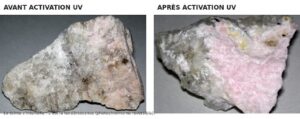
Tenebrescence: pale tugtupite becomes noticeably pinker after UV activation. Sunlight can trigger the same phenomenon thanks to its ultraviolet component. Photos: James St. John, CC BY 2.0 (Wikimedia Commons).
Tugtupite is the visual star of this selection. Its tenebrescence, or reversible photochromism, acts as a temporary memory of light: a white or pale pink area can turn bright pink, red or purplish red after exposure to sunlight or ultraviolet light. In darkness, this enhanced color fades gradually, sometimes over several weeks.
Two other effects can occur alongside it. Fluorescence is a glow visible only during ultraviolet lighting, generally red to orange-red and often stronger under short-wave UV. Phosphorescence is a faint afterglow that persists for a moment after the UV lamp is switched off. The intensity of these reactions varies from specimen to specimen.
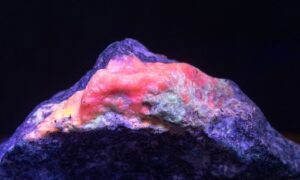
Under UV, tugtupite emits a pink to orange-red glow; the response varies with the wavelength and the specimen. Photo: Géry Parent, CC BY-SA 4.0 (Wikimedia Commons).
Nature: rare silicate related to sodalite, containing notably sodium, aluminum and beryllium.
Signature properties: tenebrescence, fluorescence and, in some specimens, phosphorescence.
Rarity: the mineral also exists in Canada and Russia, but gem quality is particularly associated with Greenland.
Name and locality: the name comes from Tugtup Agtakôrfia, today Tuttup Attakoorfia, near Narsaq; it is also linked to “tuttu,” the Greenlandic word for reindeer.
| DON’T CONFUSE THEM
Tenebrescence: the color remains changed after exposure. Fluorescence: the stone glows only under UV. Phosphorescence: a glow briefly remains after the UV light is turned off. A single tugtupite can display all three phenomena. |
Ussingite
The rare lilac of Ilímaussaq
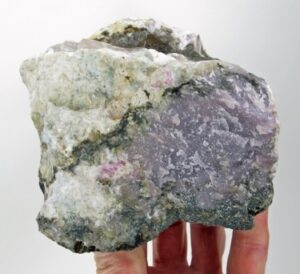
Lavender ussingite associated with sodalite in a specimen from the Ilímaussaq complex. Photo: Rob Lavinsky / iRocks.com, CC BY-SA 3.0 (Wikimedia Commons).
Ussingite is a rare mineral species. It attracts less attention than tugtupite, but its lilac color is unusual. This sodium-rich silicate mainly appears in masses or veins, ranging from colorless to pale pink, lilac and reddish violet. Its luster can be vitreous, slightly greasy, or pearly on the planes where the mineral separates easily.
At Ilímaussaq, ussingite formed late, when fluids very rich in sodium circulated through the nearly solidified rocks. It is often found alongside sodalite, natrolite, analcime, aegirine and other rare minerals. Ussingite itself is not known for diagnosed fluorescence: if a specimen glows under UV, this may be due to a neighboring mineral or microscopic inclusions.
Nature: hydroxylated sodium aluminosilicate, with the formula Na₂AlSi₃O₈(OH).
Signature property: lilac to reddish violet tones, with a vitreous to slightly greasy luster.
Rarity: a species known in a few major alkaline complexes; Ilímaussaq is its type locality.
Name: a tribute to the Danish geologist and mineralogist Niels Viggo Ussing, one of the great pioneers in the study of Ilímaussaq.
| GOOD TO KNOW: FLUORESCENCE CAN BE MISLEADING
A stone labeled “ussingite” may contain several minerals. A glow under UV does not therefore prove that ussingite itself fluoresces: sodalite, tugtupite or other inclusions may be responsible for the luminous color. |
Naujaite
A rock where crystals seem to float
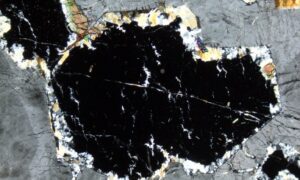
Naujaite in thin section, under crossed nicols: the image reveals the complexity of its mineral assemblage. Photo: Strekeisen, CC BY-SA 4.0 (Wikimedia Commons).
Naujaite is a rock, not a variety of sodalite. It formed in the upper parts of the Ilímaussaq magma chamber, where sodalite crystals were concentrated toward the roof of the magma. Its texture is described as poecilitic: the sodalite crystals are enclosed within larger crystals of alkali feldspar, aegirine, arfvedsonite or eudialyte. This characteristic arrangement can give the impression that the sodalite crystals are “floating” within the rock.
Its composition mainly combines sodalite, nepheline, alkali feldspar, aegirine and arfvedsonite, to which eudialyte may be added in varying proportions. Naujaite does not have a systematic UV fluorescence specific to the rock itself: some samples may fluoresce due to the sodalite or other minerals they contain, but this effect is variable and is not a defining characteristic of naujaite.
Nature: rare igneous rock, a nepheline- and sodalite-bearing syenite known as agpaitic.
Signature property: poecilitic texture, with small crystals enclosed within larger ones.
Reaction to UV: possible in some specimens, but due to the constituent minerals rather than the rock as a whole.
Name and rarity: the name comes from Naajakasik (formerly spelled Naujakasik). The rock is rare worldwide, yet forms an important unit at Ilímaussaq.
| RARE WORLDWIDE, IMPORTANT WITHIN THE MASSIF
“Rare” does not always mean “present only as tiny fragments.” Naujaite is an exceptional rock type on a global scale, yet it locally occupies considerable volumes within the Ilímaussaq complex. |
Kakortokite
Spectacular mineral alternations
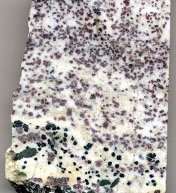 |
Kakortokite is one of the most characteristic rocks of the Ilímaussaq complex. It consists mainly of alkali feldspar and nepheline, together with eudialyte, often red, and arfvedsonite, dark to black. The variations in proportion between these different minerals give it its strongly contrasted appearance.
On the scale of the massif, its most remarkable feature is its rhythmic magmatic layering. The most characteristic units successively combine a dark, arfvedsonite-rich layer, a red layer enriched in eudialyte, then a light layer dominated by alkali feldspar and nepheline. This sequence repeats many times and reflects regular variations in mineral accumulation during the crystallization of the magma. It is one of the most spectacular examples of magmatic layering in the Ilímaussaq complex.
|
Polished kakortokite – Photo: James St. John, CC BY 2.0 (Wikimedia Commons).
Nature: cumulate igneous rock, belonging to the agpaitic nepheline syenites.
Appearance: light feldspar and nepheline, generally red eudialyte, and dark to black arfvedsonite give the rock its strongly contrasted appearance.
On the scale of the massif: the lower kakortokites comprise 29 superimposed rhythmic units. Most successively combine a black layer rich in arfvedsonite, a red layer rich in eudialyte, and a white layer dominated by feldspar and nepheline.
Economic interest: minerals of the eudialyte group notably concentrate zirconium, niobium and rare earth elements, which explains the economic interest in certain kakortokites of Ilímaussaq.
| KAKORTOKITE, AN ARCHIVE OF THE MAGMA
The succession of kakortokite layers records the variations that accompanied the crystallization of the Ilímaussaq magma. Their organization allows geologists to better understand the evolution of the magma chamber and the processes that successively concentrated certain minerals. |
Which are the rarest?
Comparing their rarity requires distinguishing a rare mineral species from a rare rock type. They can nonetheless be ranked as follows:
| Material | Type of rarity | How to present it |
| Tugtupite | Rare mineral species + rare gem | A rare mineral and gem; gem quality is particularly associated with Greenland. |
| Ussingite | Rare mineral species | A species first described at Ilímaussaq and known from few alkaline complexes. |
| Nuummite | Rare gemological material | An iridescent metamorphic rock emblematic of the Nuuk region; qualities displaying beautiful golden or bluish flashes are particularly sought after. |
| Naujaite | Very uncommon rock type | A globally rare rock type, but an important unit at Ilímaussaq. |
| Kakortokite | Very uncommon rock type | A rare rock type, but locally abundant at Ilímaussaq. |
Are they still collected or mined today?
Not in the sense that each one is subject to industrial mining. Nuummite and tugtupite are mainly found on the market as rough or polished stones, jewelry and specimens, largely from small-scale collecting and craft activity.
In Greenland, permanent residents may, under certain conditions, collect and extract minerals without a license as long as their annual value stays below the limit set by regulations. Specific licenses also exist for small-scale mining activities. Tourists, on the other hand, cannot freely gather stones or mineral resources: they must purchase them from shops, artisans or licensed operators.
Ussingite remains sought mainly as a collector’s mineral. Naujaite is mostly of scientific, educational, mineralogical or decorative interest and does not, on its own, constitute a resource subject to specific mining.
Kakortokite, on the other hand, now plays a significant potential economic role: the kakortokite sequence in southern Ilímaussaq hosts the Tanbreez rare earth deposit, where eudialyte is one of the main rare-earth-bearing minerals. A mining license was granted in 2020, and the project is currently under development, with infrastructure and production-preparation work underway. As of September 2026, however, commercial mining production has not yet begun.
What about the ice?
The ice sheet covers roughly four-fifths of Greenland, but the known occurrences presented here are, for the most part, not mined beneath hundreds of meters of ice. Nuuk and Ilímaussaq lie in the ice-free coastal margins. The real challenge, then, is less about “digging beneath the ice sheet” than about working in a vast Arctic territory with very few roads and a short field season.
| THE PRACTICAL OBSTACLES
Access by sea or air, changeable weather, a long winter season, fuel and equipment costs, low infrastructure density, transport of equipment and samples, environmental requirements, and site closure/rehabilitation. In a small gemstone market, these logistical costs can weigh far more heavily than the simple extraction of the rock. |
A mineral inventory still open
The rocks and minerals presented in this article represent only a tiny fraction of Greenland’s mineralogical diversity. The ice-free part of the territory covers more than 400,000 km² and brings together terrains spanning nearly four billion years of geological history. The formation of very ancient continental crust, metamorphism, volcanic episodes and magmatic intrusions have created a wide variety of environments, favorable to sometimes unusual mineral assemblages.
The Ilímaussaq complex offers a spectacular example of this: around 220 minerals have been identified there, several of which were first described at this site. Its unusual composition and the long evolution of its alkaline magmas favored the concentration of rare elements and the formation of mineral associations found in very few places in the world.
Other regions of Greenland have yielded rubies and pink sapphires, amazonite, kornerupine, lazurite and many other materials sought after for jewelry, collecting or scientific research. And the inventory is far from complete: the vastness of the territory, its difficult access and the uneven geological knowledge of its different regions still leave considerable room for exploration and discovery.
Sources and credits
- GEUS — Brief introduction to the geology of the Ilímaussaq alkaline complex (2001)
- Sørensen — The Ilímaussaq alkaline complex: 200 years of research (2006)
- GEUS — Gemstones of Greenland (2007)
- GIA — Tugtupite: A Gemstone from Greenland
- Smithsonian National Museum of Natural History — Tugtupite
- Handbook of Mineralogy — Ussingite
- Virtual Microscope — Greenland: Naujaite
- Virtual Microscope — Greenland: Arfvedsonite Kakortokite
- GEUS — Greenland Minex News 38: rhythmic kakortokite layers
- Pia Bailleul — When Greenlandic tugtupite becomes a gemstone (2023)
- Fluorescent Mineral Society — history and modern circulation of the tugtupite tales
- Mineral Resources Authority, Greenland — collecting without a licence
- SEC filing — Tanbreez development and production status (2026)
- Wikimedia Commons — documentation and licences for the integrated photographs