

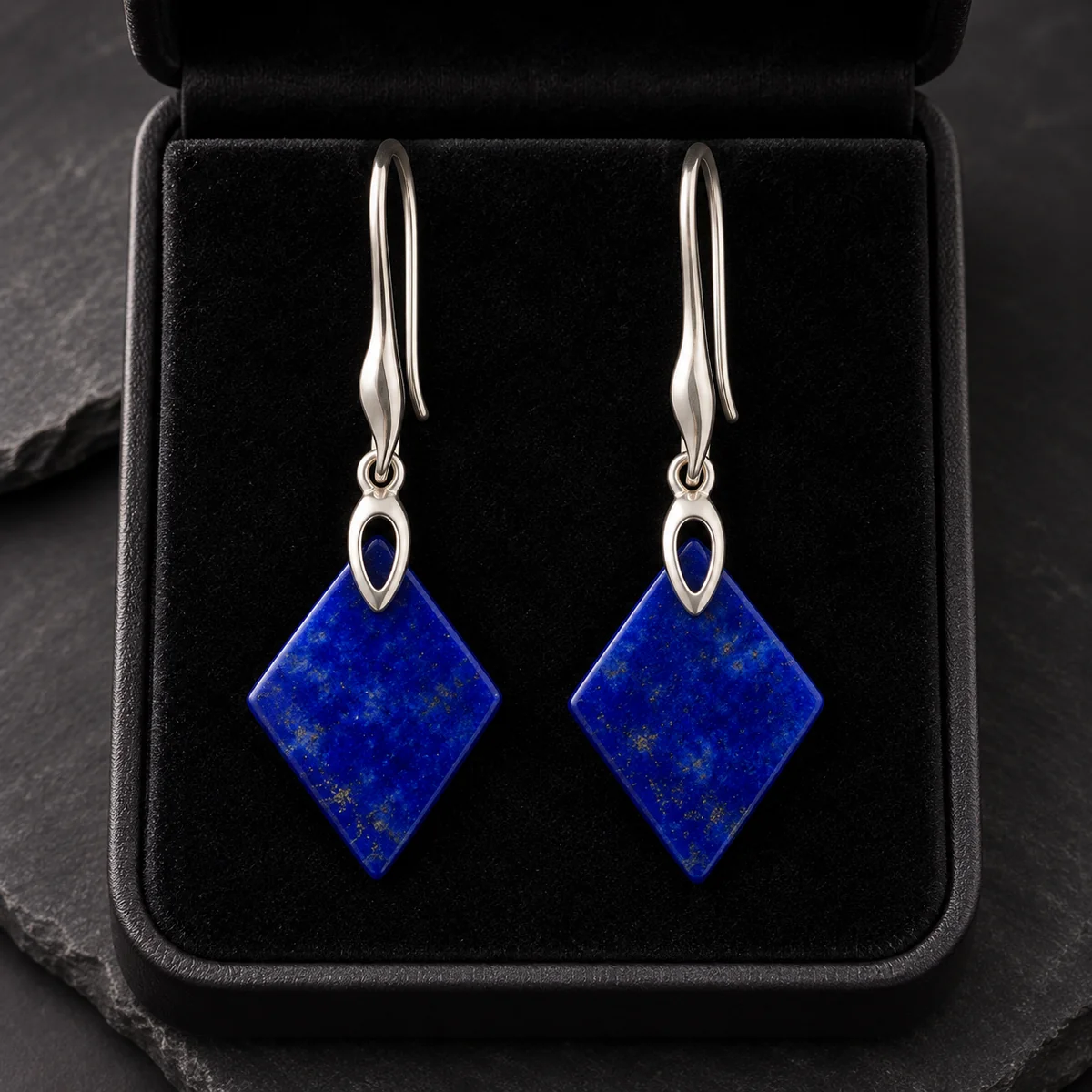
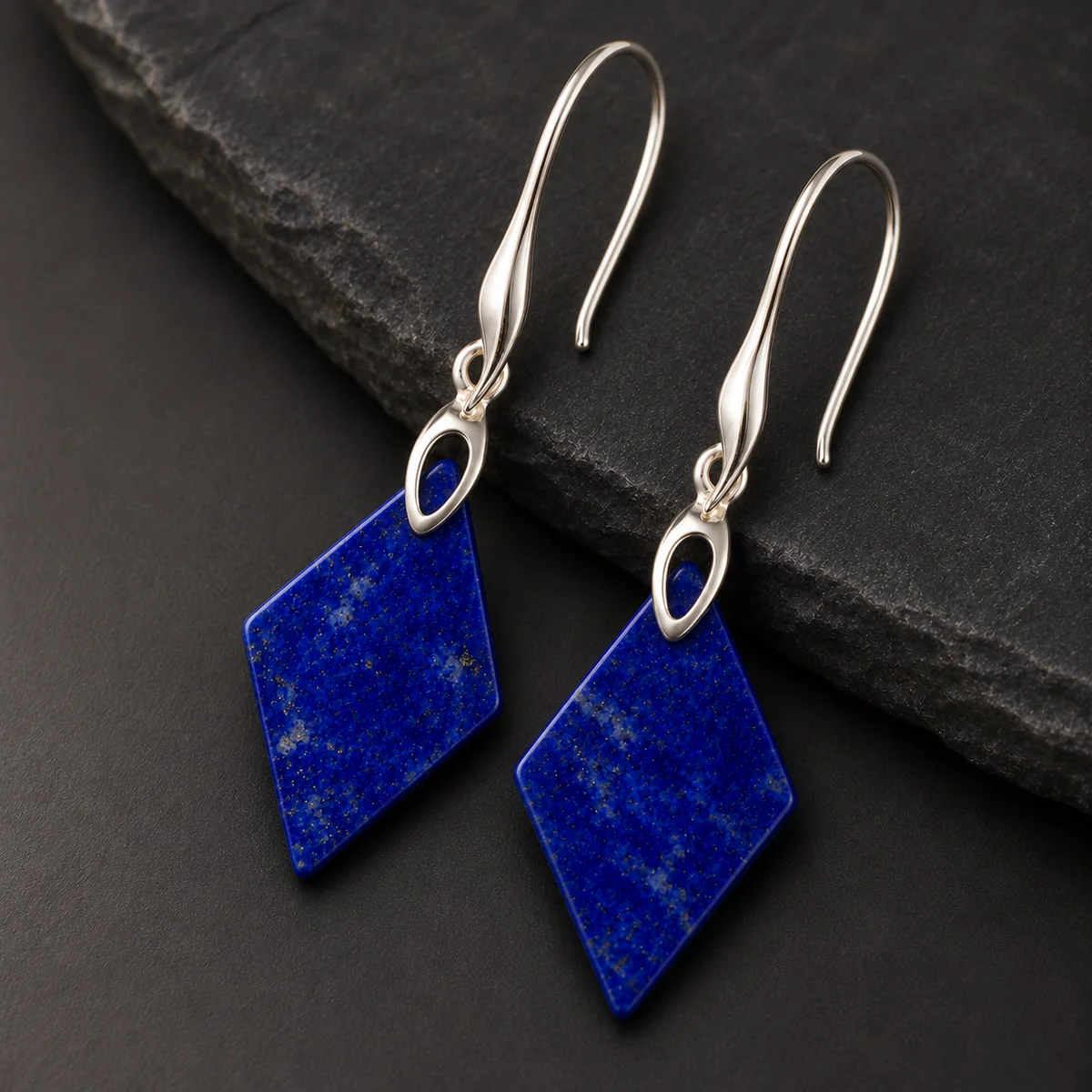
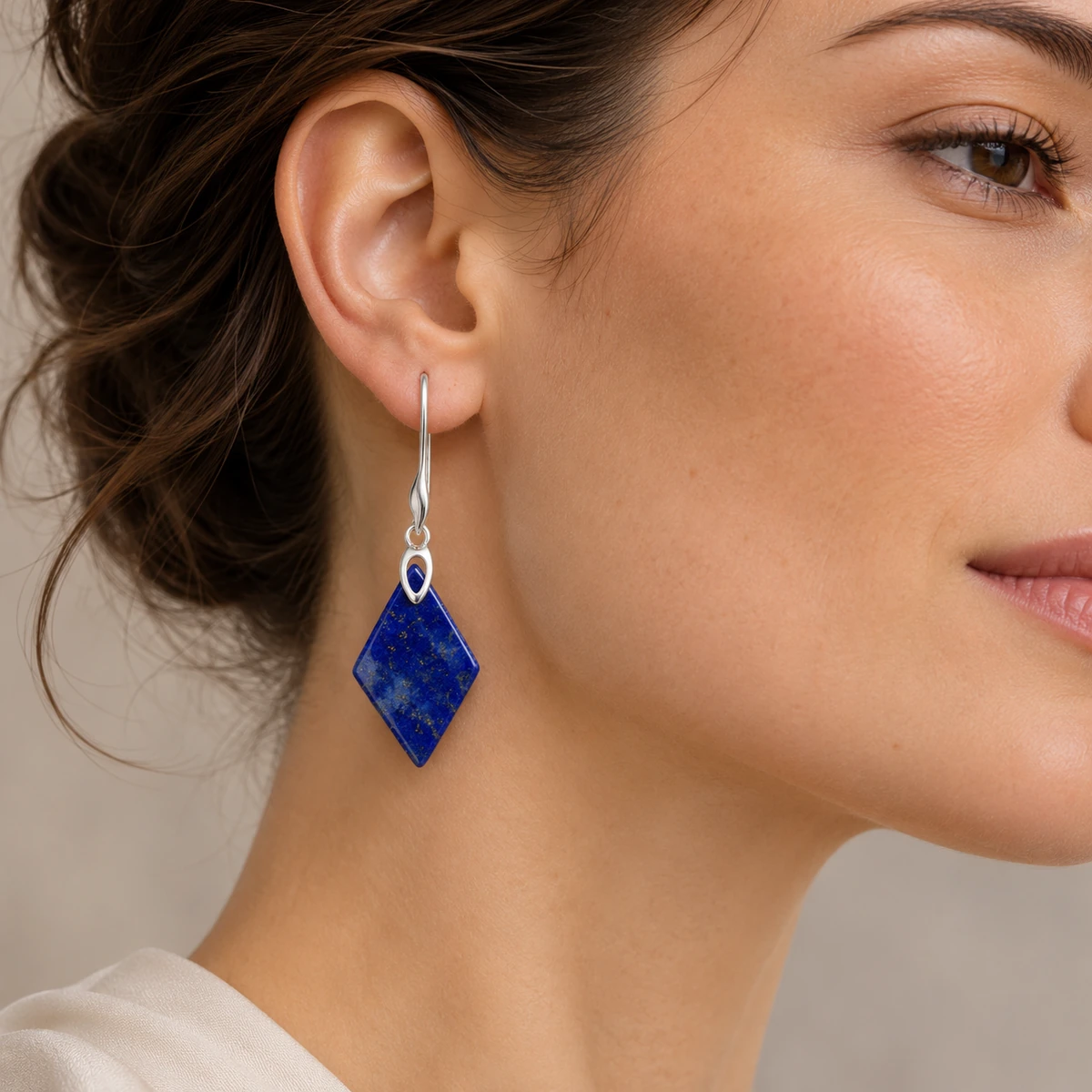


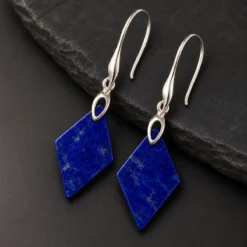
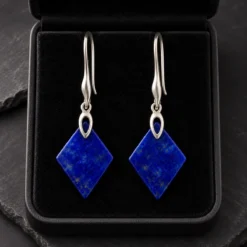
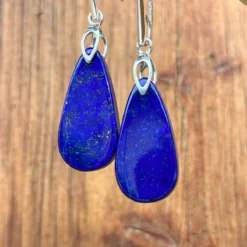
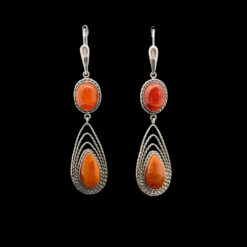
Premium lapis lazuli and silver rhombus earrings
108,00 € incl. VAT
 Origin: Afghanistan
Lovely rhombus-shaped earrings in premium lapis lazuli and 925 silver.
In stock
Stone(s): lapis lazuli
Color: blue
Earring type: drop
Length: 28 mm x 18 mm
Weight: 8 g
Precious metal: 925 silver
Number of stones: 1
Stone shape: rhombus
Stone cut: cabochon
Setting: none
Classification: silicate group
Mohs hardness: 5
Density: 2.5-3
Origin: Afghanistan
Care instructions: do not bring the stone into contact with abrasive elements that could scratch it. Also avoid repeated exposure to soap/shower gel, cosmetic products (perfume, etc.) or household cleaners, as lapis lazuli could whiten.
Non-contractual photos. Each stone features unique natural color nuances and pyrite inclusions.
About this listing: Premium lapis lazuli and silver rhombus earrings
Lapis lazuli is a rock: it mainly combines lazurite, a blue feldspathoid, with calcite and often small golden pyrite grains.
Characteristics noted on the listing: weight 8 g.
You can browse the Earrings category to see similar pieces.
ORIGINS AND MINERALOGY
Origins and mineralogy
Formation and composition
Lapis lazuli is a metamorphic rock, not a single mineral. It consists mainly of lazurite, associated with several minerals, notably calcite and pyrite.
Lazurite is responsible for its intense blue color, which varies from ultramarine to deep blue, sometimes slightly violet. Calcite forms white veins or inclusions, while pyrite appears as small golden metallic inclusions.
Lapis lazuli forms mainly during the metamorphism of limestone rocks, under the effect of high temperatures and chemical transformations involving mineralizing fluids.
Its variable composition explains the differences in shades and patterns observed from one piece to another.
Main mineralogical characteristics
- Nature: metamorphic rock composed of several minerals
- Main composition: lazurite, calcite and pyrite
- Color: ultramarine, royal blue to deep blue, sometimes violet
- Hardness: 5 to 6 on the Mohs scale
- Density: approximately 2.75, variable depending on composition
- Luster: vitreous to slightly waxy
- Transparency: opaque
Origin and main deposits
The most famous lapis lazuli deposits are found in the Badakhshan region of Afghanistan, where this rock has been mined for several millennia.
Other important deposits are located in Chile, notably in the Coquimbo region, as well as in Russia, near Lake Baikal. Occurrences are also known in Pakistan and several other countries.
Afghan lapis lazuli is particularly renowned for its intense blue shades.
History and uses
Lapis lazuli has been used for over 6,000 years in the making of jewelry, amulets, and decorative objects. It held an important place in the civilizations of Mesopotamia and Ancient Egypt.
In Pharaonic Egypt, its deep blue held strong symbolic value, particularly in connection with the divine and the afterlife. Lapis lazuli ornaments and amulets accompanied the deceased in their tombs.
From the Middle Ages, this rock was also sought after for the manufacture of the famous ultramarine blue pigment. Obtained through a process of extraction and purification of the blue matter, this pigment was particularly expensive.
It was used in illuminated manuscripts and the works of great European painters, notably during the Renaissance.
The appearance of synthetic ultramarine blue in the 19th century gradually allowed for the replacement of this natural pigment in common artistic uses.
Lapis lazuli care instructions
Lapis lazuli has moderate hardness and must be protected from shocks and scratches.
To preserve your jewelry, avoid contact with perfumes, cosmetics, detergents, and solvents.
Use a soft cloth for cleaning. If necessary, use a very slightly damp cloth, then dry carefully. Avoid prolonged immersion, ultrasonic cleaners, and steam.
Well-being and energies
Properties traditionally attributed to lapis lazuli
In contemporary energy practices, lapis lazuli is associated with wisdom, self-knowledge, and personal expression.
In lithotherapy, several properties are traditionally attributed to it:
- Mental clarity: said to promote concentration, reflection, and creativity.
- Communication: said to support the expression of emotions and feelings.
- Serenity: associated with emotional soothing and inner balance.
- Intuition: encourages introspection and meditation.
- Human relations: symbolizes sincerity, friendship, and harmony in exchanges.
Associated Chakras
- Third eye chakra: intuition, perception, and mental clarity.
- Throat chakra: communication, expression, and sincerity.
Purification
In lithotherapy practices, the purification of lapis lazuli can be performed by smudging with palo santo or white sage.
Gently pass the jewelry near the smoke without exposing it directly to heat. Then ventilate the room.
This traditional method avoids immersing the jewelry and preserves its setting.
Recharging
According to energy practices, lapis lazuli is traditionally associated with moonlight.
It can also be placed on a quartz geode, a selenite plate or an amethyst druse, taking care not to scratch its surface.
These practices stem from symbolic traditions and do not correspond to a physical process of recharging the mineral.
The properties attributed to stones in lithotherapy are not scientifically proven. They do not constitute therapeutic use and do not replace medical advice or appropriate treatment.
Expédition : 48 à 72 heures, hors week-ends et jours fériés, après confirmation du paiement.
Livraison offerte dès 60 € en France métropolitaine.
Droit de rétractation : 14 jours pour nous signaler votre décision.
You may also like…

Earrings
Related products





Earrings