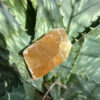


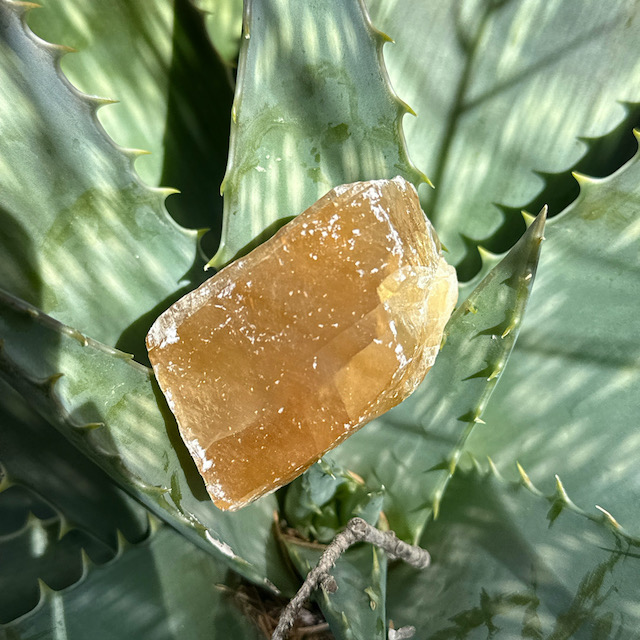
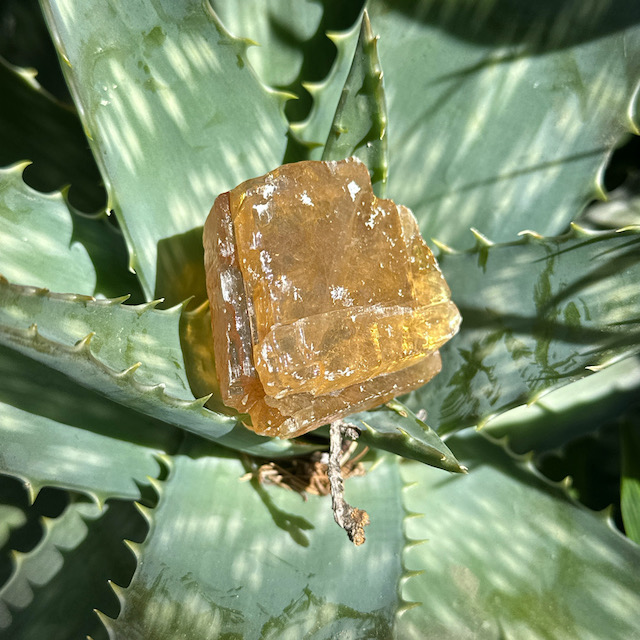
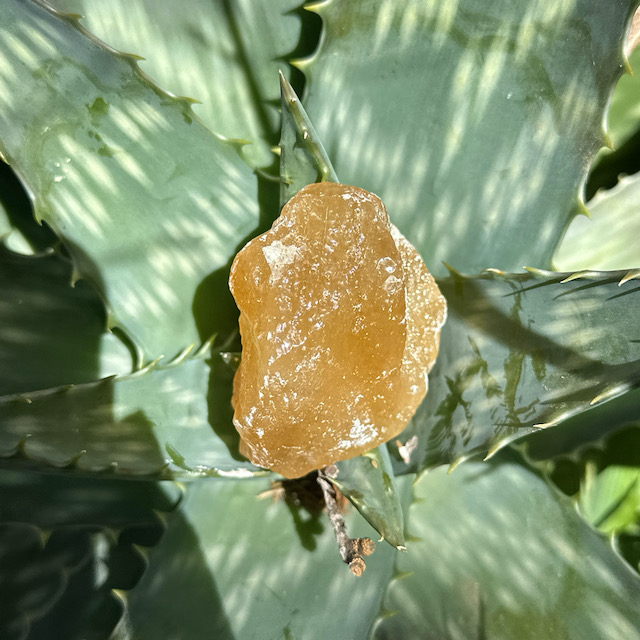
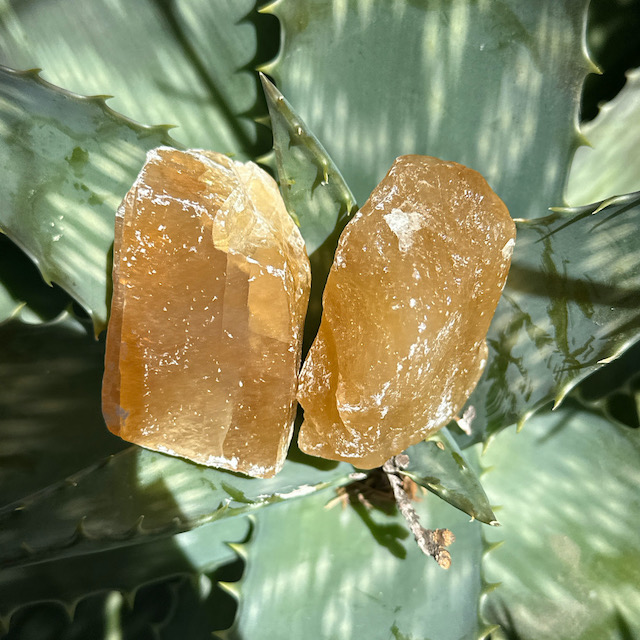
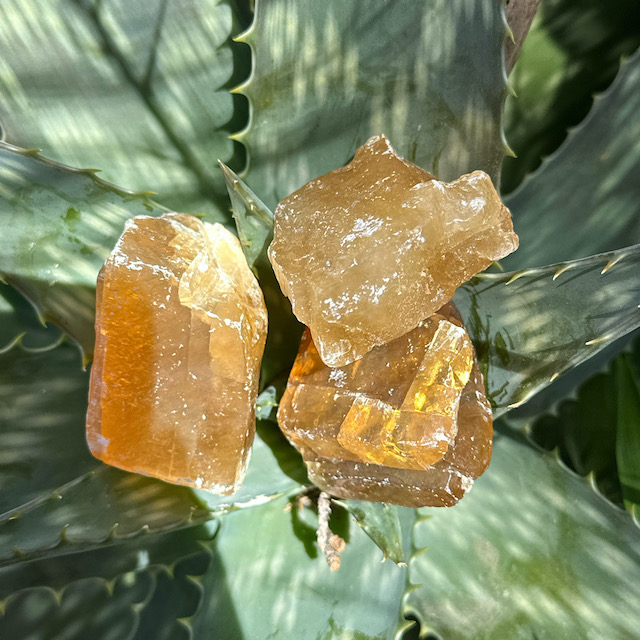
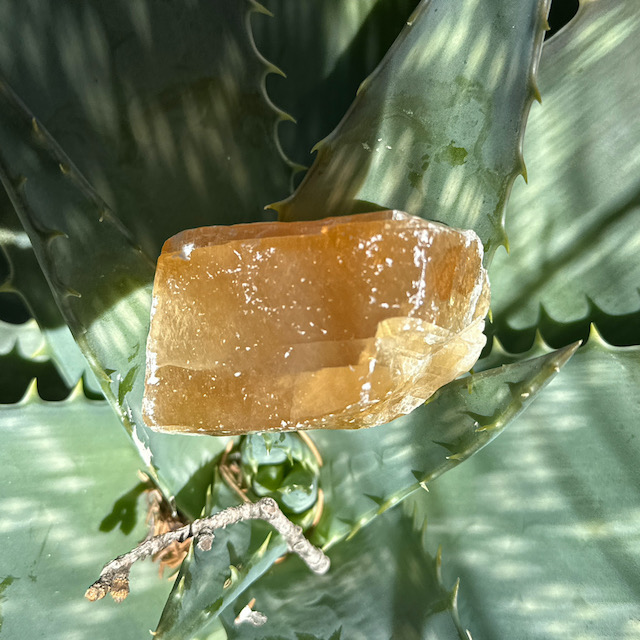
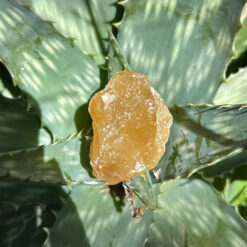
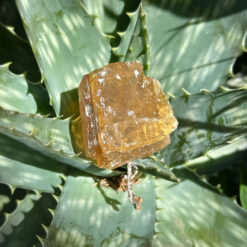
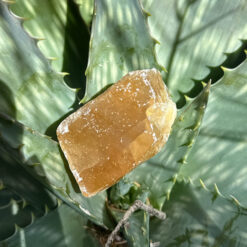
Premium rough honey calcite
7,20 € incl. VAT
Premium rough honey calcite, approximately 5cm to 6cm.
In stock
Color: honey
Dimensions: approx. 5-6 cm x 3-5cm
Approximate weight: 85 to 100 g
Shape: free form, rough stone
Photos are not contractual. Sold as a single piece.
Classification: calcite group
Mohs hardness: 3
Density: 2.6-2.8
Origin: Mexico
Care instructions: Calcite is fairly soft. Avoid contact with other stones, as it could break or chip.
Premium quality raw honey calcite, in detail
Calcite is a calcium carbonate (CaCO3) with a hardness of 3 on the Mohs scale. It effervesces on contact with acid, even weak ones, and has perfect cleavage in three directions.
Quick technical specs: approx. 5 cm; weight 71 to 165 g; freeform, raw stone.
The Raw stones category contains other listings of the same type.
Origins and minéralogy
Honey Calcite – Origin, Properties and History
Introduction to honey calcite
Honey calcite is a color variety of calcite, a mineral belonging to the carbonate family and composed of calcium carbonate (CaCO₃).
It stands out for its warm tones, ranging from golden yellow to amber brown, sometimes with orange or caramel hues. Its appearance can be translucent, allowing light to partially pass through, or more opaque depending on the structure and inclusions present in the mineral.
The name “honey calcite” refers to a calcite with this characteristic coloring. It is not a distinct mineral species: its chemical composition and crystallographic properties remain those of calcite.
In its rough state, it may show irregular surfaces, visible cleavage planes, and areas of varying transparency.
Origin and geological formation
Calcite is one of the most widespread minerals in the Earth’s crust. It is notably the main component of many limestone rocks and certain marbles.
It forms in various geological environments, mainly through precipitation of calcium carbonate from aqueous solutions.
When water rich in calcium and bicarbonates undergoes changes in temperature, pressure, or carbon dioxide concentration, dissolved calcium carbonate can precipitate and crystallize.
This mechanism occurs notably in:
- Sedimentary formations, where calcite contributes to the formation of limestone rocks.
- Underground cavities, where it forms concretions such as stalactites, stalagmites, and other calcareous deposits.
- Hydrothermal veins, where mineralized fluids circulate through rock fractures and gradually deposit crystals.
- Metamorphic processes, during which limestone rocks recrystallize to form marble.
The honey color results from the presence of certain trace elements, mineral inclusions, or features of the crystal structure. Iron compounds, particularly oxides and hydroxides, can contribute to yellow, golden, or orange tones.
Depending on the nature and concentration of these elements, the colors can range from golden yellow to amber brown, up to the deeper shades of orange calcite. The transparency and intensity of the coloring also vary from specimen to specimen and according to their formation conditions.
Composition and mineralogical properties
Honey calcite has the same fundamental properties as other calcites.
- Classification: Carbonates
- Chemical composition: Calcium carbonate (CaCO₃)
- Crystal system: Trigonal
- Colors: Honey yellow, golden yellow, orange, amber brown
- Hardness: 3 on the Mohs scale
- Density: Approx. 2.71 g/cm³
- Luster: Vitreous to pearly depending on the surface
- Transparency: Transparent to translucent, sometimes opaque
- Streak: White
- Cleavage: Perfect in three directions, rhombohedral shape
One of calcite’s most notable characteristics is its perfect rhombohedral cleavage. Under impact, it can fracture along well-defined crystallographic planes.
Its low hardness makes it relatively prone to scratches and impacts. It is notably softer than quartz, which has a hardness of 7 on the Mohs scale.
Calcite also reacts to acids, even relatively weak ones, releasing carbon dioxide. This reaction is one of the classic criteria used to identify it in mineralogy.
An optical peculiarity: birefringence
Calcite has a remarkable optical property called birefringence, or double refraction.
When a light ray passes through a sufficiently transparent and properly oriented calcite crystal, it can be split into two distinct rays. An object viewed through the crystal may then appear doubled.
This phenomenon is especially visible in Iceland spar, an exceptionally transparent form of calcite historically used for optical studies.
Honey calcite has the same crystal structure, but its inclusions and variable transparency generally make this phenomenon harder to observe.
Deposits and geographic distribution
Calcite is found in many regions around the world, in both sedimentary formations and hydrothermal deposits.
Honey-colored calcite specimens are notably documented in Mexico, the United States, and France.
Mexico in particular produces yellow to orange calcites, prized for their golden hues and variable transparency.
The characteristics of each piece vary by deposit: some specimens show well-developed crystallization, while others occur as compact crystalline masses.
History and uses of calcite
Calcite and the rocks mainly composed of it hold an important place in the history of architecture, sculpture, and decorative arts.
In antiquity
In ancient Egypt, a stone often called Egyptian alabaster was used to make vases, statues, architectural elements, and funerary objects.
Unlike gypsum alabaster, this material is a compact limestone, often referred to as travertine, mainly composed of calcite. Its translucency and natural veining were especially prized by craftsmen.
In Greek and Roman civilizations, marbles rich in calcite also held a major place in sculpture and monumental architecture.
The Romans also made use of limestone rocks’ properties to produce lime, used in making mortars and building materials.
From the Middle Ages to the Renaissance
In the Middle Ages, limestones and marbles were widely used in the construction of religious buildings, sculptures, and decorative elements.
During the Renaissance, the use of marble experienced a new surge in the arts. Sculptors such as Michelangelo made use of its qualities to create works whose fine detail relies in part on the homogeneous structure of certain marble varieties.
Modern uses
Today, calcite-rich materials play a major role in several industrial sectors.
They are notably used in the production of lime and cement, in the manufacture of paints, plastics, and paper, as well as in certain chemical and pharmaceutical processes.
Calcite is also used as a mineral filler in various industrial products.
Particularly transparent calcite crystals are of scientific interest for their optical properties.
Well-being and energies
In lithotherapy, honey calcite is mainly associated with self-confidence, motivation, and optimism.
Its warm, golden tones symbolize vitality, positive energy, and creativity. It is also said to support concentration, determination, and the drive to take on new projects.
Emotionally, honey calcite is considered a stone of balance and calm. It is said to support periods of change by encouraging a calmer, more confident outlook.
Associated chakras
- Solar plexus chakra: Self-confidence, willpower, motivation.
- Sacral chakra: Creativity, vitality, emotional balance.
Associated astrological signs
- Cancer
- Leo
- Virgo
These associations come from contemporary energy practices and may vary depending on the lithotherapy approach.
The properties attributed to stones in lithotherapy are not scientifically proven. They do not constitute medical treatment and do not replace the advice of a healthcare professional.
Care instructions
Honey calcite is a relatively soft mineral, sensitive to acidic substances.
Avoid prolonged contact with water, household products, and acidic substances. Also protect your stone from impacts and friction that could scratch or damage its surface.
To dust rough honey calcite, simply use a soft brush, which will gently clean the irregularities and crystalline surfaces.
Purification and recharging
As part of contemporary energy practices, honey calcite may be used in symbolic purification and recharging rituals.
Purification:
Smudging with white sage or palo santo is sometimes used alongside these practices. Keep the stone away from flames and heat sources.
Immersion in water is not recommended, to preserve the mineral’s natural surfaces.
Recharging:
Honey calcite can be placed in soft natural light, avoiding prolonged exposure to intense sunlight.
In certain lithotherapy practices, it is also placed on a quartz cluster or near a rock crystal geode.
These methods are symbolic practices and do not result in any scientifically established change to the mineral’s properties.
Expédition : 48 à 72 heures, hors week-ends et jours fériés, après confirmation du paiement.
Livraison offerte dès 60 € en France métropolitaine.
Droit de rétractation : 14 jours pour nous signaler votre décision.
You may also like…


Raw Stones
Minerals


Purification and recharging


Related products
Minerals


Minerals


Minerals


Minerals