

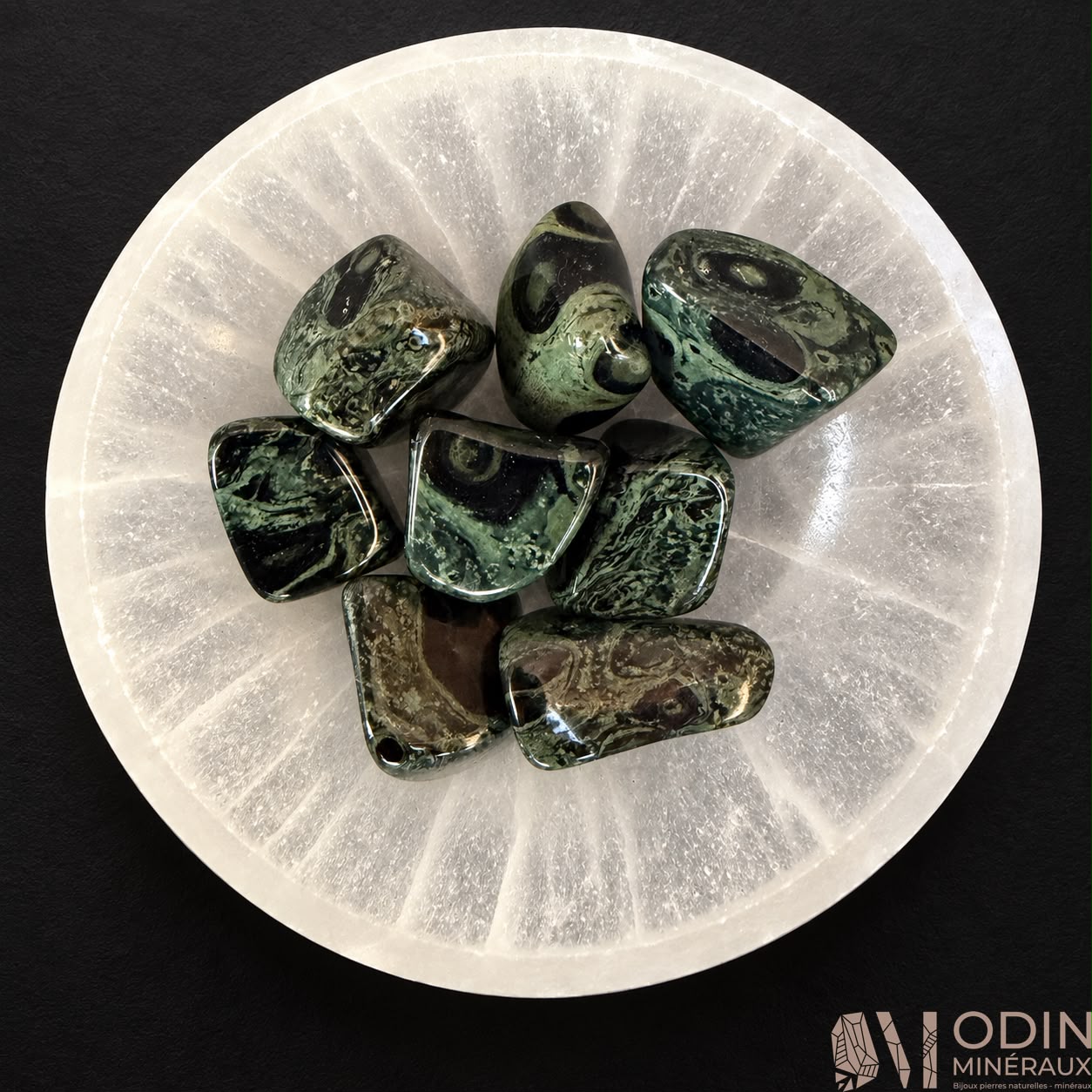
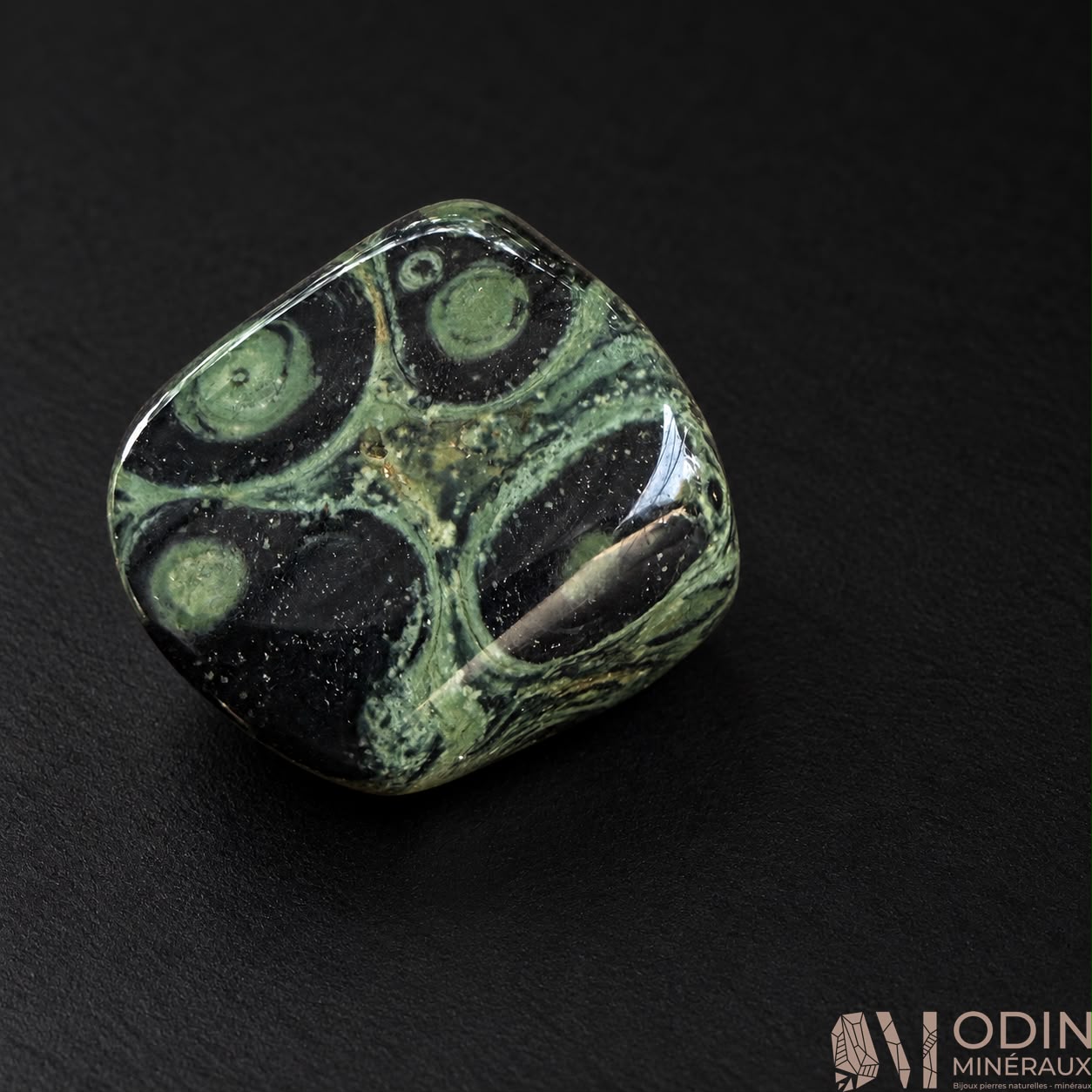
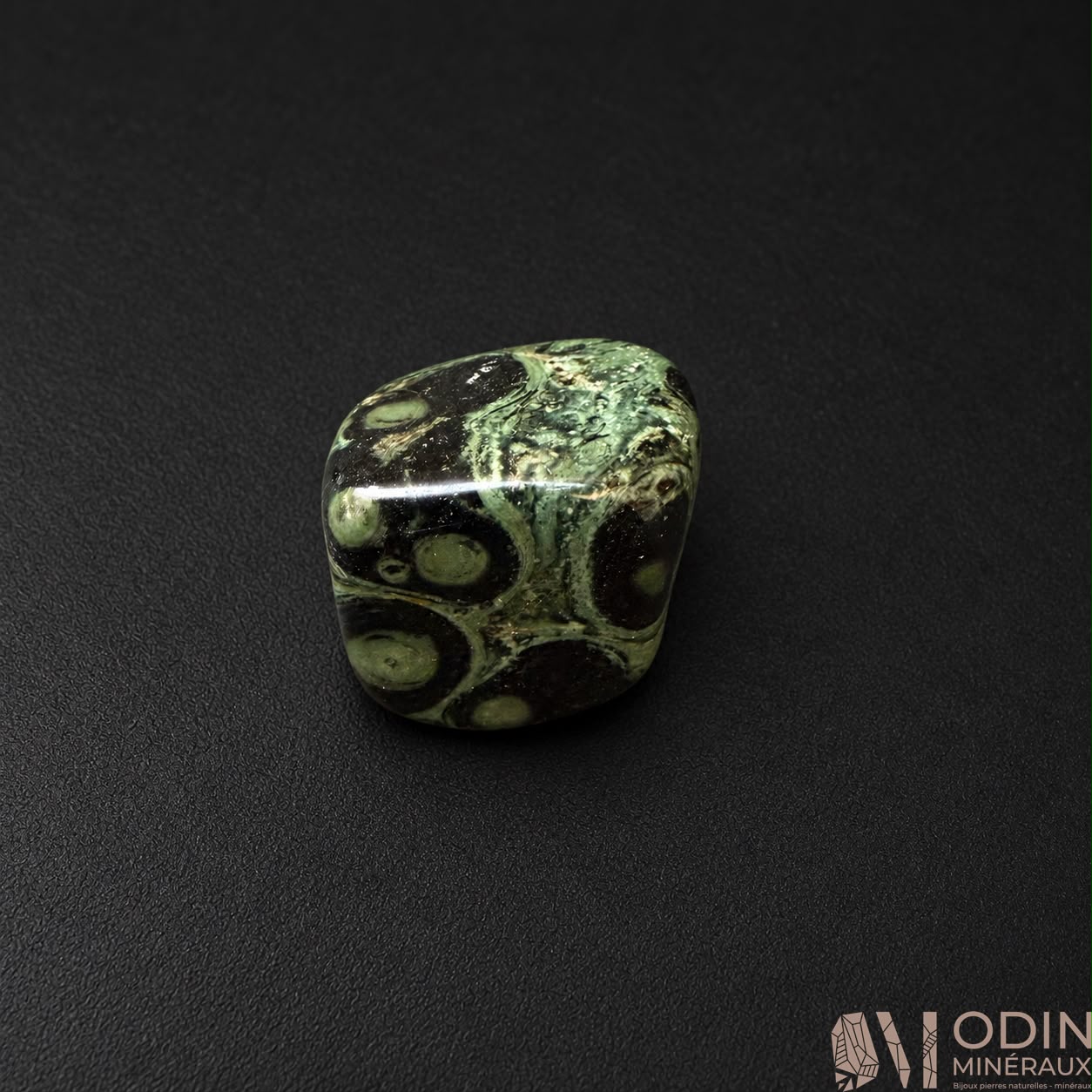
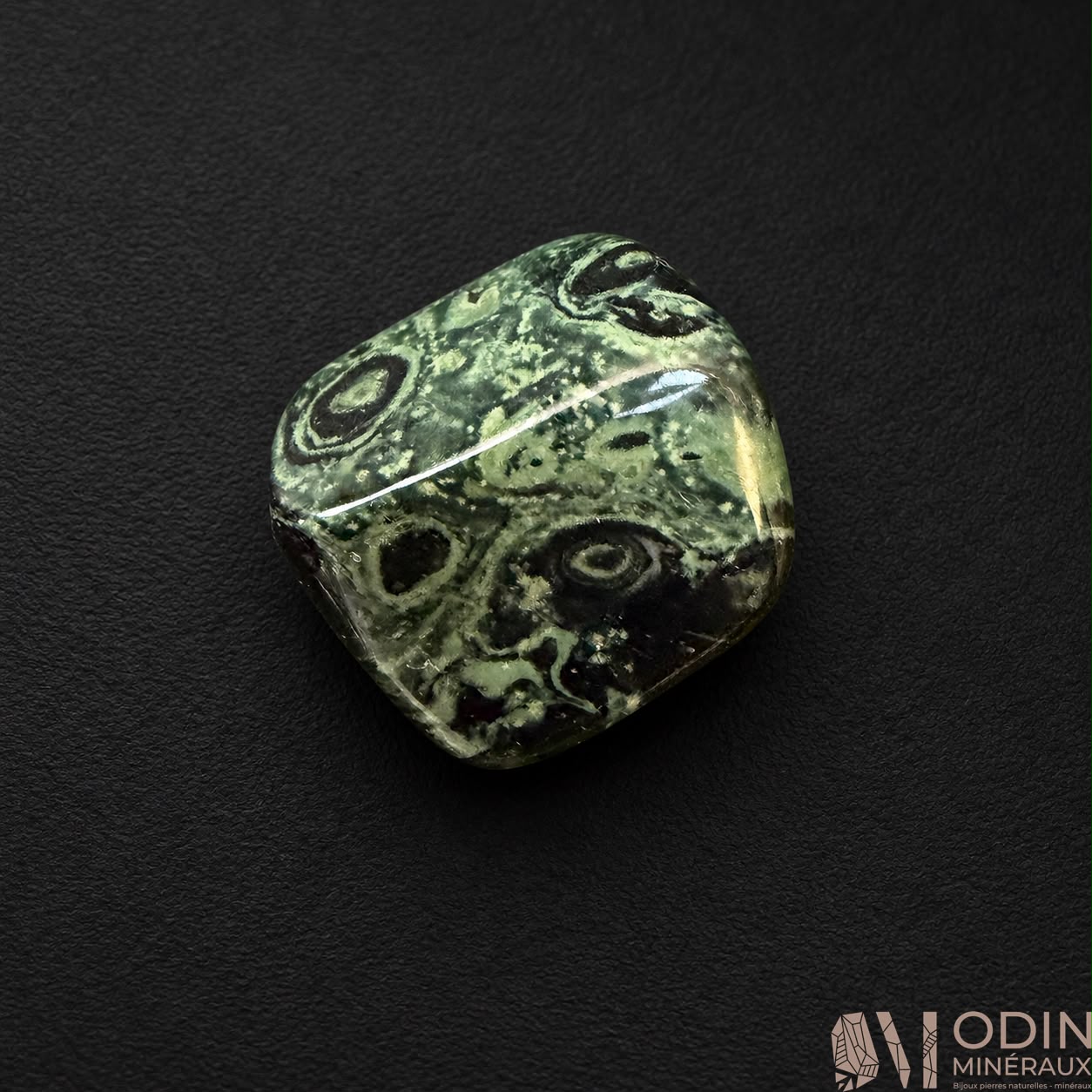
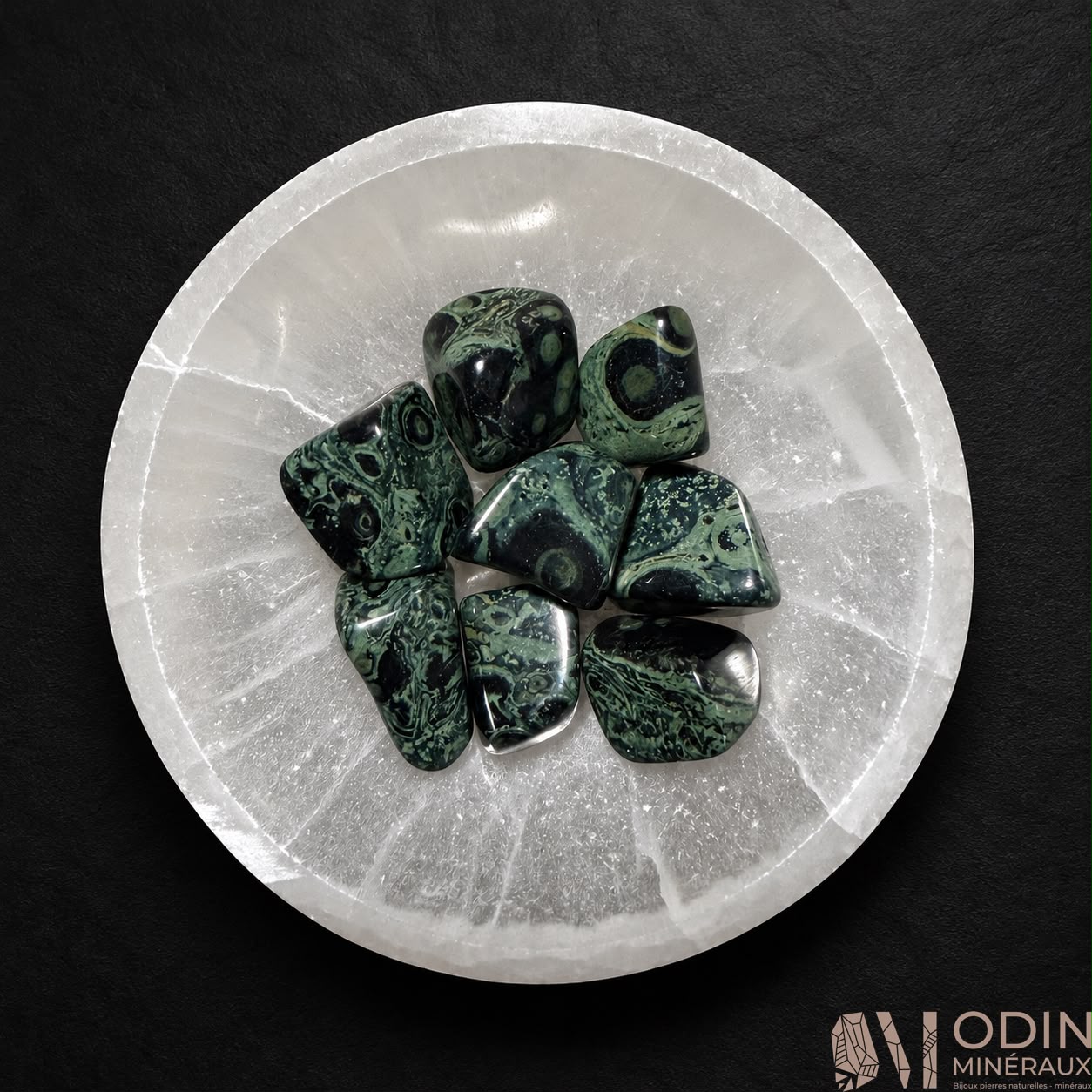
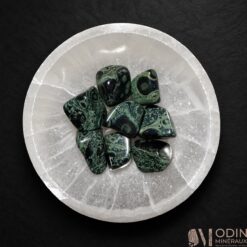
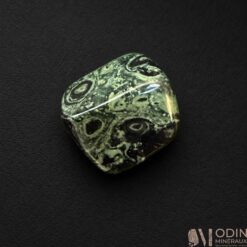
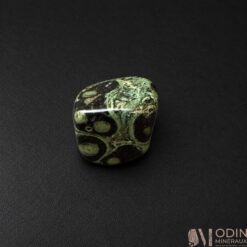
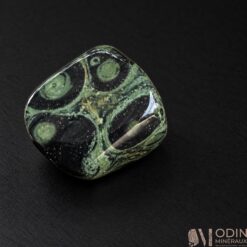
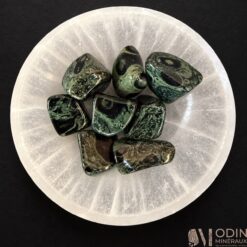
Kambaba Jasper Tumbled Stone
5,50 € incl. VAT
Discover our high-quality Kambaba Jasper tumbled stones, 2 to 4 cm, from Madagascar. Their characteristic orbicular patterns are highly appreciated.
In stock
Color: green, black
Dimensions: 2cm to 4cm
Approximate weight: 15 to 40g
Shape: tumbled stone
Non-contractual photos
Classification: Rhyolite-type volcanic rock with an orbicular structure.
Mohs hardness: 6 to 7
Density: 2.6-2.8
Origin: Madagascar
Care instructions: Clean with a soft, slightly damp cloth, then dry thoroughly. Avoid impacts, chemicals, and prolonged immersion in water
About this item: Kambaba jasper tumbled stone
Quick specs: 2cm to 4cm; weight 15 to 40g; shape tumbled stone.
You can browse the Tumbled Stones category to see similar items.
Origins and minéralogy
Kambaba Jasper: origin, formation, and mineralogical properties
➤ Origin & formation of Kambaba Jasper
The Kambaba Jasper, also known as Crocodile Jasper or Kambaba Jasper, is a natural rock originating from Madagascar, particularly recognizable by its dark green to black colors and its remarkable circular patterns.
These designs, often described as orbicular patterns, form circles, rounded spots, and sometimes concentric structures, giving each stone a unique appearance.
Despite its commercial name, Kambaba Jasper is not a true jasper in the mineralogical sense.
Petrographic analyses performed on samples from Madagascar have indeed shown that it is a volcanic magmatic rock, of the rhyolite type, composed mainly of quartz, feldspars, and various minerals belonging to the amphibole and pyroxene groups.
This distinction is important: unlike classic jaspers, generally composed of microcrystalline quartz, Kambaba possesses a structure and mineralogical composition characteristic of certain volcanic rocks.
Its appeal lies as much in the complexity of its geological formation as in its natural patterns, which are particularly valued in jewelry and decorative objects.
How is Kambaba Jasper formed?
The formation of Kambaba Jasper is linked to magmatic processes involving the crystallization and transformations of a silica-rich volcanic rock.
Rhyolite belongs to the family of volcanic magmatic rocks. Its composition is generally rich in silica and chemically comparable to that of certain granites.
During the cooling of magma, the various chemical elements present can gradually organize to form minerals.
Under certain conditions, crystals develop as radiating aggregates, giving rise to spherical or rounded structures called spherulites.
Microscopic studies dedicated to Kambaba Jasper have revealed such structures, consisting of very fine crystals organized radially.
These observations are notably compatible with a phenomenon called devitrification, during which an initially vitreous material evolves towards a crystalline organization.
Recrystallization processes can also contribute to modifying the organization of minerals within the rock.
The precise formation of each structure depends on the local crystallization conditions and the subsequent evolution of the material.
It is this geological history that explains the diversity of patterns visible on the surface of Kambaba Jasper after polishing.
Orbicular patterns: why does Kambaba Jasper exhibit circles?
The orbicular patterns constitute the most remarkable visual characteristic of Kambaba Jasper.
They generally appear as very dark green to black rounded spots, sometimes surrounded by lighter areas, on an olive green to deep green background.
Unlike simple colored spots present on the surface, these designs correspond to mineral structures integrated into the mass of the rock.
Analyses carried out by the German laboratory EPI have identified several constituents:
- Quartz: a mineral composed of silicon dioxide, present in the rock matrix.
- Feldspars: notably albite and potassic feldspars, important constituents of magmatic rocks.
- Amphiboles: some rounded aggregates contain fine mineral needles belonging to this group, with compositions close to riebeckite or pargasite.
- Pyroxenes: notably aegirine, identified in mineral associations surrounding certain aggregates.
These minerals can form complex microscopic assemblies, responsible for the color contrasts and characteristic structures of Kambaba.
The arrangement of crystals and their organization explain the appearance of sometimes circular, concentric, or irregular patterns.
Polishing particularly highlights these designs by revealing the depth of green and black hues.
Each specimen has a particular distribution of its internal structures, which makes Kambaba Jasper pebbles, spheres, cabochons, and jewelry naturally unique.
Is Kambaba Jasper a fossilized stromatolite?
This question deserves particular attention, as Kambaba Jasper is frequently presented commercially as a rock composed of fossilized algae or ancient stromatolites.
Stromatolites are sedimentary structures typically formed by the activity of photosynthetic microbial communities, which promote the accumulation or precipitation of mineral matter.
Some stromatolite formations are among the oldest known evidence of life on Earth.
Their structures can display rounded or concentric shapes, which likely explains their visual association with kambaba.
However, pattern resemblance alone is not enough to prove a biological origin.
Analyses carried out on samples of kambaba jasper revealed a composition and texture characteristic of a rock of magmatic origin, rather than a sedimentary rock formed by the accumulation of microbial structures.
Microscopic examination of thin sections notably shows crystals organized into radiating aggregates, consistent with crystallization and devitrification processes.
These observations lead to the conclusion that the kambaba studied is a spherulitic rhyolite, rather than a fossilized stromatolite.
It is therefore important to distinguish true stromatolites, whose biological origin can be documented, from volcanic rocks that display similar-looking patterns.
Mineralogical characteristics
- Nature: natural magmatic rock with orbicular or spherulitic structure
- Classification: volcanic rhyolite-type rock
- Commercial name: Kambaba Jasper, Crocodile Jasper, Kambaba Jasper
- Dominant mineralogical family: silicates
- Composition: mainly quartz, feldspars, amphiboles, and pyroxenes
- Chemical formula: no unique formula, as it is a rock composed of several minerals
- Crystal system: not applicable to the rock as a whole
- Hardness: variable depending on constituents; generally estimated around 6 to 7 on the Mohs scale
- Density: approximately 2.6 to 2.8 g/cm³ as an indication, depending on composition
- Luster: dull in its raw state, can become vitreous to slightly satiny after polishing
- Transparency: opaque
- Colors: olive green, dark green, grey-green, and black
- Patterns: rounded spots, spherulitic structures, and orbicular designs
- Cleavage: no unique cleavage applicable to the rock
- Fracture: irregular, variable depending on texture
- Appearance: massive, compact rock, presenting rounded mineral aggregates
- Main documented origin: Madagascar
Hardness and density values should be considered indicative. They can vary depending on the composition of each sample and are not laboratory measurements specific to each stone.
Kambaba jasper has a durability well suited to making many polished items. Like any natural rock, however, it remains sensitive to impacts that can cause chips or fractures.
Its aesthetic value relies mainly on the sharpness of its orbicular patterns, the harmony of its colors, the quality of its polish, and the stone’s overall condition.
Main kambaba jasper deposits
Kambaba jasper is best known for its Malagasy origin.
The best-documented occurrences are found in west-central Madagascar, notably in the Bongolava region, in the Tsiroanomandidy area.
This region has a complex geological setting, notably featuring ancient magmatic formations and various intrusive complexes.
The Ambohiby and Bevato areas are particularly known for their magmatic rocks and distinctive mineral associations.
Contrary to what is sometimes claimed, major mineralogical references do not identify equivalent kambaba jasper deposits with the same certainty in many other countries.
For stones sold under this name, Madagascar remains the reference origin.
Kambaba jasper, orbicular jasper, and ocean jasper: what’s the difference?
Several natural stones feature rounded or concentric patterns, which can lead to commercial confusion.
However, these names don’t always correspond to the same composition or geological origin.
- Kambaba jasper: a trade name for a Malagasy volcanic rock of the rhyolite type, characterized by its dark green and black colors and spherulitic structures.
- Orbicular jasper: a descriptive term used for various rocks displaying circular patterns. It does not refer to a single mineral species.
- Ocean jasper: a trade name associated with certain orbicular silica rocks from Madagascar, mainly composed of quartz and chalcedony, which can display a wide variety of colors.
- Nebula stone: a trade name used for a volcanic rock from, among other places, Mexico, which also features rounded structures but with a different color distribution.
Further confusion exists between the names Kambaba and Kabamby.
Kabamby notably designates a Malagasy locality known for certain varieties of Ocean Jasper, distinct from the Kambaba studied here.
Although their patterns may show similarities, these materials should not be systematically assimilated to each other.
Precise identification relies on mineral composition, rock structure, and, when necessary, petrographic analyses.
➤ Discovery & history through the ages
🌍 A geological history linked to Madagascar’s volcanism
The history of Kambaba Jasper begins with the magmatic processes that shaped certain regions of Madagascar.
The island possesses a particularly rich geological heritage, marked by several major periods of tectonic, magmatic, and metamorphic activity.
In the central region of Madagascar, the Ambohiby magmatic complex constitutes a particularly interesting geological ensemble.
Geochemical and geochronological studies indicate that this complex was emplaced during the Upper Cretaceous, approximately 90 million years ago.
It belongs to a geological context marked by the tectonic transformations accompanying the gradual separation of Madagascar and India.
A petrographic study conducted in 2012 in this complex notably describes rocks commercially known as Jasper Kambamba, presenting spherulitic structures interpreted as devitrification textures.
These observations help to place the material in its magmatic context.
It should be noted, however, that the age of approximately 90 million years concerns the studied geological complex. It does not constitute an individual dating of all stones sold under the name Kambaba Jasper.
This distinction is important, as some commercial texts attribute ages of several billion years to Kambaba without having specific geological dating for the samples concerned.
💎 20th century: interest in ornamental stones from Madagascar
During the 20th century, Madagascar gradually gained an important place in the international trade of minerals and ornamental stones.
The geological diversity of the island allows for the discovery and exploitation of numerous materials appreciated for their colors, textures, or particular structures.
Orbicular rocks particularly attract the attention of lapidaries due to their natural patterns, which become especially visible after cutting and polishing.
Kambaba Jasper thus finds its place among the materials sought after for the manufacture of tumbled stones, cabochons, beads, spheres, and decorative objects.
The precise history of its first commercialization remains poorly documented. It is therefore not possible to attribute its discovery with certainty to an explorer, a mineralogist, or a particular date.
🔬 Early 21st century: the first petrographic analyses
At the beginning of the 21st century, advances in analytical methods allowed for a more precise study of the composition of ornamental rocks marketed under different names.
The German laboratory EPI (Institut für Edelsteinprüfung) notably carried out an in-depth analysis of a Kambaba Jasper sample from Madagascar.
The use of microscopic observation in thin section and chemical analyses made it possible to identify the main mineral constituents of the rock and to specify its classification.
This work contributes to a better scientific understanding of Kambaba and illustrates the importance of petrographic analyses in the identification of ornamental materials.
🔬 2012: a study deepens geological knowledge
In 2012, Ndivhuwo Cecilia Mukosi presented a study on the petrogenesis of the Ambohiby complex in Madagascar at Stellenbosch University, South Africa.
This work examines different types of magmatic rocks and their geological evolution.
The researcher notably describes rocks locally designated as Jasper Kambamba, exploited as ornamental stones.
The study contributes to a better understanding of the geological conditions of formation of these materials and their place within the magmatic complex.
It constitutes an interesting reference for placing Kambaba Jasper in its geological environment.
🌐 Contemporary era: a rock recognized for its natural patterns
Today, Kambaba Jasper remains appreciated by collectors, mineral enthusiasts, and jewelry designers.
It is particularly sought after for its contrasts between olive green and black, as well as for the diversity of its circular patterns.
Advances in mineralogical analysis methods allow for a better distinction between the different orbicular rocks marketed under sometimes similar names.
This evolution contributes to a more rigorous presentation of materials, separating their commercial name from their true geological classification.
➤ Care of Kambaba Jasper: natural stones and jewelry
Kambaba Jasper is a compact rock generally suitable for making polished stones and jewelry.
Its resistance, however, depends on its mineralogical composition, particularly the proportion of quartz and feldspars.
Simple and regular maintenance helps preserve its polish and durably enhance its orbicular patterns.
Care of tumbled stones and polished minerals
To clean a Kambaba Jasper tumbled stone, use a soft, slightly damp cloth.
In case of dirt, a quick cleaning with lukewarm water and a little mild soap can be performed, followed by thorough drying.
Avoid harsh chemicals, ultrasonic cleaning, and strong temperature variations.
Prolonged immersion in water is also not recommended, as a precaution.
To preserve your tumbled stones, prefer storage that limits friction with other minerals or objects likely to scratch their surface.
Care of Kambaba Jasper jewelry
For bracelets, pendants, necklaces, and other Kambaba Jasper jewelry, preferably use a clean, soft, and slightly damp cloth.
Avoid prolonged immersion, especially when jewelry includes elastic threads, metal elements, or glued parts.
It is also recommended to limit contact with perfumes, cosmetics, and household products.
When not wearing your jewelry, preferably store it in a soft pouch or individual case.
These precautions help preserve the quality of the polish and the natural appearance of the stones.
➤ Well-being & energies: the symbolism of Kambaba Jasper
In contemporary lithotherapy traditions, Kambaba Jasper is primarily associated with stability, grounding, and inner harmony.
Its green and black colors, as well as its circular patterns, give it a symbolism linked to nature, balance, and renewal.
According to crystal healing beliefs and practices, kambaba jasper is said to be valued for:
- Grounding: it is said to symbolize stability and connection to the Earth.
- Inner harmony: it is associated with inner calm and the pursuit of serenity.
- Self-confidence: it is believed to represent determination and inner strength.
- Renewal: it is said to symbolically support periods of change and personal transformation.
- Harmony: its green tones are said to evoke balance, nature, and openness to others.
- Focus: it is traditionally associated with centering and clarity of mind.
In some energy healing traditions, kambaba jasper is associated with the heart chakra, symbolically linked to harmony and emotional relationships.
It can also be linked to the root chakra, associated with stability and grounding.
These associations are contemporary and do not constitute ancient traditions historically established for this rock.
Warning: the energetic properties mentioned are based on lithotherapy beliefs. They are not scientifically proven. Using minerals for well-being is not a medical treatment and cannot replace medical advice or follow-up.
Cleansing and recharging Kambaba Jasper in lithotherapy
In lithotherapy traditions, cleansing and recharging correspond to symbolic rituals, distinct from the physical maintenance of the mineral.
Purification:
Kambaba Jasper can be symbolically cleansed by fumigation with white sage or palo santo.
Burn a stick of sage or palo santo, then gently pass your stone near the smoke, without exposing it directly to the flame.
Ensure this operation is performed in a well-ventilated room.
Recharging:
In contemporary lithotherapy practices, Kambaba Jasper is generally associated with soft sunlight or moonlight.
It is common to place it in a bright spot for a few hours, avoiding high heat.
Other symbolic practices involve placing the stone:
- In a quartz geode
- On a quartz cluster
- On an amethyst druzy
- On a selenite plate
These practices belong to crystal healing traditions and do not alter the physical or chemical properties of kambaba jasper.
Lithotherapy is based on tradition and does not replace medical advice.
Expédition : 48 à 72 heures, hors week-ends et jours fériés, après confirmation du paiement.
Livraison offerte dès 60 € en France métropolitaine.
Droit de rétractation : 14 jours pour nous signaler votre décision.
You may also like…


Minerals


Purification and recharging


Related products


Minerals


Minerals


Minerals


Minerals